Crypto Card Expiry 2026: What Happens to Your Balance
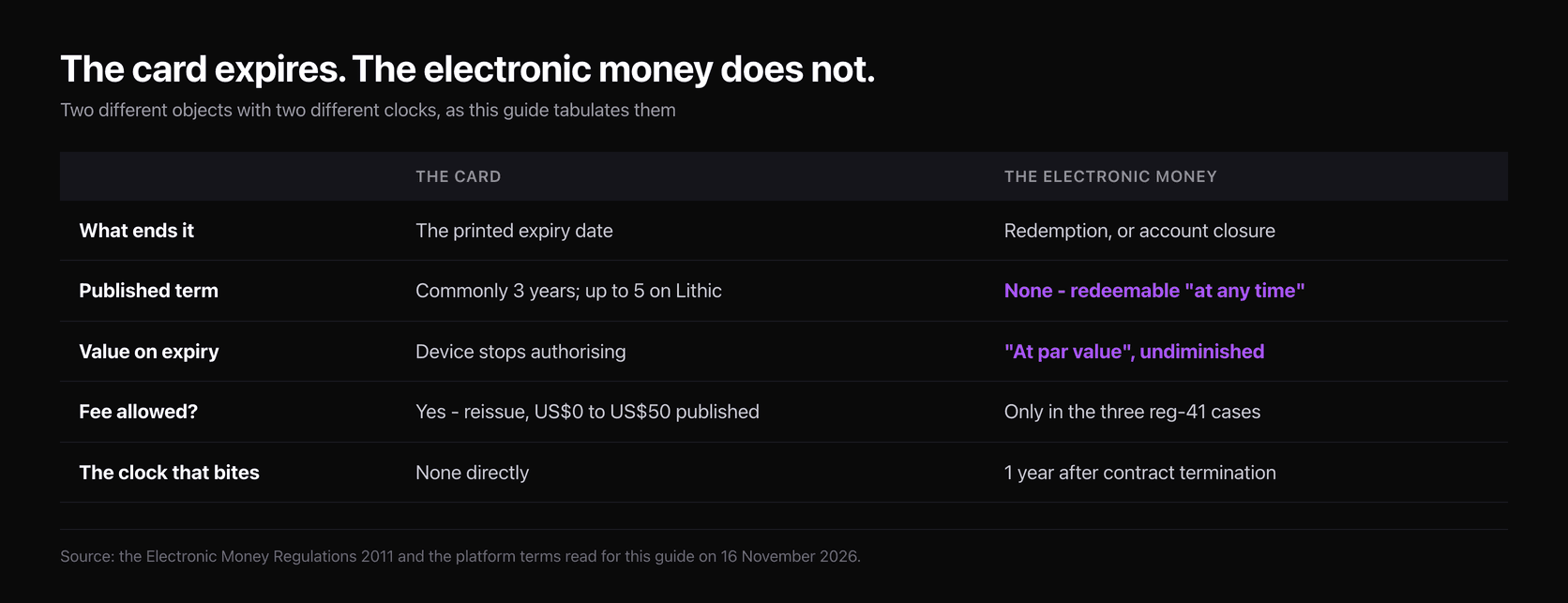
- The card expires. The electronic money does not. The UK's e-money rules oblige an issuer to redeem a holder's balance “at any time” and “at par value” — there is no expiry date on that obligation.
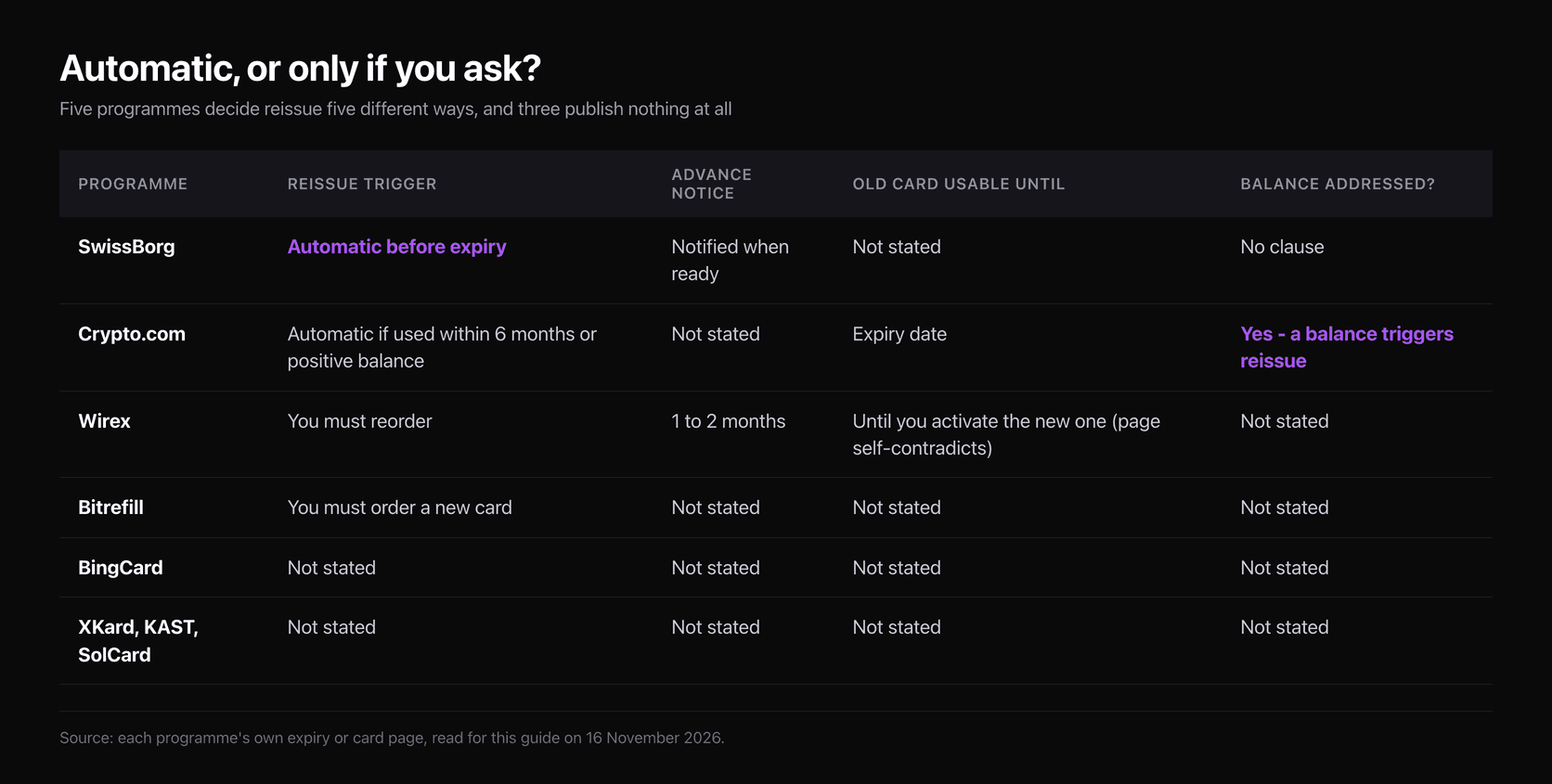
- A replacement is not automatic by default. Stripe: “Stripe doesn't automatically replace expiring cards.” The programme decides, and the five we read decide five different ways.
- Your card number probably stays the same. On Stripe an expired card's replacement gets a new security code and expiry but keeps its number; Lithic keeps “the same card token and PAN”. Only lost and stolen cards get new numbers.
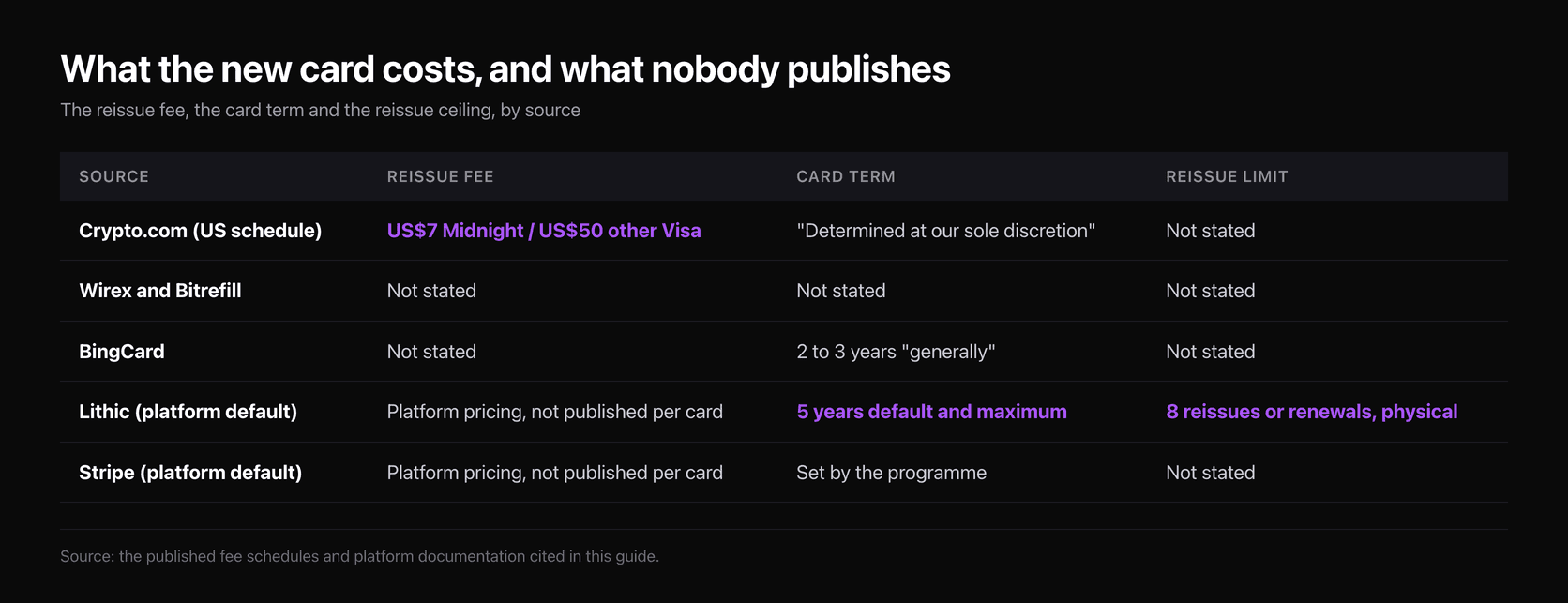
- Crypto.com reissues only if you used the card or left money on it — and the new card's tier follows your current plan “regardless of the tier of your expired card”. Reissue is US$7 on Midnight, US$50 on other Visa cards.
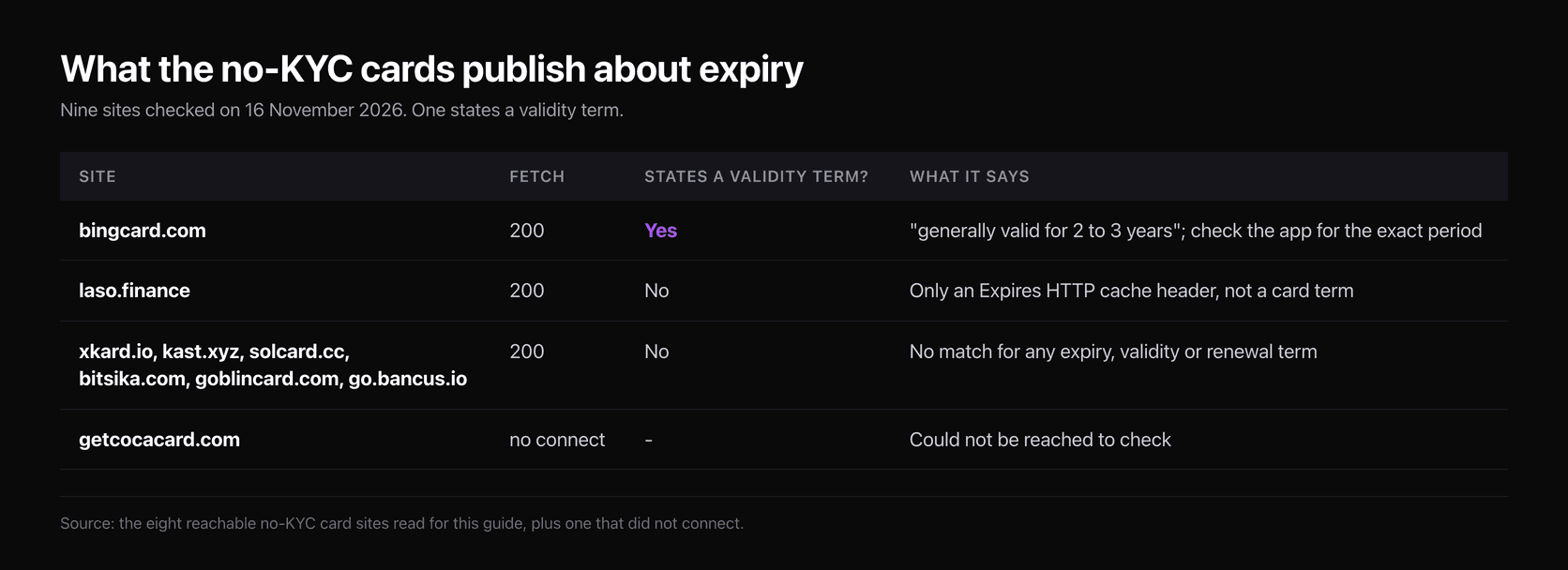
- Of eight reachable no-KYC card sites, exactly one states a validity term. BingCard's cards are “generally valid for 2 to 3 years” — and it tells you to check the app for the real number.
On this page
- The card expires, the money does not
- What the no-KYC cards publish about expiry
- Automatic, or only if you ask?
- Your card number probably stays the same
- What the new card costs
- The reissued card may not be the card you had
- Your subscriptions are the quiet part
- What to do before the date on the front
- Final take
- Sources
- Related articles
- FAQ
There is a date printed on the front of your card, and almost nothing in this industry tells you what happens the day after it. That matters more on a crypto card than a bank card, because crypto card expiry decides three things at once: whether anyone issues you a new card, what it costs, and whether the balance on the old one is still reachable. The cheapest published answer is US$7 and the dearest is US$50, and one programme uses the date to move you to a lower tier. So we spent 16 November 2026 reading two issuing platforms' documentation, five programmes' own expiry pages, a card rulebook in full, and the three regulations that decide whether your money has an expiry date at all.
Two things are worth separating before anything else. The card is an access device, and it has a printed expiry date. The balance behind it is usually electronic money, and it does not. Nearly every confused forum post about an expired crypto card comes from collapsing those two into one.

The card expires, the money does not
Start with the law, because it is the only part of this that does not vary by programme. Most crypto cards in the UK and the EEA are prepaid cards funded with electronic money, and the UK's Electronic Money Regulations 2011 set out what an issuer owes you. Regulation 39 is two lines long and it is the whole answer to “have I lost my money”: an issuer must, at the holder's request, redeem “at any time” and “at par value, the monetary value of the electronic money held”.
Read that against a plastic card and the asymmetry is obvious: no clause ties redemption to a card being valid, there is no deadline and no haircut — par value means par value. Regulation 40 adds that the contract must state the conditions of redemption “clearly and prominently”, including any fees. Regulation 41 is where a clock finally appears, and it is not the card's: a redemption fee is permitted in only three situations, one being redemption “requested more than one year after the date of termination of the contract”, and any such fee must be “proportionate and commensurate with the costs actually incurred”.
So the clock that can cost you money starts at termination of the contract, not expiry of the card — and an expiring card does not terminate your account on any programme we read. Panicking about the printed date is the wrong response; ignoring a closed account for a year is the thing with a price attached.
| The card | The electronic money | |
|---|---|---|
| What ends it | The printed expiry date | Redemption, or account closure |
| Published term | Commonly 3 years; up to 5 on Lithic | None — redeemable “at any time” |
| Value on expiry | Device stops authorising | “At par value”, undiminished |
| Fee allowed? | Yes — reissue, US$0 to US$50 published | Only in the three reg-41 cases |
| The clock that bites | None directly | 1 year after contract termination |
One honest limit: that is UK law and, through the same European e-money framework, broadly EEA law. A card issued in the United States, or by a programme outside that perimeter, is governed by its own cardholder agreement — and the agreements are where the generosity stops. It is why our guide to balance protection and the insolvency rules matters more than any printed date.
What the no-KYC cards publish about expiry
This is the part no comparison site has measured, so we measured it. On 16 November 2026 we fetched nine no-KYC and low-KYC card sites and searched each for any form of expiry, expire, expiration, validity and renewal.
Eight of the nine returned HTTP 200; getcocacard.com would not connect at all. Of those eight, one states a card validity term: BingCard, which says its cards are “generally valid for 2 to 3 years, reducing the frequency of renewals” and then immediately defers — “Please check the exact validity period in the BingCard web application.”
The other seven say nothing. Laso Finance looked like a second hit until we read the context: its only match is <meta http-equiv="Expires" content="0" />, an HTTP caching header, not a card term. XKard, KAST, SolCard, Bitsika, Goblin Card and Bancus do not use the words at all. That is not a claim these cards never expire — every card with a printed date does. It is a claim about what you can learn before handing over money, which on a no-KYC card is the only due diligence available.
| Site | Fetch | States a validity term? | What it says |
|---|---|---|---|
| bingcard.com | 200 | Yes | “generally valid for 2 to 3 years”; check the app for the exact period |
| laso.finance | 200 | No | Only an Expires HTTP cache header, not a card term |
| xkard.io, kast.xyz, solcard.cc, bitsika.com, goblincard.com, go.bancus.io | 200 | No | No match for any expiry, validity or renewal term |
| getcocacard.com | no connect | — | Could not be reached to check |
Compare that with the custodial programmes below, each of which publishes a dedicated expiry page. Same pattern we found counting which no-KYC cards document a PIN: the thinner the identity check, the thinner the paperwork — and the paperwork is what tells you how to get your money back.
Automatic, or only if you ask?
The single most useful sentence we found all day comes from the layer underneath the cards. Stripe, which issues cards for other companies, states it without hedging: “Stripe doesn't automatically replace expiring cards. You're responsible for identifying cards that are approaching their expiration date, canceling them, and creating replacement cards.”
Read that twice if you hold a card from a small programme: the platform does not do it for them. Whether you get a new card is a feature somebody at your programme either built or did not — which is why the five we read behave five different ways.
SwissBorg is the clearest: its rulebook says the card “will expire on a specified date, visible in the card details” and that “A new virtual card will be automatically issued before the expiration”. Crypto.com is conditional: “If you have made transactions on your Crypto.com Prepaid Card within six months of card expiry” or “your card has a positive balance at the time of expiry”, then “we will automatically re-issue a card to you for a term determined at our sole discretion”. Note what that pairing does — leaving money on the card is itself a trigger for reissue, and the new term is explicitly not promised to match the old one.
Wirex and Bitrefill both put the work on you. Bitrefill is one sentence: “When your card expires, you must order a new card.” Wirex notifies you “around one to two months before the expiry date” asking you to order a new card, and the reorder lives under Cards → the expiring card → Reorder Card → “Card expires soon”, with delivery “within 7-10 business days”.
Wirex is also the one page in the set that contradicts itself, which is worth flagging rather than smoothing over. It says the card “will be automatically deactivated on the last day of the expiration month” — and also that “you should be able to use your Wirex card 30 days after its expiry date”. Those cannot both govern. Plan around the earlier date and ask support which applies.
| Programme | Reissue trigger | Advance notice | Old card usable until | Balance addressed? |
|---|---|---|---|---|
| SwissBorg | Automatic before expiry | Notified when ready | Not stated | No clause |
| Crypto.com | Automatic if used within 6 months or positive balance | Not stated | Expiry date | Yes — a balance triggers reissue |
| Wirex | You must reorder | 1–2 months | Until you activate the new one (page self-contradicts) | Not stated |
| Bitrefill | You must order a new card | Not stated | Not stated | Not stated |
| BingCard | Not stated | Not stated | Not stated | Not stated |
| XKard, KAST, SolCard | Not stated | Not stated | Not stated | Not stated |
Your card number probably stays the same
Most people assume an expired card means fresh digits and an evening of updating saved payment details. On the platform layer that assumption is wrong, and both platforms we read agree.
Stripe publishes a table of three scenarios. For an expired card, the replacement gets a new security code and a new expiry date — and not a new card number. Same for a damaged card. Only “Card lost/stolen” produces a new number, and Stripe explains why: “Lost or stolen cards get new card numbers for security reasons.” Lithic describes its renewal the same way: it keeps “the same card token and PAN” and issues “an updated expiry and CVC2 code”, for both PHYSICAL and VIRTUAL cards.
Two details on top of that. Stripe says the original keeps working until the replacement is activated, and that “Activating the replacement card cancels the original card” — so activation, not the printed date, is usually the real cut-off. And there is a ceiling nobody advertises: Lithic states that “A PHYSICAL card can be reissued or renewed a total of 8 times.” It also sets the default term when a programme specifies none — “an expiration date five years in the future” — and caps it at five years.
A programme can still override this and hand you fresh digits, and at least one does: Wirex says its replacement carries a different card number and expiry date, which is why it tells you to update recurring payments. The honest rule is that the platforms make same-number renewal the default, and your programme may or may not have taken it.
What the new card costs
Published reissue pricing is thin, and where it exists it sits in the fee schedule rather than the expiry article — which is why most readers never find it. Crypto.com's US fee and limit schedule lists a “Reissue Card” line at US$7 for Midnight and US$50 for “Other VISA Cards”: a seven-fold spread inside one programme, decided by which card you hold.
Wirex's expiry page walks through the whole reorder flow and names no fee; Bitrefill's names none either. Neither says the replacement is free, and that distinction is worth keeping: the correct reading is unknown, not nothing. The comparable numbers for every other card event are in crypto card issuance fees and what it costs to close a crypto card.
| Source | Reissue fee | Card term | Reissue limit |
|---|---|---|---|
| Crypto.com (US schedule) | US$7 Midnight / US$50 other Visa | “Determined at our sole discretion” | Not stated |
| Wirex and Bitrefill | Not stated | Not stated | Not stated |
| BingCard | Not stated | 2–3 years “generally” | Not stated |
| Lithic (platform default) | Platform pricing, not published per card | 5 years default and maximum | 8 reissues or renewals, physical |
| Stripe (platform default) | Platform pricing, not published per card | Set by the programme | Not stated |
The reissued card may not be the card you had
This is the finding we did not expect, and the strongest argument for reading your programme's expiry page before the date arrives. On Crypto.com, expiry is a re-pricing event.
Its help page states: “Please note that your reissued Crypto.com Prepaid Card tier will correspond to your Level Up plan,” “regardless of the tier of your expired card.” The page then works the example through. Hold a Jade card with a positive balance, with your CRO unstaked and no Level Up subscription at the time of renewal, and “you will be reissued a Midnight Card upon expiry” — the entry tier. Unstake only part of the CRO, or subscribe to Level Up Plus, and “you will be reissued a Ruby Card upon expiry” instead.
Nothing about that is hidden or unreasonable: a tier bought with a locked stake is not owed to you forever once the stake is unlocked. But it is the one mechanism here that costs real money silently — the cashback rate you chose the card for can change on a date you were not watching. If the rate is why you hold it, our breakdown of cashback caps on crypto cards is the number to re-check at reissue.
One thing to separate: a tier change at expiry is not a programme closing. If no replacement is coming at all, that is a wind-down, tracked in crypto card shutdowns.
Your subscriptions are the quiet part
Every recurring payment on a card is a stored card number with a stored expiry date, and expiry is the event that breaks them. The networks built machinery for exactly this, and almost no cardholder knows it is running.
Stripe describes its side plainly: “For many of our card programs, Stripe automatically updates the card details on file with acquiring merchants, even when a card is completely reissued,” the point being “saving your cardholders the hassle of manually re-entering card details when their cards expire”. Updating them “ensures that recurring payments and stored payment details continue to function”.
Then the exception that matters: “Stripe doesn't update businesses with the new card number, expiration, and security code of a replacement card if the old card is marked as being lost or stolen.” Reporting a card lost severs every stored payment; letting it expire does not. Opposite outcomes from two actions people treat as interchangeable.
One wrinkle for anyone with a hotel or car-hire authorisation sitting over an expiry date: Stripe says authorisations on the original card “are migrated to the replacements, but might still clear on the original cards”, so an old one can settle against a card you consider dead. Same mechanism as pre-authorisation holds, and the reason not to drain a balance to zero on expiry day.
What to do before the date on the front
Everything above collapses into a short sequence, and the order matters more than any single step.
- Find your expiry date now, not in month 35. It is printed on a physical card and in the card details for a virtual one — SwissBorg's “visible in the card details” is the industry norm.
- Search your programme's help centre for “expiry” today. If it returns nothing — as it will on seven of the eight no-KYC sites we fetched — ask support in writing before the date, not after.
- Ask two questions and keep the answers. Is the replacement automatic or do I order it, and what happens to my balance on the expiry date? Those are the two that programmes leave unstated most often.
- Do not leave a large balance riding on the date. Crypto.com treats a positive balance as a reason to reissue; nobody else we read commits to anything. Spend it down or move it out — but remember an old authorisation may still clear against the old card.
- Check the fee schedule, not the FAQ. The reissue price lives in the fee table, and US$50 is a real published number in this niche.
- If you are on a staked tier, re-read the tier rules before renewal. On Crypto.com the reissued card follows your current plan, not your old card, so renewal is when a downgrade lands.
- Note which subscriptions you would miss. Letting a card expire usually preserves them through card-on-file updates; reporting it lost does not.
Final take
The honest answer to “what happens when my crypto card expires” is that the card is the only thing with an expiry date. Under the e-money rules the balance behind it is redeemable at any time at par value, and the fee clock starts when the contract ends, not when the plastic does.
What varies — with no industry norm to fall back on — is the plumbing: whether anyone issues you a new card, whether it keeps your number, what it costs, and whether it returns on the tier you chose. The custodial programmes publish most of that. The no-KYC programmes publish almost none of it, and on a card held for privacy, the paperwork you cannot read is the money you cannot plan around.
See which cards document the basics
Kardd reads what each card actually publishes — issuer, KYC level, fees, limits and the clauses behind them — so you can tell a programme that documents an expiry, a reissue and a balance from one that documents none of them.
Kardd may earn a commission on sign-ups, including XKard, whose site publishes no expiry, validity or renewal term at all — as the census above records. Affiliate disclosure.
Sources
All read on 16 November 2026. Stripe, “Replacement cards” (no automatic replacement of expiring cards; the scenario table; the original usable until activation; migrated authorisations; card-on-file updating and the lost/stolen exception). Lithic, “Renew a card” (same token and PAN, updated expiry and CVC2; the 8-reissue ceiling) and Lithic, “Cards” (the five-year default and maximum term). Crypto.com, “Prepaid Card — Rewards & Benefits” (the reissue triggers, the term at sole discretion, the tier following the Level Up plan, and the Jade examples), with reissue pricing from its US fees and limits schedule. Wirex, “What happens when your Wirex card expires” (the notice period, the reorder path, 7-10 business days, the different card number, and both conflicting cut-off statements). Bitrefill, “What happens when my Bitrefill Card expires”. SwissBorg Card Rulebook (section 3.3 on the specified expiry date and the automatic new virtual card; no balance-at-expiry clause anywhere in it). The redemption rules are the UK's Electronic Money Regulations 2011: regulation 39 (issue at par value; redeem “at any time” and “at par value”), regulation 40 (conditions of redemption stated clearly and prominently) and regulation 41 (when a redemption fee is permitted, including more than one year after termination, and the proportionality test).
Recorded rather than guessed. The census is our own fetch of each live site on 16 November 2026, searched for expiry, expire, expiration, validity and renewal: xkard.io, solcard.cc, laso.finance, bingcard.com, www.kast.xyz, bitsika.com, goblincard.com and go.bancus.io all returned 200; getcocacard.com would not connect. BingCard's validity sentences are from its own homepage. Quoted nowhere above, because we could not read them: Bitpanda's and Mercuryo's card articles both 403'd, and EUR-Lex would not serve the Electronic Money Directive — which is why the redemption rules are cited in their UK implementing form.
Related Articles
- Crypto Card Balance Protection 2026: The Insolvency Rules
- Crypto Card Closure Fees 2026
- Crypto Card Issuance Fees 2026: $0 to $125
- Crypto Card Inactivity Fees 2026: The 12-Month Clock
- Crypto Card PIN 2026: Two PINs, One Card
- Crypto Card Issuers 2026: 16 Programmes Checked
Frequently Asked Questions
Do I lose my money when my crypto card expires?
The card and the balance run on different clocks. The card is an access device with a printed date; the balance behind it is usually electronic money, and under the UK's Electronic Money Regulations 2011 an issuer must redeem it at your request “at any time” and “at par value”. The card stopping work is not the money ceasing to exist — but how you reach it varies, and almost no no-KYC programme publishes that part.
Is a new crypto card issued automatically when mine expires?
Not by default. Stripe states that it “doesn't automatically replace expiring cards” and that the programme is responsible, so it is a per-programme choice. SwissBorg says a new virtual card “will be automatically issued before the expiration”; Crypto.com reissues only if you transacted within six months or the card has a positive balance; Wirex and Bitrefill require you to order it.
Does my card number change when the card expires?
Usually not. Stripe's replacement table gives an expired card a new security code and expiry but not a new number — only lost or stolen cards get new numbers — and Lithic keeps “the same card token and PAN” on a renewal. A programme can override that: Wirex says its replacement has a different number, so check your own app.
How long is a crypto card valid for?
Three years is the common pattern and hardly anyone prints it. Lithic generates an expiry “five years in the future” when a programme specifies none, and caps it there. Of the no-KYC sites we fetched, BingCard alone states a term — “generally valid for 2 to 3 years” — and tells you to check its app for the exact period.
What does it cost to replace an expired crypto card?
Anywhere from nothing to US$50, and published figures are sparse. Crypto.com's US schedule lists “Reissue Card” at US$7 for Midnight and US$50 for other Visa cards; Wirex and Bitrefill describe the reorder without naming a fee. Read silence as unknown rather than free, and look in the fee schedule rather than the help article.
Will my subscriptions keep working after my card is reissued?
Often yes, through machinery you never see. Stripe says it automatically updates card details held by merchants “even when a card is completely reissued”, so “recurring payments and stored payment details continue to function”. The exception matters: it does not push updates for a card marked lost or stolen. Wirex tells you to update recurring payments yourself.
Can a reissued crypto card come back on a lower tier?
Yes, and Crypto.com documents it. A reissued card's tier “will correspond to your Level Up plan, regardless of the tier of your expired card”. Hold a Jade card with a positive balance, CRO unstaked and no Level Up subscription at renewal, and you are reissued a Midnight card; unstake part of it or subscribe to Level Up Plus and you get Ruby.