Crypto Card Cashback Caps 2026: When 10% Pays 2.4%
- Two different numbers are both called “the cap”. A spending cap limits the spend that earns; a reward cap limits the payout. Bybit's base tier publishes a $5 monthly cashback cap — at 2%, that is reached after $250 of spending.
- Bybit's top tier pays a worse effective rate than its middle tier. Tier 6 is 10% capped at $600 and needs $25,000 a month to qualify — an effective 2.40%. Tier 3 is 4% capped at $150 and qualifies at $3,500, delivering a full 4.00%.
- Crypto.com publishes three different cap tables for one card family. All nine regional help pages say rewards apply to the first $750 on Plus. The US marketing page lists $250 to $10,000 and a footnote saying CRO rewards are not subject to a monthly cap.
- One programme shows its working. The Coinbase One Card's rewards terms carry a worked example, say the cap is shared across tiers, and state that it resets at the start of each calendar month. The other five define almost none of that.
- A paid tier's fee is recovered by spend, not by rate. KAST Premium costs $1,000/yr for +0.5% over its free tier, so it only pays for itself above roughly $16,667 a month of card spend.
On this page
- Two numbers, one word
- Six programmes and where each one stops
- Crypto.com publishes three cap tables
- The tier that asks for more than it pays on
- The one issuer that shows its working
- What a cap does to your actual rate
- A rate with no cap printed beside it
- On a paid tier, the cap sets the break-even
- Finding your own cap in five minutes
- Sources
- FAQ
A card advertising 10% cashback can pay you less than one advertising 4%, and the document explaining why is never the one on the landing page. Crypto card cashback caps are the monthly ceiling that stops the headline rate part-way through your spending, published in two incompatible units, away from the rate itself, and sometimes in three versions that disagree. We read six programmes from their own pages and terms on 13 October 2026 and recomputed every rate against its own cap. On one of them, the top tier returns a worse effective rate than the middle tier — and the arithmetic that shows it is one division the issuer never performs for you.

Two numbers, one word
Before any comparison is possible you have to notice that “cap” names two quantities. One limits the spend eligible to earn; the other limits the reward paid out. They are related only by the rate, and a $750 of one kind differs from a $750 of the other by a factor of sixty-six.
This is the mistake the comparison sites make in print. The most thorough roundup ranking for this query uses a single “cap” column holding some spend limits and some payout limits, unlabelled, and its figures then contradict its own FAQ. Here is the conversion that resolves it.
| Spending cap | Reward cap | |
|---|---|---|
| What it limits | The spend eligible to earn | The payout itself |
| Typical wording | “rewards apply to the first USD 750” | “equivalent monthly cashback cap (USD) 5” |
| Who publishes it this way | Crypto.com, Coinbase One Card | Bybit |
| To get the other one | cap × rate = max reward | cap ÷ rate = spend where it binds |
| Worked example | $750 × 1.5% = $11.25 a month | $5 ÷ 2% = $250 of spend |
The two quantities both called a cap, and the one division that converts between them.
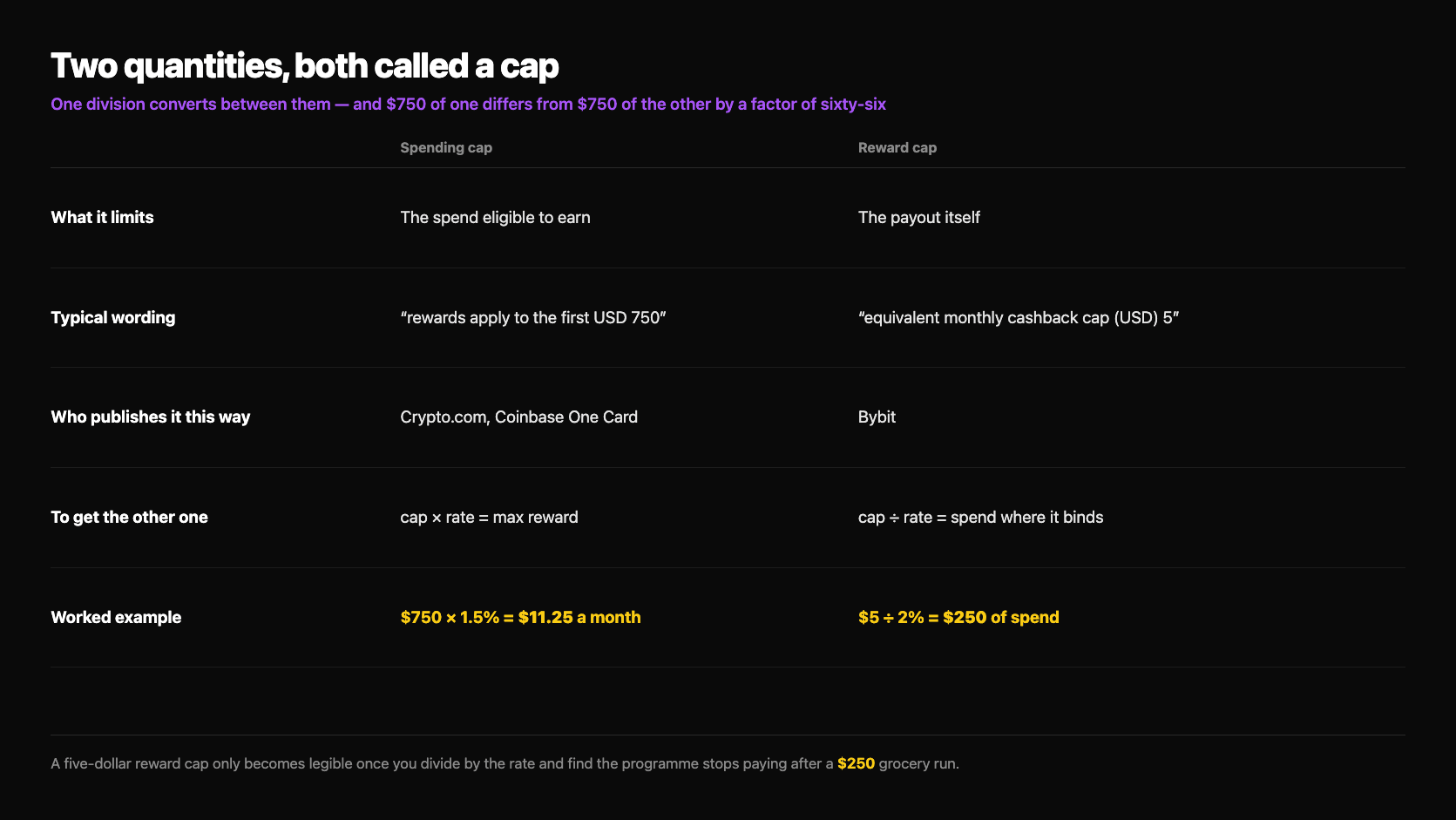
Keep the last row in mind, because it is the shape of the whole problem: a five-dollar reward cap only becomes legible once you divide by the rate and find the programme stops paying after a $250 grocery run. Neither number is hidden — they are printed in different units, in a different document, from the rate they modify.
Six programmes and where each one stops
These are the six we could verify against the issuer's own page or terms document. Where a programme publishes a reward cap we divided by the rate to get the spend at which it binds; where it publishes a spending cap we multiplied to get the maximum payout. Every cell is quoted or one multiplication from a quoted figure.
| Programme (top tier shown) | Rate | Published cap | Binds at | Max reward/mo |
|---|---|---|---|---|
| Crypto.com Obsidian | 4.5% | $5,000 spend, 1.0% after | $5,000 | $225 + 1.0% |
| Crypto.com Plus (Ruby) | 1.5% | $750 spend, nothing after | $750 | $11.25 |
| Bybit Tier 6 (Infinite) | 10.00% | $600 reward | $6,000 | $600 |
| Bybit Tier 1 (Base) | 2.00% | $5 reward | $250 | $5 |
| Coinbase One Card Tier 4 | 4.0% | $10,000 spend, 2.0% after | $10,000 | $400 + 2.0% |
| Nexo Platinum | 2% (NEXO) / 0.5% (BTC) | none stated | — | not capped on the page |
| KAST Private | 3% | exists, not printed | unknown | unknown |
| XKard / XHYPE | no rewards programme | n/a | — | — |
Six programmes as published on 13 October 2026. “Binds at” is the monthly spend above which the advertised rate no longer applies in full.
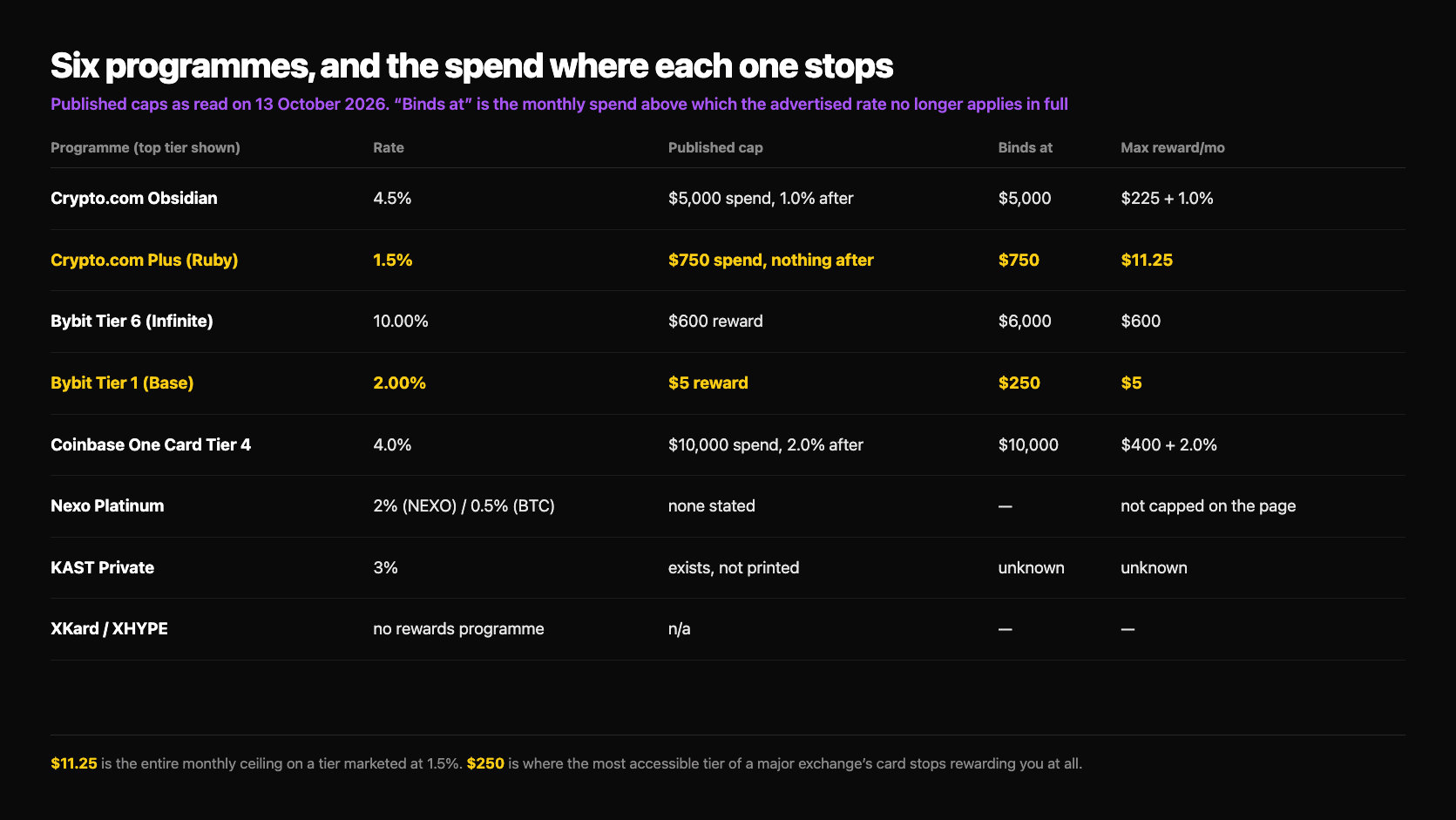
The two bolded cells are the ones worth arguing about. $11.25 is the entire monthly ceiling on a tier marketed at 1.5% — $135 a year. And $250 is where the most accessible tier of a major exchange's card stops rewarding you at all, below a week's shopping for most households. The rates in the first column are real. None survives contact with the fourth.
Crypto.com publishes three cap tables
We went looking for how Crypto.com's reward cap varies by region, because its fee schedules vary enormously — nine separate documents, as we found reading all nine fee schedules by country. The reward cap does not vary by region: we read all nine, and every one carries the same five figures. What varies is which Crypto.com document you happen to read.
| Tier | All 9 help pages | crypto.com/cards (US) | crypto.com/ca/cards |
|---|---|---|---|
| Basic / Midnight | N/A | $250, then 1% | 0%, no cap shown |
| Plus / Ruby | first $750 | $500 | 1.5% up to $750 |
| Pro / Jade & Indigo | first $1,500 | $1,000 | 2.5% up to $1,500 |
| Private Icy / Rose | first $3,000, 0.5% after | $5,000 | 3.5% up to $3,000, 0.5% after |
| Obsidian | first $5,000, 1.0% after | $10,000, then 2% | 4.5% up to $5,000, 1% after |
| Is it capped? | Yes, a monthly spending cap | “CRO rewards earned are not subject to a monthly cap” | Yes, per tier |
Three Crypto.com documents, read the same day, on the same question. The bottom row is the contradiction.
Each column is individually coherent. The help-centre section — headed Monthly Spending Cap for CRO Rewards on eight of the nine and Monthly CRO Rewards Limit on the Brazil and LATAM schedule — reads as an eligibility limit on spend. The US marketing page reconciles its numbers by scoping them to Bitcoin earnings and footnoting that CRO rewards are uncapped — defensible, but a direct contradiction of the help page for the same market. The Canadian page pairs each cap with a rate, so the maximum payout is at least computable.
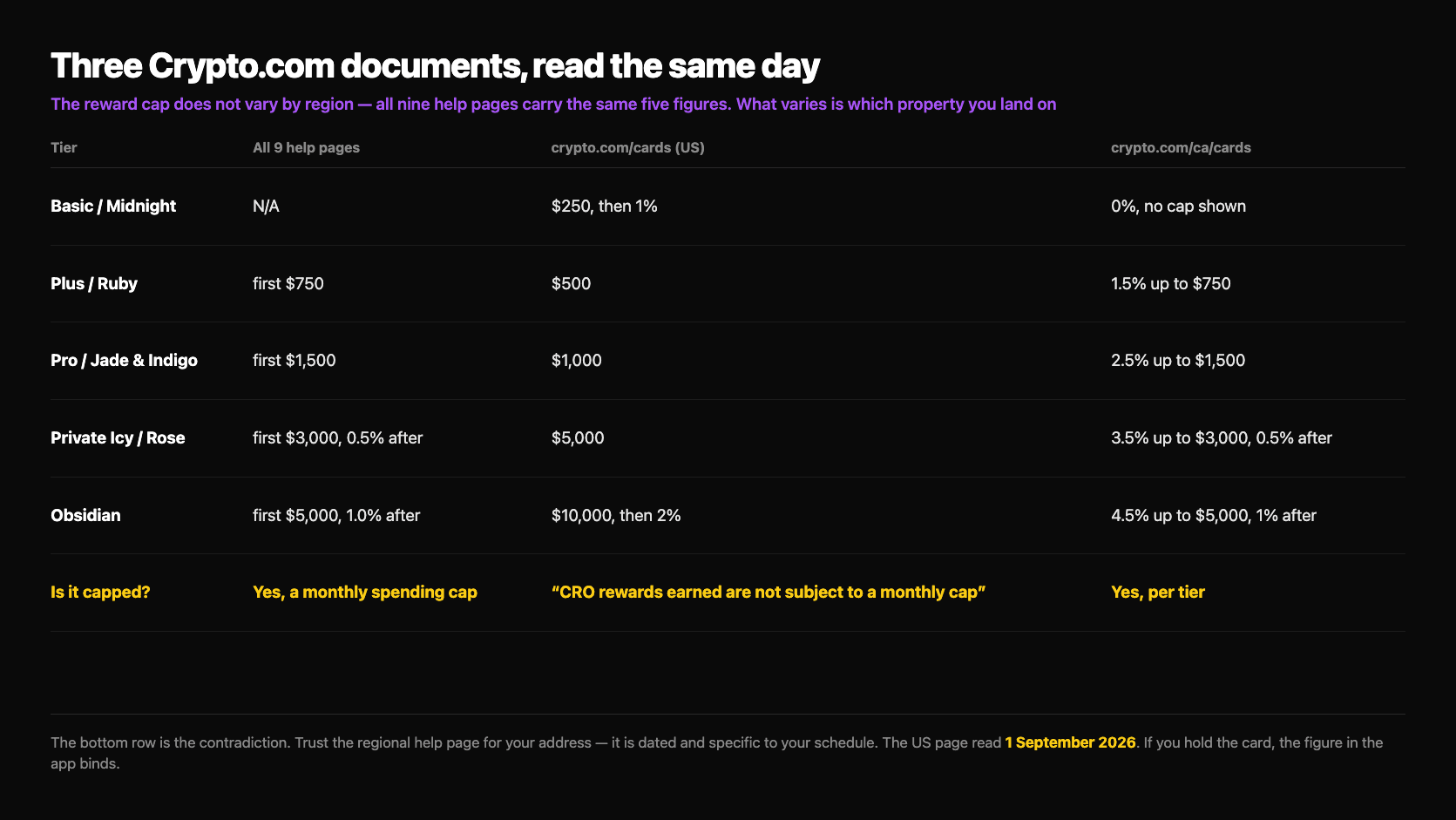
The consequence is small and annoying: you cannot answer “is my Crypto.com cashback capped” from the website alone, and the answer depends which property you landed on. Trust the regional help page for your address — it is dated, and specific to the schedule you are on. The US page read 1 September 2026. If you hold the card, the figure in the app binds.
The tier that asks for more than it pays on
Bybit publishes the cleanest cap table of the six: one grid giving, for every tier, the multiplier, the monthly point cap, the equivalent monthly cashback cap in USD and the minimum monthly spending needed to qualify. Its rules changed on 5 October 2026, eight days before we read it, and no comparison page we checked reflects that date. Publishing all four columns together is what makes the next point visible, and Bybit is the only one of the six that gives you enough to see it.
| Tier | Rate | Cashback cap | Cap binds at | Spend to qualify | Effective rate |
|---|---|---|---|---|---|
| 1 (Base) | 2.00% | $5 | $250 | none | 2.00% to $250 |
| 2 (Beta) | 2.00% | $50 | $2,500 | $500 | 2.00% |
| 3 (Alpha) | 4.00% | $150 | $3,750 | $3,500 | 4.00% |
| 4 (Apex) | 6.00% | $250 | $4,167 | $9,500 | 2.63% |
| 5 (Omega) | 8.00% | $400 | $5,000 | $12,500 | 3.20% |
| 6 (Infinite) | 10.00% | $600 | $6,000 | $25,000 | 2.40% |
Bybit's own six tiers. “Effective rate” is the cap, or the rate if the cap is not reached, measured at the spend required to qualify. Qualifying spend applies to non-VIP users.
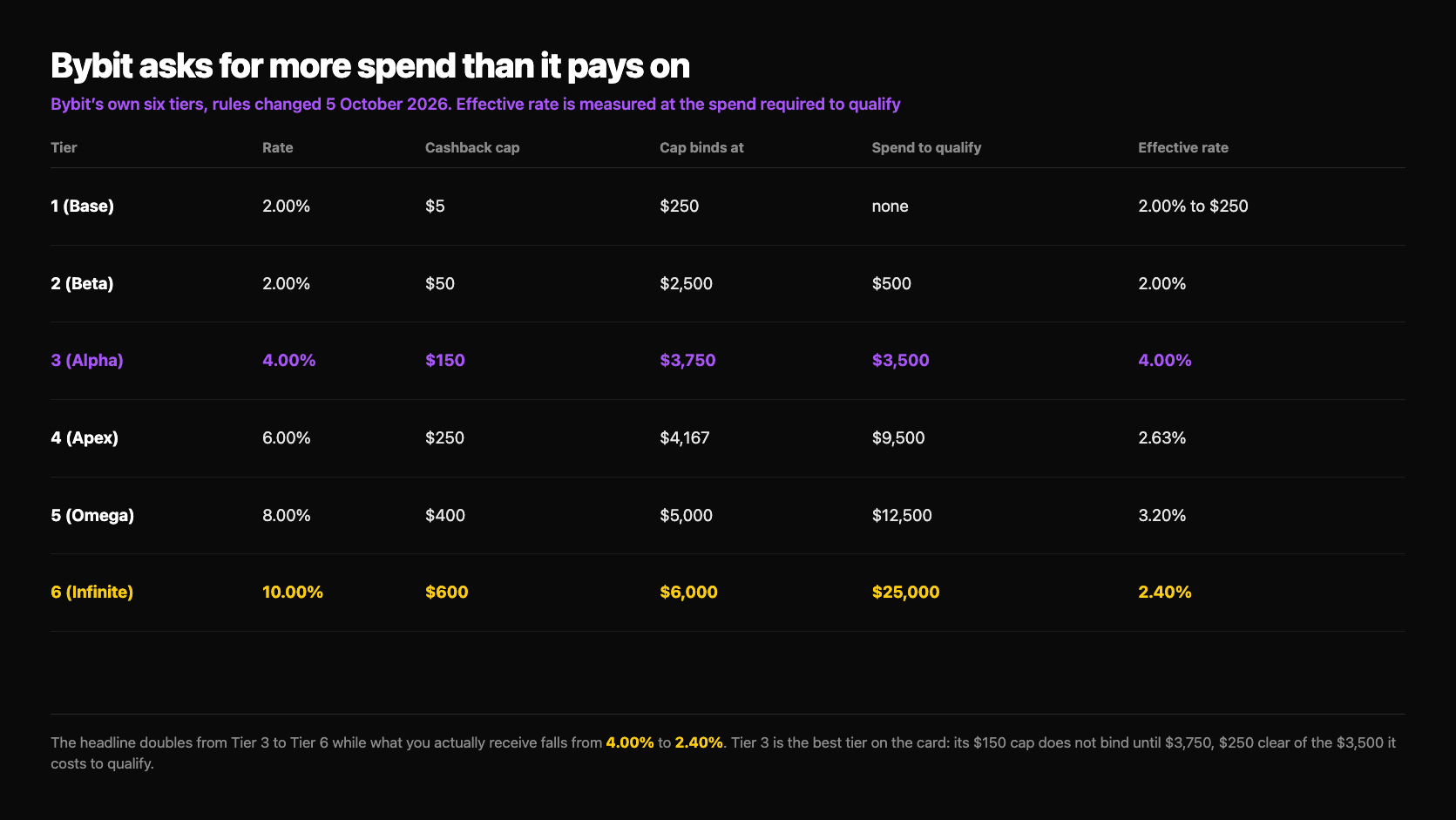
On the top three tiers the qualifying spend is larger than the spend at which the reward stops. Tier 4 asks for $9,500 a month to unlock a 6% rate exhausted at $4,167. Tier 6 asks for $25,000 to unlock 10%, and $600 on $25,000 is 2.40% — so the headline doubles from Tier 3 to Tier 6 while what you actually receive, as a share of what you spent, falls by nearly half. Tier 3 is the best tier on the card: its $150 cap does not bind until $3,750, $250 clear of the $3,500 it costs to qualify, so a Tier 3 spender collects the whole 4.00%.
None of this is concealed — it is four published columns and two divisions. But the card is marketed on the first column, and we found no comparison page that puts the fourth beside it. Our Bybit card review covers the rest of the mechanics.
The one issuer that shows its working
The Coinbase One Card is a credit card, not a prepaid crypto card, and a poor fit for anyone reading this site for privacy reasons — but its rewards terms are the best-drafted document in the set. Dated 15 August 2025, they do four things none of the other five manage.
They state the tier thresholds as a measurable quantity, Assets on Coinbase, with the averaging method spelled out. They name the cap in both units at once: the higher rates “apply to the first $10,000 in Eligible Purchases per calendar month, with a 2.0% Rewards Rate for all Eligible Purchases in excess of $10,000”. They say the cap is shared — it applies “collectively across Eligible Purchases at Tier 2, Tier 3 and Tier 4 in a given calendar month” — so climbing a tier mid-month hands you no fresh allowance. And they define the reset: “The Reward Rate caps reset at the start of each calendar month”.
Then they do what no other issuer does and work an example. A cardholder starts in Tier 3, spends $6,000 at 3.0%, moves to Tier 4, spends $4,000 more at 4.0%, has used the shared $10,000 allowance, and earns 2.0% on the remaining $3,000. That paragraph answers more than the other five cap sections combined, and it costs a page of plain English.
What a cap does to your actual rate
Here are the same programmes expressed the only way that matters: the rate you actually receive across your whole bill. Every cell is reward paid divided by amount spent.
| Programme | $500 | $1,000 | $2,500 | $5,000 | $10,000 |
|---|---|---|---|---|---|
| Bybit Tier 1 — 2%, $5 cap | 1.00% | 0.50% | 0.20% | 0.10% | 0.05% |
| Crypto.com Plus — 1.5%, $750 | 1.50% | 1.12% | 0.45% | 0.22% | 0.11% |
| KAST Standard — 1.5% flat | 1.50% | 1.50% | 1.50% | 1.50% | 1.50% |
| Nexo Platinum — 2% flat | 2.00% | 2.00% | 2.00% | 2.00% | 2.00% |
| Crypto.com Obsidian — 4.5%, $5k | 4.50% | 4.50% | 4.50% | 4.50% | 2.75% |
| Bybit Tier 6 — 10%, $600 cap | 10.00% | 10.00% | 10.00% | 10.00% | 6.00% |
| Coinbase One T4 — 4%, $10k | 4.00% | 4.00% | 4.00% | 4.00% | 4.00% |
Effective rate = reward paid ÷ monthly spend. Bybit Tier 6 is shown at its own rate; reaching it requires $25,000 of monthly spend, where the effective rate is 2.40%.
Read the rows against each other, not down a column. A flat 1.5% — the free tier of a card nobody puts at the top of a cashback list — overtakes Bybit's base tier above $333 a month and Crypto.com's Plus tier above $750. A flat 2% overtakes that same ceiling above $562. The crossover is always one division: the reward cap divided by the uncapped rate you are comparing with.
So the question is not “what is the highest rate” but “what do I spend, and does the cap bind below it”. At $600 a month every row except Bybit's base tier pays its headline in full. At $4,000, four of the seven have stopped paying what they advertise. Our cashback card ranking orders cards by rate; this table is the correction to apply to it. A reward paid in a volatile token is also not the asset you spent, and the conversion spread on a crypto card can erase a one-percent reward by itself.
A rate with no cap printed beside it
Two of the six publish a rate and no ceiling, and the cases are not equivalent.
Nexo lists 2% in NEXO Tokens or 0.5% in Bitcoin on Platinum, descending through Gold at 1% / 0.3%, Silver at 0.7% / 0.2% and Base at 0.5% / 0.1%. No monthly cap is stated anywhere on the card page. What it does state is a different gate: eligibility needs an account balance above $5,000 in digital assets, so the rate is bought with locked capital rather than with spend. The choice between 2% in a platform token and 0.5% in Bitcoin is a four-fold difference in rate against a difference in what you end up holding. Our Nexo card review covers the balance requirement.
KAST is the more interesting case, because it markets against hidden limits: its page says most cards hide monthly caps behind the word unlimited and that KAST does not. Its membership table lists three rates — Standard 1.5% free, Premium 2% at $1,000 a year, Private 3% at $10,000 a year — then invites you to “upgrade your membership to unlock higher cashback caps” without printing one of them. The caps exist; the sentence selling the upgrade says so. They are just not on the page, which leaves the number you would need to value the upgrade available only after buying it.
On a paid tier, the cap sets the break-even
A subscription turns the comparison into a threshold, and it is usually higher than people expect, because what you buy is not the rate — it is the difference from the rate you already get for nothing.
KAST's free Standard tier pays 1.5%. Premium costs $1,000 a year for 2%, so you are purchasing an extra 0.5 percentage points. Recovering $1,000 at 0.5% takes $200,000 of annual card spend, about $16,667 a month. Private costs $10,000 a year for 3%, an extra 1.5 points, needing roughly $666,667 a year.
| KAST membership | Fee / yr | Rate | Gain vs free | Break-even spend / mo |
|---|---|---|---|---|
| Standard | free | 1.5% | — | — |
| Premium | $1,000 | 2% | +0.5 pts | $16,667 |
| Private | $10,000 | 3% | +1.5 pts | $55,556 |
Break-even on cashback alone, ignoring the memberships' other perks, and assuming the rate applies to every dollar. Any cap on the paid tier raises these figures.
That last caveat bites. These break-evens assume the paid rate applies to all of your spend — exactly the assumption the first half of this article says never to make — and KAST does not publish the caps that would let us test it. If Private's cap binds at, say, $40,000 a month, the $55,556 break-even is unreachable by construction and the membership can never pay for itself out of cashback. We cannot say whether it does, because the number is not published. The memberships also bundle card issuance and higher reserve rates, which may justify the fee on their own; this table values the cashback line only. Our KAST card review covers the rest of the bundle.
Finding your own cap in five minutes
Four steps, in this order, because step one is where the wrong answers come from:
- Get the cap from a dated document, not the landing page. Where they disagree — and on Crypto.com they do — trust the dated regional schedule or the terms PDF. If you hold the card, the app beats both.
- Establish which kind of cap it is. If it limits what you spend, multiply by your rate for your real monthly maximum. If it limits what you are paid, divide by your rate to find where it stops.
- Compare that with your own card spend, not your total spending. Only spend through this card counts, and most programmes exclude some categories.
- If the cap binds below your spend, recompute the rate as reward divided by total spend, then check whether a flat lower uncapped rate beats it. Above the cap it very often does.
One structural point is worth sitting with: a card with no rewards programme has no cap to read, no tier to qualify for and no token to be paid in. For spend above most of the ceilings here that is the arithmetically better trade, which is why fees that recur monthly deserve more attention than a rate that stops. How much you are allowed to spend, rather than earn on, is a different ceiling, covered in crypto card spending limits.
Picking on fees instead of on a rate that stops?
Every cap here is a reason to weigh costs that recur monthly over a rate that expires part-way through the month. Our comparison ranks every card we track on the fees you actually pay — top-up, FX, ATM and annual.
Some links on Kardd are affiliate links and may earn us a commission. No commercial relationship changed a figure in the tables above.
Sources
- Crypto.com help centre, Card – Fees & Limits collection — the index to all nine schedules, read 13 October 2026.
- Crypto.com fees and limits, United States — the cap section; dated 1 September 2026.
- Crypto.com fees and limits, Singapore (resident) — the same section, identical figures; dated 1 September 2026.
- Crypto.com fees and limits, Europe (Brazil & select LATAM residents) — same figures, section headed Monthly CRO Rewards Limit.
- crypto.com/cards — the US marketing page: per-tier caps, and the footnote that CRO rewards are not subject to a monthly cap.
- crypto.com/ca/cards — the only one of the three pairing each cap with its rate.
- Bybit, Introduction to Bybit Card Rewards — the six-tier table of rates, caps and qualifying spend; rules effective 5 October 2026.
- Coinbase One Card Rewards Program Terms & Conditions — tier thresholds, the shared $10,000 cap, the reset and the worked example; last updated 15 August 2025.
- Nexo Card — four loyalty tiers, NEXO-versus-Bitcoin rates, the $5,000 balance requirement; no cap stated.
- KAST — three memberships with fees and rates, and the line inviting an upgrade to unlock higher caps.
- XHYPE (formerly XKard) — plan pricing, top-up fees and annual limits; no cashback programme published.
Related Articles
- Best Crypto Cashback Card 2026: Real Rates, Real Trade-Offs
- Crypto.com Card Fees by Country 2026: 9 Schedules
- Crypto Card Spending Limits 2026: The Real Numbers
- Crypto Card Exchange Rates 2026: Two Conversions
- Bybit Card Review 2026
- KAST Card Review 2026
Frequently Asked Questions
What is a cashback cap on a crypto card?
The monthly ceiling that stops your advertised rate applying to everything you spend. A spending cap limits the spend eligible to earn — Crypto.com says rewards apply to the first USD 750 a month on Plus, so spend above that earns nothing. A reward cap limits the payout — Bybit's base tier publishes a USD 5 monthly cashback cap, reached at 2% after USD 250 of spending. Comparing two cards means converting one into the other by dividing the reward cap by the rate.
Which crypto card has the highest cashback cap in 2026?
Of the six we read on 13 October 2026, the Coinbase One Card allows the most reward before its rate drops: the higher rates apply to the first $10,000 of eligible purchases per calendar month, worth $400 at the 4% top tier, with 2% above it. Crypto.com's Obsidian allows $5,000 at 4.5% with 1.0% thereafter, worth $225 a month. Bybit's top tier caps the payout at $600 but asks for $25,000 of monthly spend to qualify.
Why does a 10% cashback card pay less than a 4% one?
Because the cap and the qualifying spend can be set so you never reach the headline across the whole bill. Bybit's Tier 6 pays 10% capped at $600 and needs $25,000 of monthly spend to qualify, and $600 on $25,000 is an effective 2.40%. Tier 3 pays 4% capped at $150, qualifies at $3,500, and because the cap does not bind until $3,750 keeps a full 4.00%.
Does Crypto.com cap CRO card rewards?
Its own documents disagree, which is the finding rather than an evasion. All nine regional help pages print the same figures — under a Monthly Spending Cap for CRO Rewards heading on eight, and Monthly CRO Rewards Limit on the Brazil and LATAM one: first $750 on Plus, $1,500 on Pro, $3,000 on Icy and Rose with 0.5% thereafter, $5,000 on Obsidian with 1.0% thereafter. The crypto.com/cards page lists $250 to $10,000 plus a footnote saying CRO rewards are not subject to a monthly cap. The Canadian page gives a third set. Trust the dated schedule for your region, or the app.
Do any crypto cards have uncapped cashback?
Some publish a rate and no cap, which is weaker than it sounds. Nexo lists 2% in NEXO Tokens or 0.5% in Bitcoin on Platinum with no ceiling on the page, though it requires a $5,000 digital-asset balance. KAST publishes 1.5%, 2% and 3% and tells you to upgrade to unlock higher cashback caps without printing them. An unstated cap is not an absent cap.
When does a lower uncapped rate beat a higher capped one?
Above the spend given by the cap divided by the flat rate. A flat 1.5% beats a $5 reward cap above $333 of spend and Crypto.com's $11.25 Plus ceiling above $750. A flat 2% beats that ceiling above $562 and Bybit's $600 top-tier cap above $30,000.
Do cashback caps reset monthly?
On the programmes that publish the mechanics, yes, by calendar month rather than billing cycle. The Coinbase One Card terms are most explicit: the caps reset at the start of each calendar month and are shared across tiers, so moving up mid-month gives no fresh allowance. Crypto.com describes a monthly cap without defining the month. Bybit sets eligibility by the date the merchant posts the transaction, not when it was authorised, so a purchase on the last day of a month can fall into the next one's allowance.
Is a paid cashback membership worth the fee?
Only above a spend level you should work out first, because the fee buys the difference from the free rate. KAST Premium costs $1,000 a year and lifts cashback from 1.5% to 2%, half a point, so it recovers its fee only above $200,000 of annual spend — about $16,667 a month. Private costs $10,000 a year for 3%, an extra 1.5 points, needing roughly $666,667 a year. Both assume the rate applies to every dollar, so any cap pushes the break-even higher.