Crypto Card Credit Checks 2026: Who Pulls, Who Reports
- Two of the nine agreements authorise a consumer report, and both are credit cards. Gemini's Mastercard (WebBank) and the Coinbase One Card (First Electronic Bank) each spell it out. The four prepaid agreements contain no such clause at all.
- The most interesting pull is not a credit check. Gemini's § 32 authorises a pull from Experian “solely to confirm your identity to avoid fraudulent transactions in your name”.
- One prepaid card mentions bureaus anyway. BitPay's privacy notice says Metropolitan Commercial Bank collects personal information “from others, such as credit bureaus” — on a card with no credit feature.
- A crypto credit card can be repriced on your file mid-term. Gemini's § 35 allows rate changes based on “your credit score, other information contained in your credit report”; Coinbase's pulls reports to raise your limit “even if you have not requested such increase”.
- Of seven no-KYC programmes, two mention credit checks and none publishes a reporting clause. BingCard says “No Credit Checks”; SolCard says “no bank account or credit check required”. The other five say nothing either way.
On this page
- Three kinds of crypto card, three different credit checks
- What a crypto card credit check actually authorises
- The pull that is not a credit check, and it names Experian
- Who tells the bureaus about your crypto card
- What the prepaid agreements say, and the one that mentions bureaus anyway
- The no-KYC record: seven programmes, two sentences
- Why “credit mode” is a loan, not a credit card
- How to check your own card in ten minutes
- Final take
- Sources
- Related articles
- FAQ
Every page that ranks for this question answers a different one. You want to know whether a crypto card credit check will land on your file, and what comes back is a list of the best crypto rewards cards. The stakes are not theoretical: one of these agreements lets the issuer pull your report to raise your limit “even if you have not requested such increase”, and another lets it reprice your interest rate on the strength of “your credit score, other information contained in your credit report”. So we spent 18 November 2026 reading the documents instead — nine cardholder agreements and privacy notices totalling roughly 77,000 words, the two statutory subsections they rely on, and the live record of seven no-KYC programmes.
Three things are worth separating before any of it makes sense. A card can pull your credit report; a card can furnish information back to the bureaus; and a card can do the first without the second. Almost every guide collapses all three into “does it affect my credit score”, which is why the answers contradict each other.
Three kinds of crypto card, three different credit checks
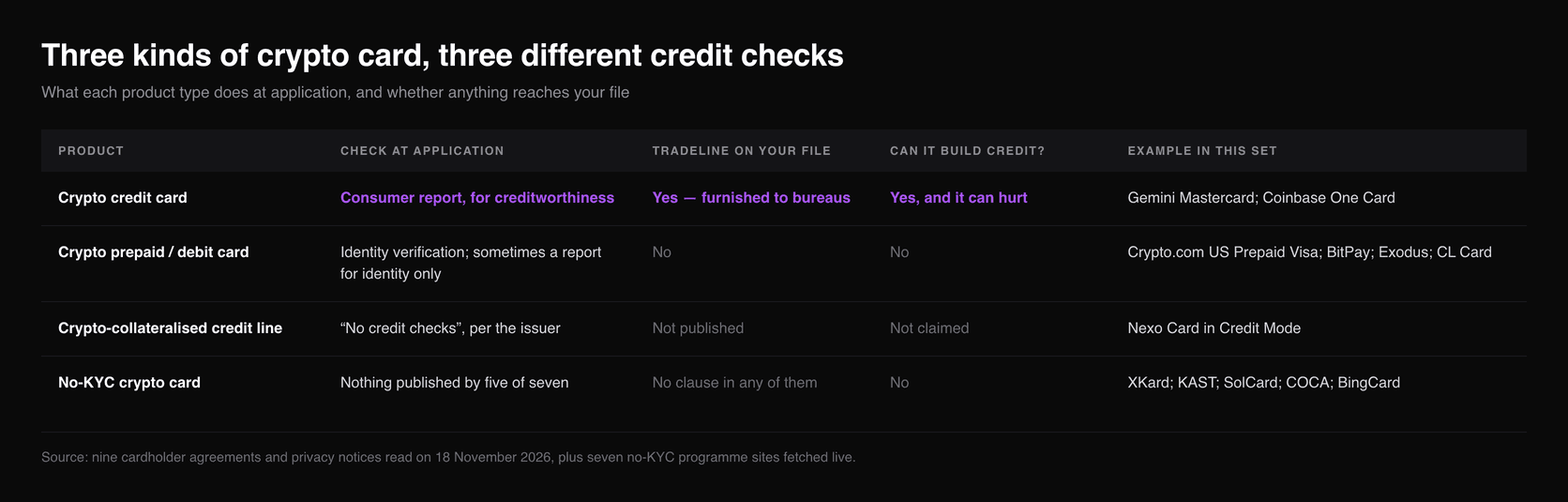
The word “crypto card” covers three products that touch your credit file in completely different ways, and the marketing rarely distinguishes them. SolCard, to pick the example in our own directory, describes itself with the phrase “crypto credit card” in its FAQ while being funded, in the next sentence, “directly from your crypto wallet”. That is a prepaid card using a credit card's vocabulary.
| Product | Check at application | Tradeline on your file | Can it build credit? | Example in this set |
|---|---|---|---|---|
| Crypto credit card | Consumer report, for creditworthiness | Yes — furnished to bureaus | Yes, and it can hurt | Gemini Mastercard; Coinbase One Card |
| Crypto prepaid / debit card | Identity verification; sometimes a report for identity only | No | No | Crypto.com US Prepaid Visa; BitPay; Exodus; CL Card |
| Crypto-collateralised credit line | “No credit checks”, per the issuer | Not published | Not claimed | Nexo Card in Credit Mode |
| No-KYC crypto card | Nothing published by five of seven | No clause in any of them | No | XKard; KAST; SolCard; COCA; BingCard |
Only the first row is a credit product in the sense a bureau understands. For the other three the useful question is not whether they build credit but whether anyone looks at your file on the way in — which turns out to have a surprising answer.
What a crypto card credit check actually authorises
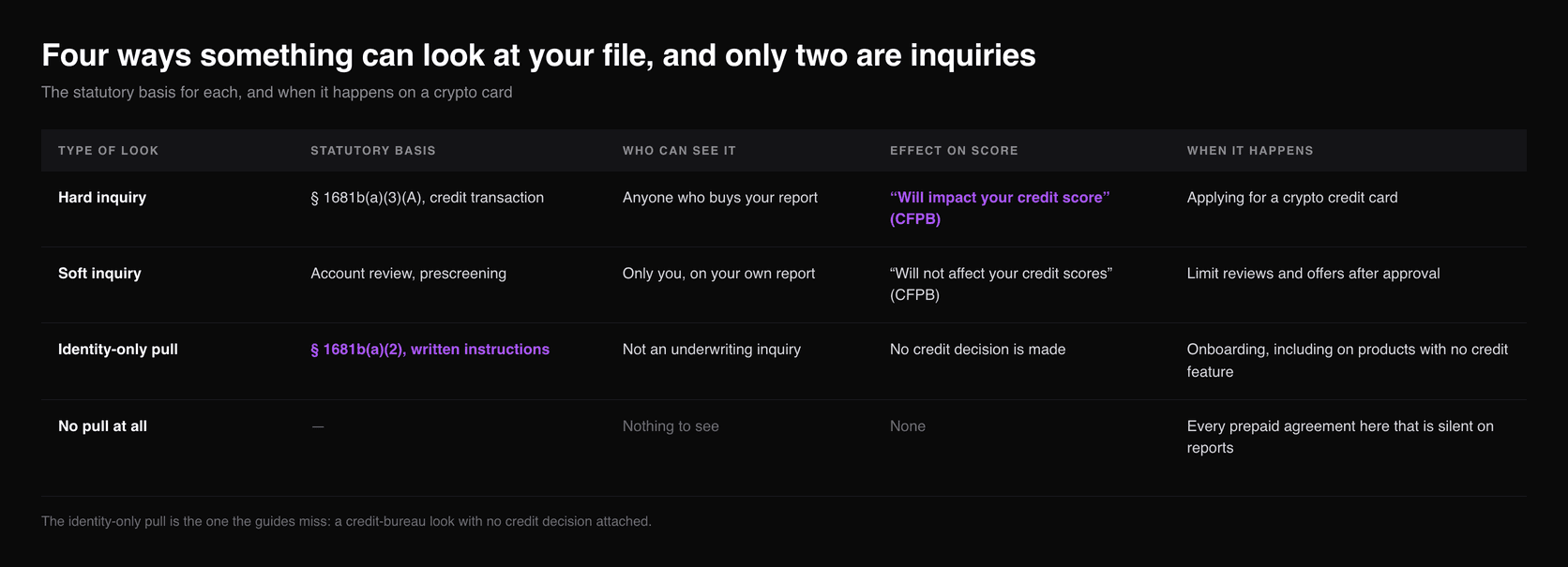
A credit report is not handed out on request. Under the Fair Credit Reporting Act a consumer reporting agency may furnish a report only for a listed permissible purpose, and the two that matter here are next door to each other in the statute. 15 U.S.C. § 1681b(a)(3)(A) covers the one everybody pictures: a person who intends to use the information “in connection with a credit transaction involving the consumer”. § 1681b(a)(2) covers the quieter one: a report furnished “in accordance with the written instructions of the consumer to whom it relates”.
The second needs no credit transaction at all. You consent, and the report is lawfully furnished for whatever purpose you consented to — which, on a card with no credit feature, is usually confirming you are who you say you are. That is how a prepaid product can reach your credit file without ever extending you a penny of credit.
What each type of look costs you is a separate question, and the CFPB answers it cleanly.
| Type of look | Statutory basis | Who can see it | Effect on score | When it happens on a crypto card |
|---|---|---|---|---|
| Hard inquiry | § 1681b(a)(3)(A), credit transaction | Anyone who buys your report | “Will impact your credit score” (CFPB) | Applying for a crypto credit card |
| Soft inquiry | Account review, prescreening | Only you, on your own report | “Will not affect your credit scores” (CFPB) | Limit reviews and offers after approval |
| Identity-only pull | § 1681b(a)(2), written instructions | Not an underwriting inquiry | No credit decision is made | Onboarding, including on products with no credit feature |
| No pull at all | — | Nothing to see | None | Every prepaid agreement here that is silent on reports |
The third row is the one the competing guides do not have, and it has a named bureau behind it.
The pull that is not a credit check, and it names Experian
The clearest statement of an identity-only pull in this whole set is buried at § 32 of the Gemini Mastercard Credit Card cardholder agreement, under the heading “FCRA Compliance”. It reads: “You understand that by clicking on the I AGREE button immediately following this notice, you are providing ‘written instructions’ to Gemini under the Fair Credit Reporting Act authorizing Gemini to obtain information from your personal credit profile or other information from Experian. You authorize Gemini to obtain such information solely to confirm your identity to avoid fraudulent transactions in your name.”
Three details are worth pulling out. It is the statutory written-instructions route, not the credit-transaction route. It names one bureau rather than “the credit bureaus”. And it is a separate clause from the underwriting authority at § 19, which means a single click can trigger two different kinds of access to your file for two different reasons. The business version of the same card compresses it into one line: “By applying for the Account, you provide ‘written instructions’ under the Fair Credit Reporting Act authorizing us to obtain consumer reports on you and any Guarantor for these purposes.”
This matters well beyond Gemini, because it is the mechanism by which a card that lends you nothing can still reach a credit bureau. If you are choosing a card for privacy, the clause to look for is not “credit check” — which a prepaid programme can truthfully say it does not run — but any sentence containing “consumer report”, “written instructions” or the name of a bureau. Our guide to what crypto card KYC actually requires covers the document side of the same bargain.
Who tells the bureaus about your crypto card
Pulling is the half people worry about. Furnishing is the half that changes your score for years. Both credit cards in this set do it, and both say so in nearly identical language.
Gemini's § 19: “We may also furnish information concerning you and your Account to other creditors, other financial institutions, and credit bureaus. Late Payments, missed payments, returned payments or other defaults on your Account may be reflected in your credit report.” The Coinbase One Card agreement, effective 1 November 2026 and issued by First Electronic Bank under licence from American Express, opens its Credit Reports section with “We may report information about your Account to the credit bureau(s)” and the same warning about late and missed payments.
Coinbase's pull authority is the broader of the two, and reading it in full is instructive. You authorise the bank and its service providers to obtain consumer reports “(a) to evaluate your creditworthiness when you apply for or open your Account”; “(b) from time to time throughout the term of this Agreement or if there is any outstanding amount you owe us on your Account (including any time after your Account has closed or this Agreement has terminated)”; and “(c) to determine your eligibility for an increase in your Credit Limit, even if you have not requested such increase”. Access does not end when the account does.
Gemini's § 35 then closes the loop in the other direction: the issuer may change “interest rates, fees and charges”, and such changes “may be based on our anti-fraud policies and procedures, your level of compliance with this Agreement, your credit score, other information contained in your credit report, prevailing economic conditions and/or any other factors”. Your file is not only a gate at the application; on a crypto credit card it is an input to your pricing for as long as you hold it. The headline APR tells you nothing on its own — Coinbase's own disclosure box quotes 19.74% to 29.74% “when you open your account, based on your creditworthiness”, a ten-point spread decided by the report.
What the prepaid agreements say, and the one that mentions bureaus anyway
Now the other four. We searched each prepaid agreement for “consumer report”, “credit bureau”, “credit reporting”, “credit check” and “credit score”. Three of the four returned nothing on any of them.
Crypto.com's US Prepaid Visa cardholder agreement (Community Federal Savings Bank, with Foris as programme manager) states at the top that “The Card is not a credit card” and repeats it in the FDIC disclosure at the foot: “No overdraft/credit feature.” Its identity section is a USA PATRIOT Act customer identification programme, not a credit inquiry — federal law “requires all financial institutions and their third parties to obtain, verify, and record information that identifies each person who obtains a Card”, and so it asks for your name, address, date of birth and social security number. That is a prepaid card collecting an SSN with no consumer-report clause anywhere in 13,800 words. The Baanx CL Card (Cross River Bank) and the Exodus Card use the same drafting almost word for word: “The Card is not a credit card… There are no overdraft or credit features associated or available in connection with the Card.”
BitPay is the exception, and it is not in the agreement body but in the privacy notice bound to it. Metropolitan Commercial Bank states: “We also collect your personal information from others, such as credit bureaus, affiliates, or other companies.” The same notice tells you that federal law lets you limit only certain sharing, including “sharing for affiliates' everyday business purposes – information about your creditworthiness”. A card with no credit feature, whose issuing bank nonetheless receives information from bureaus and holds a view of your creditworthiness it may share.
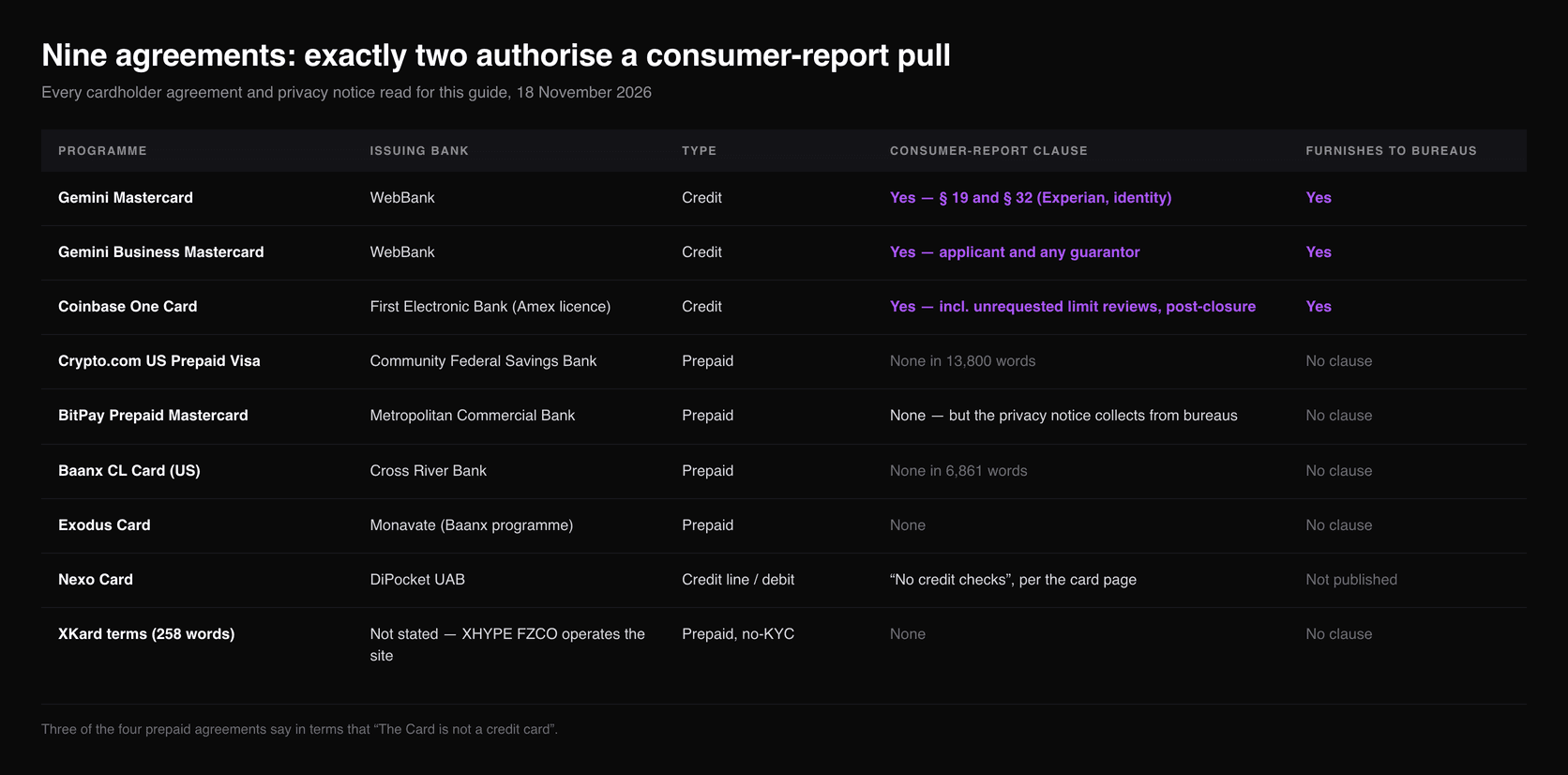
| Programme | Issuing bank | Type | Consumer-report clause | Furnishes to bureaus |
|---|---|---|---|---|
| Gemini Mastercard | WebBank | Credit | Yes — § 19 and § 32 (Experian, identity) | Yes |
| Gemini Business Mastercard | WebBank | Credit | Yes — applicant and any guarantor | Yes |
| Coinbase One Card | First Electronic Bank (Amex licence) | Credit | Yes — incl. unrequested limit reviews, post-closure | Yes |
| Crypto.com US Prepaid Visa | Community Federal Savings Bank | Prepaid | None in 13,800 words | No clause |
| BitPay Prepaid Mastercard | Metropolitan Commercial Bank | Prepaid | None — but the privacy notice collects from bureaus | No clause |
| Baanx CL Card (US) | Cross River Bank | Prepaid | None in 6,861 words | No clause |
| Exodus Card | Monavate (Baanx programme) | Prepaid | None | No clause |
| Nexo Card | DiPocket UAB | Credit line / debit | “No credit checks”, per the card page | Not published |
| XKard terms (258 words) | Not stated — XHYPE FZCO operates the site | Prepaid, no-KYC | None | No clause |
The pattern is tidy enough to be useful as a rule of thumb: in this set, every card that reaches your credit file is a card that lends you money, with one privacy notice as the exception that proves worth reading. For what happens to the data these programmes do hold, see our work on crypto card data retention.
The no-KYC record: seven programmes, two sentences
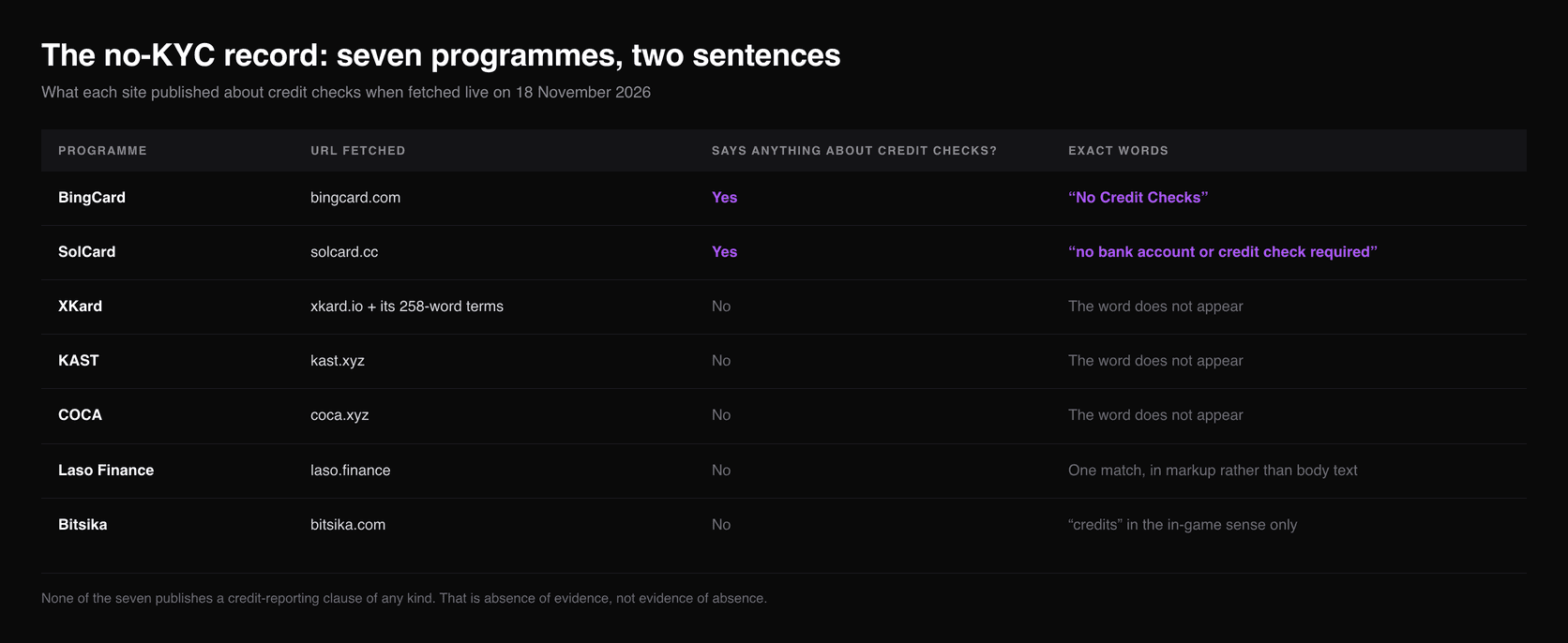
This is the part that matters most on a site about cards you can get without handing over a passport, and the honest finding is a near-silence. On 18 November 2026 we fetched each no-KYC programme in our own directory and searched the live page text for the word “credit”. Two of seven say anything a reader could act on.
| Programme | URL fetched | Says anything about credit checks? | Exact words |
|---|---|---|---|
| BingCard | bingcard.com | Yes | “No Credit Checks” |
| SolCard | solcard.cc | Yes | “no bank account or credit check required” |
| XKard | xkard.io + its 258-word terms | No | The word does not appear |
| KAST | kast.xyz | No | The word does not appear |
| COCA | coca.xyz | No | The word does not appear |
| Laso Finance | laso.finance | No | One match, in markup rather than body text |
| Bitsika | bitsika.com | No | “credits” in the in-game sense only |
Read that carefully, because the temptation is to turn it into a promise. It is absence of evidence, not evidence of absence. None of these seven publishes a consumer-report clause, and five do not publish a credit-check statement either way — which is consistent with running no checks at all, and equally consistent with having never written the clause down. XKard, which we may earn a commission on, is in the second group: its terms and conditions run to 258 words, were last updated 4 June 2025, and name XHYPE FZCO in Dubai Silicon Oasis as the site's operator without naming an issuing bank.
One housekeeping note from the same pass: the URL our directory holds for Goblin Card now serves an unrelated tabletop-gaming page, so we excluded it rather than score a zero against a site that is no longer the product. If you are weighing these programmes generally, no-KYC versus KYC crypto cards sets out the rest of the trade.
Why “credit mode” is a loan, not a credit card
Nexo deserves its own paragraph because its card is the one product here whose name actively misleads on this question. The Nexo Card runs in “Credit or Debit Mode”, and Credit Mode is borrowing against your crypto. You would reasonably expect a credit file somewhere in that. The card page says the opposite, twice: “No credit checks or repayment schedules required”, and “Enjoy flexible repayment with no fixed schedule or credit checks.”
That is coherent once you see what secures the loan: there is no underwriting to do, because your own collateral is the underwriting, which is also why the page mentions neither credit scores nor credit reporting. The card is issued by DiPocket UAB and is available “only to citizens and residents of selected European countries”, so the US bureau machinery above does not reach it at all. Credit here means a loan you have already secured, not a line extended on the strength of your file.
How to check your own card in ten minutes
You do not have to take any of this on trust for the card in your pocket. The whole method is a document search and two free lookups.
- Find the cardholder agreement, not the help centre. The help centre is written by marketing; the agreement is written by the bank. Six of the nine documents here are PDFs linked from a legal or terms page.
- Search it for five phrases. “Consumer report”, “credit bureau”, “credit reporting”, “written instructions” and “creditworthiness”. If all five are absent, the document does not claim the right to touch your file. If “written instructions” appears, read that clause in full — it is the identity route, and it may name a bureau.
- Check the privacy notice separately. BitPay's bureau sentence is not in its agreement. On a US card the privacy notice is usually a separate two-page table bound to the back.
- Note which bank, not which brand. The programme can change issuing banks and the clauses change with them. Our round-up of who issues each crypto card is the fastest way to find the entity whose name is on the paperwork.
- Then look at your own report. Hard inquiries are visible to anyone who buys your report; soft inquiries only to you. If you expected no check and find an inquiry, the agreement you just searched tells you which clause it came under.
Final take
The question is usually asked as “will this hurt my credit score”, and for almost every card on this site the answer is a boring no, because there is no account for a bureau to hold. The interesting question is the one underneath: who is allowed to look. On that, the answer splits along a line nobody advertises — lending products pull and furnish, spending products mostly do neither, and a handful of spending products reserve the right to read your file for identity while telling you, accurately, that they run no credit check. Both sentences can be true at once, and only the agreement tells you which you are signing.
See which cards document what they do with your data
Kardd reads what each card actually publishes — issuer, KYC level, fees, limits and the clauses behind them — so you can tell a programme that writes its rules down from one that writes 258 words and a marketing page.
Kardd may earn a commission on sign-ups, including XKard, whose terms say nothing about credit checks in either direction. Affiliate disclosure.
Sources
All read on 18 November 2026. Gemini Mastercard Credit Card cardholder agreement (§ 19 Credit Reporting, § 20 Inaccurate Information, § 32 FCRA Compliance naming Experian, § 35 Change of Terms; 11,820 words) and the Gemini Business Card cardholder agreement (the guarantor clause), with the issuing bank confirmed on Gemini's own card page. Coinbase One Card cardholder agreement (effective 1 November 2026; the Credit Reports section, the three-limb consumer-report authority, the APR disclosure box, the California/Utah and New York notices; 15,290 words). Crypto.com US Prepaid Visa cardholder agreement (“The Card is not a credit card”, the PATRIOT Act identification programme, “No overdraft/credit feature”; 13,837 words, no consumer-report clause). BitPay Prepaid Mastercard cardholder agreement and its bound Metropolitan Commercial Bank privacy notice (the bureau-collection sentence and the creditworthiness-sharing limit). Baanx CL Card terms (Cross River Bank; 6,861 words) and the Exodus Card terms (Monavate; the identical not-a-credit-card drafting). Nexo Card page (Credit and Debit Mode, “No credit checks”, DiPocket UAB, selected European countries). XKard terms and conditions (258 words; XHYPE FZCO; last updated 4 June 2025). Statutory text from 15 U.S.C. § 1681b (permissible purposes, (a)(2) and (a)(3)(A)), and the inquiry definitions from the CFPB on credit inquiries.
Counted rather than guessed. The no-KYC figures are our own fetches of each live site on 18 November 2026, searched for the word “credit” in body text: xkard.io, kast.xyz, solcard.cc, coca.xyz, bingcard.com, laso.finance and bitsika.com all returned 200. goblincard.com returned 200 but served an unrelated tabletop-gaming page and was excluded rather than scored. Word counts are of the extracted text of each PDF, not of the page.
Related Articles
- Gemini Credit Card Review 2026
- Crypto Card KYC Rules 2026
- Crypto Card Data Retention 2026
- Crypto Card Issuers 2026: 16 Programmes Checked
- Crypto Card Taxes 2026: What a Swipe Actually Triggers
- No-KYC vs KYC Crypto Cards: The Real Trade-offs
Frequently Asked Questions
Do crypto cards require a credit check?
Only the credit ones. Of nine agreements read on 18 November 2026, the two credit cards both authorise a consumer-report pull — Gemini at § 19, Coinbase in its Credit Reports section. The four prepaid agreements contain no consumer-report clause at all, and three state in terms that “The Card is not a credit card”.
Do crypto cards affect your credit score?
A crypto credit card does, both ways: Gemini and Coinbase both say late, missed or returned payments “may be reflected in your credit report”. A prepaid or debit crypto card has no tradeline to report, so it can neither help nor hurt, and none of the prepaid agreements claims otherwise.
Can a crypto debit card pull your credit report?
It can, for identity rather than underwriting. Gemini's § 32 is the clearest case in the set: clicking I AGREE gives “written instructions” under the FCRA authorising a pull from Experian “solely to confirm your identity”. BitPay's prepaid privacy notice also says the bank collects personal information “from others, such as credit bureaus”.
Is a crypto card credit check a hard or a soft inquiry?
An application for a crypto credit card is a hard inquiry, and the CFPB says those “will impact your credit score”. Account reviews and prescreening are soft, and “will not affect your credit scores”. An identity-only pull under § 1681b(a)(2) is neither — no credit is being applied for — but the agreements use no label, so read the clause.
Do no-KYC crypto cards check your credit?
Nothing published says they do, and almost nothing says they do not. Of seven programmes fetched on 18 November 2026, two address it: BingCard's “No Credit Checks” and SolCard's “no bank account or credit check required”. None publishes a consumer-report clause. That is absence of evidence, not evidence of absence.
Can a crypto card build your credit history?
Only one that furnishes a tradeline, which here means the two credit cards. A prepaid card creates no account for a bureau to hold. Crypto.com's US agreement says it plainly in its FDIC disclosure: “No overdraft/credit feature.” If building credit is the goal, a crypto prepaid card is the wrong instrument however good the cashback.
Does Nexo's Credit Mode show up on your credit file?
Nexo's card page says the opposite of what the name suggests: “No credit checks or repayment schedules required”. It is crypto-collateralised borrowing rather than a credit card, issued by DiPocket UAB and available only in selected European countries, and the page mentions neither credit scores nor credit reporting.