Crypto Card 3D Secure 2026: Five of Six Need a Phone
- Approval, enrolment and authentication are three separate decisions. A card can be funded, unblocked and inside its limits, and still fail at a step that is not asking about your balance.
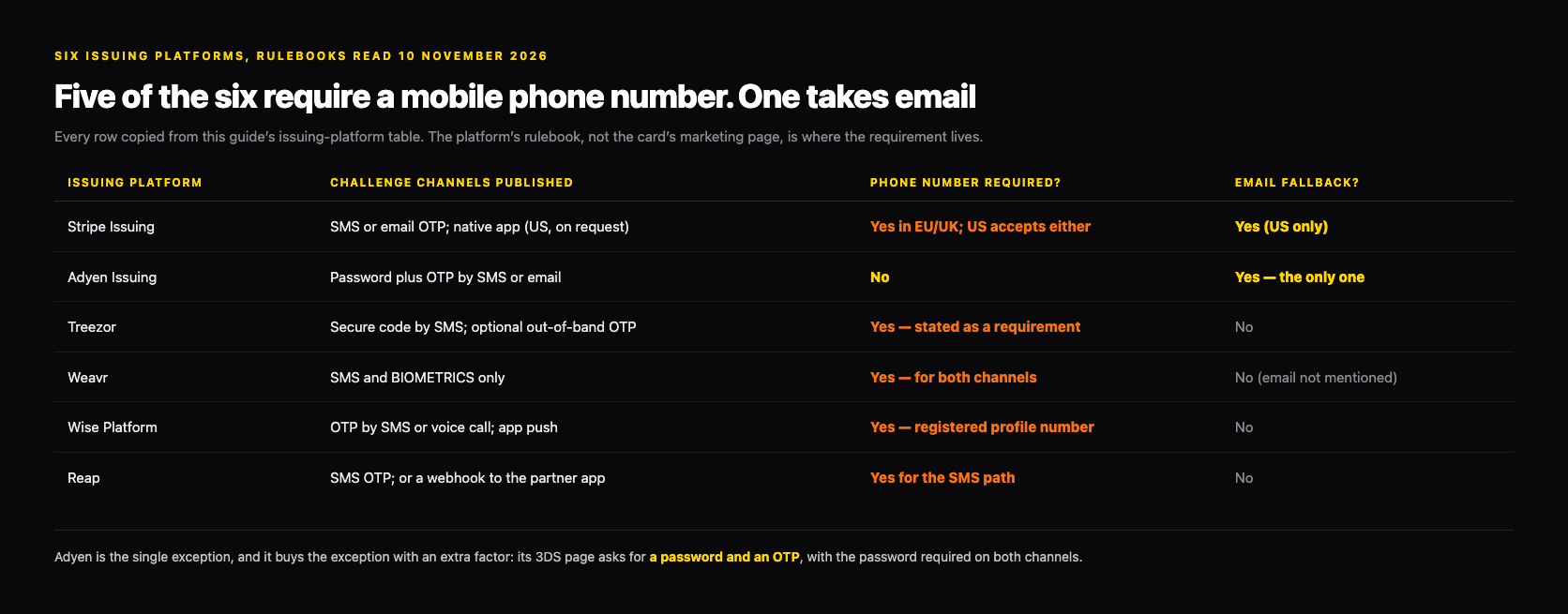
- Five of the six issuing platforms we read require a phone number. Treezor says registration “requires a mobile phone number”; Weavr offers only SMS and biometrics, and its biometric path still needs a mobile number. Only Adyen falls back to email.
- One platform states the no-contact outcome in a single line. Stripe: “Cardholders without a phone number or email on file aren’t enrolled in 3DS.” In the EU and UK it goes further — a valid phone number is required.
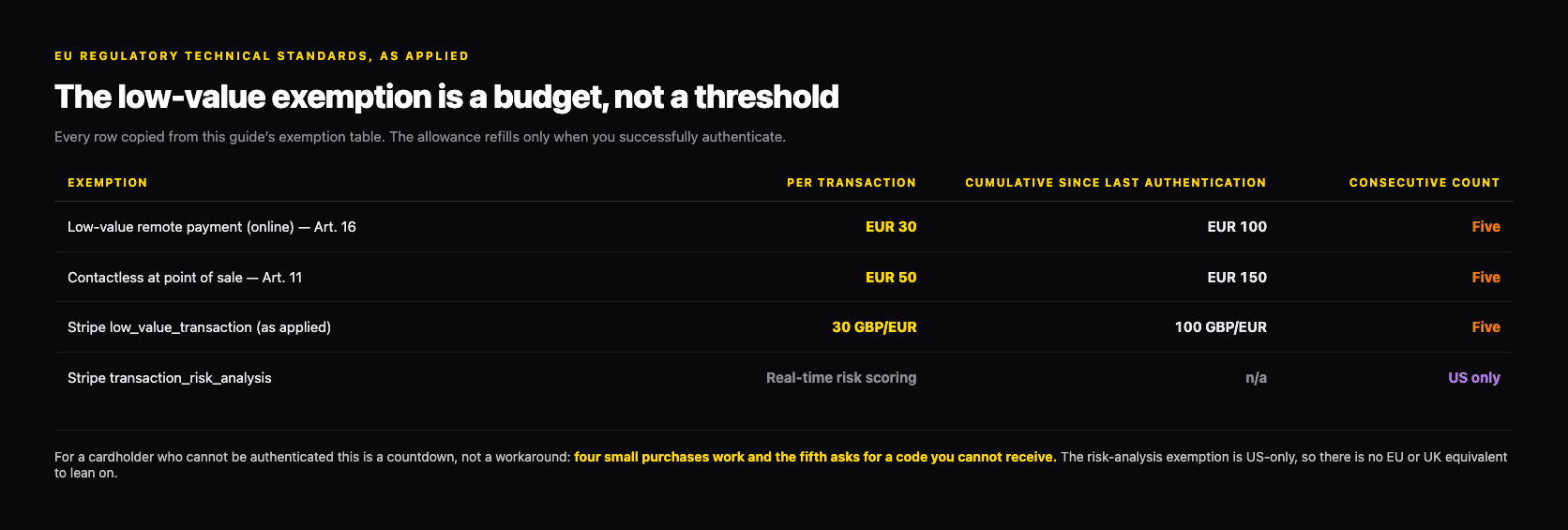
- The only way through without a challenge is a threshold, and the thresholds are small. EUR 30 per remote payment, EUR 100 cumulative, five in a row, then you are authenticated whether you can be or not.
- Finishing the check moves the fraud loss onto the issuer — and Stripe says it moves “whether or not your Issuing cards are enrolled in 3DS”, so the shift can happen with nothing verified.

On this page
- Approval, enrolment and authentication are three decisions
- What six issuing platforms actually require
- The one platform that says what happens with nothing on file
- Where the code goes, and the channel that is closing
- The thresholds that get you through without a challenge
- How many wrong codes before you are locked out
- Finishing the check moves the liability
- What this means on a no-KYC card
- How to check your own card before you need it
- Final take
- Sources
- Related articles
- FAQ
The card has money on it, it is not frozen, and the purchase still fails — at a grey pop-up asking for a code that never arrives. That step is crypto card 3D Secure, and it is the one part of a card programme that cannot be satisfied by funding the card, because it is not asking about the card. It is asking whether the issuer can reach you. We spent 10 November 2026 reading the published 3DS rules of six card-issuing platforms and the EU regulation they are all built to, and the answer is narrower than the marketing on any no-KYC card suggests: five of the six will not authenticate a cardholder who has no phone number.
Three mechanisms are worth separating before any of it makes sense. Enrolment decides whether your card can be challenged at all. Delivery decides where the code is sent. Exemption decides when the whole thing is skipped. Most troubleshooting advice online addresses the second and assumes the first, which is why it so rarely helps the person whose card was never enrolled.
Approval, enrolment and authentication are three decisions
The reasonable assumption is that a card which works in a shop works online. The two go through different checks, and the online one has a step the shop does not: the merchant can ask your issuer to prove you are present.
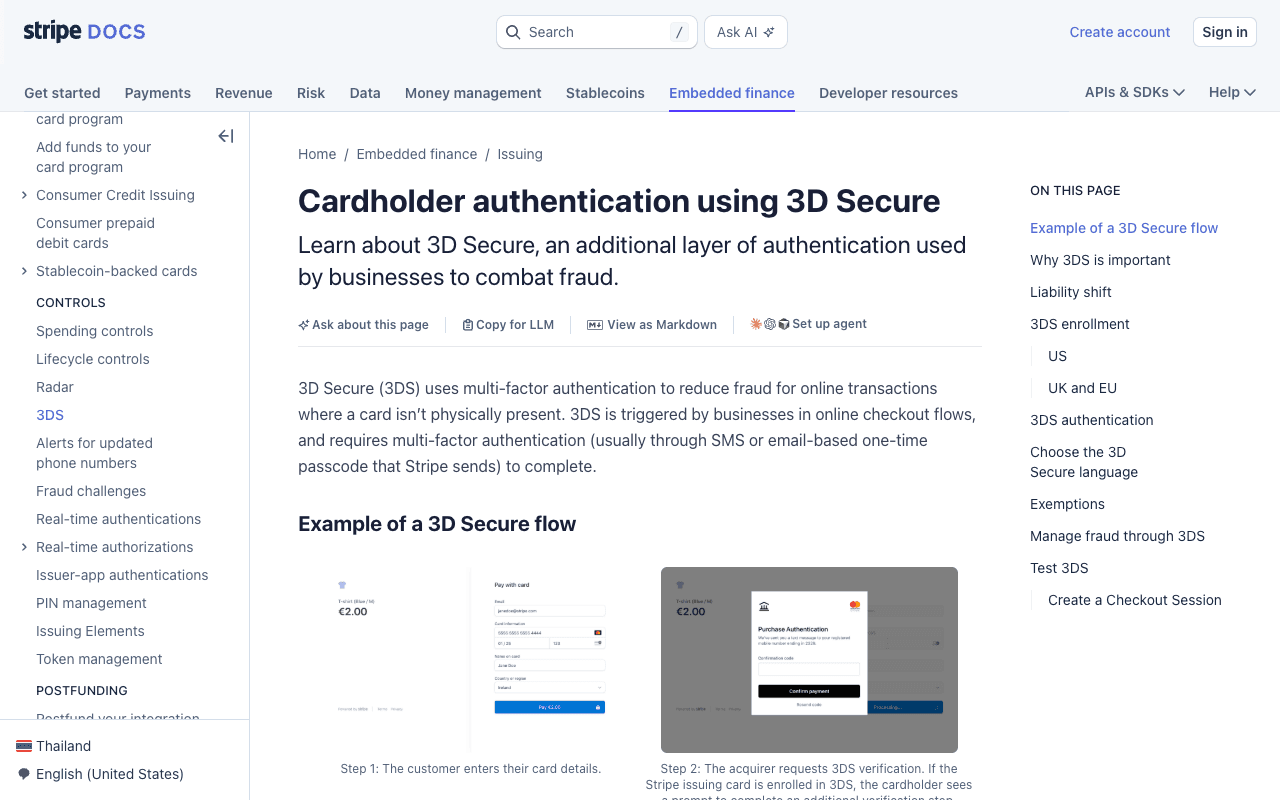
Whether that request reaches you depends on a setting made long before you tried to buy anything. Stripe describes the sequence from the issuing side: the acquirer requests verification, and then — its words — “If the Stripe issuing card is enrolled in 3DS, the cardholder sees a prompt to complete an additional verification step.” The conditional is the important word. An unenrolled card does not get a prompt, and the merchant gets back a result Stripe labels attempt_acknowledged, meaning the business tried and “the card isn’t enrolled or couldn’t reach Stripe”.
That result is not an approval. It is an absence of evidence, which Stripe's own guidance calls insufficient to judge the transaction either way. A card that cannot be challenged does not glide through; it arrives at checkout with nothing to show. Our guide to why crypto cards get declined covers the mechanical causes; this one happens before any of them.
What six issuing platforms actually require
Crypto cards are not issued by the companies whose logo is on them. They run on a card-issuing platform, and that platform's rulebook — not the card's marketing page — is where the authentication requirement lives. Six are published, read on the same day.
| Issuing platform | Challenge channels published | Phone number required? | Email fallback? |
|---|---|---|---|
| Stripe Issuing | SMS or email OTP; native app (US, on request) | Yes in EU/UK; US accepts either | Yes (US only) |
| Adyen Issuing | Password plus OTP by SMS or email | No | Yes — the only one |
| Treezor | Secure code by SMS; optional out-of-band OTP | Yes — stated as a requirement | No |
| Weavr | SMS and BIOMETRICS only | Yes — for both channels | No (email not mentioned) |
| Wise Platform | OTP by SMS or voice call; app push | Yes — registered profile number | No |
| Reap | SMS OTP; or a webhook to the partner app | Yes for the SMS path | No |
Two of those rows are unusually blunt. Treezor's integration page states that “Registering the card for 3D Secure requires a mobile phone number”, and adds that before you reach that step “you must ensure the User was created with a mobile phone number”. There is no alternative described. Weavr's is a different kind of blunt: “Currently, we support SMS and BIOMETRICS as possible authentication channels”, with SMS on by default — and the biometric route is not an escape, because it requires a linked user who is active and “has a mobile number defined”.
Adyen is the single exception in the set, and it buys the exception with an extra factor. Its flow asks for two things at the 3DS page: “Their password” and “A one-time password (OTP) sent through SMS or email”, with the password required for both channels. So email works, but only on a platform that also makes you set a password in advance. The default order still favours the phone: email OTP is described as a lower-priority method than SMS, except in some countries where Adyen says it always uses email.
The one platform that says what happens with nothing on file
Every platform above implies an outcome for a cardholder it cannot reach. Only two state it, and they state it at different layers — which is why reading both is worth more than reading either.
Adyen, on the transaction: “If no phone number is provided, it falls back to email, if available.” Then: “If neither contact method is provided, the transaction is declined, because the OTP cannot be sent.”
Put them side by side and the shape of the problem appears. Stripe's version means the card never enters the system that could challenge you; Adyen's means it enters and then fails at the moment of purchase. Neither is a card that quietly works, and neither failure is visible until you are at a checkout.
The regional rule is stricter still. Stripe says US enrolment is optional and off unless requested, while in the UK and EU “all cards issued within the EU and UK require a valid phone number on file for the relevant cardholder”. A phone number stops being a delivery preference there and becomes a condition of issuing the card. Reap puts the day-to-day consequence in one sentence: “A wrong or stale number means the cardholder cannot complete the OTP step and the transaction is declined.” A number you no longer control is the same as no number.
Where the code goes, and the channel that is closing
Delivery is where the published cardholder-side pages are useful, because they are written by the programmes people actually hold. They also disagree, and one of them is moving.
| Programme or platform | How the challenge arrives | Published window | Can you opt out? |
|---|---|---|---|
| Gnosis Pay | SMS OTP to the registered number | Not stated | Not offered |
| Venn Mastercard | 6-digit code by email; enrolled automatically | Not stated | Yes, on request |
| Webot | 3DS code at checkout | 15 minutes | Not offered |
| Reap (webhook mode) | Event to the partner app, authenticated in-app | 5 minutes to respond | Per-card setting |
| Wise Platform | SMS, voice call, or app push | Not stated | Not offered |
| EU regulation (floor) | Any two of knowledge, possession, inherence | Code accepted once only | No |
Gnosis Pay's page is the clearest cardholder-side statement in the set: “A one-time passcode (OTP) will be sent via SMS to your registered phone number”, with the advice to “confirm your phone number is up to date in your Gnosis App account”. When a code is entered and the payment still fails it names three causes: the OTP expired, was mistyped, or the card is frozen in the app — so authentication can succeed while the card declines anyway. Gnosis Pay is also winding down its card, making its docs a snapshot rather than a plan.
The forward-looking line comes from Wise, which recommends its in-app flow over SMS on the grounds that “SMS will no longer be supported as a verification method in some regions”. Read against the table above, that is the uncomfortable direction of travel: the channel five of six platforms depend on is being retired in places, and the replacement is an app with an account behind it.
The thresholds that get you through without a challenge
There is one legitimate route past a challenge you cannot complete, and it is not a trick: the rules themselves exempt small payments. The figures are fixed in the EU's regulatory technical standards, and they are low enough that nobody should plan around them.
| Exemption | Per transaction | Cumulative since last authentication | Consecutive count |
|---|---|---|---|
| Low-value remote payment (online) — Art. 16 | EUR 30 | EUR 100 | Five |
| Contactless at point of sale — Art. 11 | EUR 50 | EUR 150 | Five |
| Stripe low_value_transaction (as applied) | 30 GBP/EUR | 100 GBP/EUR | Five |
| Stripe transaction_risk_analysis | Real-time risk scoring | n/a | US only |
The arithmetic matters more than the headline figure. The exemption is not “payments under EUR 30 never get challenged”; it is a budget that refills only when you successfully authenticate. Stripe states it in the regulation's own terms: once the exemption has been used five times since the last successful authentication, or the exempted payments exceed 100 GBP or EUR, “the exemption doesn’t apply, and the cardholder must be authenticated”.
For a cardholder who cannot be authenticated, that is a countdown, not a workaround: four small purchases work and the fifth asks for a code you cannot receive. The risk-analysis exemption is marked US-only in Stripe's own table, so in the EU and UK there is no equivalent to lean on. Our guide to crypto cards in Europe under MiCA covers the wider picture.
How many wrong codes before you are locked out
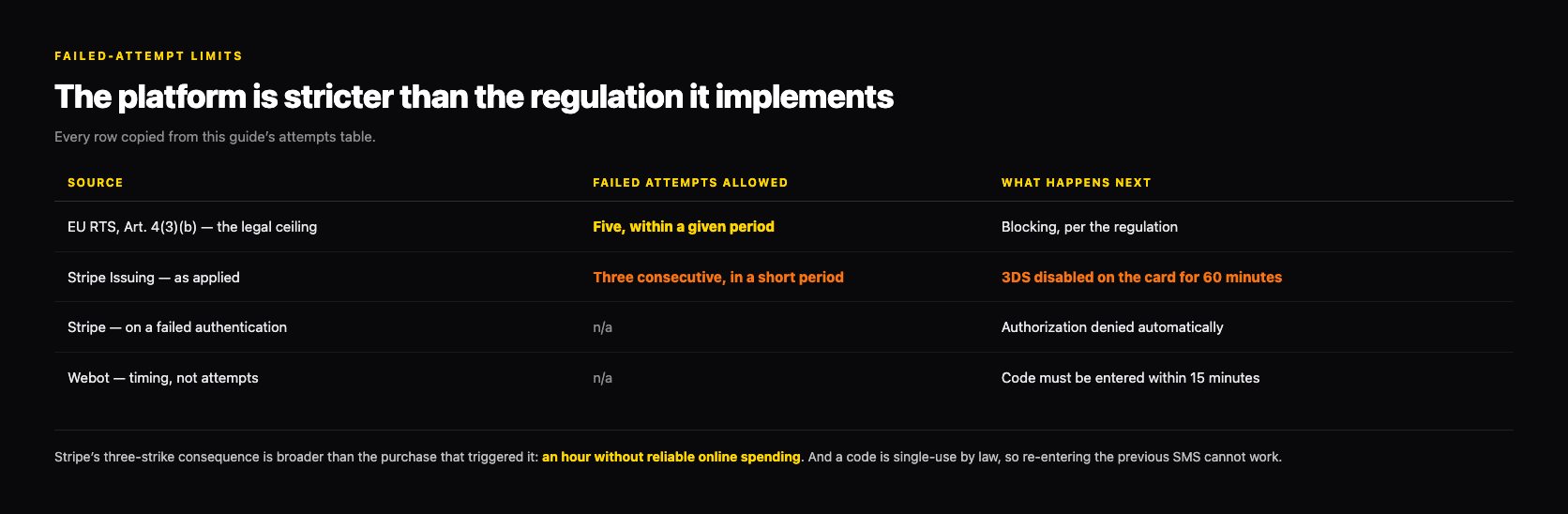
Getting a code wrong is survivable; getting it wrong repeatedly is not, and the limits are tighter than the regulation requires.
| Source | Failed attempts allowed | What happens next |
|---|---|---|
| EU RTS, Art. 4(3)(b) — the legal ceiling | Five, within a given period | Blocking, per the regulation |
| Stripe Issuing — as applied | Three consecutive, in a short period | 3DS disabled on the card for 60 minutes |
| Stripe — on a failed authentication | n/a | Authorization denied automatically |
| Webot — timing, not attempts | n/a | Code must be entered within 15 minutes |
Stripe's three-strike rule is the one to know, because its consequence is broader than the purchase that triggered it: 3DS is disabled on the card for an hour, which in practice means an hour without reliable online spending. The regulation's own ceiling is five, so this is a platform choosing to be stricter, and it is the kind of detail that only appears in an issuing doc nobody markets.
Two smaller points are worth keeping. A code is single-use by law — the regulation says it “shall be only accepted once” — so re-entering the previous SMS cannot work. And one cause has nothing to do with you: Webot lists “Your card issuer does not allow payments to crypto exchanges” as a reason verification never completes.
Finishing the check moves the liability
The reason merchants trigger 3DS is not politeness. It is that a completed challenge moves who pays for a fraudulent transaction, and the issuing platforms say so in the open.
Stripe's wording is the most quotable in this article, and the second sentence is the one that should give a cardholder pause: “When a business triggers 3DS verification, liability for fraud shifts from the business to the issuer in most cases. This applies whether or not your Issuing cards are enrolled in 3DS, meaning issuers can take on increased liability without any additional verification.”
Read that against the enrolment rules and a genuine oddity falls out. A card with no contact details on file cannot be challenged, cannot prove anything about who used it — and the liability still moves to its issuer. That is a structural reason an issuer might decline the unverifiable transaction outright rather than wear the risk, and it explains the pattern no-KYC cardholders describe: approvals in shops, failures online.
The cardholder-side consequence is more mundane. Venn recommends keeping 3DS on precisely because un-enrolling removes the fraud liability protections that come with successful authentication. None of this makes an authenticated transaction automatically your problem, but it changes who argues about it — the subject of our guide to what you can actually dispute on a crypto card.
What this means on a no-KYC card
This site is a no-KYC directory, so the honest reading is the uncomfortable one: 3D Secure is an identity requirement wearing a security label. Not identity in the document-upload sense — no platform above asks for a passport at the 3DS step — but a verified channel that reaches one person. A card sold on the promise of an email address and nothing else has, by construction, the one thing five of six platforms will not accept.
Which reframes what a “no-KYC card that works online” is actually claiming. Either it holds a phone number you gave it, in which case the anonymity is narrower than advertised and that number is retained data; or it holds nothing, in which case the card is unenrolled and its online behaviour depends on merchants accepting a transaction with no authentication evidence. Both are defensible products. Neither is the product the marketing describes.
Our own records say as little as the vendors do, and we would rather state that than fill it in. XKard names no issuer and no authentication method in its documentation, and our card record carries neither — a gap we will not paper over with an inference. The same silence covers most of the 16 programmes in our issuers round-up: the issuing platform decides this question, and it is the layer least often disclosed. For the trade-off in the round, see no-KYC versus KYC and virtual cards.
How to check your own card before you need it
All of this is checkable in advance, which is the only time the answer is useful. The order below puts the cheapest checks first.
- Find out whether a phone number is on file at all. Not your login 2FA — the number attached to the card. Reap documents these as separate settings, and changing one does not change the other.
- Search the help centre for “3DS” and “OTP”, not “online payments”. The authentication article is almost always separate from the how-to-spend page, and it is the one that names the channel.
- If no page names a channel, assume SMS and assume a number is required. That is the default on five of the six platforms here, including both that publish a flat requirement.
- Test with a small online purchase while you still have the number. A card that has never been challenged tells you nothing; the exemption budget means the fifth small payment is the honest test.
- Treat a number you no longer control as no number. Ask support how to change it before you need to, and check whether they can.
- Do not ask for 3DS to be switched off. It is rarely offered, it is not offered at all on EU and UK issued cards, and the programme that does offer it warns you lose liability protection.
Compare what each card actually requires
Kardd reads what each card publishes — issuer, KYC level, fees, limits and the clauses behind them — so you can see which cards document an authentication path and which say nothing at all.
Kardd may earn a commission on sign-ups, including XKard, whose documentation names no issuer or authentication method. Affiliate disclosure.
Final take
The useful answer to “why did my card fail the verification step” is that the step was never about the card. It was a question put to your issuer about whether it can reach you, and on five of the six platforms that publish an answer, reaching you means a mobile number.
What makes it worth an article is how little of it is visible from outside. The requirement lives in an issuing platform's integration docs, not on any card's website. The exemption that might carry you through is a EUR 30 budget that refills only on success. And the liability the mechanism exists to move can move without anything being verified at all.
For a no-KYC card the conclusion is not that online spending is impossible — it is that the phone number is the real KYC threshold, and it is the one nobody advertises. Ask about it before you fund anything.
Sources
All read in full on 10 November 2026. Stripe, “Cardholder authentication using 3D Secure” (the enrolment rule for cardholders with no contact details, the EU/UK phone-number requirement, US opt-in enrolment, the liability-shift paragraph, the three-attempt 60-minute lockout, the exemption table and the attempt_acknowledged result). Adyen, “Password and OTP” (password plus OTP, the email fallback, and the decline when neither contact method exists). Treezor, “Register a card for 3DS” (the flat mobile-number requirement and the out-of-band fallback). Weavr, “3D Secure configuration” (SMS and biometrics only; the mobile number needed for the biometric path). Wise Platform, “3DS” (SMS or voice call, app push, and the regional retirement of SMS). Reap, “3D Secure” (the phone number from the user record, the stale-number decline, and the five-minute webhook window). Commission Delegated Regulation (EU) 2018/389 (Article 4 on the single-use code and the five-attempt ceiling, Article 11 on contactless limits, Article 16 on low-value remote limits). Gnosis Pay, “Making secure online payments with 3D Secure” (SMS to the registered number, and the three causes of a post-code decline). Venn, “3D Secure authentication on your Venn Mastercard” (automatic enrolment, the email passcode, and un-enrolment on request). Webot, “What is 3D Secure (3DS)?” (the 15-minute window, and issuer blocks on crypto payments).
Recorded rather than guessed, because we could not read them: the Zendesk-hosted help centres at support.gemini.com, support.reap.global and help.gnosispay.com all returned 403 to this run, as did support.nebeus.com, so where an article existed on both Zendesk and Intercom we cite the readable copy and nothing from the other. Gnosis Pay's page carries no publication date, only a relative “Updated” marker. Where a card programme publishes no authentication page at all — which is most of them, XKard included — we say so rather than assume the common default.
Related Articles
- Crypto Card Declined? 9 Reasons and Fixes for 2026
- Crypto Card Chargebacks 2026: What You Can Actually Dispute
- Crypto Card Issuers 2026: 16 Programmes Checked
- Crypto Card KYC Rules 2026: The July 2027 EU Deadline
- Crypto Card Europe Under MiCA 2026: 8 Cards That Survived The Rules
- Best Crypto Virtual Card 2026: Instant Issuance, No KYC Options
Frequently Asked Questions
Do you need a phone number for a crypto card 3D Secure check?
On five of the six issuing platforms whose rules we read, yes. Treezor states that registering a card for 3D Secure requires a mobile phone number. Weavr supports only SMS and biometrics, and its biometric path still needs a mobile number on the linked user. Wise, Reap and Stripe all send the code to a registered phone number. Adyen is the only one of the six that will fall back to email.
What happens if a crypto card has no phone number or email on file?
Stripe is the only platform that states the outcome plainly: cardholders without a phone number or email on file are not enrolled in 3DS at all. Adyen states the transaction-level consequence instead, saying that if neither contact method is provided the transaction is declined because the OTP cannot be sent. An unenrolled card is not a card that skips the check.
Can you turn 3D Secure off on a card?
Sometimes, and it is a worse idea than it sounds. Venn will un-enrol a card if you ask support, and warns that doing so removes the fraud liability protections that come with successful authentication. In the EU and UK it is not generally on offer: Stripe says cards issued there are enrolled by default because of local regulations.
How much can you spend without a 3D Secure challenge?
Under the EU rules the low-value remote exemption covers a single payment up to EUR 30, and stops applying once the exempted payments since your last authentication total EUR 100 or reach five in a row. In-store contactless runs on higher figures: EUR 50 per tap, EUR 150 cumulative, five consecutive. Stripe applies the same thresholds in sterling or euro.
How many times can you get a 3D Secure code wrong?
The regulation caps it: consecutive failed attempts before blocking shall not exceed five. Individual platforms are stricter than they have to be. Stripe disables 3DS on the card for 60 minutes after three consecutive failures in a short period, which locks you out of online spending rather than just the one purchase.
Does completing 3D Secure make a disputed charge your problem?
It shifts who carries the fraud loss, from the merchant to the issuer. Stripe adds the part worth knowing: that shift applies whether or not the cards are enrolled in 3DS, so an issuer can take on the liability without having verified anything. What it does not do is make you liable automatically, and in the EU and UK the unauthorised-transaction rules still sit above it.
Do no-KYC crypto cards support 3D Secure?
Most do not say, and that silence is the finding. A card sold on an email address alone has no verified phone number to send a code to, which puts it on the wrong side of every platform rule we read. XKard, the card this site has an affiliate relationship with, names no issuer and no authentication method in its documentation, and our card record carries neither. We will not infer one.