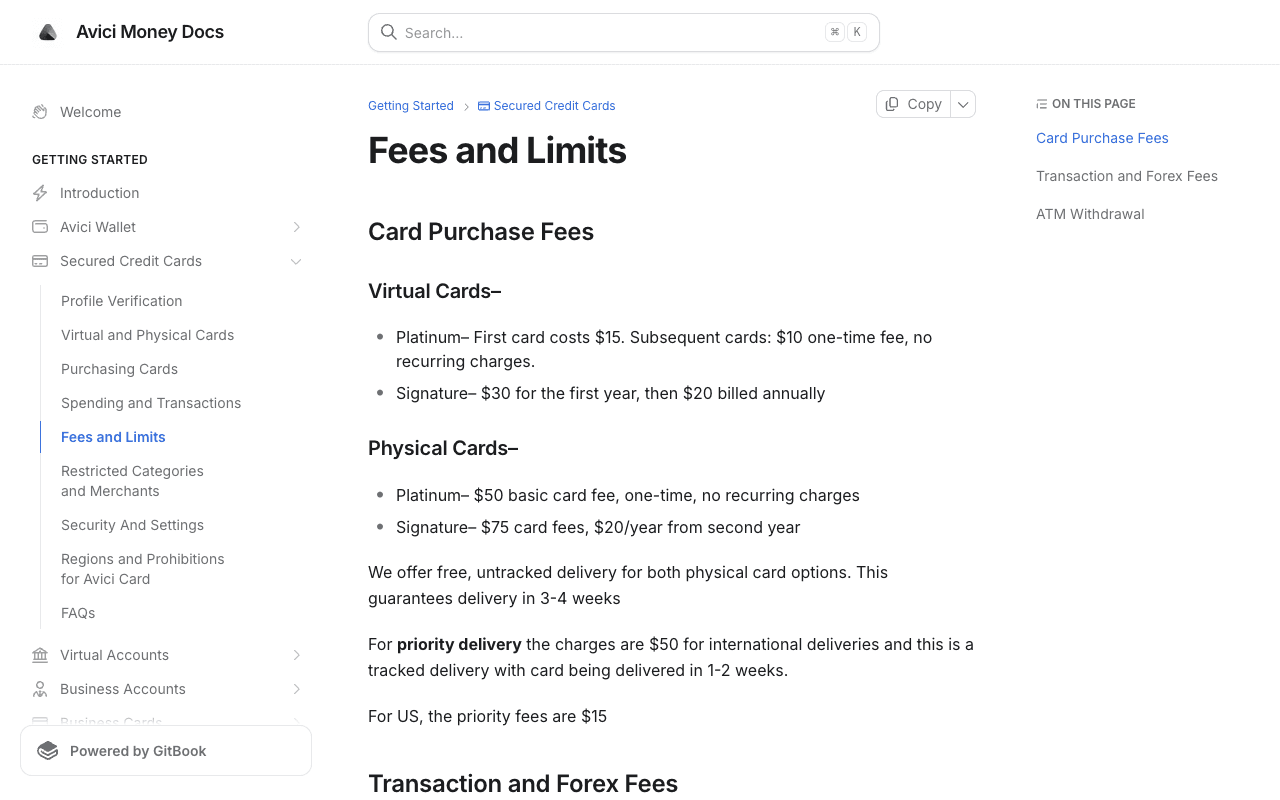
- The same plastic costs $0 to $125. Bleap and Wirex issue free; Crypto.com asks US$4.99; KAST asks $40; RedotPay asks 100 USD; an Avici Signature card with tracked international delivery comes to $125.
- Delivery is the charge the market gets wrong. The published ceiling across page one is $25. Wirex charges 49.99 NZD for DHL Express to New Zealand and Avici $50 for international priority — both above it, and KAST's flat $40 is triple the “free to $15” range quoted for plastic.
- The real entry cost is a tier gate, not a card fee. A Crypto.com Jade or Indigo card needs $29.99 a month, $299.90 a year, or $5,000 of CRO locked up. Tangem waives its Plus fee at $65,000 held. Neither is an “issuance fee” and both dwarf one.
- Losing the card costs ten times more than getting it. Crypto.com reissues a Midnight card for US$7 and every other tier for US$50, against a US$4.99 issuance fee. Six other programmes publish no replacement price at all.
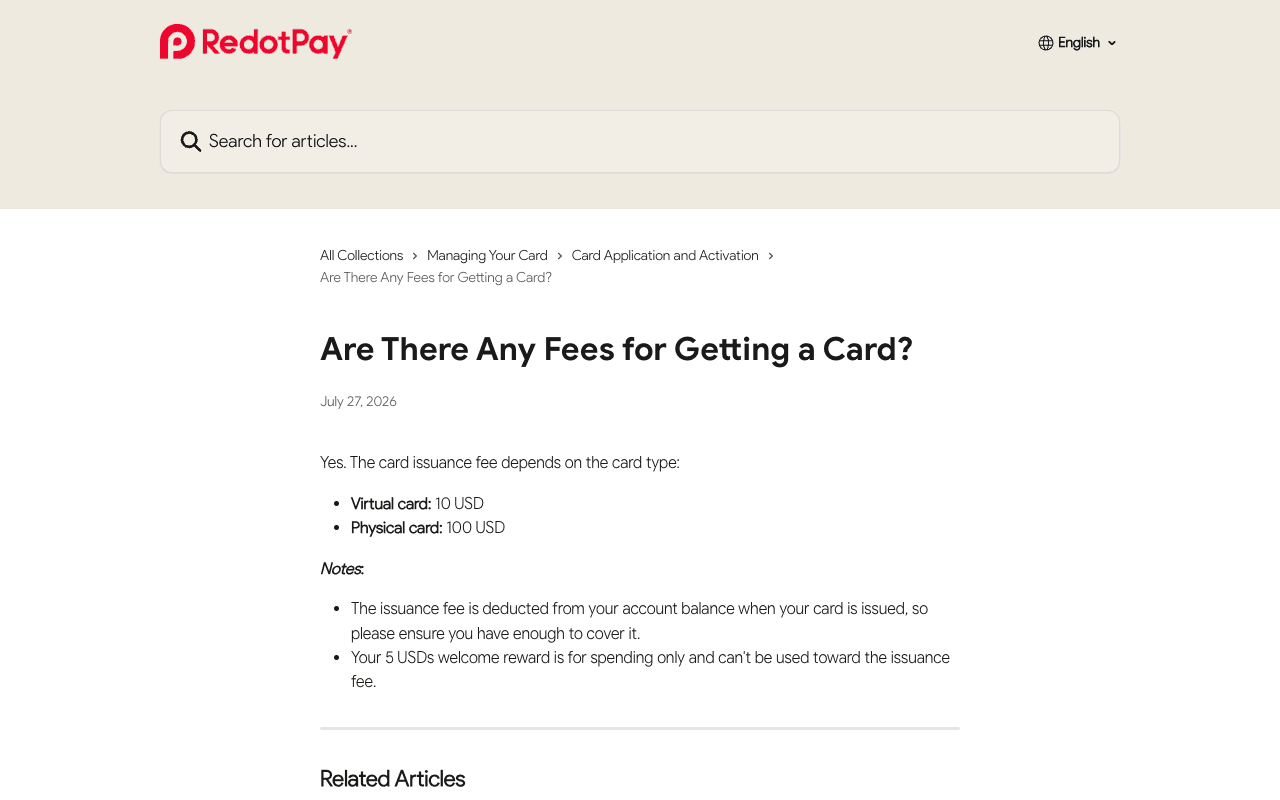
- RedotPay's 100 USD is explicitly non-refundable — “payment confirms your application” — and physical cards are not available in every country, so you pay before the availability question is settled.
On this page
- Three gates, and only one is called a fee
- What each programme charges to issue the card
- Delivery is the number the market gets wrong
- The real entry cost is a tier gate
- The same plastic, $0 to $125
- One of these fees is non-refundable
- Four issuers publish nothing you can read
- Leaving is priced higher than joining
- The cheapest way to get a crypto card in 2026
- Final take
- FAQ
Every fee guide in this market starts at the moment money is already on the card. That skips a charge you pay first and cannot spread over anything: crypto card issuance fees, plus the delivery charge and the tier gate that usually sit beside them. The spread is not small. The same object — a plastic Visa or Mastercard in an envelope — costs nothing from Bleap, 1 AUD to post from Wirex in Australia, US$4.99 from Crypto.com, $40 from KAST, 100 USD from RedotPay and $125 from Avici if you want the Signature card tracked to a non-US address. We read nine programmes' own fee pages on 29 September 2026 and priced the cost of simply being handed a card, before a single cent is loaded. The finding that changed our own view: the biggest entry cost in this market is not called an issuance fee at all.

Three gates, and only one is called a fee
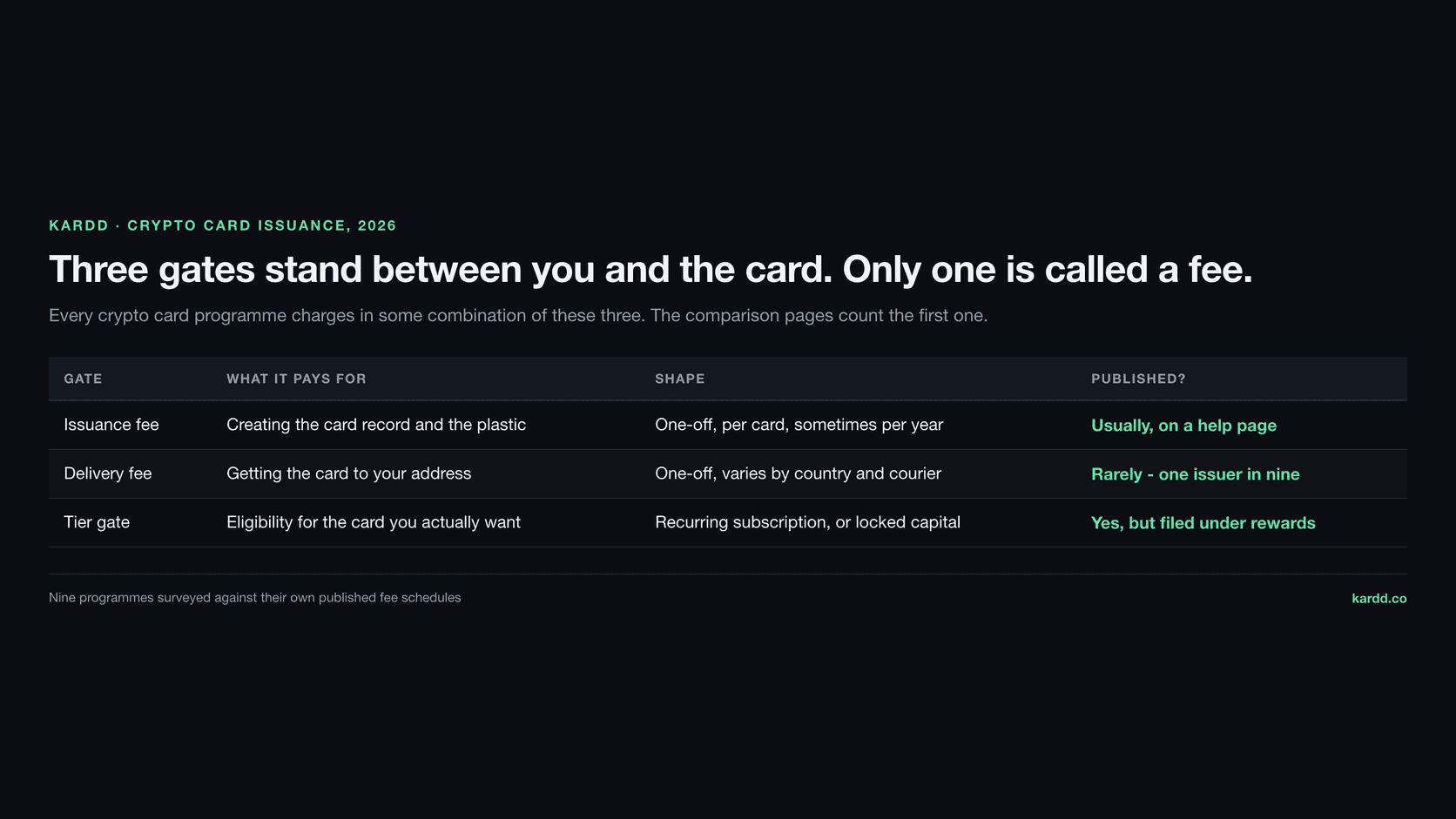
Page-one guides collapse everything into a single “issuance fee: free to $100” range. Three separate charges live inside that range and they behave nothing alike, which is why the range is useless for deciding anything.
| Gate | What it pays for | Shape | Published? |
|---|---|---|---|
| Issuance fee | Creating the card record and the plastic | One-off, per card, sometimes per year | Usually, on a help page |
| Delivery fee | Getting the card to your address | One-off, varies by country and courier | Rarely — one issuer in nine |
| Tier gate | Eligibility for the card you actually want | Recurring subscription, or locked capital | Yes, but filed under rewards |
Read that table and the “free card” claim loses most of its meaning. A card can be free to issue and still cost $40 to receive, or free on both counts and still be unreachable without $5,000 of locked capital. The gate you hit depends entirely on which programme you picked and where you live — the same reason our supported-countries guide ended up with three different lists rather than one.
What each programme charges to issue the card
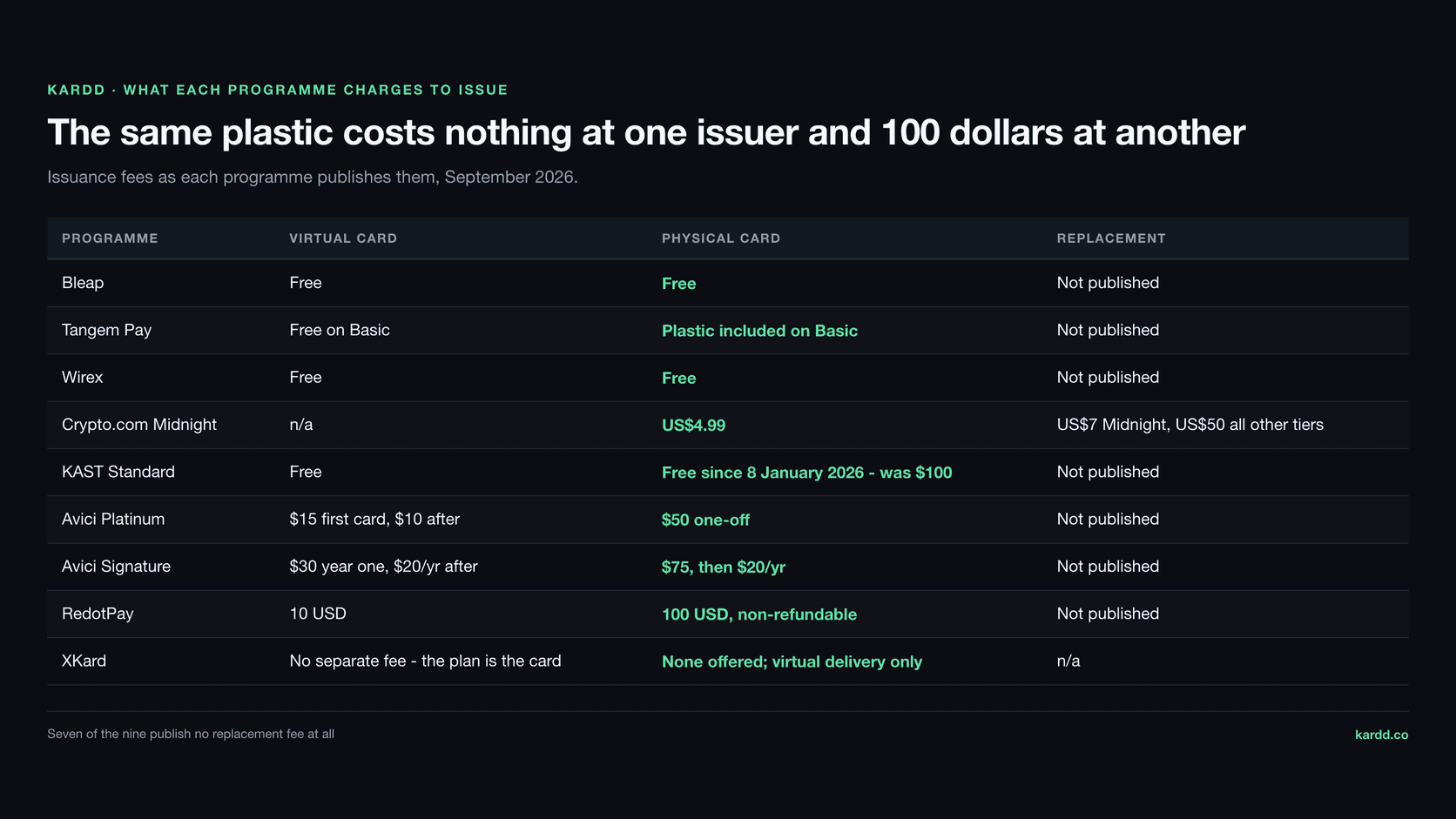
Here is the table the SERP does not carry: virtual, physical and replacement, per programme, from the issuer's own page. Where a programme publishes nothing we have written “not published” rather than borrowing a third-party figure.
| Programme | Virtual card | Physical card | Replacement |
|---|---|---|---|
| Bleap | Free | Free — “no issuance fee, no monthly fee, and no maintenance fee” | Not published |
| Tangem Pay | Free on Basic | Plastic included on Basic | Not published |
| Wirex | Free | Free — schedule reads “Card Issuance | Free” | Not published |
| Crypto.com Midnight | n/a | US$4.99 | US$7 Midnight, US$50 all other tiers |
| KAST Standard | Free | Free since 8 January 2026 — was $100 | Not published |
| Avici Platinum | $15 first card, $10 after | $50 one-off | Not published |
| Avici Signature | $30 year one, $20/yr after | $75, then $20/yr | Not published |
| RedotPay | 10 USD | 100 USD, non-refundable | Not published |
| XKard | No separate fee — the plan is the card | None offered; virtual delivery only | n/a |
Two things fall out immediately. The first is that a free card is the norm and a priced card is the exception: four of nine charge nothing for either form factor, and the outliers are RedotPay at 100 USD and Avici at $50 to $75. The second is that the replacement column is almost empty. Crypto.com is the only programme in the set that publishes what a lost card costs, and its answer — US$50 on every tier above Midnight — is ten times its own issuance fee. Everywhere else, the number arrives in the app at the moment you have no card and no leverage.
Avici is also the only programme charging for a virtual card annually, and a $20-a-year Signature virtual card is not an issuance fee after year one — it is a subscription wearing one's name.
Delivery is the number the market gets wrong
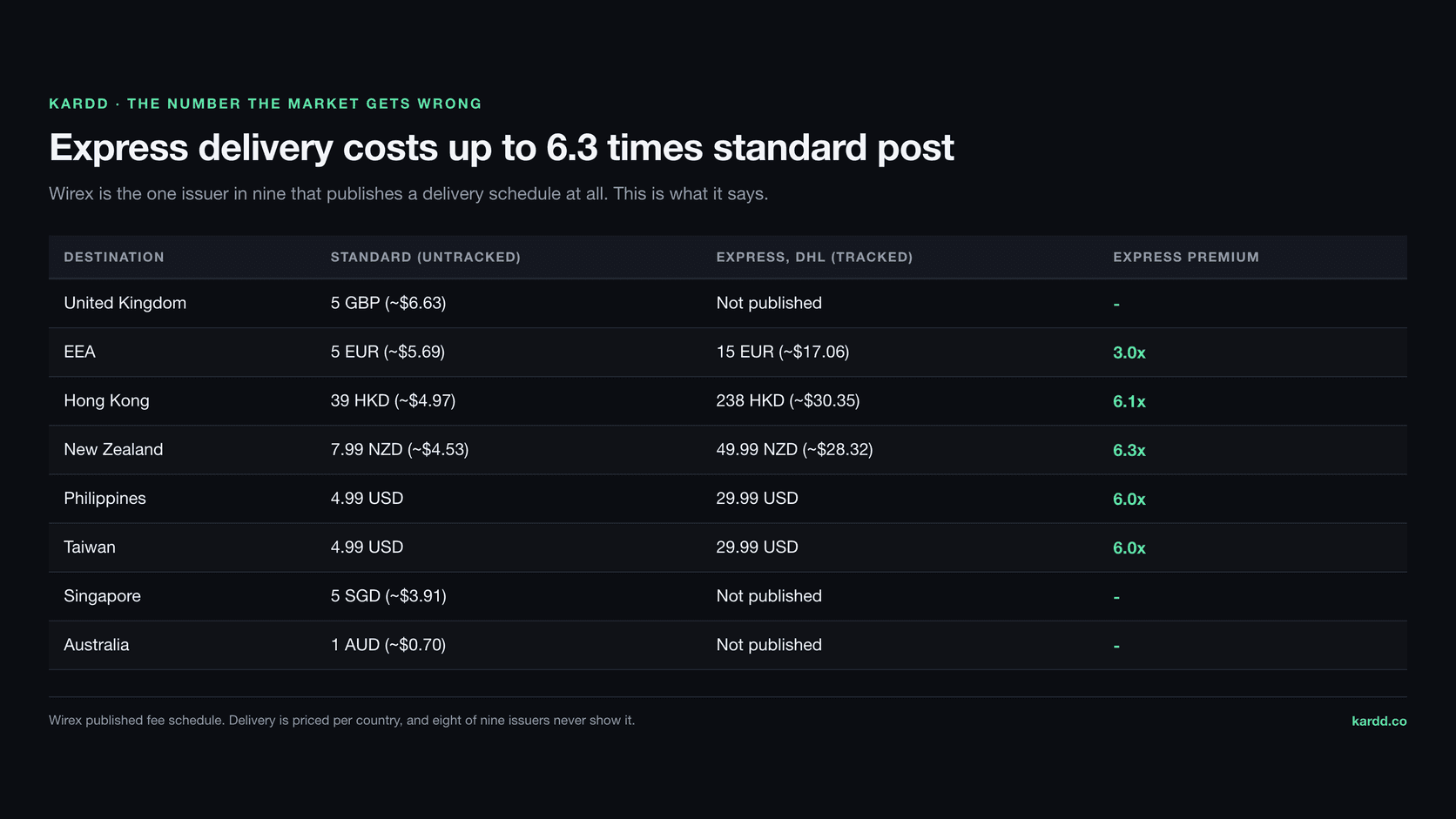
Only one programme in our set publishes delivery properly, and its schedule is the most interesting document in this article. Wirex issues the card free and then charges to post it, by country and by courier. The figures below are verbatim from its fee page, with US dollar equivalents at the 29 September 2026 00:02 UTC reference rates.
| Destination | Standard (untracked) | Express, DHL (tracked) | Express premium |
|---|---|---|---|
| United Kingdom | 5 GBP (~$6.63) | Not published | — |
| EEA | 5 EUR (~$5.69) | 15 EUR (~$17.06) | 3.0x |
| Hong Kong | 39 HKD (~$4.97) | 238 HKD (~$30.35) | 6.1x |
| New Zealand | 7.99 NZD (~$4.53) | 49.99 NZD (~$28.32) | 6.3x |
| Philippines | 4.99 USD | 29.99 USD | 6.0x |
| Taiwan | 4.99 USD | 29.99 USD | 6.0x |
| Singapore | 5 SGD (~$3.91) | Not published | — |
| Australia | 1 AUD (~$0.70) | Not published | — |
The same card, from the same issuer, costs 1 AUD to receive in Sydney and 49.99 NZD to receive in Auckland if you want it tracked — a forty-fold gap that has nothing to do with the card and everything to do with postage. That is worth knowing before you conclude a programme is cheap, and it is the reason a delivery figure quoted as a single global number is always wrong.
Set that beside the other two programmes that price shipping and the range in circulation turns out to be too narrow. KAST charges a flat $40 to ship a card it gives away for free, having dropped its $100 card fee on 8 January 2026 — so the entire cost of a KAST card is now postage. Avici ships free but untracked over three to four weeks, and charges $15 within the US or $50 internationally for tracked priority. Page one of the SERP quotes shipping as “free to $15” for plastic and “free to $25” for metal. Three separate issuer pages beat that ceiling, and one of them by a factor of two.
The real entry cost is a tier gate
Now the part no crypto card guide connects to card access. On several programmes the card you have read about is not purchasable at any issuance fee — it is attached to a tier, and the tier has a price or a capital requirement. Crypto.com renamed its ladder in 2026, so the card names you remember now sit behind Level Up tiers.
| Programme / tier | Card it unlocks | Cash price | Capital alternative |
|---|---|---|---|
| Crypto.com Basic | Midnight | None | None required |
| Crypto.com Plus | Ruby Visa Signature | $4.99/mo or $49.90/yr | Lock up $500 of CRO |
| Crypto.com Pro | Jade / Indigo Visa Signature | $29.99/mo or $299.90/yr | Lock up $5,000 of CRO |
| Crypto.com Private | Icy / Rose / Obsidian | Not offered | CRO lockup only |
| Tangem Pay Plus | Plastic | $29.99/mo | $4,500 monthly spend, or $65,000 in Yield Mode |
| Tangem Pay Prestige | Plastic & metal | $999/yr | None published |
| KAST Premium | Visa Infinite | $1,000/yr | None published |
| KAST Private | Visa Infinite | $10,000/yr | None published |
| XKard Essential / Premium / Whale | Virtual only | $9 / $19 / $49 a month, billed annually | None offered |
Compare the columns and the issuance fees from the previous section look like rounding errors. Crypto.com's Midnight card costs US$4.99. The Jade or Indigo card two rungs up costs $299.90 a year, or sixty times the Midnight fee every year, or $5,000 of a single volatile token locked away. That is the true issuance price of a crypto card in 2026 and it is filed under rewards programmes, not fees.
The capital alternative deserves a warning rather than a recommendation. Locking $500 of CRO instead of paying $49.90 a year is not a saving of $49.90; it is the substitution of a known small cost for a hundredfold larger position with price risk and a lockup attached. Tangem's version — $65,000 held in Yield Mode to waive a $29.99 monthly fee — makes the arithmetic plain. And a balance held with a card programme is a balance held with a counterparty, which is the whole argument of our piece on what actually protects a card balance.
XKard sits at the honest end of this shape. There is no issuance fee and no physical card to ship, so the plan is the entry cost outright: $108 a year at Essential, billed annually, with $5 of instant credit returned. What the plan buys is a card issued without an identity check, which is a real product difference rather than a tier badge — and it is priced accordingly, as our top-up fee comparison shows in the recharge commission.
The same plastic, $0 to $125
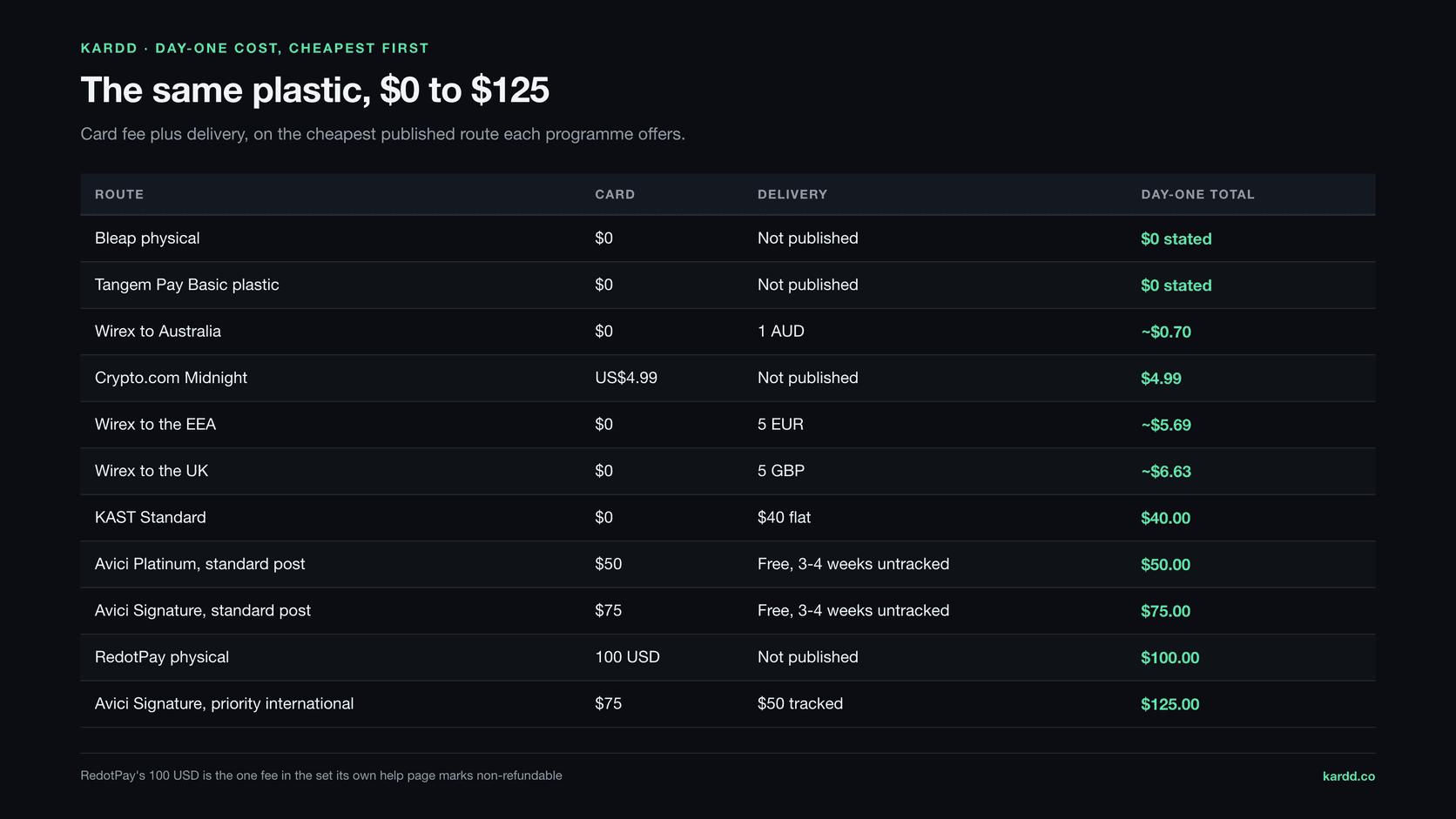
Put issuance and the cheapest published delivery together and you get the number a buyer actually pays on day one. Every line below is card fee plus postage to a single address, in US dollars, with no tier upgrade and nothing loaded.
| Route | Card | Delivery | Day-one total |
|---|---|---|---|
| Bleap physical | $0 | Not published | $0 stated |
| Tangem Pay Basic plastic | $0 | Not published | $0 stated |
| Wirex to Australia | $0 | 1 AUD | ~$0.70 |
| Crypto.com Midnight | US$4.99 | Not published | $4.99 |
| Wirex to the EEA | $0 | 5 EUR | ~$5.69 |
| Wirex to the UK | $0 | 5 GBP | ~$6.63 |
| KAST Standard | $0 | $40 flat | $40.00 |
| Avici Platinum, standard post | $50 | Free, 3–4 weeks untracked | $50.00 |
| Avici Signature, standard post | $75 | Free, 3–4 weeks untracked | $75.00 |
| RedotPay physical | 100 USD | Not published | $100.00 |
| Avici Signature, priority international | $75 | $50 tracked | $125.00 |
An Avici Signature card tracked to a non-US address costs about 179 times what a Wirex card costs to post in Australia, and both arrive as a piece of plastic that works at the same terminals. Nothing in that spread is explained by the card itself. It is explained by whether the programme monetises issuance, and most do not.
So paying for a card should buy you something you can name — a metal body, a Visa Infinite BIN, a jurisdiction that will ship to you. If you cannot name it, four programmes above hand you the same rail for nothing, which is why our virtual versus physical comparison keeps landing on virtual.
One of these fees is non-refundable
RedotPay publishes its numbers cleanly — 10 USD virtual, 100 USD physical, deducted from your account balance when the card is issued, on a help page last updated 27 July 2026. The clause worth reading twice is on its physical-card page, updated 30 July 2026.
We are not alleging that RedotPay ships cards to unsupported addresses. The point is narrower and it applies to any programme with the same shape: a non-refundable fee paid before an eligibility check transfers the eligibility risk to you. The mitigation costs nothing — read the unsupported-countries list before you tap pay, and check it against the address the card will actually be posted to rather than the country you hold a passport for.
Four issuers publish nothing you can read
An honest comparison has to report what it could not verify. Four programmes in wide circulation have no reachable primary statement of their card fees, and every number you see quoted for them traces back to a third party.
| Issuer | What happened on 29 September 2026 | Status |
|---|---|---|
| Bybit | Card fees page answers 200 to HEAD and 503 to GET | Same failure as 27 September |
| Nexo | Card limits and fees article returns analytics scripts and no content | Physical orders reported paused |
| UPay | Physical card fee page returns 403 behind a bot wall | Unverifiable |
| Plutus | Only primary statement of the 9.99 GBP card order fee is a blog post from 19 February 2021 | Five years stale |
Bybit is the one to watch, because a HEAD request succeeding while a GET returns 503 means the page exists and the body is being refused — the same pattern we hit two nights earlier. That is not a one-off outage. Plutus is the more instructive case: its card order fee of 9.99 GBP is widely quoted as current, and the only statement of it we can trace to Plutus is an announcement from February 2021 that also describes a staking model the programme has since replaced.
The pattern across both this article and our top-up fee research is consistent enough to state as a rule: the cheap fees in this market are published and the expensive ones are discovered in the app. Every zero we found was on a public page. Two of the three largest charges were too.
Leaving is priced higher than joining
One more fee belongs on this page, because it is set at the same moment and almost never mentioned: what it costs to stop. Wirex's schedule, which issues cards for free, also carries this line.
Crypto.com's version is the reissue fee: US$4.99 to be given a Midnight card, US$50 to replace anything above it. A plan-based programme has a quieter one, because an annually billed subscription means stopping in month two costs the remaining ten. None of it is hidden, but it behaves like the inactivity fees we documented earlier: a charge that lands once you have stopped paying attention.
The cheapest way to get a crypto card in 2026
Five checks, in this order, settle the entry cost before you commit. None of them takes more than a minute and each one closes a gap we found in the pages above.
| Check | Where to look | What a bad answer looks like |
|---|---|---|
| Do I need the plastic at all? | Whether you withdraw cash or tap a terminal that rejects wallets | “Probably not” — the virtual card is free almost everywhere |
| Issuance fee, both form factors | The issuer's own fees help page, not a review | No page exists, or the page 403s |
| Delivery to my country | A delivery table, or the checkout screen before payment | A flat figure with no country breakdown |
| Is the card behind a tier? | The rewards or membership page, not the card page | A subscription or a token lockup you had not budgeted for |
| Refundable, and replaceable at what price? | The application terms and the reissue line | “Cannot be cancelled or refunded” with no reissue fee published |
Run those and the cheapest route in this market is unambiguous: take a free virtual card from a programme that publishes a zero, and order plastic only when a specific terminal or an ATM forces you to. Reach for a paid card when the thing you are buying is named and real — a jurisdiction that will ship to you, an ATM allowance, a BIN your bank does not block — and in those cases price the delivery line before you price the card.
Final take
Getting a crypto card costs between nothing and $125, and the variable driving that spread is not card quality. It is whether the programme has chosen to monetise the handover at all. Four of the nine we read charge nothing, which means every fee above zero is a choice the issuer made and should be able to justify to you.
The bigger trap is the one that is not called an issuance fee. A $4.99 card sitting behind a $299.90-a-year tier is a $299.90 card, and a $5,000 CRO lockup is not a discount on a subscription — it is a much larger commitment with a token price attached. Price the gate, not the plastic. And when a fee is non-refundable, read the eligibility list first, because that is the one mistake on this page that cannot be undone.
See what a card costs before you order it
Kardd tracks the whole fee stack — issuance, delivery, top-up, spend, FX, ATM and inactivity — alongside custody model and KYC level, so the entry cost is visible before you commit to a programme.
Kardd may earn a commission on sign-ups, including XKard. Affiliate disclosure.
Related Articles
- Crypto Card Top-Up Fees 2026: The Cost to Load $100
- No-KYC Crypto Card Fees: The Full Breakdown
- Crypto Card ATM Withdrawal Fees 2026: 9 Cards Compared
- Crypto Card Inactivity Fees 2026: The 12-Month Clock
- Virtual vs Physical No-KYC Crypto Cards
- Crypto Card Supported Countries 2026: The Three Lists
Frequently Asked Questions
How much does it cost to get a crypto card in 2026?
Anywhere from nothing to $125 for the same product. Bleap publishes no issuance fee at all, Wirex issues free and charges 1 AUD to post the card in Australia, Crypto.com charges US$4.99 for a Midnight card, KAST gives the card away and charges $40 to ship it, RedotPay charges 100 USD, and an Avici Signature card is $75 plus $50 for tracked international delivery. Every figure is from the issuer's own page, read on 29 September 2026.
Which crypto cards have no issuance fee?
Bleap states in writing that its Mastercard has no issuance fee, no monthly fee and no maintenance fee. Wirex's schedule lists card issuance as free for virtual and physical alike. Tangem Pay's Basic tier includes a free virtual card and a plastic one. KAST removed its $100 card fee on 8 January 2026. The only charge left in each case is delivery, and three of the four do not publish it.
Do crypto cards charge for delivery?
Some do, and it is the least documented charge in the market. Wirex publishes a matrix by country: 5 GBP in the UK, 5 EUR in the EEA, 39 HKD in Hong Kong, 1 AUD in Australia and 4.99 USD in the Philippines and Taiwan for untracked post, rising to 15 EUR, 238 HKD and 49.99 NZD for DHL Express. KAST charges $40 flat. Avici ships free but untracked, or $15 in the US and $50 internationally for tracked priority.
Why does RedotPay charge $100 for a physical card?
Its help centre simply states the fee: 10 USD virtual, 100 USD physical, deducted from your balance when the card is issued. The clause that matters more sits on the physical-card page, updated 30 July 2026 — payment confirms the application and cannot be cancelled or refunded. Physical cards are also not available in every country, so the non-refundable fee is paid before the availability question is settled.
Is a crypto card subscription the same as an issuance fee?
Economically it is the entry cost, and usually the larger number. XKard has no separate card fee because the plan is the card: $9, $19 or $49 a month billed annually, so $108 at the cheapest tier. Crypto.com's Plus tier and its Ruby card cost $4.99 a month, $49.90 a year, or a $500 CRO lockup; Pro and the Jade or Indigo card cost $29.99 a month, $299.90 a year, or $5,000 of CRO locked up.
Can you avoid a crypto card tier subscription by staking?
Where it is offered, yes, but the capital dwarfs the fee it replaces. Crypto.com accepts a $500 CRO lockup instead of $49.90 a year for Plus, or $5,000 of CRO instead of $299.90 a year for Pro, with Private available by lockup only. Tangem waives its $29.99 monthly Plus fee at $4,500 of monthly spend or $65,000 held in Yield Mode. A lockup is not a saving — it is a far larger position with price risk attached.
What happens if you lose a crypto card?
Replacement is priced well above issuance wherever it is published at all. Crypto.com charges US$7 to reissue a Midnight card and US$50 for every other tier, ten times what the Midnight card cost to obtain. Wirex, Bleap, KAST, RedotPay, Avici and Tangem Pay publish no replacement fee on any page we could read, which means the number arrives in the app at the moment you have no card and no leverage.
Which crypto card issuers do not publish their card fees?
Four of the ones we tried on 29 September 2026: Bybit, whose card fees page answers 200 to a HEAD request and 503 to a GET; Nexo, whose card limits and fees article returns only analytics scripts; UPay, whose physical card fee page returns 403; and Plutus, whose only primary statement of its 9.99 GBP card order fee is a blog post from February 2021.
Sources
Fees quoted above come from each issuer's own published pages, read on 29 September 2026: the Crypto.com prepaid card fees and limits page, RedotPay's card fee article, the Wirex fee schedule and Avici's fees and limits documentation. Currency conversions use the 29 September 2026 00:02 UTC reference rates.