Crypto Card Inactivity Fees 2026: The 12-Month Clock

- The twelve-month clock is a gift-card rule your card is exempt from. Regulation E §1005.20(d) sets the one-year floor and the one-fee-a-month cap — and §1005.20(b)(2) excludes every reloadable card from it. Issuers land on twelve months anyway, which means convention is doing the work a rule is not.
- The card advertising “Inactivity fee: None” is the most expensive year of dormancy on this page. XKard charges nothing for inactivity and $9–$49 a month for the card, so a dormant year costs $108 at the cheapest tier against Crypto.com's worst case of $96.24.
- One Crypto.com clause, five currencies, an 88% spread. From 1 October a UK cardholder pays £6 ($8.02) a month and an Australian pays A$6 ($4.27) for the identical sentence. Nobody converted anything; they just wrote “6” five times.
- KuCoin's clock is 90 days, not twelve months — €3 per card, per month, and the card is automatically closed if the fee cannot be deducted for a further 90 days.
- A declined transaction is not activity. Crypto.com states it in terms: declined and refunded transactions do not count, so the checkout that failed reset nothing, and the fee never resets its own clock.
On this page
- Which cards charge an inactivity fee
- The twelve-month clock is a gift-card rule
- One clause, five currencies, an 88% spread
- KuCoin's 90-day clock is the outlier
- What actually counts as activity
- How long your balance survives
- The no-KYC answer: a subscription instead
- In the EEA and UK, just ask for it back
- Killing the clock, and the final take
- FAQ
You stopped using a card eighteen months ago and the balance is smaller than you left it. A crypto card inactivity fee is the only charge in this market that grows while you do nothing, and nobody checks it before signing up because it sits four screens into a fee schedule. Crypto.com raised its US, Singapore and Australian figures on 1 September 2026 and raises the UK and European ones on 1 October, which makes September the month this got more expensive in five countries at once. We read the published fee schedules of nine card programmes and pulled the clause out of each one, so the numbers below are quotes rather than estimates. The finding that surprised us: the card that states “Inactivity fee: None” costs more per dormant year than any card here that charges one.
Which Crypto Cards Charge an Inactivity Fee in 2026
One column below reads “we could not read it”, and that is not padding. A brand that publishes no inactivity clause has not promised you anything, and in a market where terms change by help-centre edit, silence is the weakest possible assurance. We have separated what an issuer states from what a reviewer reports, because those are different evidence and every roundup we checked blurs them.
| Card | Inactivity fee | Clock | Evidence |
|---|---|---|---|
| Crypto.com | US$5.95 / £5 / €5 / S$6 / A$6 per month | 12 months | Five regional fee pages, first-party |
| KuCoin KuCard | €3 per card, per month | 90 days | KuCoin announcement, first-party |
| KAST | $1 per month (reported) | 12 months | Secondary — help centre bot-walled |
| Wirex | None on balances; 25%/month clawback on unused promotional WXT | 30 days (promo tokens only) | UK terms of service, first-party |
| RedotPay | None — stated | — | Dedicated help article, first-party |
| XKard | “Inactivity fee: None” | — | XKard FAQ, first-party (but see below) |
| Plutus | Not stated on its fee page | — | Fee page read, no clause found |
| Nexo | None (reported) | — | Secondary — help centre JS-rendered |
| Bybit | None (reported) | — | Secondary — help centre renders empty |
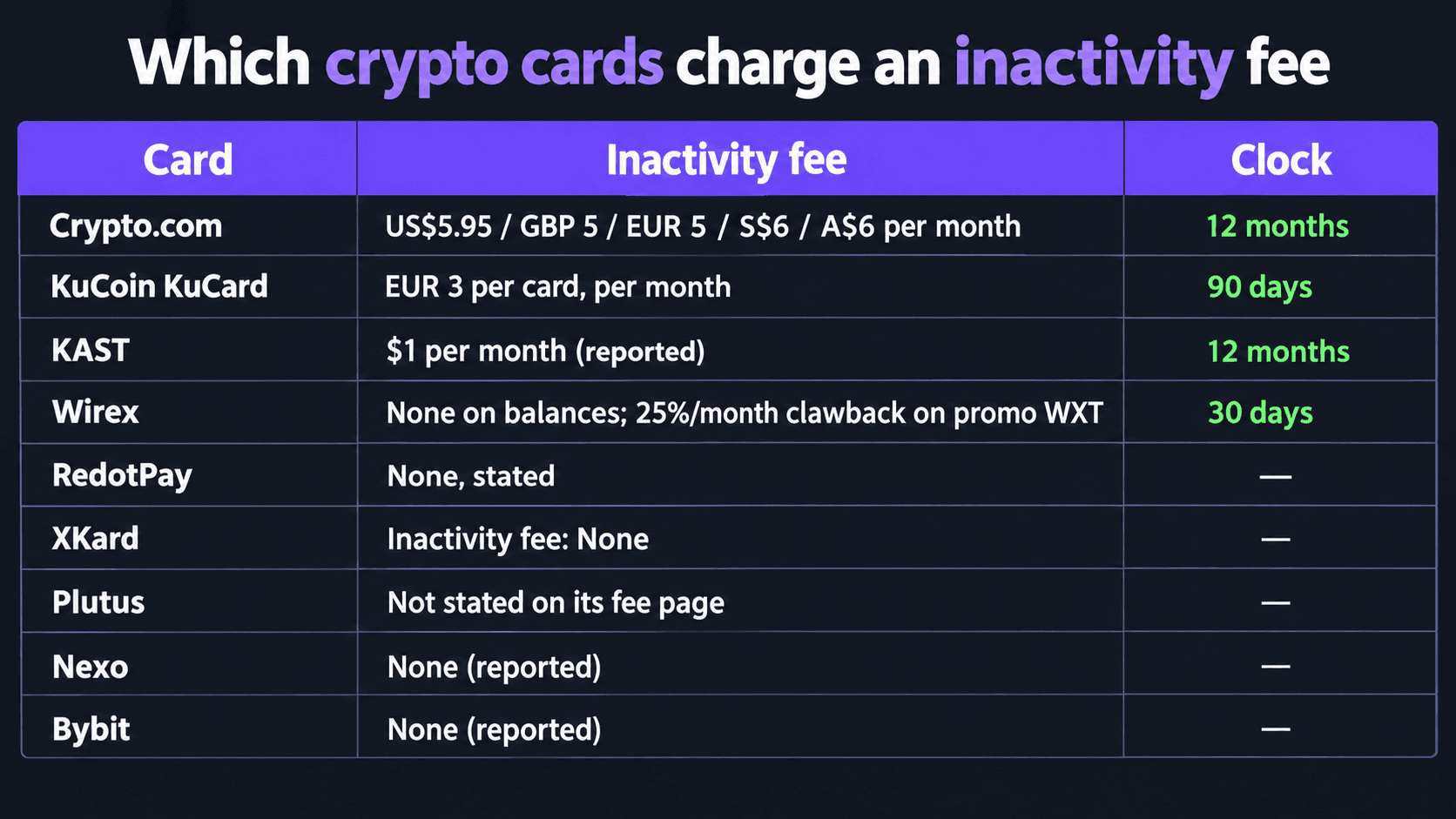
Two brands answer the question directly. RedotPay maintains a help article titled with the question a worried cardholder actually types, answered in one sentence: “No. RedotPay doesn't charge any card management, monthly, or annual fees.” XKard lists the line item in its FAQ. Everyone else buries it in a regional fee schedule or leaves you to infer it from an absence — and inference is how the roundups get this wrong. One widely-syndicated September 2026 piece claims Nexo is the only card explicitly ruling out an inactivity fee, which was untrue of both RedotPay and XKard on the day it published.
The Twelve-Month Clock Is a Gift-Card Rule Your Card Is Exempt From
Every card in the table that charges the fee waits twelve months, except one. That looks like regulation and it is not, and the gap between those two things is the most useful thing on this page.
The rule people are half-remembering is 12 CFR §1005.20(d), which implements the CARD Act's gift-card protections: “No person may impose a dormancy, inactivity, or service fee with respect to a gift certificate, store gift card, or general-use prepaid card, unless… there has been no activity… in the one-year period ending on the date on which the fee is imposed… and… not more than one dormancy, inactivity, or service fee is imposed in any given calendar month.” There is your twelve months and your one-fee-a-month cap, in federal law since 2010.
Now read §1005.20(b)(2). Those terms “do not include any card, code, or other device that is… reloadable and not marketed or labeled as a gift card or gift certificate.” Every crypto card is reloadable — reloading is the entire product. Not one card on this page is inside that rule. The twelve-month floor and the one-fee-a-month cap are things a crypto card issuer may adopt, and things it may drop tomorrow.
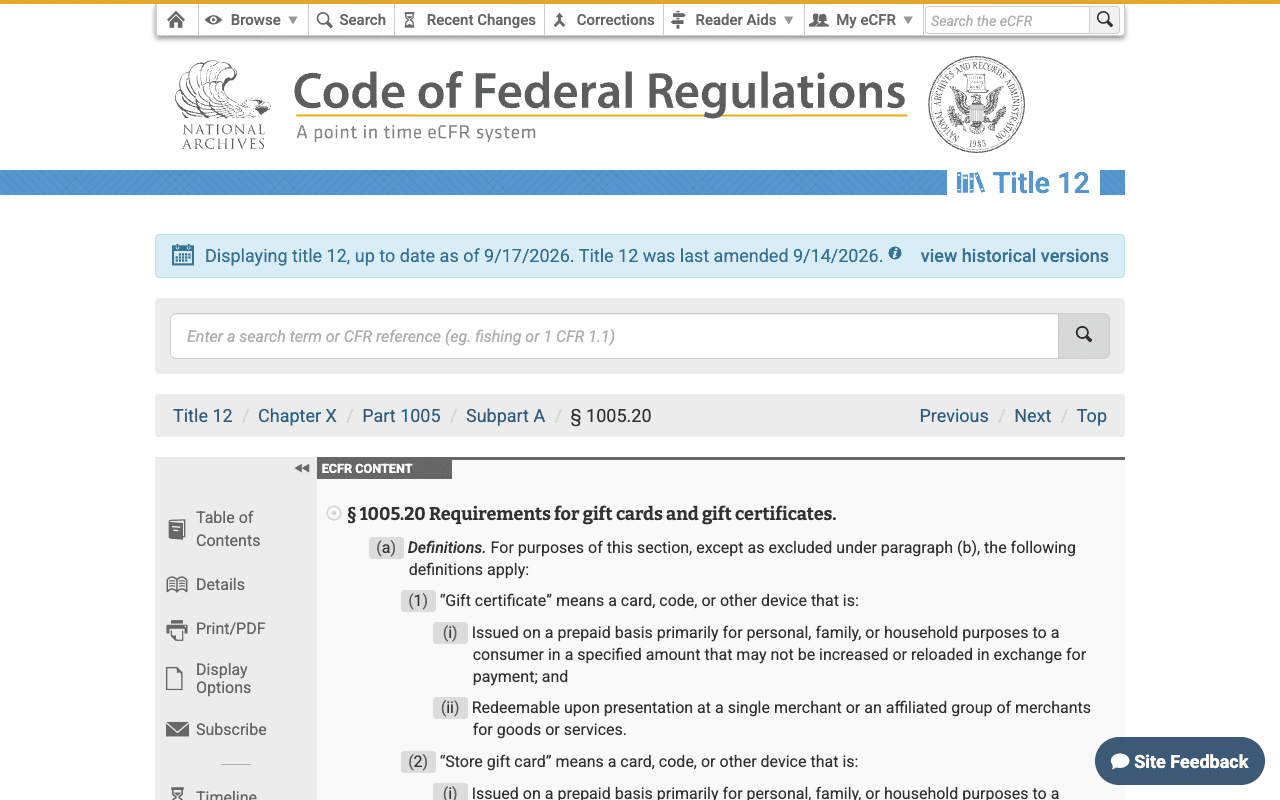
Regulation E reaches these cards in one narrow way. §1005.18(b)(2)(vii) makes the inactivity fee one of only seven fees that must appear on a prepaid account's short-form disclosure, together with “the conditions that trigger the financial institution to impose that fee” — the regulator's judgement being that it belongs on the same one-screen summary as the monthly fee and the ATM fee. Almost every brand we checked treats it as a footnote. It is the same structure we found in crypto card chargebacks: Regulation E has a slot for the answer, and this end of the market sits outside the part of the rule that would fill it.
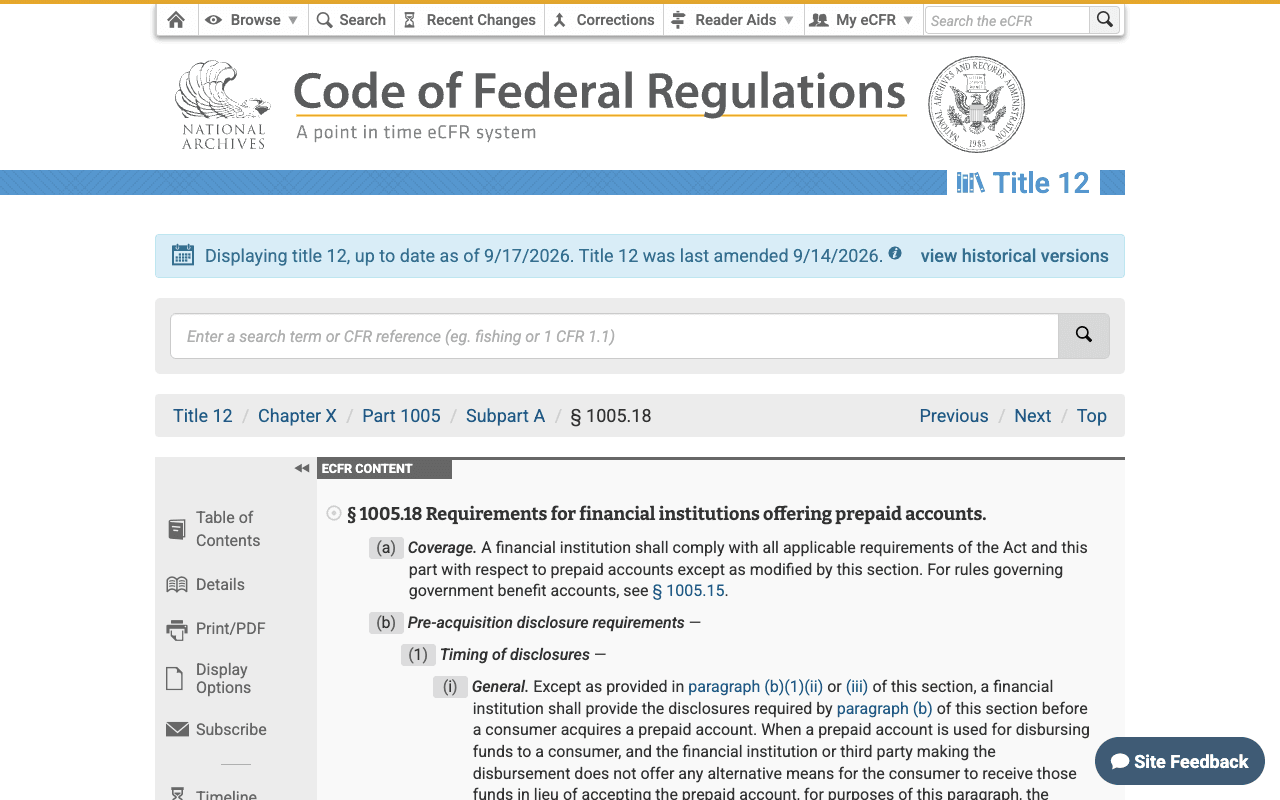
One more definition earns its keep. §1005.20(a)(7) defines activity as “any action that results in an increase or decrease of the funds underlying a certificate or card, other than the imposition of a fee”. A fee can never reset the clock that generates it.
One Clause, Five Currencies, an 88% Spread
Crypto.com is the only brand publishing the same inactivity clause across five regional fee schedules, which makes it the one place you can see what happens when a fee is written rather than calculated. The sentence is identical in all five; the number is “5”, rising to “6”, in whatever currency the page is denominated in. Nobody converted anything.
| Region | Listed fee | Rises to | Effective | New fee in USD |
|---|---|---|---|---|
| United Kingdom | £5 | £6 | 1 Oct 2026 | $8.02 |
| Europe | €5 | €6 | 1 Oct 2026 | $6.89 |
| United States | US$4.95 | US$5.95 | 1 Sep 2026 | $5.95 |
| Singapore | S$5 | S$6 | 1 Sep 2026 | $4.70 |
| Australia | A$5 | A$6 | 1 Sep 2026 | $4.27 |
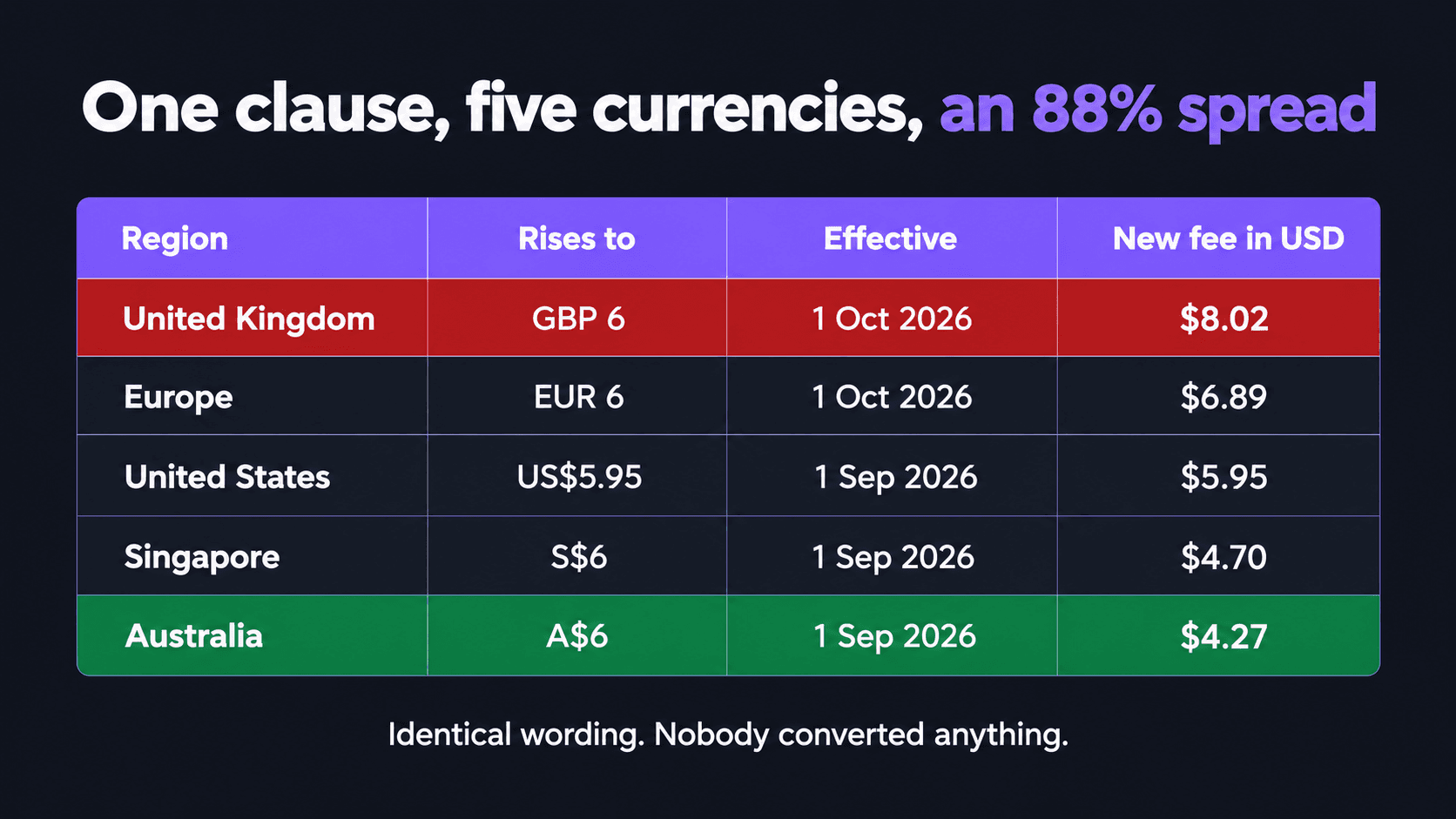
Converted at the rates published on 19 September 2026, a British cardholder will pay $8.02 a month for the same twelve months of silence that costs an Australian $4.27. That is an 88% premium on a clause with identical wording, conditions and exclusions. It is not a pricing decision about the UK market; it is what you get when a round number is typed into five pages, and it always moves against whoever holds the strongest currency.
Two details worth noticing. The increases are staged — US, Singapore and Australia on 1 September, UK and Europe on 1 October — so for the whole of September two Crypto.com inactivity regimes run at once. And when we read the US, Singapore and Australian pages on 19 September, eighteen days after their increase took effect, all three still described it in the future tense (“Effective 1 September 2026 fee will be updated…”) with the old figure still in the fee column. Take the higher number as the live one.
KuCoin's 90-Day Clock Is the Real Outlier
Every published guide says inactivity fees kick in after “3 to 12 months”, a range built by averaging one outlier with everyone else. The outlier is KuCoin, and it shows what this market does when no convention restrains it.
KuCoin's own announcement sets the fee at 3 EUR per card, per month, triggered by 90 consecutive calendar days without a card transaction, counted from the activation date. Three things follow that no twelve-month card does. It applies per card, so someone holding three virtual cards for three subscriptions is exposed three times over. It runs from activation rather than last use, so a card you ordered, activated and never funded is already on the clock. And if the fee cannot be deducted, after a further 90 days “the card will be automatically closed”.
That last clause is a different kind of risk from a shrinking balance. A closed card is not a paused card: any merchant holding it on file for a subscription now has a dead token, and recovery runs through support rather than the app. KuCoin's own guidance is to terminate cards you do not need rather than let them sit — unusually honest, and correct for any multi-card setup. One figure here is unreconciled: a KuCoin support page is reported to quote 2 USDC per card per month rather than 3 EUR, and we could not read it directly, so treat the currency as regionally variable and confirm it in-app.
What Actually Counts as Activity
This is the most actionable paragraph on the page and no competitor we read attempts it. The clause resets on activity, and “activity” is defined far more narrowly than anyone assumes.
Crypto.com's wording is “no cardholder-initiated financial activity on the card”, with an explicit carve-out: “Declined and refunded transactions do not constitute financial activity.” A declined transaction does not reset the clock — so the person most likely to be charged is the one who tried to use the card, got knocked back for one of the ordinary reasons we catalogued in why crypto cards get declined, gave up, and reasonably believed they had used it. A refunded purchase is retroactively not activity either.
Note what is missing too: the phrase is on the card. Logging into the app is not it. Topping up the wallet behind the card is not obviously it. A cashback credit is not cardholder-initiated. Combine that with §1005.20(a)(7) and you get the pattern that catches people — a dormant card generates monthly debits that look like transactions on the statement and reset nothing. The only reliable reset is one small purchase that completes and settles. Buy a coffee, not a refundable test charge.
How Long Your Balance Survives
None of the schedules we read caps the total at the balance or promises to return a remainder, so the honest comparison is not the monthly rate but how long a stranded balance lasts. Here is $200 left on a card, from last transaction to zero, at the rates applying from 1 October 2026.
| Card | Grace | Then | $200 gone after |
|---|---|---|---|
| XKard (Basic tier) | None | $108/year subscription | ~24 months |
| Crypto.com (UK) | 12 months | £6 ($8.02)/month | ~37 months |
| Crypto.com (Europe) | 12 months | €6 ($6.89)/month | ~41 months |
| Crypto.com (US) | 12 months | $5.95/month | ~46 months |
| Crypto.com (Singapore) | 12 months | S$6 ($4.70)/month | ~55 months |
| Crypto.com (Australia) | 12 months | A$6 ($4.27)/month | ~59 months |
| KuCoin KuCard | 3 months | €3 ($3.44)/month | ~61 months, or card closed sooner |
| RedotPay | — | Nothing stated | Never, on the published terms |
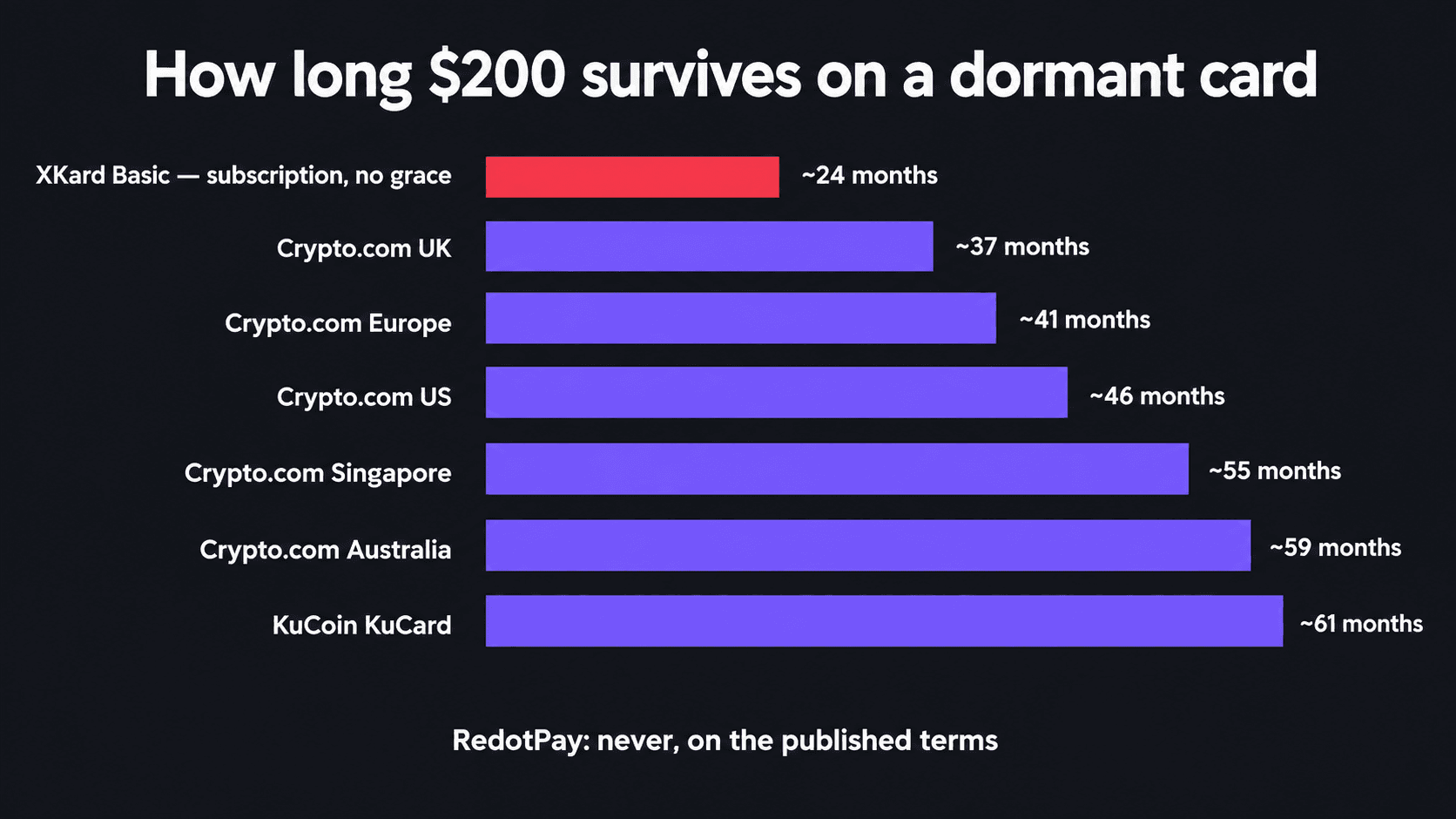
Read the first row against the rest. The card with no inactivity fee empties a stranded balance in half the time of the harshest card that has one, because a subscription does not wait twelve months and does not need you to be inactive. That inversion is the argument of the next section. Worth saying plainly, too: ~24 to ~61 months is longer than most people expect, which cuts both ways — this is rarely an emergency, and it is very easy to forget for four years.
The No-KYC Answer: There Is No Inactivity Fee, Because There Is a Subscription
Here is where the no-KYC end of the market diverges, and not in the direction the marketing implies. XKard's FAQ answers the fee question in a clean list: “Annual card issuance or renewal fee: Based on the card type ($9/month, $19/month, $49/month – paid annually). Inactivity fee: None. Card cancellation fee: None.” Two of those lines are good news. The first makes the other two almost irrelevant.
| What a dormant year costs | Charged as | Year 1 | Year 2 |
|---|---|---|---|
| XKard Elite ($49/mo) | Subscription | $588 | $588 |
| XKard Premium ($19/mo) | Subscription | $228 | $228 |
| XKard Basic ($9/mo) | Subscription | $108 | $108 |
| Crypto.com (UK, from 1 Oct) | Inactivity fee | $0 | $96.24 |
| Crypto.com (US) | Inactivity fee | $0 | $71.40 |
| KuCoin KuCard | Inactivity fee | $30.98 (9 months) | $41.32 |
| RedotPay | — | $0 | $0 |
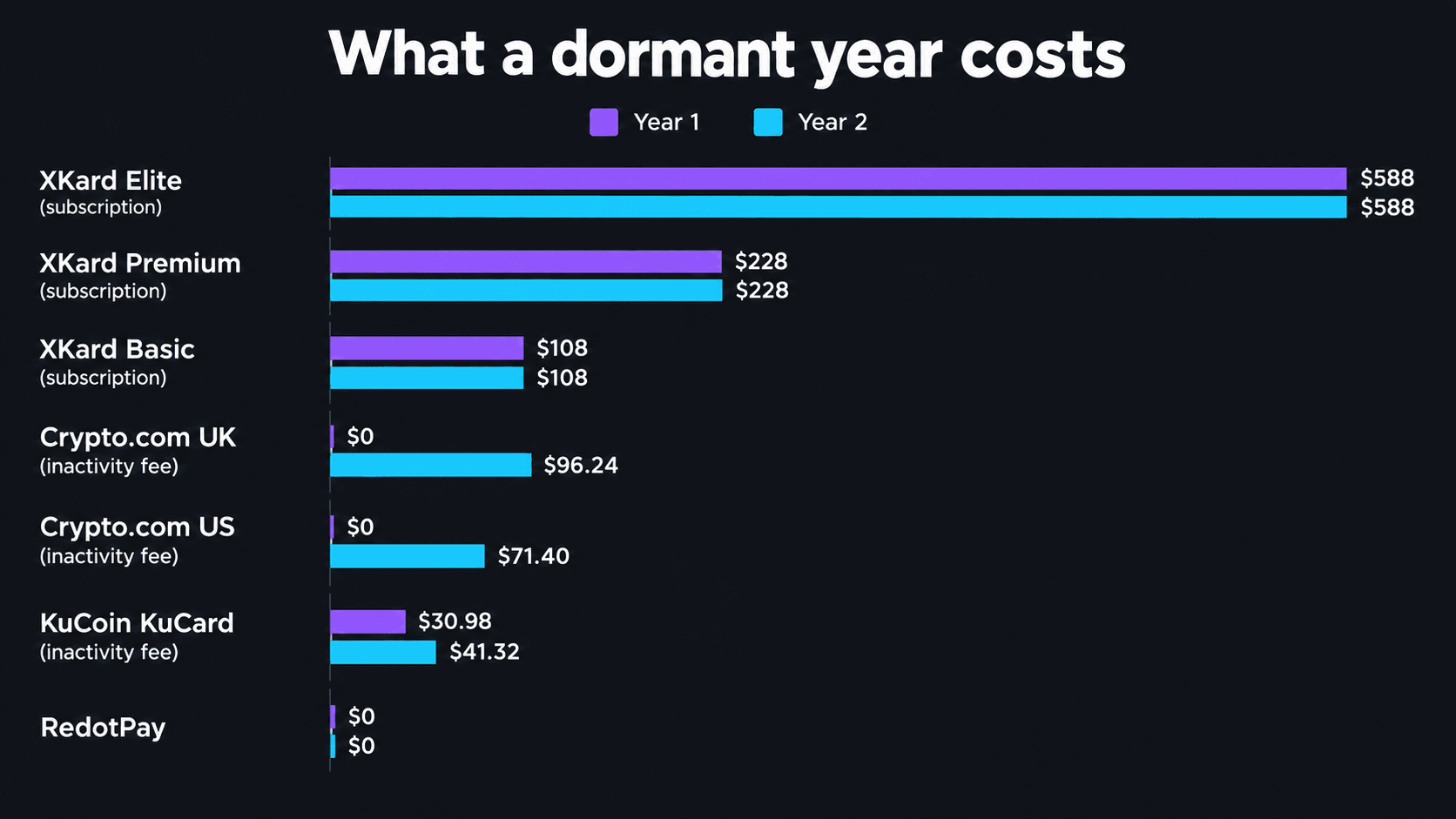
The cheapest XKard tier costs more for a dormant year than the most expensive inactivity fee in this comparison, and it starts charging eleven months earlier. That is not an argument against no-KYC cards — it is an argument against reading “no inactivity fee” as a saving. A card that never asks who you are cannot monetise you through a verified banking relationship, so it charges rent at the door instead, and rent does not care whether you turn up. Our no-KYC card fee breakdown runs the same arithmetic across the whole segment, and the XKard review covers what the subscription buys when you are using it, which is where these cards earn back the spread.
RedotPay is the genuine free-to-hold option here, and it gets there by charging up front: issuance is paid once, and the card then sits at zero cost. For a card you touch twice a year, that shape fits better than either a subscription or a clock. Wirex sits in a fourth category worth naming: its current UK terms carry no balance inactivity fee, but they apply a 25% monthly clawback on unused promotional WXT starting 30 days after the tokens land, repeating until the promotional balance is gone. Reward tokens, not your money — but it is still a fee for not spending, on the shortest clock in this article.
Wirex is also where the published roundups go wrong. Third-party reviews in circulation this month variously assert a “$5/month after 90 days” inactivity fee and an “18-month, 0.20% of balance” storage fee. Neither appears in the Wirex UK terms of service or on either Wirex fee page we read on 19 September 2026. The 0.20% storage fee was a real Wirex policy that drew public complaint in 2021; it is not in the document governing a UK account today. If you are relying on a review rather than the terms, you are reading history.
In the EEA and UK, You Can Just Ask For It Back
There is one structural protection that no US cardholder has and most EEA and UK cardholders do not know they have, and it makes the entire inactivity question optional for them.
A card balance at a European e-money institution is electronic money, and Article 11(2) of the Electronic Money Directive requires that issuers “redeem, at any moment and at par value, the monetary value of the electronic money held” upon request by the holder. Not at the end of a term, not at a threshold, not after a review — at any moment, at par. Article 11(4) then permits a redemption fee only in three narrow cases and adds that any such fee “shall be proportionate and commensurate with the actual costs incurred”. The UK carried the same requirement into its own e-money regime.
Be precise about what this does. It is not a cap on inactivity fees — a monthly service charge is not a redemption fee, and nothing in Article 11 stops an issuer levying one. What it gives you is an unconditional exit. If a clock is running on a balance you are not using, the European answer is not to feed the card a transaction every eleven months; it is to demand the money at par and be done. That right also underpins the redemption ranking in crypto card balance protection, where an EEA e-money-token holder ends up with the strongest claim of the three regimes we compared.
Killing the Clock, and the Final Take
The practical version is short. Find the clause before you need it — search your issuer's fee page for “inactivity” and note the currency as well as the number, because the currency is doing more work. If you are keeping the card, make one small completed purchase a year, a month before the anniversary, and not a refundable one. If you are not, empty it: redeem at par in the EEA and UK, and elsewhere move the balance out and close the card rather than leave a live one with a clock on it. And if you hold several virtual cards, count them — a per-card fee on a three-card setup is a three-times problem, and the cards you forgot are by definition the inactive ones.
The wider point is that this fee is the clearest signal of what a card programme thinks you are. Charging rent monthly regardless means it has decided you are a subscriber. Waiting twelve months and then charging means it has decided you are a balance to be administered. Charging nothing either way means it is confident it makes money on your spending, or has not thought about it, and the terms rarely say which. Pick the shape that matches how you actually use a card, not the one whose fee table reads best — because on the numbers above, the fee table that reads best belongs to the most expensive dormant year on the board. If a balance is already stuck behind something worse than a fee, frozen crypto card funds is next; if you are choosing fresh, start from the no-KYC card comparison.
Compare what a card costs when you are not using it
Kardd tracks KYC level, custody, top-up networks, limits and the full fee stack across the crypto card market — including the charges that only appear in a fee schedule.
Kardd may earn a commission on sign-ups. Affiliate disclosure.
Related Articles
- No-KYC Crypto Card Fees: The True Annual Cost
- Crypto Card ATM Withdrawal Fees 2026: 9 Cards Compared
- Crypto Card Balance Protection 2026: The Insolvency Rules
- Crypto Card Chargebacks 2026: What You Can Actually Dispute
- Crypto Card Supported Countries 2026: The Three Lists
- Why No-KYC Crypto Cards Shut Down
Frequently Asked Questions
Do crypto cards charge an inactivity fee?
Some do, most say they do not, and the disclosure quality varies enormously. Crypto.com publishes one on every regional fee page it maintains — around five units of local currency a month after twelve months without a cardholder-initiated transaction. KuCoin's KuCard charges €3 per card per month after only 90 days. RedotPay and XKard state in their own pages that they charge none. Several brands simply do not address it anywhere we could read, which is not the same thing as a promise.
How long before a crypto card is considered inactive?
Twelve months is the convention and 90 days is the outlier. Crypto.com uses twelve months of no cardholder-initiated financial activity across the US, UK, Europe, Singapore and Australia. KuCoin uses 90 consecutive calendar days counted from card activation rather than last use, which catches cards that were ordered and never used. No rule forces either number onto a reloadable crypto card, so twelve months is borrowed, not required.
What counts as activity on a crypto card?
Money has to move, on the card, successfully. Crypto.com states that declined and refunded transactions do not constitute financial activity, so a card that failed at a checkout has reset nothing and a purchase you returned counts for nothing. Opening the app, checking a balance, topping up the wallet behind the card and receiving cashback are none of them cardholder-initiated card transactions. One small completed purchase that settles is the reliable reset.
Can a crypto card inactivity fee take my whole balance?
Given enough time, yes. None of the schedules we read caps the total at the balance or says charging stops before zero. At the rates applying from 1 October 2026, a $200 balance is consumed in roughly 37 months on a UK Crypto.com card, and roughly 59 months on an Australian one. Regulation E §1005.20(a)(7) names the mechanism: a fee is not activity, so it can never reset its own clock.
Do no-KYC crypto cards charge inactivity fees?
Usually not, because they charge a subscription instead. XKard states “Inactivity fee: None” and “Card cancellation fee: None”, and on the same page prices the card at $9, $19 or $49 a month by tier, paid annually. A dormant year therefore costs at least $108, more than any inactivity fee in this comparison and starting eleven months sooner. The fee for doing nothing has not been removed — it has been renamed and moved to the front.
Is there a law limiting crypto card inactivity fees?
In the US there is a rule, and reloadable crypto cards sit outside it. Regulation E §1005.20(d) bars a dormancy, inactivity or service fee on a gift certificate, store gift card or general-use prepaid card unless there has been no activity for a year, the terms are disclosed on the card, and no more than one such fee falls in a calendar month. §1005.20(b)(2) then excludes any card that is reloadable and not marketed as a gift card — which is every crypto card there is.
How do I stop a crypto card inactivity fee?
Make one small completed purchase before the clock expires, or take the money out. Crypto.com says the fee stops and the twelve months reset once activity resumes; KuCoin says any card transaction before deactivation waives the fee and resets the 90-day counter. If you are finished with the card, emptying it beats feeding it a transaction a year — and in the EEA and UK, Article 11 of the Electronic Money Directive lets an e-money holder demand redemption at par at any moment.
Sources
Every fee above was read from the issuer's own page on 19 September 2026 and quoted: Crypto.com card fees and limits (United States), (United Kingdom), (Europe), (Singapore) and (Australia); KuCoin, KuCard: Update on Inactivity Fee Charges; RedotPay, Are there any fees if I don't use my card for a month?; XKard's FAQ; Wirex General Terms of Service (United Kingdom) and its fee schedule; and Plutus's published fee page. Regulation text from 12 CFR §1005.20 and §1005.18; EU redemption rights from Directive 2009/110/EC, Article 11. Currency conversions use the reference rates published 19 September 2026 (1 USD = 0.748117 GBP, 0.871262 EUR, 1.276568 SGD, 1.404454 AUD). Nexo's and Bybit's help centres render as empty shells to automated requests and KAST's returns a bot challenge, so those three rows are marked as reported rather than quoted. Fees change without notice — confirm on the issuer's own page before you rely on any figure here.