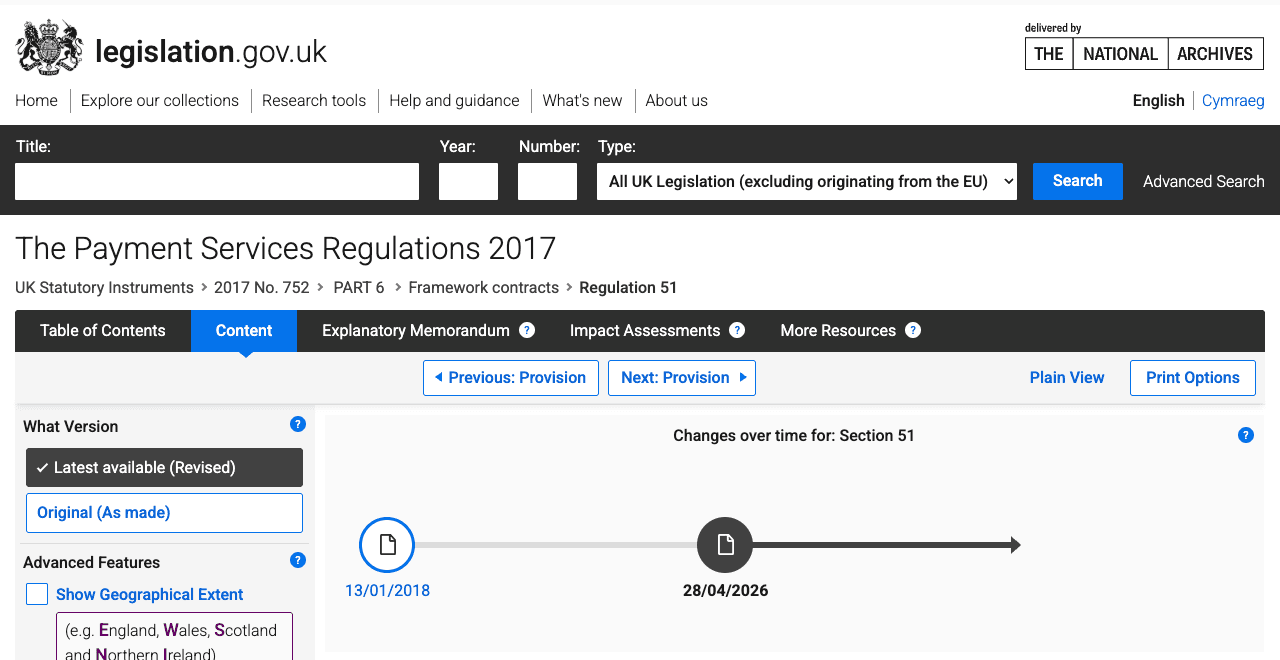
- The UK answer changed on 28 April 2026 and nobody in this market has mentioned it. Regulation 51B now demands 90 days' notice, a reason “sufficiently detailed and specific” to understand the closure, and the complaint and ombudsman routes. The old rule was two months and no reason at all.
- It only attaches to a contract entered on or after that date. An older card falls under regulation 51A: two months, and only if the contract so provides. Most cardholders are still on the old regime.
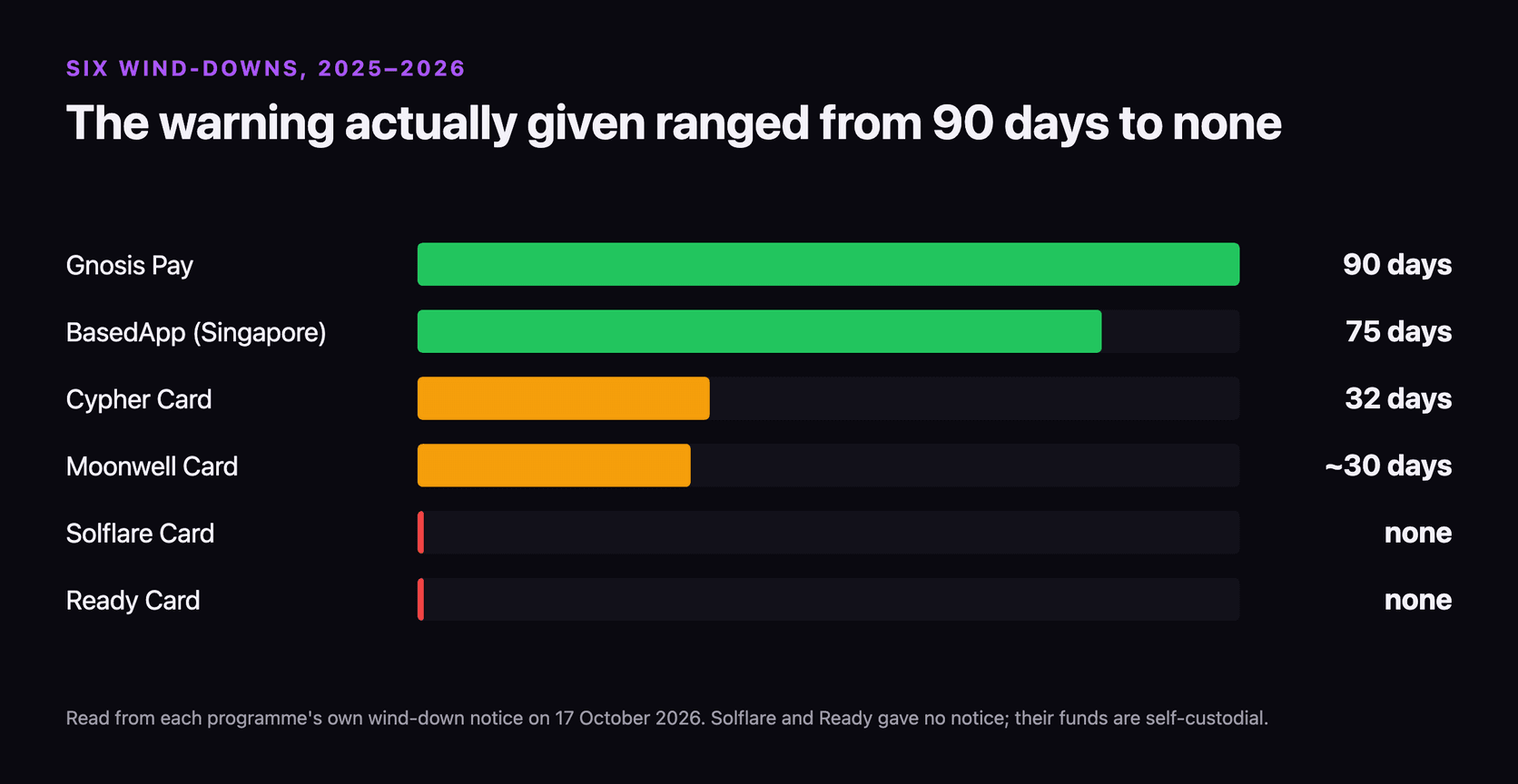
- Warning actually given, in days, across six programmes: 90, 75, 32, ~30, 0 and 0. Gnosis Pay gave exactly the new statutory 90. Two cards went dark the day their issuer failed.
- The contracts mostly promise nothing. Crypto.com's US agreement reserves cancellation “with or without cause or notice”; KAST reserves it “at any time, without notice”; the seven-clause XHYPE terms behind the card we earn most from carry no termination provision at all.
- One asymmetry worth knowing. Under that US agreement a cheque for your balance costs a fee when you close the card and is explicitly free when they cancel it.
On this page
- The year the issuer failed, not the card
- Six wind-downs and the warning each gave
- What the law requires before they close you
- Why the 90-day rule probably misses you
- What the card terms themselves promise
- The ten-part notice, scored
- Custody decides whether a notice matters
- The cheque that is free only when they cancel
- What to do the day a notice lands
- Sources
- FAQ
In July 2026 two crypto cards stopped working on the same afternoon, and their users found out from the point-of-sale terminal. Crypto card shutdowns are now a category rather than an incident, and the question nobody here answers is the one that decides what a shutdown costs you: how much warning are you owed? There is a real answer, it changed in the UK on 28 April 2026, and we could not find one crypto card page that cites it. We read the amended regulations, the Irish transposition, four programmes' own terms and six wind-down notices, and scored every one.
The year the issuer failed, not the card
The failures that defined 2026 did not start at the brand on the plastic. They started one layer down, at the licensed issuer or the infrastructure company that the brand rented, and the brand found out roughly when its customers did.
Kulipa, a card-issuing infrastructure provider, wound down at the end of July. Solflare paused its card on 28 July 2026 — “Both the virtual and physical cards went dark the same day”, as the trade coverage put it. Ready shut its programme the same week and its co-founder said publicly that the company had been given no notice. Trade reports put the affected programmes at around twenty.
The second pattern is quieter and more common: the infrastructure provider gets bought and the card is not part of the deal. Nium acquired Cypher in July 2026; Cypher's own wind-down pages, updated 7 July 2026, disabled card loading the next day. The Moonwell Card, which ran on Cypher, stopped with it.
Six wind-downs and the warning each gave
Here are the programmes we could date against a published notice or contemporaneous report. “Days of warning” counts from the earliest dated notice we could find to the day the card stopped authorising — not to the withdrawal deadline, which is usually later and is a separate number in the next column.
| Programme | Notice dated | Card stops | Days of warning | Final withdrawal |
|---|---|---|---|---|
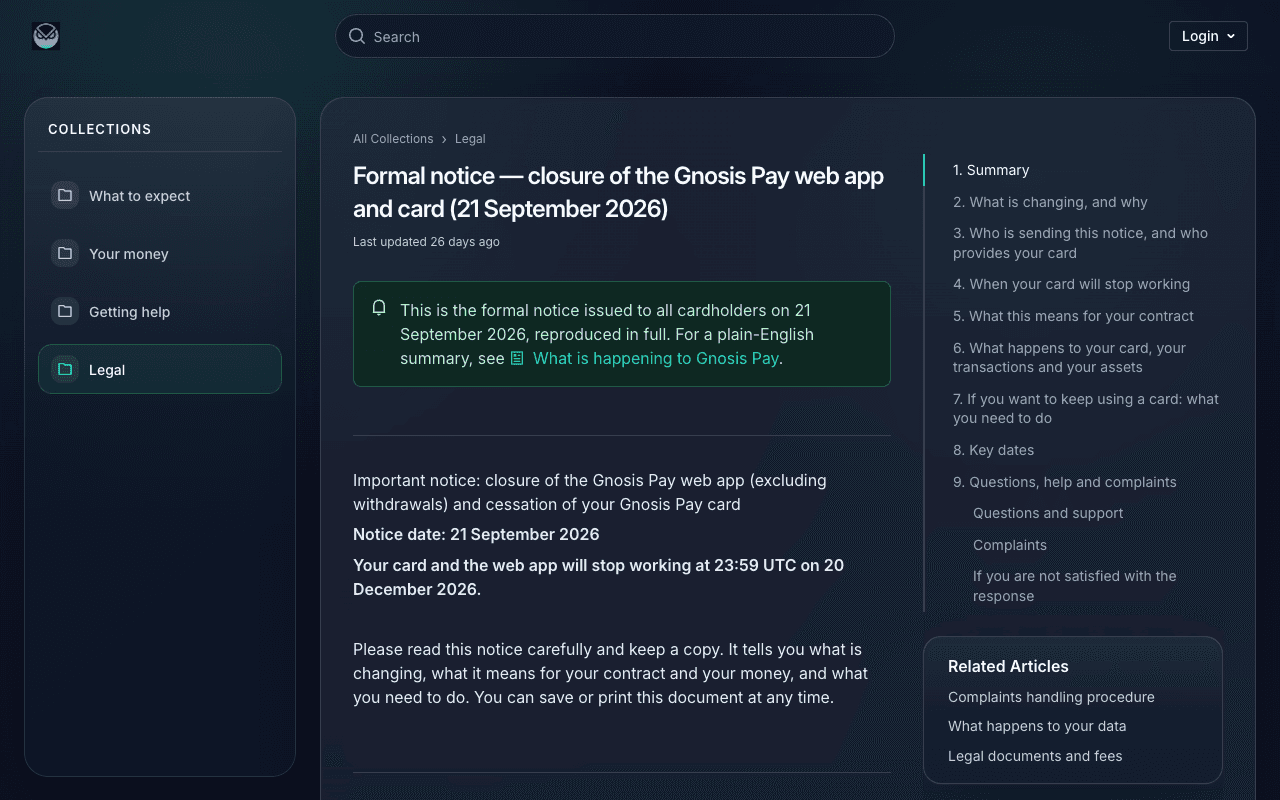
| Gnosis Pay | 21 Sep 2026 | 20 Dec 2026, 23:59 UTC | 90 | No deadline — stays open |
| BasedApp (Singapore) | 1 Sep 2025 | 15 Nov 2025 | 75 | 30 Nov 2025, then swept to USDC |
| Cypher Card | 7 Jul 2026 | 8 Aug 2026, 00:00 UTC | 32 | 6 Sep 2026 |
| Moonwell Card | Jul 2026, undated | after 7 Aug 2026 | ~30 | 6 Sep 2026 |
| Solflare Card | None | 28 Jul 2026 | 0 | n/a — funds self-custodial |
| Ready Card | None | late Jul 2026 | 0 | n/a — funds self-custodial |
Six programmes, read 17 October 2026. The spread runs from the full statutory 90 days to none at all.
The median is not the risk. Four of the six gave between thirty and ninety days; the two that gave nothing are the two whose issuer failed rather than retired. And the withdrawal deadline is the number that bites — only one programme here does not have one.
What the law requires before they close you
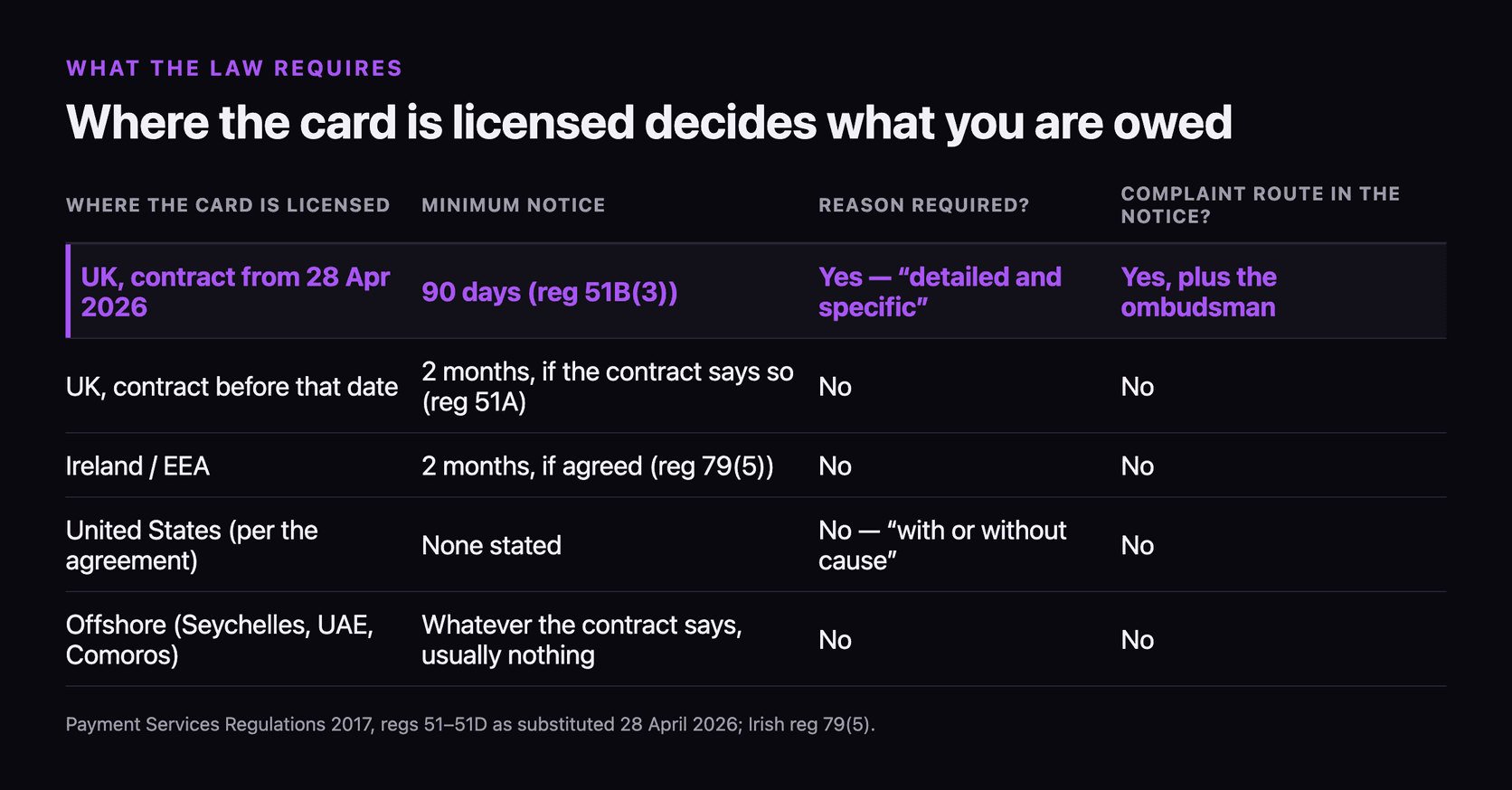
Ask how much notice is owed and the honest answer is a jurisdiction, not a number. Three regimes cover most cards this site tracks, and they sit further apart than the marketing suggests.
The United Kingdom rewrote its rule on 28 April 2026. Regulations 51 to 51D of the Payment Services Regulations 2017 were substituted that day by the Payment Services and Payment Accounts (Contract Termination) (Amendment) Regulations 2025. The new regulation 51B says a termination notice must contain “an explanation of the reasons for termination which is sufficiently detailed and specific to enable the payment service user to understand” it, must say how to complain to the provider and of any right to complain to the Financial Ombudsman Service, and must come “at least 90 days before the termination is to take effect”.
Regulation 51C then carves five situations out of that requirement entirely — among them being unable to complete customer due diligence, and having “reasonable grounds to suspect” the service has been used in connection with serious crime. Those exemptions matter more on a no-KYC card than on a current account.
The EEA still runs on two months. Ireland's transposition, regulation 79(5) of S.I. No. 6/2018, is the clean statement: a provider “may terminate a framework contract concluded for an indefinite period by giving not less than 2 months' notice”, if agreed in the contract. No reason is required and no complaint route has to be named.
The United States contracts out of the question. The Crypto.com Prepaid Visa Cardholder Agreement, effective 1 September 2026, says at section 18 that the issuer may “revoke Card privileges, or cancel your Card with or without cause or notice, other than as required by applicable law”.
| Where the card is licensed | Minimum notice | Reason required? | Complaint route in the notice? |
|---|---|---|---|
| UK, contract from 28 Apr 2026 | 90 days (reg 51B(3)) | Yes — “detailed and specific” | Yes, plus the ombudsman |
| UK, contract before that date | 2 months, if the contract says so (reg 51A) | No | No |
| Ireland / EEA | 2 months, if agreed (reg 79(5)) | No | No |
| United States (per the agreement) | None stated | No — “with or without cause” | No |
| Offshore (Seychelles, UAE, Comoros) | Whatever the contract says, which is usually nothing | No | No |
The same card brand can sit in three of these rows at once, depending on which entity issued your card.
Why the 90-day rule probably misses you
The headline is the easy half. The qualification is the half that decides whether any of it applies to the card in your pocket, and it is written into the regulations themselves: the 90-day rule in regulation 51B governs a framework contract “entered into on or after 28th April 2026”. Everything signed before that date stays under regulation 51A, which preserves the old position word for word — “by giving at least two months' notice, if the contract so provides”.
The practical ladder: a card opened since late April 2026 carries a real 90-day entitlement with reasons and an ombudsman behind it; one opened earlier carries two months at best; one issued from Dubai, the Seychelles or the Comoros carries whatever its clauses say. Which is the next section, and it is bleak.
What the card terms themselves promise
We read four programmes' own documents looking for one thing: what does this contract commit to before it switches your card off? The answers run from an explicit reservation of the right to give no warning at all, to a provision that does not exist.
KAST is the most forthright. Its platform terms reserve the right “to terminate, suspend, or limit your use of its Services at any time, without notice, at its sole discretion”, and separately to “discontinue the Services… at any time, for any reason, without notice to the user”. There is a counterweight doing a lot of work: if the company closes your account “you will be notified of such action as required by law”. The company is KAST Tech, registered in Anjouan in the Comoros, under the laws of Seychelles — so that clause is not asking for 90 days. The same document says that on the company's “failure, bankruptcy or liquidation” you are not protected by consumer law at home.
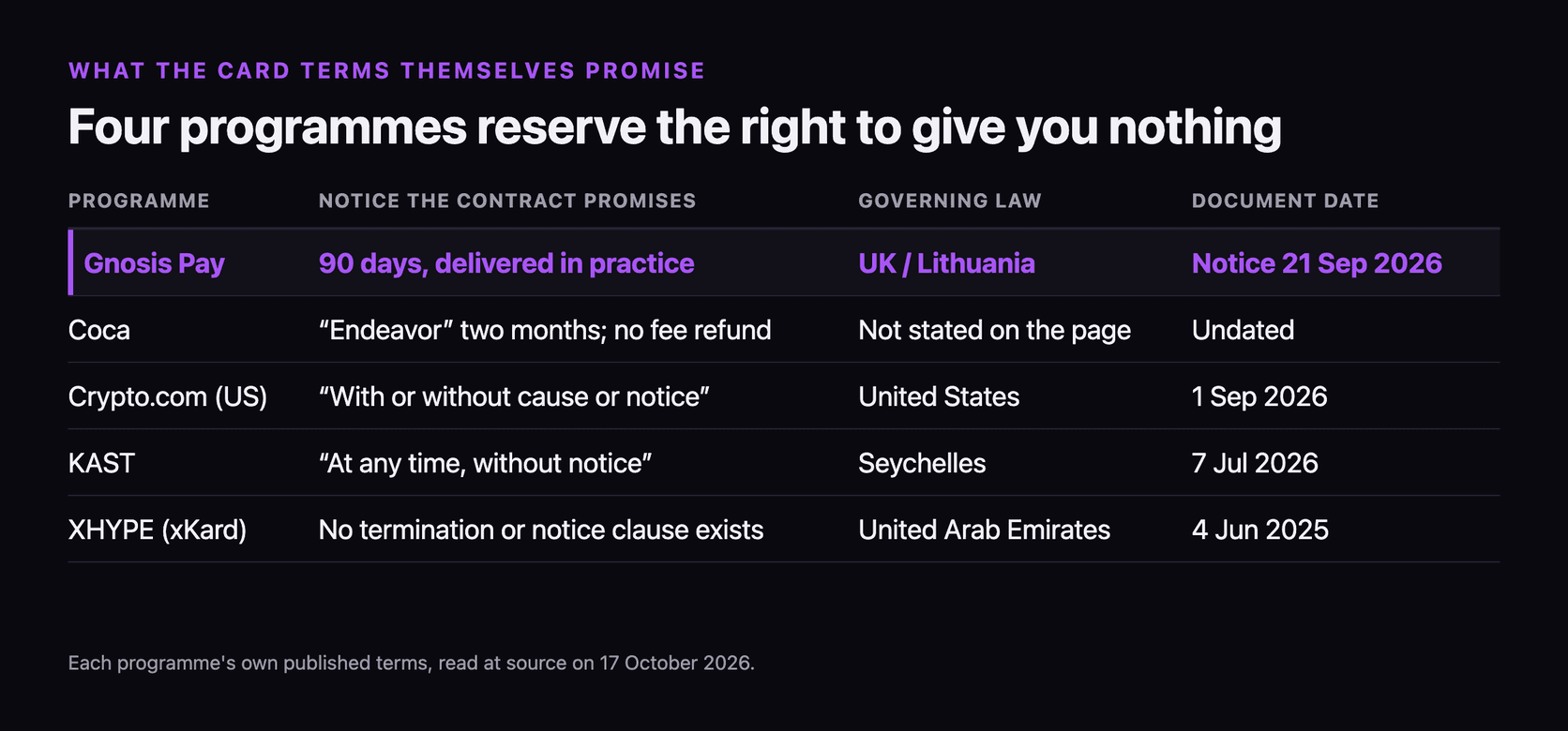
Coca is the only one that addresses a wind-down directly. If it withdraws the wallet altogether, “we'll endeavor to give you two months' notice” — an endeavour rather than an obligation, 30 days short of the UK standard, and the clause adds that no fees are refunded.
XHYPE, whose terms cover the card this site earns the most from, publishes seven clauses last updated 4 June 2025, with no termination, notice or wind-down clause. Clause 2 says “We are not a card issuer” and names no issuer; clause 6 disclaims liability for damage from the “use or unavailability of services” — the shutdown scenario, named and excluded.
| Programme | Notice the contract promises | Governing law | Document date |
|---|---|---|---|
| Gnosis Pay | 90 days, delivered in practice; issuer FCA- and Bank of Lithuania-authorised | UK / Lithuania | Notice 21 Sep 2026 |
| Coca | “Endeavor” two months, on withdrawing the wallet; no fee refund | Not stated on the page | Undated |
| Crypto.com (US) | “With or without cause or notice, other than as required by applicable law” | United States | 1 Sep 2026 |
| KAST | “At any time, without notice”; notified “as required by law” | Seychelles | 7 Jul 2026 |
| XHYPE (xKard) | No termination, notice or wind-down clause exists | United Arab Emirates | 4 Jun 2025 |
Four contracts and one delivered notice. Only the regulated one promises a number you could hold anybody to.
The ten-part notice, scored
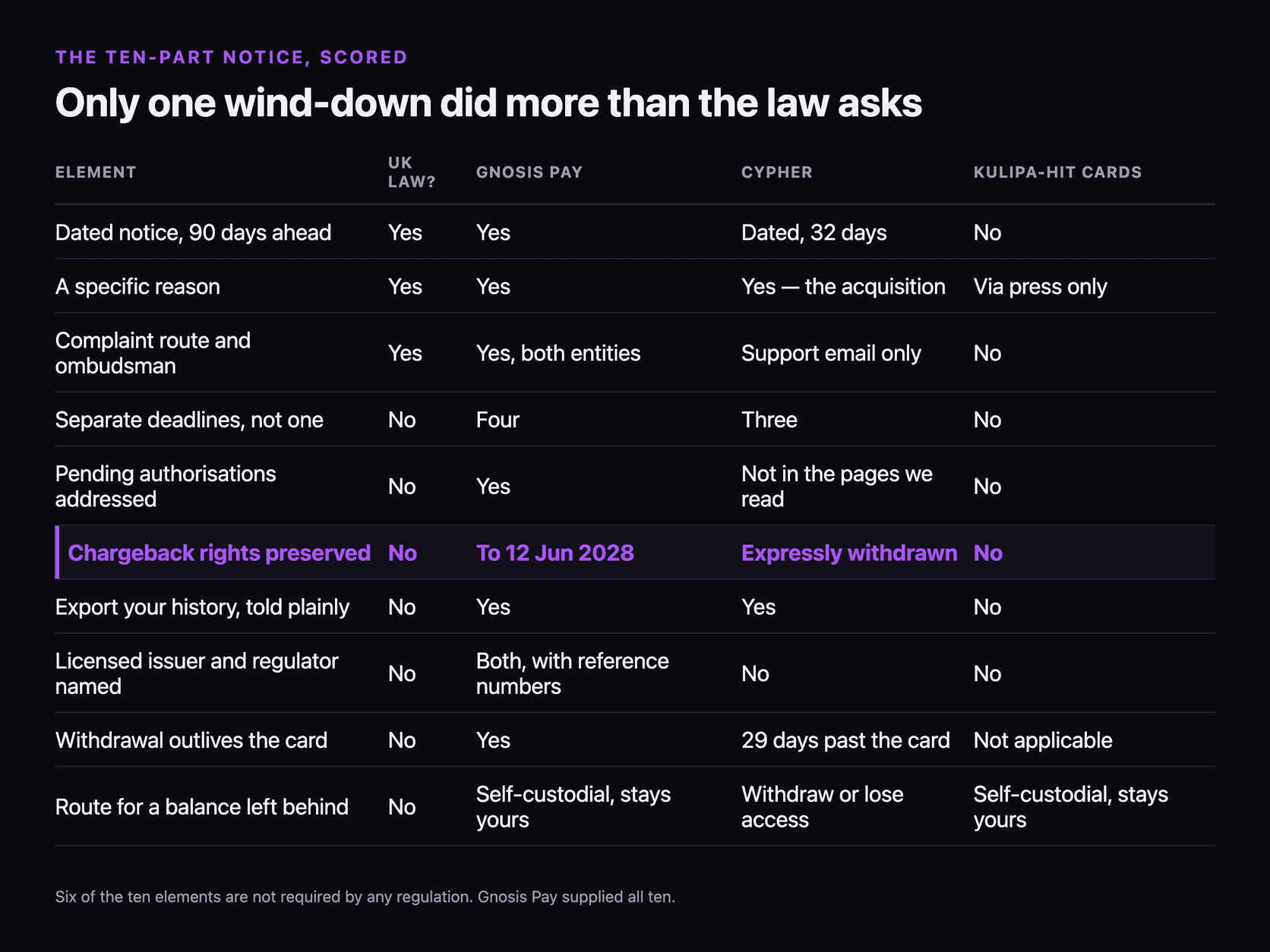
Gnosis Pay's notice of 21 September 2026 is the most complete exit document in this market, so we broke it into ten elements and scored the others against it. Three are now compelled in the UK by regulation 51B; the other seven are discretionary everywhere, which makes them the real test.
| Element | UK law? | Gnosis Pay | Cypher | Kulipa-hit cards |
|---|---|---|---|---|
| Dated notice, 90 days ahead | Yes | Yes | Dated, 32 days | No |
| A specific reason | Yes | Yes | Yes — the acquisition | Via press only |
| Complaint route and ombudsman | Yes | Yes, both entities | Support email only | No |
| Separate deadlines, not one | No | Four | Three | No |
| Pending authorisations addressed | No | Yes | Not in the pages we read | No |
| Chargeback rights preserved | No | To 12 Jun 2028 | Expressly withdrawn | No |
| Export your history, told plainly | No | Yes | Yes | No |
| Licensed issuer and regulator named | No | Both, with reference numbers | No | No |
| Withdrawal outlives the card | No | Yes | 29 days past the card | Not applicable |
| Route for a balance left behind | No | Self-custodial, stays yours | Withdraw or lose access | Self-custodial, stays yours |
Ten elements, read from the notices themselves. Blank cells are not inferences: where a programme publishes nothing, the cell says so.
The sharpest difference is the chargeback row. Gnosis Pay keeps dispute support running twenty months past the card's last day and says cessation “does not affect your rights” under scheme rules. Cypher says the opposite in one sentence: “we will no longer be accepting new chargebacks or dispute requests”, and points users at the merchant. Both are legitimate choices; neither card's terms flagged which one you were buying. What a scheme dispute is actually worth is in our guide to crypto card chargebacks.
Custody decides whether a notice matters
There is an uncomfortable symmetry in the register above. The two programmes that gave zero notice are the two where nobody lost money: the cards pulled from the user's own self-custodial wallet at the moment of purchase, so no balance sat with the failed issuer. The one that gave a full 90 days is self-custodial too.
That is not an argument that notice does not matter — a card that dies mid-holiday is a real problem. It is an argument that notice and exposure are separate axes, and a card can be bad on one and fine on the other. A custodial prepaid card with a generous notice period still turns your balance into a claim on a company, which is why the withdrawal deadline rather than the card-off date is the number to diary.
Where a balance actually sits, and what “protected” means in four regimes, is in the balance protection guide; why this keeps happening to no-KYC programmes is in why no-KYC crypto cards shut down.
The cheque that is free only when they cancel
One clause reverses an assumption almost everybody holds. Section 28 of the Crypto.com US cardholder agreement sets out two routes for a residual balance. If you close the card you may spend it to zero, or request a cheque, “which we will do for a fee as set forth in the Schedule of All Fees and Charges”. If they cancel it: “we will send you a check in the amount of your Card Account balance for no charge”.
Being shut down is, on that document, cheaper than leaving — the mirror image of the exit pricing in our survey of crypto card closure fees, where seven of nine Crypto.com schedules print a closure figure and the US one prints “Close card — No charge” on every tier.
What to do the day a notice lands
The order matters, because the deadlines in these notices are not the same deadline wearing different hats.
- Write down every date separately. Card-off, withdrawal close, support close, dispute close. Gnosis Pay published four; Cypher three. The one that strands people is the withdrawal date, weeks after the card stops working, ignored because the card already feels dead.
- Export your transaction history first. It is the only item here that becomes impossible rather than merely expensive once access ends.
- Move the balance out early, not at the deadline. A closing programme's withdrawal queue is where a last-minute transfer reliably fails.
- Cancel recurring payments at each merchant. No issuer can move a subscription for you, and a failed renewal costs you a service rather than a fee.
- Check whether disputes are still open before relying on one. One of these six stopped accepting new chargebacks as part of its wind-down.
- If you are in the UK and the notice gives no reason, say so. A regulation 51B notice has to explain itself and point you at the Financial Ombudsman Service. If yours does neither and your contract started after 28 April 2026, that is a complaint with a named destination.
The pre-emptive version is one question: before you load a card, find out which entity issues it and where that entity is licensed. On every contract above, that one fact predicted the rest.
Picking a card that will still exist next year?
Shutdown risk does not show up in a fee table. Our comparison lists who issues each card and where, alongside the running costs, so you can weigh the cheap one against the one with a regulator behind it.
Some links on Kardd are affiliate links and may earn us a commission. No commercial relationship changed a finding above, including the one about XHYPE's missing termination clause.
Sources
- Payment Services Regulations 2017, regulation 51B — the 90-day notice, the reasons requirement and the complaint routes; substituted 28 April 2026 by S.I. 2025/688.
- Payment Services Regulations 2017, regulation 51A — two months for pre-28 April 2026 contracts, “if the contract so provides”.
- Payment Services Regulations 2017, regulation 51C — the five cases needing no notice at all.
- European Union (Payment Services) Regulations 2018, regulation 79 — the EEA position: not less than two months; termination free after six.
- Gnosis Pay, formal notice of closure — four deadlines, the reason, the ombudsman routes, pending authorisations and preserved chargebacks; 21 September 2026.
- CRYPTO.COM Prepaid Visa Cardholder Agreement (United States) — sections 18 and 28 and Schedule A; effective 1 September 2026.
- Cypher wind-down support — the 6 September 2026 close and the end of new chargebacks and disputes; updated 7 July 2026.
- KAST Platform Terms — termination without notice, notification “as required by law”, and the bankruptcy disclosure.
- Coca terms of use — the “endeavor to give you two months' notice” clause; undated.
- XHYPE terms and conditions — all seven clauses, read in full; last updated 4 June 2025.
- Spendnode on the Solflare Card pause — trade report, 29 July 2026; the 28 July stop date.
- Crypto Briefing on the Moonwell Card shutdown — trade report, 5 September 2026; the 7 August cutoff.
- Fintech News Singapore on BasedApp — trade report; the 1 September 2025 notice, 15 November deactivation and USDC sweep.
Related Articles
- Gnosis Pay Shutting Down 2026: What Cardholders Must Do
- Crypto Card Closure Fees 2026: $0 to $55 to Exit
- Crypto Card Balance Protection 2026: The Insolvency Rules
- Why No-KYC Crypto Cards Shut Down
- Crypto Card Chargebacks 2026: What You Can Actually Dispute
- Crypto Card Inactivity Fees 2026: The 12-Month Clock
Frequently Asked Questions
How much notice must a crypto card issuer give before closing your account?
On the licence behind the card and when you signed up. UK regulation 51B, substituted 28 April 2026, requires at least 90 days plus a reason specific enough to understand the closure — but only for contracts entered on or after that date. Earlier ones fall under regulation 51A: two months, and only if the contract provides for it. Ireland's regulation 79(5) sets not less than two months.
What happens to my money if a crypto card shuts down?
On who was holding it. On a self-custodial card the balance never left your own wallet, so the card stops and the money does not — what Solflare and Ready cardholders found when Kulipa wound down. On a custodial prepaid card it is a claim on the programme and you are relying on a withdrawal window: Cypher's ran to 6 September 2026, and BasedApp swept anything over a dollar to the user's own wallet as USDC after 30 November 2025.
Which crypto cards shut down in 2026?
The ones we could date: the Solflare and Ready cards, both stopped at the end of July when their issuer Kulipa wound down; the Cypher Card and the Moonwell Card that ran on it, after Nium acquired Cypher, with the platform closing 6 September 2026; and the Gnosis Pay consumer card, ending 23:59 UTC on 20 December 2026.
Can a crypto card be cancelled without notice?
As a matter of contract, in several of the agreements we read, yes. The Crypto.com US agreement says the card may be “canceled, repossessed, or revoked at any time without prior notice subject to applicable law”. KAST reserves termination “at any time, without notice, at its sole discretion”. Whether that holds depends on the licence behind the card rather than the wording, which is why the issuer's jurisdiction is the thing to check first.
Does the UK 90-day closure rule apply to my crypto card?
Only if the provider is a UK payment service provider, the arrangement is an indefinite framework contract, and you entered into it on or after 28 April 2026. Regulation 51C then removes the requirement in five situations, including an inability to complete customer due diligence — which bites harder on a low-verification card than on a current account. A card issued outside the UK and EEA carries none of this.
What does a complete crypto card shutdown notice contain?
Ten things, on the evidence of the best one published here. Gnosis Pay's notice of 21 September 2026 gives 90 days' warning, a stated reason, the complaint route and ombudsman for each entity, four deadlines rather than one, explicit handling of pre-cutoff authorisations, chargeback rights preserved to 12 June 2028, an instruction to export your history, the issuer named with its regulator and reference number, withdrawal left open after the app closes, and a position on any balance left behind.
What should I do the day a shutdown notice arrives?
Write every date down separately: card-off and withdrawal-close are different days, and the second strands people. Export your transaction history first — it is the only item that becomes impossible rather than expensive. Then move the balance out early, cancel recurring payments at each merchant, and check whether disputes are still being accepted.