Crypto Card Balance Protection 2026: The Insolvency Rules
- Safeguarding is not compensation. The FCA's own review of payment firm insolvencies from Q1 2018 to Q2 2023 found average shortfalls of 65% of customers' funds. “Segregated” described those firms too.
- The UK rules change on 7 May 2026. Policy statement PS25/12 brings in daily reconciliation, monthly reporting and annual safeguarding audits — the first real test of whether “safeguarded” means what cardholders assume.
- FDIC pass-through only pays if a bank fails. When Synapse collapsed the partner banks stayed open, so nothing paid out, and the trustee found a $65m–$95m gap against customer claims.
- An EU e-money token card has the strongest claim of the three. MiCA Article 49 gives holders redemption at par, at any time, by operation of law rather than by contract.
- No regime anywhere covers the crypto leg. Every scheme in this article protects fiat or e-money. The tokens sitting on the card side of the ledger are protected by nothing at all.
On this page
- “Protected” means four different things
- The UK: safeguarding is not FSCS
- What the asset pool actually pays you
- What changes on 7 May 2026
- The US: pass-through pays only if a bank fails
- The EU: MiCA makes redemption a legal right
- Self-custody deletes the counterparty
- Your crypto balance is protected nowhere
- Read your own card's terms in five minutes
- Final take
- FAQ
Every crypto card app shows you a balance, and almost none of them tell you who is holding it — which is the only fact that decides what crypto card balance protection is worth when the issuer fails. The number that should end the argument comes from the FCA: across payment firm insolvencies between the first quarter of 2018 and the second quarter of 2023, the average shortfall was 65% of customers' money. Every one of those firms was required to segregate. Two thirds of it was gone anyway.
So we read the rules rather than the marketing — the FCA's safeguarding policy statement and its May 2026 commencement date, the FSCS's own page on what it will not cover, the UK special administration regime and the Court of Appeal judgment that defines what a cardholder owns, the FDIC pass-through conditions and the Synapse collapse that tested them, and Article 49 of MiCA — and lined them up against how the cards in our directory actually hold money. Three regimes, one table each. The finding that surprised us: the strongest legal claim of the three belongs to a euro stablecoin cardholder in the EU, not to anyone holding a balance in a British app.
“Protected” Means Four Different Things
Crypto card balance protection is not one thing that a card either has or lacks. There are four regimes in play, they sit at very different strengths, and a single card can put one leg of your money in one and the other leg in another.
| Regime | What it promises | Pays out when | Strength |
|---|---|---|---|
| Deposit insurance FSCS, FDIC, NCUSIF | A fixed sum back from a public scheme | An insured bank fails | Strongest |
| E-money safeguarding UK EMRs, EU EMD2 | Your money is kept apart and paid to you first | The issuer fails — from whatever is actually there | Conditional |
| MiCA redemption right e-money tokens | Redemption at par, at any time | On demand, by operation of law | Strong claim, no fund |
| Nothing crypto custody, offshore issuers | Whatever the terms of service say | You join the creditor queue | None |
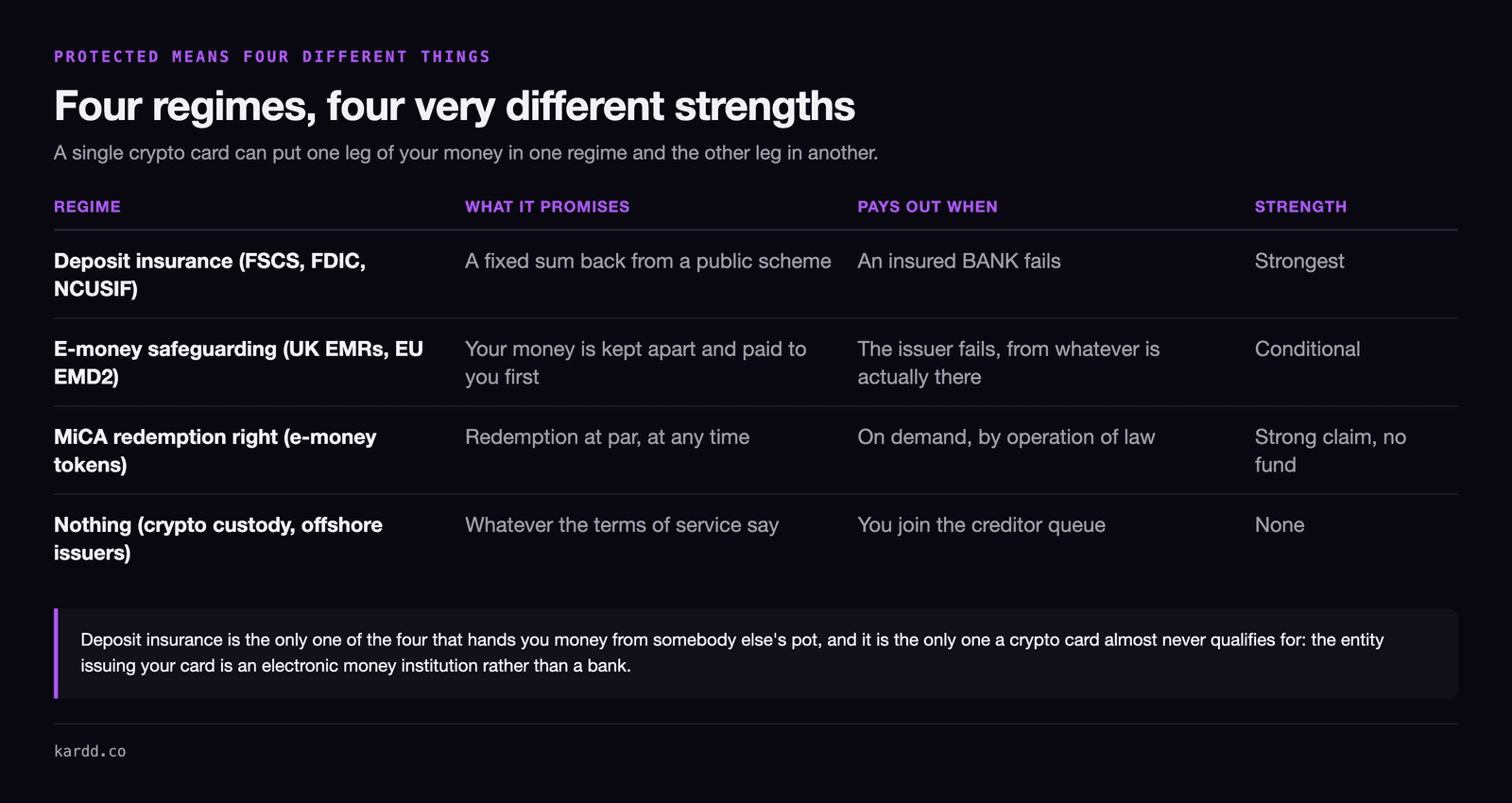
Notice what the first row costs you. Deposit insurance is the only one of the four that hands you money from somebody else's pot, and it is the only one a crypto card almost never qualifies for, because the entity issuing your card is an electronic money institution rather than a bank. That is not a scandal; it is the licence. The problem is that the apps are designed to look like banking, so people load balances as if row one applied.
The UK: Safeguarding Is Not FSCS
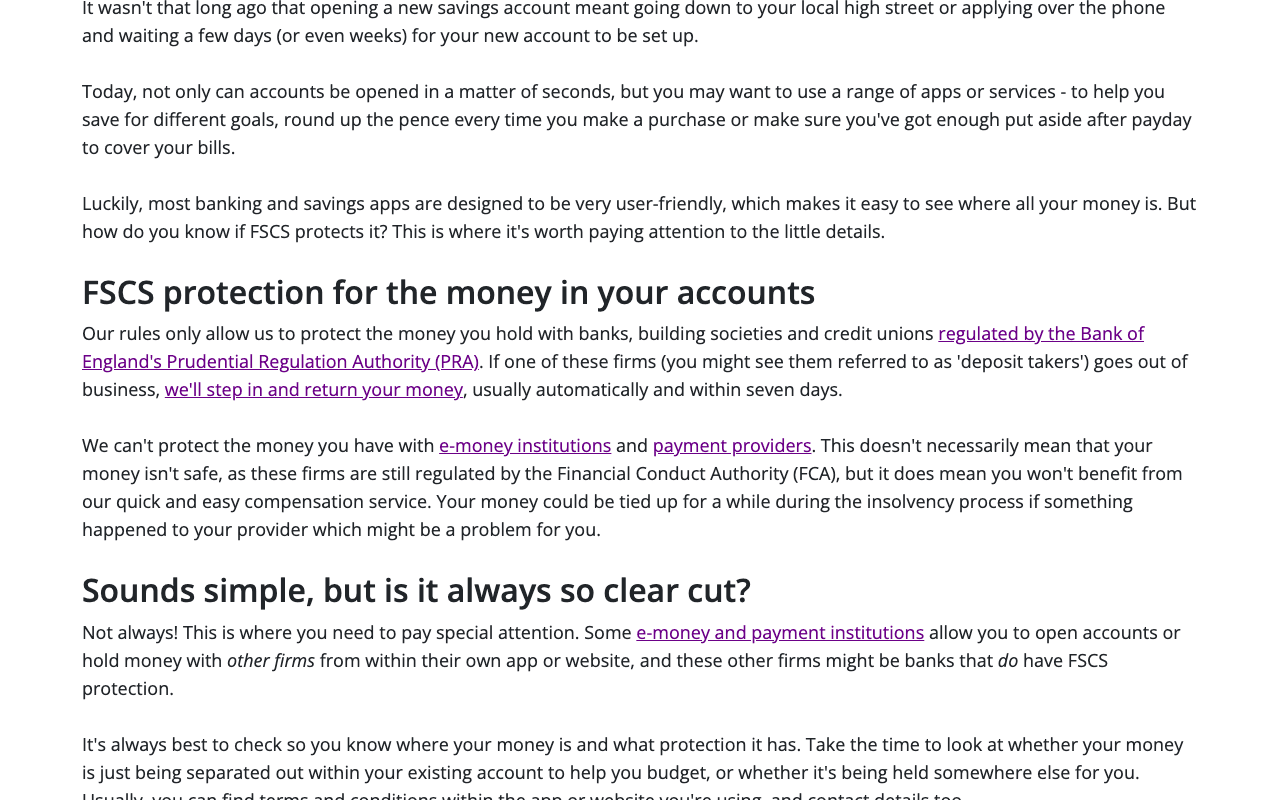
The FSCS is unusually direct about this. Its guidance on e-money says: “We can't protect the money you have with e-money institutions and payment providers.” Not a caveat, not a limit — an exclusion. Meanwhile the deposit limit that does not apply to you rose to £120,000 on 1 December 2025, with the temporary high balance protection at £1.4m, so the gap between a bank balance and a card balance is now wider in cash terms than it has ever been.
Issuers say the same thing when you read their regulatory pages rather than their landing pages. Wirex's UK regulation page states that the FSCS does not apply to its services and that customer currency is safeguarded in a segregated bank account instead. That is an honest description of an electronic money institution. It is also a much smaller promise than most people hear.
| Question | Bank account | Crypto card e-money balance |
|---|---|---|
| FSCS cover | Yes, to £120,000 | None |
| Who holds the money | The bank, on its balance sheet | A segregated account at a third-party bank |
| If the firm fails | Scheme pays, typically within days | Special administration, then a distribution |
| Amount you get back | Full, up to the limit | Whatever the pool holds, less distribution costs |
| Average historical shortfall | Not applicable | 65% (FCA, Q1 2018–Q2 2023) |
| Crypto held alongside it | Not applicable | Outside both regimes entirely |
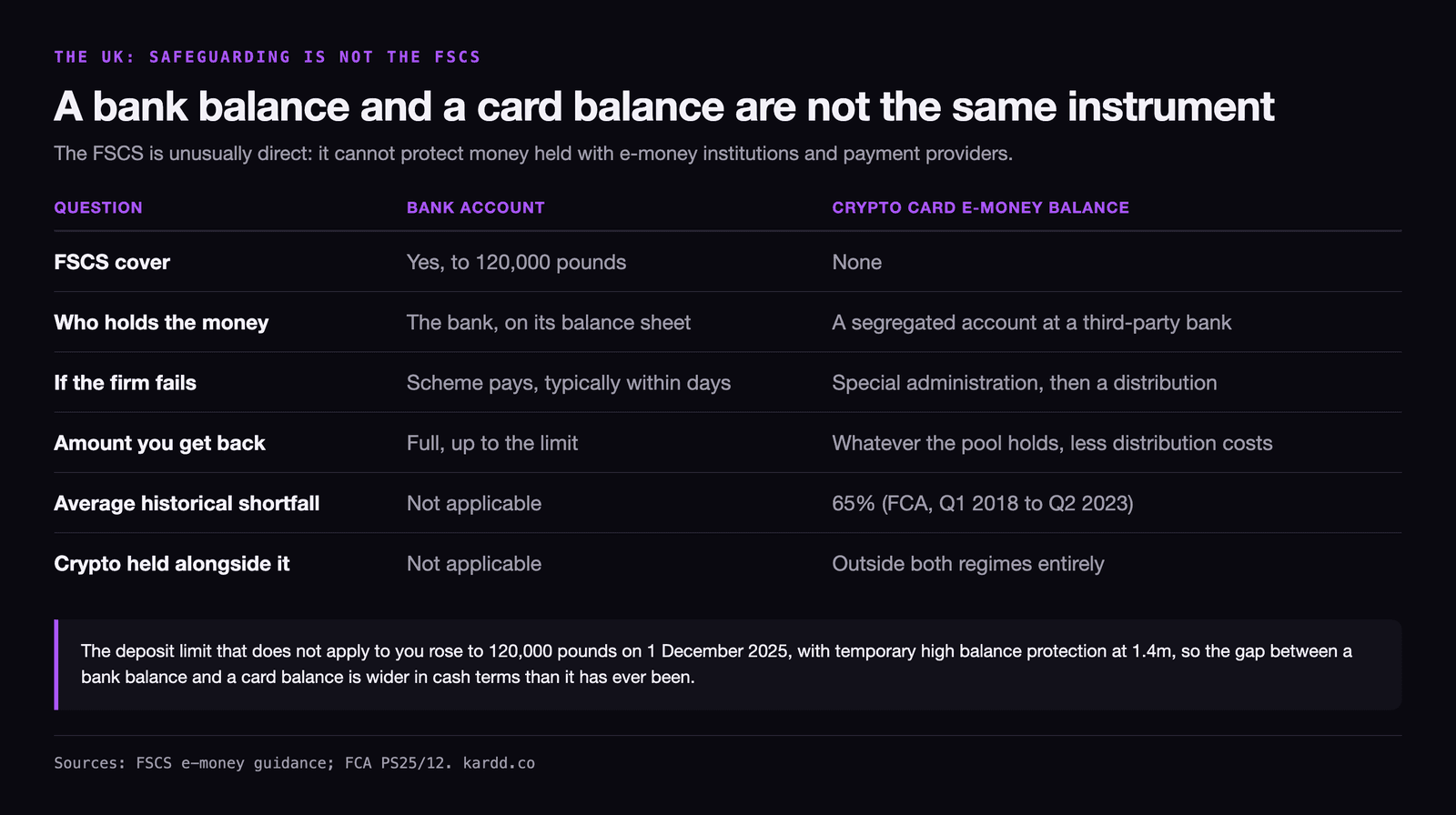
That last row is the one cardholders trip over. A UK crypto card app typically holds two balances for you — an e-money balance that funds the card and a crypto balance that funds the e-money balance. Only the first is safeguarded, and only up to the moment you move value back across the line. If your card freezes with funds on it, which half is frozen changes what you can realistically recover.
What the Asset Pool Actually Pays You
When a UK electronic money institution fails, it goes into a special administration under the Payment and Electronic Money Institution Insolvency Regulations 2021. The administrator gathers the safeguarded money into an asset pool, and e-money holders are paid from that pool ahead of the firm's other creditors. So far, so reassuring.
Two details undo most of the reassurance. First, the Court of Appeal held in the Ipagoo case that the Electronic Money Regulations create no statutory trust over customer money: the relationship is contractual, and holders have a claim against the institution rather than a proprietary interest in identifiable funds. The same judgment did rule that money which should have been safeguarded but was not still forms part of the pool — helpful, and also a reminder that this question only reaches a court when the money is missing.
Second, e-money holders' claims are not diluted by insolvency expenses except for the costs of distributing the asset pool, which come out of the pool itself. A small balance in a large administration therefore takes a haircut for the privilege of being returned to you, after a wait measured in months or years rather than days.
What Changes on 7 May 2026
The FCA has accepted the diagnosis. Policy statement PS25/12, published on 7 August 2025, overhauls the safeguarding regime for payments and e-money firms with effect from 7 May 2026 — which means the rules under which your card balance sits today are, by design, the weak version.
| New requirement | What it fixes | Applies to |
|---|---|---|
| Daily reconciliation of safeguarded funds | The drift that produced the 65% gap | All payment and e-money firms |
| Monthly regulatory reporting | The FCA finding out before insolvency, not after | Payment firms |
| Annual audit by a qualified auditor | Self-certified compliance | Firms holding £100,000+ in customer funds |
| Documented failure planning | The multi-year wait for a distribution | All in scope |
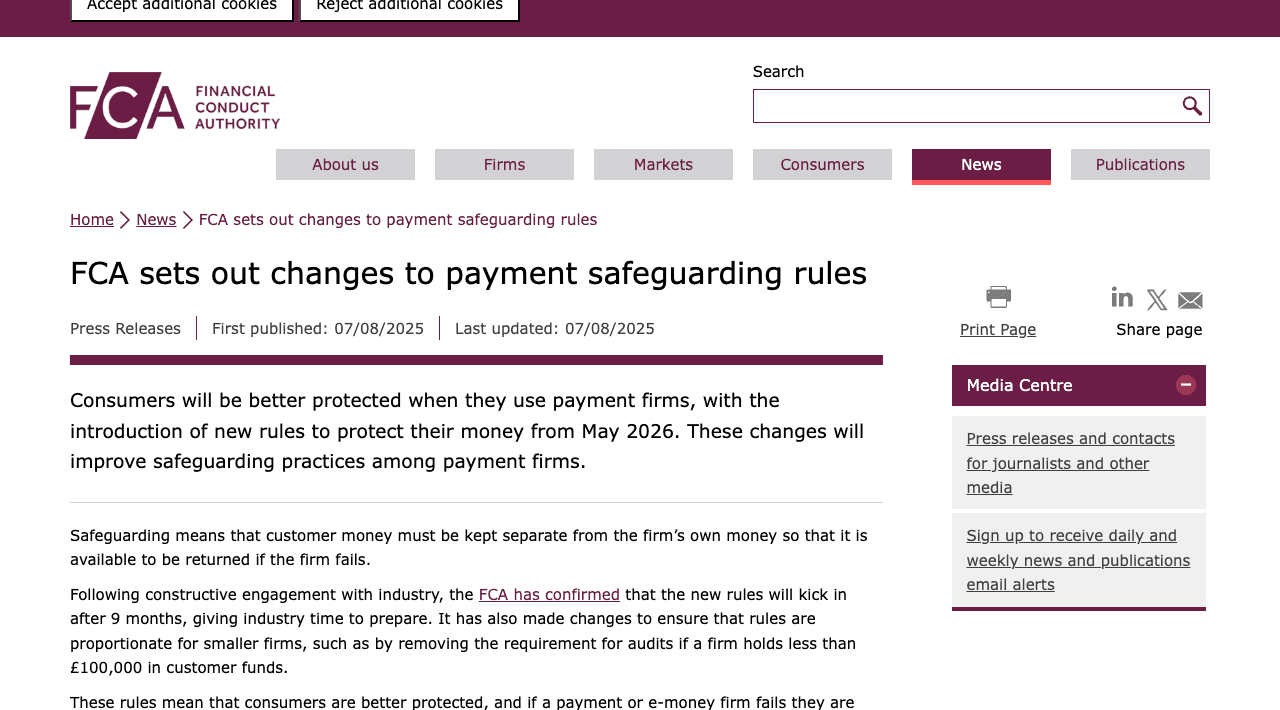
If you hold a balance with a UK-regulated card issuer, this is the date to put in your calendar, and a fair question to put to support in the meantime: is the firm already reconciling daily, or waiting for the deadline? Firms that have done the work tend to say so.
The US: Pass-Through Pays Only If a Bank Fails
American crypto card marketing loves the phrase “FDIC insured”, and it is doing an enormous amount of work. The FTC's position is blunt: “crypto deposits are not FDIC insured, period”, and FDIC insurance does not cover crypto assets at all. What can be insured is the dollar leg, and only through a structure called pass-through coverage.
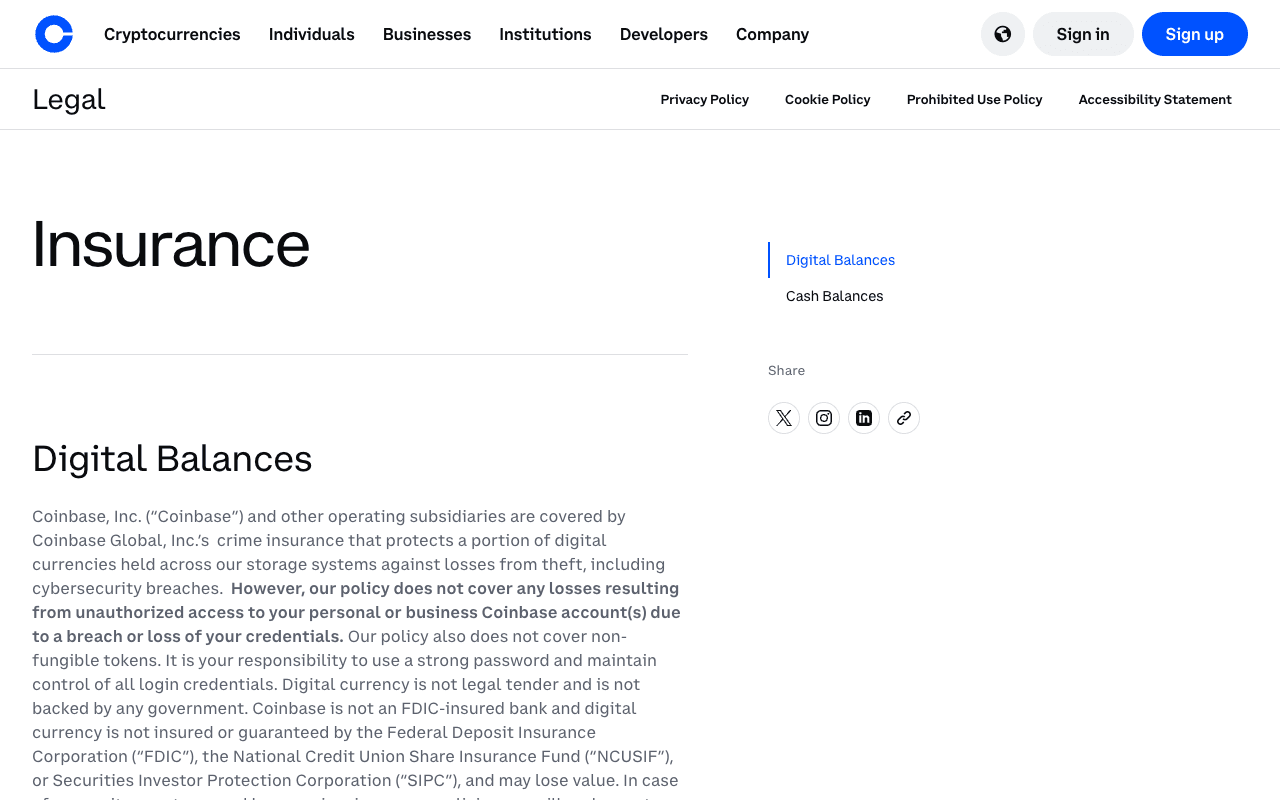
Coinbase describes the arrangement honestly enough to use as a template: US customer dollars are held as cash in pooled custodial accounts at FDIC-insured banks or NCUSIF-insured credit unions, with pass-through coverage up to the $250,000 per-depositor limit — while digital currency is not insured or guaranteed by the FDIC, NCUSIF or SIPC and may lose value. Crucially, the coverage is contingent on the provider keeping accurate records and on the regulator's determinations at the time a bank goes into receivership.
| What fails | Does FDIC pay? | Why |
|---|---|---|
| The partner bank | Yes, to $250,000 | A bank failure is the trigger, if records identify you |
| The card programme / middleman | No | No bank failed, so the fund has no trigger |
| The crypto custodian | No | Crypto is not a deposit |
| Records, without any insolvency | No | Pass-through depends on the ledger being right |
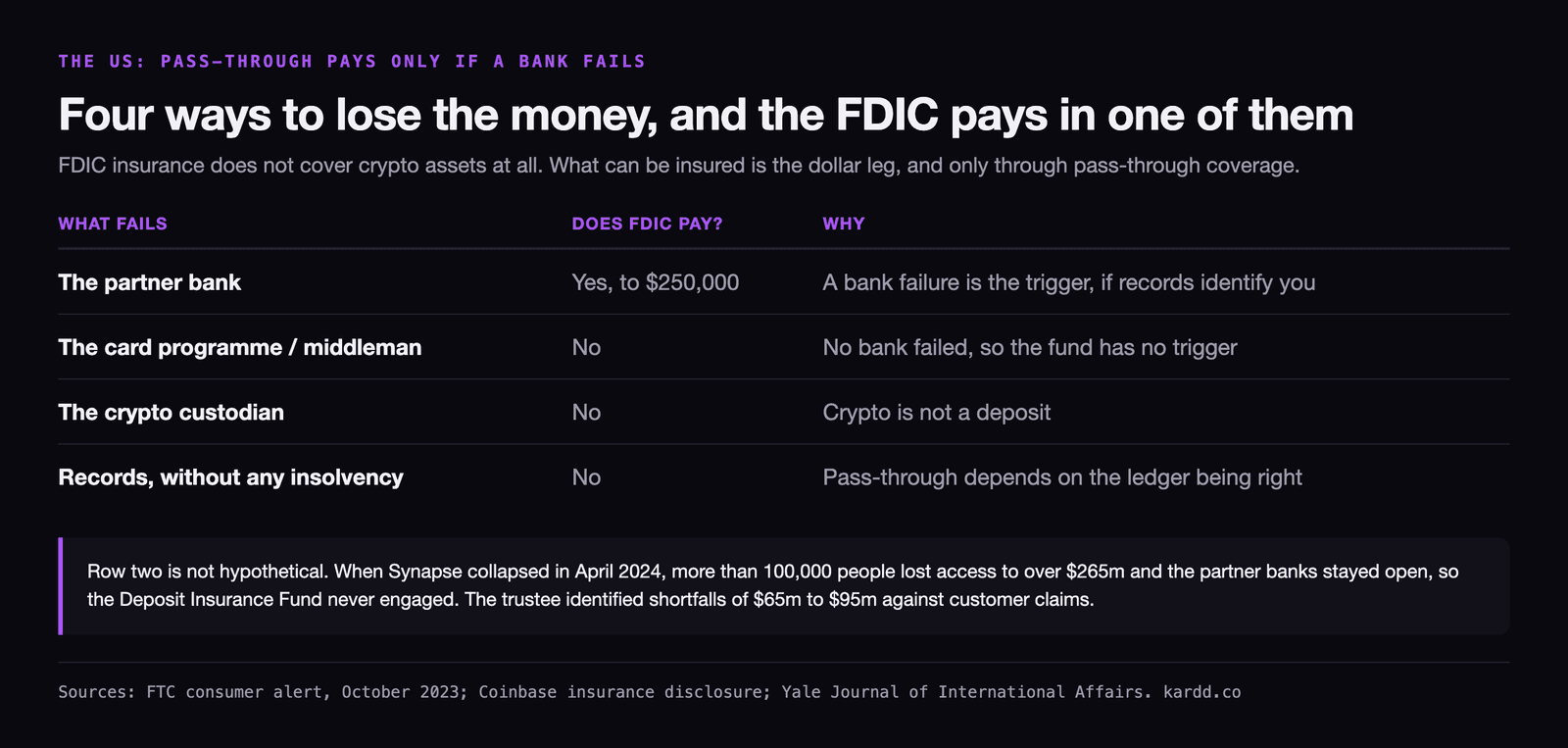
Row two is not hypothetical. When Synapse collapsed in April 2024, more than 100,000 people lost access to over $265m held across several fintech platforms — and the partner banks stayed open, so the Deposit Insurance Fund never engaged, because it disburses only on a bank failure. The bankruptcy trustee, a former FDIC chair, identified shortfalls of $65m to $95m against customer claims, the result of pooling funds across several banks with records nobody could reconstruct. Customers had done nothing wrong and held an insurance promise that had no trigger.
Voyager is the other half of the lesson, and it is usually told as only one. Voyager told customers their deposits were FDIC insured; the FTC took action over that claim and Voyager and its affiliates were permanently banned from offering crypto deposit, exchange and withdrawal products. Separately, in its bankruptcy, customers received an initial recovery of about 35.72% roughly a year after filing. The false promise and the real outcome are two different failures, and the second is what a card balance is exposed to.
The EU: MiCA Makes Redemption a Legal Right
The European position is the most interesting of the three, because it attaches the protection to the token rather than to the account. Under Article 49 of the Markets in Crypto-Assets Regulation, the holder of an e-money token can demand redemption from the issuer at any time and at par value, in funds other than electronic money, with any fee limited to the cost of execution. The right cannot be waived or made conditional, and it arises by operation of law — you do not need to have contracted with the issuer to hold it.
That matters for a specific and growing class of card. Cards that settle in a euro e-money token move value that carries its own statutory redemption claim, on top of the ordinary safeguarding obligations that apply to the issuing institution under the e-money directive. Our guide to crypto cards in Europe under MiCA covers how that reshaped the market; here the point is narrower and legal.
| Feature | UK e-money balance | EU e-money token (MiCA) |
|---|---|---|
| Source of your claim | Contract with the issuer | The regulation itself |
| Redemption value | Face value, per terms | Par value, mandatory |
| Redemption fee | Per terms | Capped at cost of execution |
| Proprietary interest in the funds | No (Ipagoo) | Claim against the issuer |
| A compensation fund behind it | No | No |
Read the last row before you get too comfortable. A stronger claim is still a claim. Nothing in MiCA creates a deposit guarantee scheme for tokens, so if the issuer cannot pay, the quality of your legal right decides where you stand in the queue rather than whether there is money in it.
Self-Custody Deletes the Counterparty
There is one card design that sidesteps this entire article, and it does so by giving something up. If the tokens stay in a wallet you control until the moment a purchase settles, there is no pooled balance at the issuer to be caught in an administration — no asset pool, no distribution, no waiting. The insolvency risk that the last four sections describe simply does not attach.
What you give up is everything an intermediary was providing. There is no firm obliged to redeem at par, nobody to reverse a payment that went wrong, no regulator with jurisdiction over your balance, and no recovery path for a lost key. You have traded counterparty risk for operational risk, and operational risk is the one that falls entirely on you. Our Gnosis Pay review and the Web3 card roundup score which cards genuinely hold this shape and which only market it.
Your Crypto Balance Is Protected Nowhere
Every regime above — FSCS, FDIC, safeguarding, MiCA redemption — covers fiat or e-money. None covers the tokens. The FSCS says explicitly that it cannot protect you if a platform that exchanges or holds cryptoassets fails. The FTC says FDIC insurance does not cover crypto assets. There is no third scheme quietly filling the gap.
| Where your value sits | Covered by | If the firm fails |
|---|---|---|
| Fiat loaded on the card (UK/EU) | Safeguarding rules | Priority claim on the asset pool |
| Dollars at a partner bank (US) | Pass-through FDIC, conditionally | Only if the bank is the one that failed |
| E-money token settling the card (EU) | MiCA Article 49 | Statutory redemption claim |
| Crypto in the issuer's custody | Nothing | Unsecured creditor, terms of service govern |
| Crypto in your own wallet | Nothing | Unaffected — it was never theirs |
The practical consequence is a habit rather than a product choice: convert what you intend to spend, not what you intend to hold. A card is a spending instrument, and the protection available to a card balance is thin in every jurisdiction we checked.
Read Your Own Card's Terms in Five Minutes
You can establish your real crypto card balance protection from the issuer's own pages faster than you can compare cashback rates. Six questions, in order of how much they change the answer.
| Ask | Where to look | Bad answer |
|---|---|---|
| Which legal entity issues the card? | Footer of the terms, not the homepage | A name you cannot find in any register |
| Under which licence, in which country? | “How we are regulated” page | “Compliant with all applicable laws” |
| Where is the fiat held? | Search the terms for “safeguard” | No hit for the word at all |
| What happens to crypto on insolvency? | Search for “insolvency” | Silence, or “general unsecured” |
| Is deposit insurance claimed? | Search for “FDIC” / “FSCS” | Claimed without naming the bank |
| Who do you complain to? | Complaints / ombudsman page | An email address and nothing else |
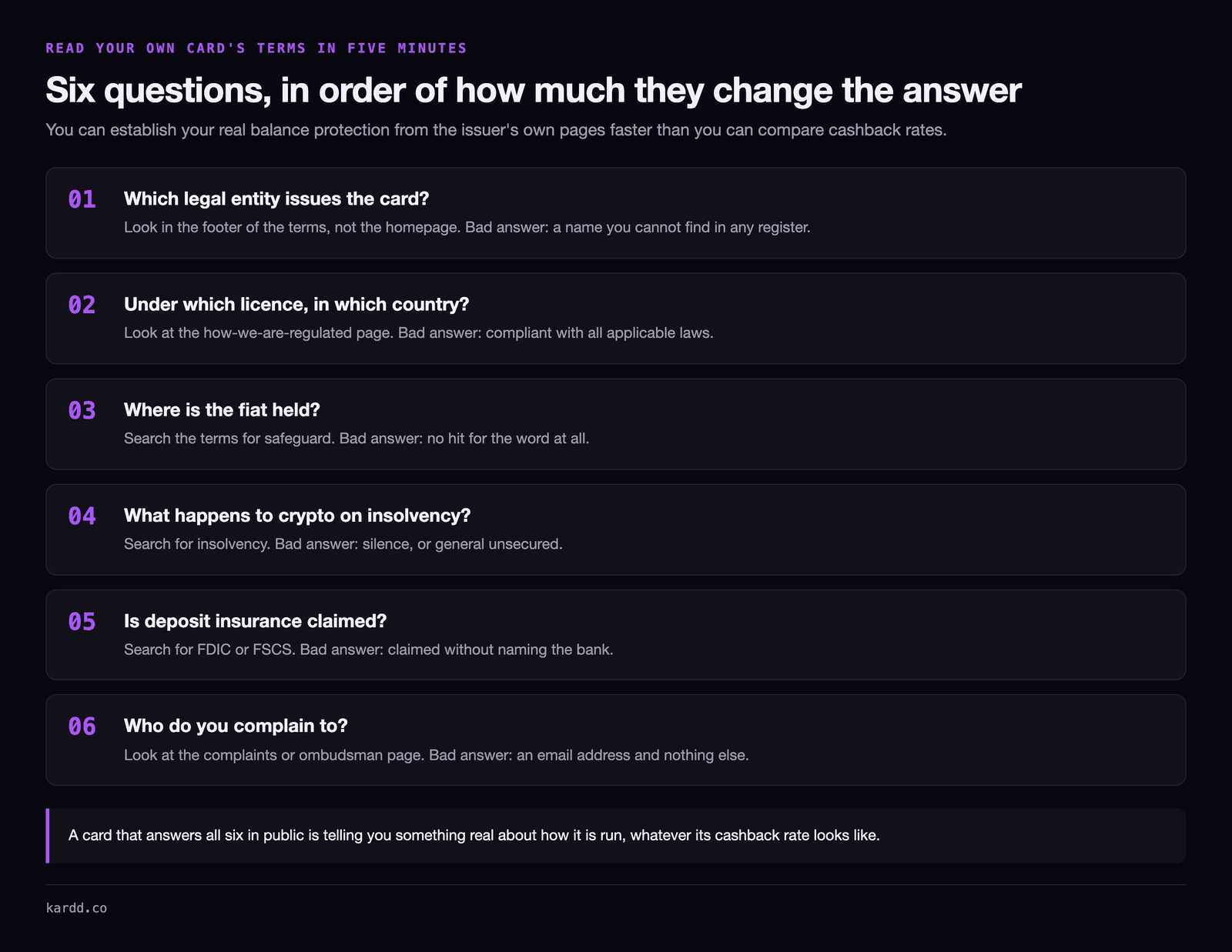
A card that answers all six in public is telling you something real about how it is run, whatever its cashback rate looks like. We record the issuing entity and licence for every card in the Kardd directory for exactly this reason.
Final Take
Crypto card balance protection is real but shallow, and it is thinnest exactly where the marketing is loudest. In the UK your balance sits outside the FSCS and inside a safeguarding regime whose historical average shortfall was 65%, with a serious upgrade arriving on 7 May 2026. In the US, pass-through insurance is genuine and narrow, and it did nothing for the customers of a middleman that failed while its banks stayed open. In the EU, a token-settled card carries the strongest claim of the three and still no compensation fund behind it.
None of that makes crypto cards a bad idea. It makes a large card balance a bad idea. Size the float to the spending, keep the holdings somewhere you chose deliberately, and read the six questions above before you load anything you would miss.
Compare cards by who actually holds the money
Kardd tracks issuing entity, licence, custody model, KYC level and fees across the whole crypto card market — so you can judge the structure behind a card, not just its cashback rate.
Kardd may earn a commission on sign-ups. Affiliate disclosure.
Related Articles
- Are No-KYC Crypto Cards Safe? Risks You Need to Know
- Crypto Card Frozen? What to Do When Your Card Locks Your Funds
- Why No-KYC Crypto Cards Shut Down
- Crypto Cards in Europe Under MiCA 2026
- Best Crypto Card UK 2026: HMRC Rules and Availability
- What Is a Crypto Card? The 2026 Pillar Guide
Frequently Asked Questions
Is my crypto card balance FSCS protected?
No. The FSCS protects deposits held with a PRA-authorised bank, building society or credit union, and says plainly that it cannot protect money held with e-money institutions and payment providers. A crypto card balance issued by an electronic money institution falls under the safeguarding rules instead, which require the firm to segregate your money but do not compensate you if some of it is missing when the firm fails.
What does safeguarding actually get me if the card issuer fails?
A priority claim on an asset pool, not a guarantee of the full amount. Under the Payment and Electronic Money Institution Insolvency Regulations 2021 an administrator gathers the safeguarded funds into an asset pool and pays e-money holders from it ahead of other creditors — but the costs of distributing that pool come out of the pool, and the FCA's review of payment firm insolvencies from Q1 2018 to Q2 2023 found average shortfalls of 65% of customers' funds.
Are crypto card balances FDIC insured in the United States?
Crypto never is. Dollar balances sometimes are, on a pass-through basis, if the provider places them with an FDIC-insured partner bank and keeps records good enough for the FDIC to identify each customer. Coinbase describes exactly that arrangement and states that digital currency is not insured or guaranteed by the FDIC. The pass-through only pays if the partner bank itself fails, which is the part most marketing leaves out.
Why did FDIC insurance not help Synapse's customers?
Because no bank failed. The Deposit Insurance Fund disburses when an insured bank fails, and in the Synapse collapse the middleman failed while its partner banks stayed open, so there was no trigger. The bankruptcy trustee reported shortfalls of $65m to $95m against customer claims — more than 100,000 people lost access to over $265m — because pass-through coverage depends on accurate records that did not exist.
Does MiCA protect a euro stablecoin card balance?
It gives you a redemption right that a plain e-money balance does not. Article 49 of the Markets in Crypto-Assets Regulation requires the issuer of an e-money token to redeem it at any time and at par value, with any fee limited to the cost of execution, and that claim arises by operation of law rather than because you contracted with the issuer. It is a stronger legal position, though still not deposit insurance.
Is a self-custodial crypto card safer if the issuer goes bust?
Safer from that specific risk, and less protected from every other one. If the tokens stay in a wallet you control until settlement, an issuer insolvency cannot trap them, because there is no pooled balance to trap. In exchange you give up what a regulated intermediary provides: nobody to reverse a payment, nobody obliged to redeem at par, and a lost key is final. See our stablecoin card comparison for which cards work this way.
How much should I keep loaded on a crypto card?
Treat the balance as spending money rather than storage. Every regime here restores a balance slowly, partially, or both, so the practical control is the size of the float rather than the strength of the scheme. Top up for the spending you expect over the next few weeks, and keep long-term holdings in custody you picked for its own sake.
Sources
Primary sources checked September 2026: the FCA on its safeguarding rule changes (PS25/12, in force 7 May 2026, the 65% average shortfall and the £100,000 audit threshold), the FSCS on e-money and its protection (the exclusion, and the £120,000 deposit limit from 1 December 2025), the Payment and Electronic Money Institution Insolvency Regulations 2021, Latham & Watkins on the special administration regime and the Ipagoo appeal (no statutory trust; distribution costs come out of the asset pool), Wirex on its UK regulatory status, the FTC on crypto firms claiming FDIC insurance (and the Voyager action), Coinbase's insurance disclosure (pass-through mechanics and the crypto exclusion), the Yale Journal of International Affairs on the Synapse collapse, and Regulation (EU) 2023/1114 (MiCA), Article 49. Voyager's initial 35.72% distribution is as reported in bankruptcy coverage rather than from a court filing we could read in full. Protection depends on the entity that issued your card — confirm yours before loading a balance.