Crypto Card Pre-Auth Holds 2026: 2 Hours or 60 Days
- Three rulebooks, three deadlines for the same hold. Visa's petroleum guidance: a confirmation advice within two hours, after which issuers must release the excess. UK and EEA law: immediately after the payment order arrives. Crypto.com's US agreement: up to 60 days. Your issuer's licence decides which you get — not the hotel.
- A UK or EEA issuer may not place the hold at all without your consent to the exact amount. Regulation 78 of the Payment Services Regulations 2017 is one sentence and no card page quotes it. Nobody consents to an exact figure at a pump.
- On a converting card, the hold is a disposal. KAST's terms freeze a “Settlement Amount” including a discretionary buffer, then convert those tokens at the market rate at the time of the transaction. Release hands back stablecoin or fiat — not the token sold, nor at its selling price.
- Three programmes publish nothing. XKard, Gnosis Pay and Wirex have no retrievable pre-authorisation clause — no document to hold them to, and no stated deadline to chase.
On this page
- A hold is not a charge, and that is the problem
- Why prepaid crypto cards take it worst
- Three deadlines that disagree
- Your legal right in the UK and the EEA
- The hold that sells your crypto
- What the fuel pump actually asks for
- Hotels and car hire: the 60-day line
- Which issuers publish a hold policy
- Getting a stuck hold released
- Final take
- FAQ
You check out of a hotel, the bill is €180, and €500 of your balance is still gone four days later. Nothing was charged twice and nothing went wrong — you have met a crypto card pre-authorisation hold, and on a prepaid card the money it freezes is the only money you have. The cost is not a fee, it is access: a $300 hold on a $400 balance leaves $100 for the rest of the trip. Every guide we read explains the mechanic with uncited round numbers and stops. So we read the two statutes that set a release deadline, four programmes' own card documents and Visa's petroleum rulebook — and found “how long can they hold it” has three published answers, between two hours and sixty days.

A hold is not a charge, and that is the problem
Some merchants do not know your final amount when you present the card. A pump does not know whether you will take $20 or $120 of fuel. So the terminal asks your issuer to approve an estimate, and your issuer reserves that figure. The money is not taken, it is made unavailable — the same thing in practice, a different thing in law.
Crypto.com's US Prepaid Visa Cardholder Agreement, effective 1 September 2026, sets out what the issuer promises at that moment: “When we authorize a purchase transaction, we commit to make the requested funds available when the transaction finally settles, and we will place a temporary hold on your Card’s funds for the amount indicated by the merchant.” Two details do the damage. The amount is indicated by the merchant, not by you or your issuer. And the hold runs until the transaction “finally settles” — a moment the agreement sets no deadline on.
That is the mechanic every competitor describes. What follows is what they leave out: who must undo it, and by when.
Why prepaid crypto cards take it worst
A credit card absorbs a hold inside a credit line you were not using. Most crypto cards are prepaid instruments where the loaded balance is the limit, so a hold does not reduce your headroom, it spends it — and a prepaid card cannot go negative. If a terminal asks $150 and you hold $80, you are refused, not because you cannot afford the $40 of fuel but because you cannot afford the estimate. Crypto.com's agreement confirms “no overdraft/credit feature”; its decline-at-point-of-sale fee is $0, the one mercy in the stack.
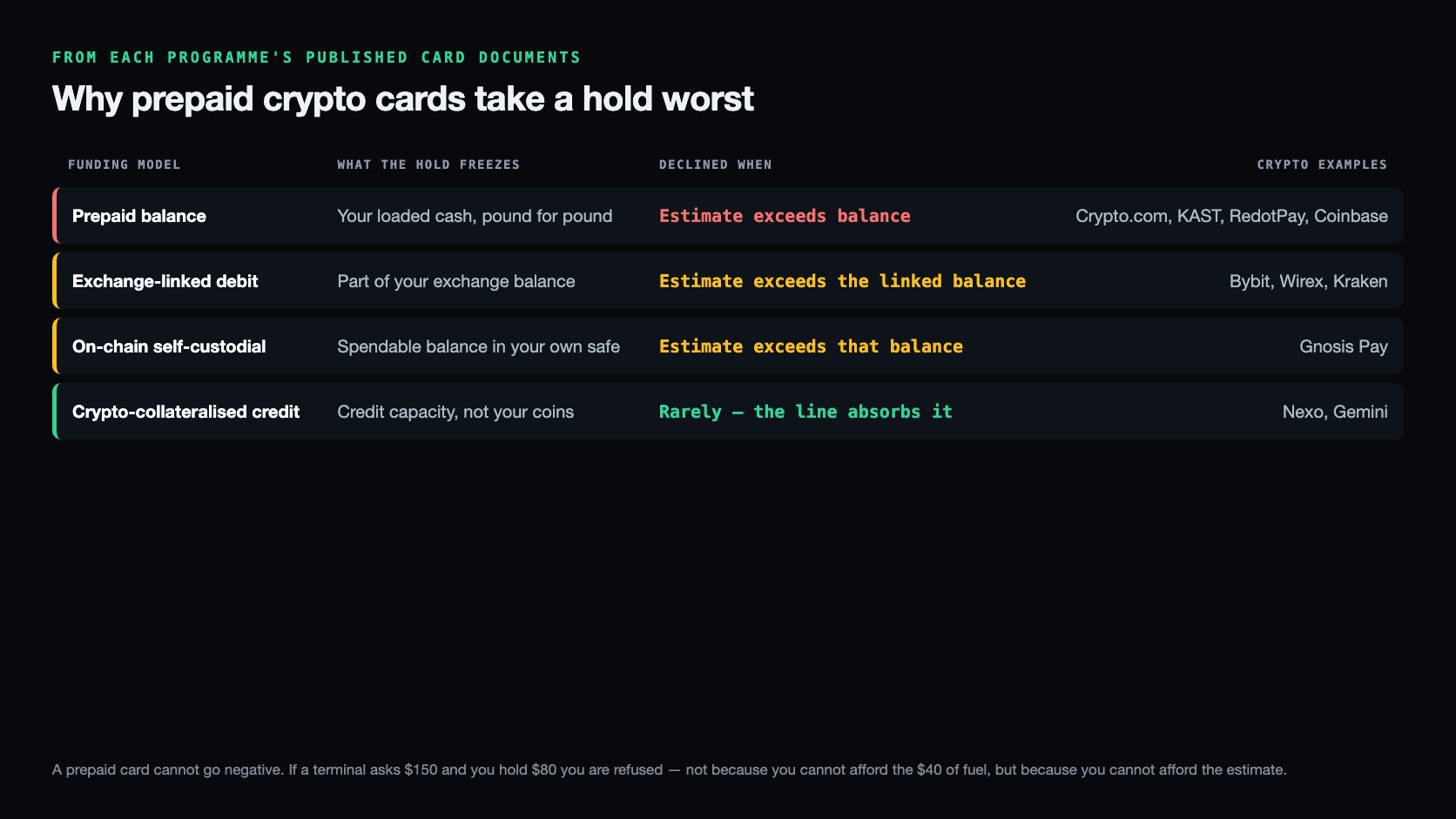
| Funding model | What the hold freezes | Declined when | Crypto examples |
|---|---|---|---|
| Prepaid balance | Your loaded cash, pound for pound | Estimate exceeds balance | Crypto.com, KAST, RedotPay, Coinbase |
| Exchange-linked debit | Part of your exchange balance | Estimate exceeds the linked balance | Bybit, Wirex, Kraken |
| On-chain self-custodial | Spendable balance in your own safe | Estimate exceeds that balance | Gnosis Pay |
| Crypto-collateralised credit | Credit capacity, not your coins | Rarely — the line absorbs it | Nexo, Gemini |
How the four funding models meet an authorisation hold. Kardd, 7 October 2026, from each programme's published card documents.
Three deadlines that disagree
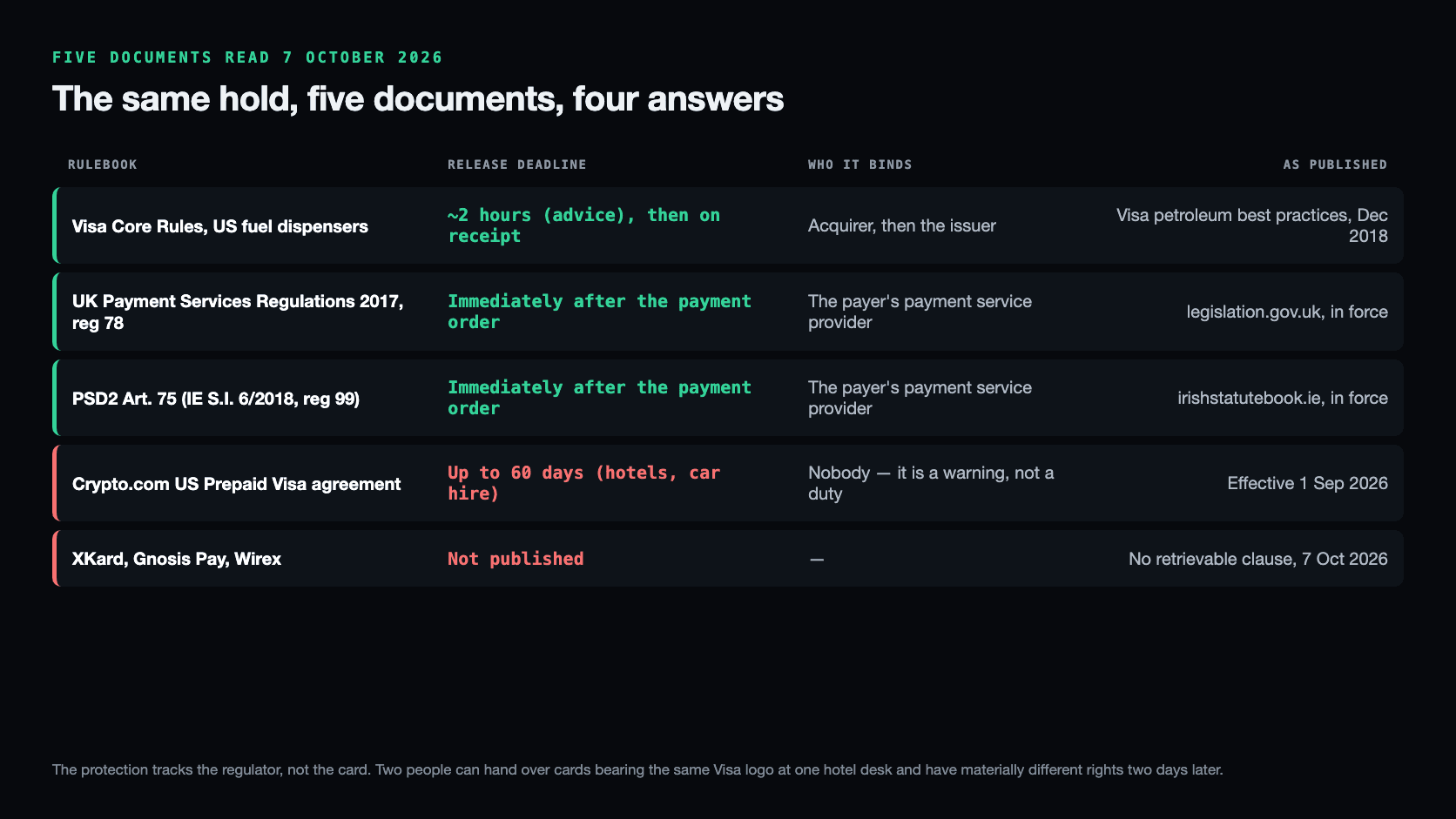
Ask how long a hold can last and each governing document answers differently.
Visa's guidance to US petroleum merchants is the strictest and least known. It states that “Visa Core Rules and Visa Product and Service Rules require U.S. automated fuel dispenser merchants that perform $1 status checks to submit Acquirer Confirmation Advices (0120 non-financial messages) within two hours of the status check authorization”, then imposes the duty that matters: “Upon receipt of the authorization holds, participating issuers must release any holds exceeding the final transaction amount specified in the advice.” The process diagram is blunter — “Card issuer releases the cardholder account hold when the confirmation advice message is received.”
UK and EEA law sets no clock in hours but ties release to an event that cannot be deferred. A US prepaid agreement, governing the most popular crypto card in the world, says sixty days.
| Rulebook | Release deadline | Who it binds | As published |
|---|---|---|---|
| Visa Core Rules, US fuel dispensers | ~2 hours (advice), then on receipt | Acquirer, then the issuer | Visa petroleum best practices, Dec 2018 |
| UK Payment Services Regulations 2017, reg 78 | Immediately after the payment order | The payer's payment service provider | legislation.gov.uk, in force |
| PSD2 Art. 75 (IE S.I. 6/2018, reg 99) | Immediately after the payment order | The payer's payment service provider | irishstatutebook.ie, in force |
| Crypto.com US Prepaid Visa agreement | Up to 60 days (hotels, car hire) | Nobody — it is a warning, not a duty | Effective 1 Sep 2026 |
| XKard, Gnosis Pay, Wirex | Not published | — | No retrievable clause, 7 Oct 2026 |
The same hold, five documents, four answers. Read 7 October 2026; sources at the end.
The structural finding is the one this site keeps reaching from different directions, most recently in our work on what happens to your balance if the issuer fails: the protection tracks the regulator, not the card. Two people can hand over cards bearing the same Visa logo at one hotel desk and have materially different rights to their own money two days later — one issued under a UK e-money licence, the other under a US prepaid programme.
Your legal right in the UK and the EEA
This is the section no crypto card guide has. Regulation 78 of the Payment Services Regulations 2017 is one sentence with two limbs, both useful if your money is stuck. Where a payee-initiated card transaction's amount is unknown when the payer authorises it:
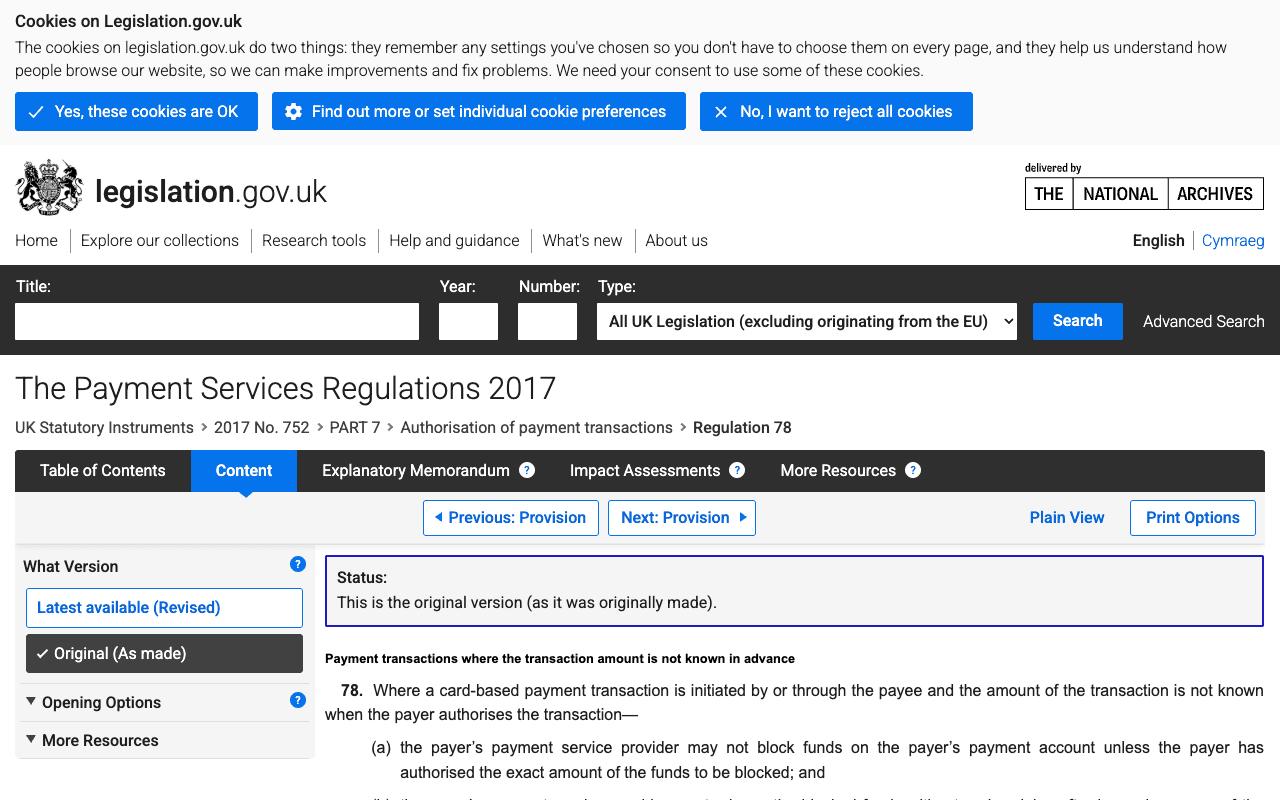
“(a) the payer’s payment service provider may not block funds on the payer’s payment account unless the payer has authorised the exact amount of the funds to be blocked; and
(b) the payer’s payment service provider must release the blocked funds without undue delay after becoming aware of the amount of the payment transaction, and in any event immediately after receipt of the payment order.”
Ireland's transposition of PSD2 — S.I. No. 6 of 2018, regulation 99 — says the same, which is how you know the duty is European rather than British: the issuer “may block funds…only if the payer has given consent to the exact amount of the funds to be blocked”, and must release “at the latest immediately after receipt of the payment order”.
Read limb (a) against a fuel pump and the gap is obvious: nobody consents to $150, you insert a card and start pumping. On limb (b), be precise: the duty is your issuer's, and the payment order arriving triggers it. If the hotel never sends a final amount, your issuer has nothing to release against — the real reason holds linger. The statute does not make your issuer liable for a merchant's silence; it removes the excuse once the merchant has spoken.
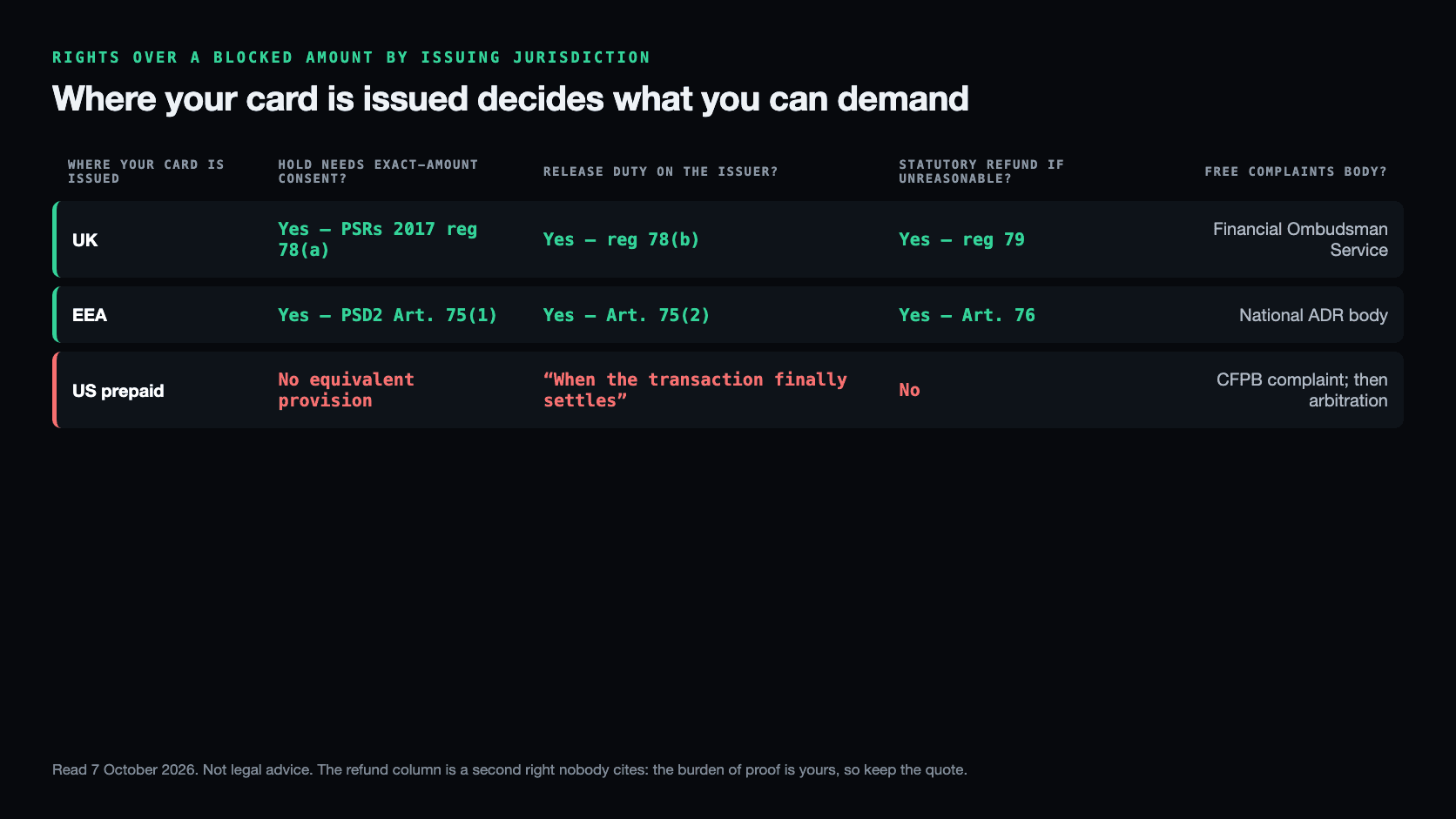
| Where your card is issued | Hold needs your exact-amount consent? | Release duty on the issuer? | Statutory refund if the amount was unreasonable? | Free external complaints body? |
|---|---|---|---|---|
| UK | Yes — PSRs 2017 reg 78(a) | Yes — reg 78(b) | Yes — reg 79 | Financial Ombudsman Service |
| EEA | Yes — PSD2 Art. 75(1) | Yes — Art. 75(2) | Yes — Art. 76 | National ADR body |
| US prepaid | No equivalent provision | “When the transaction finally settles” | No | CFPB complaint; then arbitration |
Rights over a blocked amount by issuing jurisdiction, 7 October 2026. Not legal advice.
The refund column is a second right nobody cites. Regulation 100 of the Irish instrument, transposing PSD2 Article 76, entitles a payer to a refund where “the authorisation did not specify the exact amount” and the amount “exceeded the amount the payer could reasonably have expected”. A hotel settling at triple its own quote is that pattern exactly. The burden of proof is yours, so keep the quote.
The hold that sells your crypto
Everything above applies to any prepaid card. This does not, and it is why a generic payments explainer cannot serve a crypto cardholder: on a card that converts at authorisation, a hold is not a freeze, it is a sale.
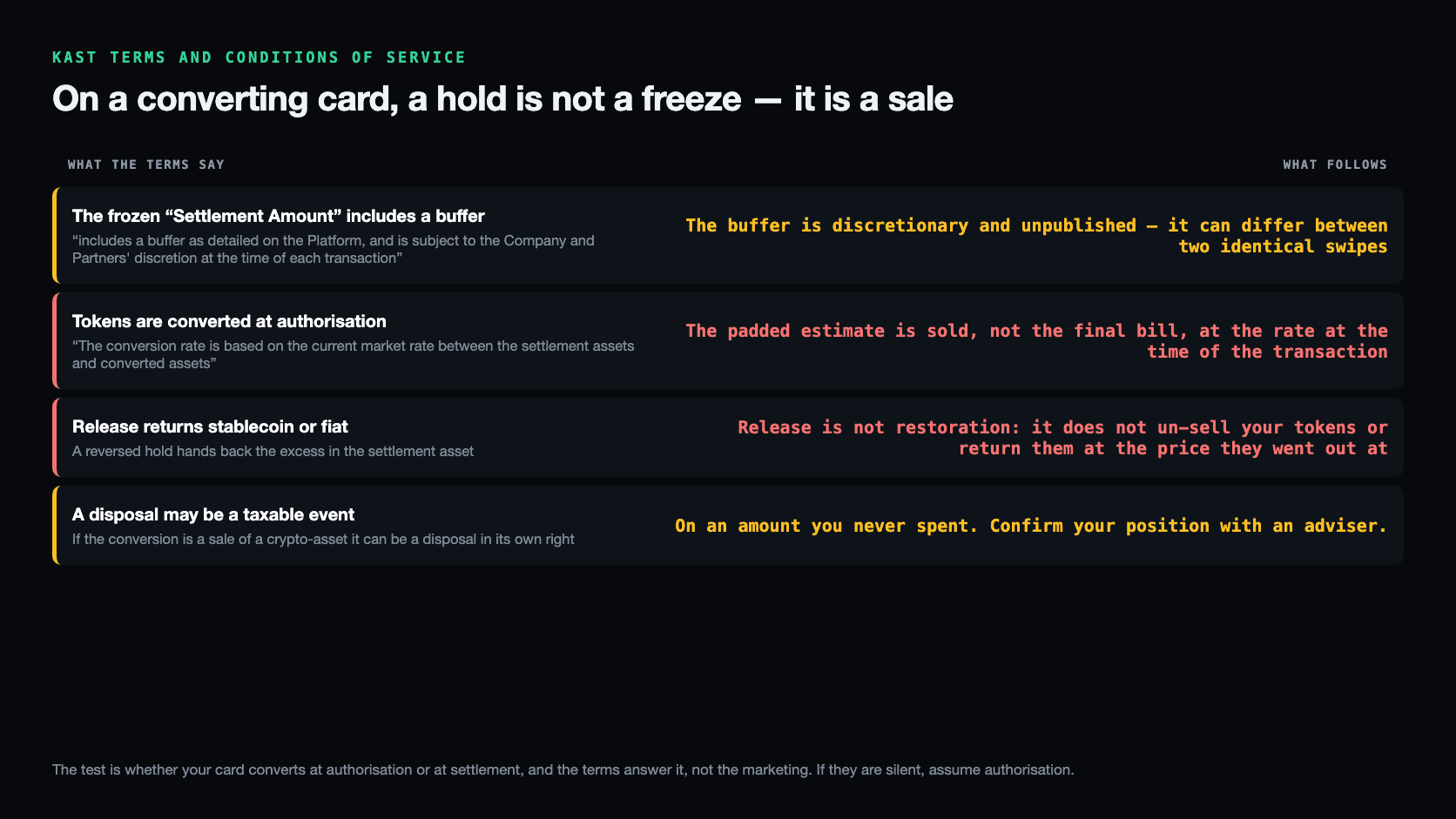
KAST's Terms and Conditions of Service set it out in two consecutive clauses. The hold: “You authorize the Partner to temporarily freeze an amount in the Custodian Wallet equal to the transaction cost and associated fees. This amount, referred to as the ‘Settlement Amount’, includes a buffer as detailed on the Platform, and is subject to the Company and Partners’ discretion at the time of each transaction.” Then the conversion: “you grant our Partners permission to convert and deduct the necessary amount of Acceptable Tokens from the Custodian Wallet … The conversion rate is based on the current market rate between the settlement assets and converted assets.”
So the figure converted is the Settlement Amount — the padded estimate, not the final bill — at the market rate at the time of the transaction. Three things follow that no competitor states:
1. Release is not restoration. A reversed hold returns the excess in stablecoin or fiat. It does not un-sell your tokens or return them at the price they went out at: a hold placed before a rally and released after one costs you the move on the buffer as well as the bill.
2. The buffer is discretionary and unpublished. “A buffer as detailed on the Platform” is not a number, and discretion “at the time of each transaction” means it can differ between two identical swipes.
3. A disposal may be a taxable event. If the conversion is a sale of a crypto-asset it can be a disposal in its own right — on an amount you never spent. We cover the general treatment in what a crypto card swipe actually triggers; confirm your position with an adviser.
Not every card works this way: one holding a stablecoin balance and settling in that stablecoin has no conversion to perform. The test is whether your card converts at authorisation or at settlement, and the terms answer it, not the marketing. If they are silent, assume authorisation.
What the fuel pump actually asks for
The fuel pump is the most common place a crypto card fails and the most misreported. Visa's petroleum document gives three ways a dispenser can authorise: the exact amount where the cardholder states it, a “$1.00 status check” where they do not, or a real-time estimate. Under the status-check route, once approved “the cardholder can begin pumping fuel up to $100 for US issued cards ($150 for commercial cards)”.
Here is the caveat the uncited articles skip: Visa's only public-facing petroleum document is dated December 2018 and still prints those figures. Visa raised the chip-terminal status-check limit to $175 in 2022, which is why consumer guides quote $100, $125, $150 and $175 interchangeably and none is simply wrong. For the figure that applies to your card today, your issuer's own number beats any range — and Crypto.com publishes one, updated 20 July 2026: gas stations “may factor in additional amounts to cover the potential filling of the tank, which can be around $50-150”.
| Merchant type | Published figure, and whose | Stated duration | The fix that works |
|---|---|---|---|
| Fuel pump (pay at pump) | $50–$150 — Crypto.com help centre, 20 Jul 2026 | Advice due in ~2 hrs (Visa) | Pay inside at the kiosk |
| Restaurant / bar | “An additional 20% (or more)” — Crypto.com agreement, 1 Sep 2026 | Until settlement | Keep 25% headroom over the bill |
| Hotel | Not published by any issuer we read | Up to 60 days for excess | Ask the desk for the exact figure |
| Car hire | Not published by any issuer we read | Up to 60 days for excess | Call ahead; many refuse prepaid |
| Abandoned transaction | Whole estimate — Crypto.com agreement | Until settlement or expiry | Complete or cancel at the terminal |
Only two hold figures are published by any issuer we read; the rest are the merchant's to set.
The pay-inside fix is not folk wisdom — it is Crypto.com's written advice: “if you want to avoid such a hold, you may want to pay inside the gas station, instead of paying at the pump.” Naming an exact amount at the kiosk turns an estimate into an ordinary authorisation, and is also the one route that satisfies regulation 78(a). If your card fails elsewhere too, our breakdown of nine reasons a crypto card gets declined separates a hold problem from a limit or category problem.
Hotels and car hire: the 60-day line
Competitors put the hotel hold at “up to 7 days”. The issuer's own document says otherwise, and it is the most important sentence here for anyone about to travel. From the Crypto.com US Prepaid Visa Cardholder Agreement, effective 1 September 2026: “Car rentals, hotels and other service-oriented merchants may choose to factor in additional amounts upon check-in, and it may take up to 60 days after your stay or your rental to have any excess amounts held by the hotel or rental company added back to your available balance.”
The same figure appears in the company's general help centre article of 20 July 2026, served to UK and European cardholders as readily as American ones. That is not an allegation of unlawfulness: the clause describes how long the merchant may take, while the statutory duty binds your issuer once it has the payment order. But a UK or EEA cardholder reading it is told the pessimistic outcome and nothing of the statutory one.
Car hire is the harder of the two. Many agencies refuse prepaid cards outright at the counter regardless of balance, because the card cannot be charged for damage once you have gone — merchant policy, not a payments rule, and no loaded balance changes it. The only reliable preparation is a phone call before you fly. If a hold does strand your money, the mechanics of getting it back are the ones we trace in where a crypto card refund actually goes.
Which issuers publish a hold policy
We looked for a pre-authorisation clause in each programme's published documents on 7 October 2026. The spread is the finding: one documents holds thoroughly, one documents the conversion but not the duration, and three publish nothing a cardholder could plan around.
| Programme | Pre-auth clause published? | Gives a hold figure? | Gives a release deadline? |
|---|---|---|---|
| Crypto.com | Yes — agreement §14 + help centre | Yes — $50–150 fuel, 20%+ tips | Partly — “up to 60 days” |
| KAST | Yes — terms, pre-auth + conversion | No — discretionary “buffer” | No |
| XKard | No clause retrievable | No | No |
| Gnosis Pay | No clause retrievable | No | No |
| Wirex | No clause retrievable | No | No |
Searched each programme's terms, legal pages and help centre, 7 October 2026. “No clause retrievable” means none was served in the public page source; three render their legal text client-side, so a clause may exist behind an app login.
Read the table with that caveat. XKard's terms page, Gnosis Pay's help centre and Wirex's legal pages all returned HTTP 200 with their text rendered in the browser rather than the page source, so no clause is publicly retrievable — not the same as none existing. The effect is: a clause you cannot read before you travel cannot help you at the counter. The pattern matches published spending limits and blocked merchant categories: the programmes publishing least are the same ones.
Getting a stuck hold released
A crypto card pre-authorisation hold that has outstayed its welcome is a sequencing problem, not a dispute. Step three cannot succeed until step one has happened.
| # | Do this | Why it is this way round |
|---|---|---|
| 1 | Ask the merchant to confirm it has sent the final amount | Only the merchant can close the authorisation; your issuer cannot release against a figure it never received. |
| 2 | Get the folio, receipt or rental agreement showing the settled total | Evidence of the exact amount — and of the quote, if you later need the reg 79 refund route. |
| 3 | Ask your issuer in writing to release the blocked funds | Cite PSRs 2017 reg 78(b), or PSD2 Art. 75(2) if EEA-issued. Writing starts the complaint clock. |
| 4 | At a fuel pump, ask whether a confirmation advice was received | Visa requires it within ~2 hours, and the issuer to release the excess on receipt. |
| 5 | Escalate to the ombudsman or ADR body after 8 weeks | Free and binding on a UK firm. DRN-5941317 shows FOS hears crypto card cases. |
| 6 | Stop loading the card until it clears | Topping up to spend around a hold raises your exposure without resolving it. |
The order matters more than the wording. Steps 3–5 need a UK- or EEA-regulated issuer.
Step five is worth knowing exists. The Financial Ombudsman Service takes complaints against UK-authorised crypto card issuers — decision DRN-5941317 concerns FORISGFS UK LIMITED trading as Crypto.com, the entity behind the UK card. It is free, and needs no wrong that fits a chargeback, which matters because a hold is not a charge. Where a settled amount is wrong rather than stuck, our guide to what you can actually dispute on a crypto card covers that route.
Check the issuer before you check in
Kardd tracks the issuing entity, the licence, the custody model and the KYC level for every card we cover — which is what decides whether a stuck hold is a two-hour problem or a sixty-day one.
Kardd may earn a commission on sign-ups, including XKard. Affiliate disclosure.
Final take
A hold is the one crypto card cost that never appears in a fee table, and the only one where a stranger at a till sets the amount. It is not going away, so the useful question is not how to avoid holds but whose deadline applies to yours. There the documents are clear and the marketing silent: Visa says two hours at a pump, UK and EEA law says immediately once the final amount lands, and the most popular crypto card in the world warns of sixty days.
So: pay inside at fuel stations, every time, on every card. Keep a quarter more loaded than your bill at restaurants, and a good deal more before a hotel or rental counter. And before you travel, learn two facts about your own card — which entity issues it, and whether it converts at authorisation or at settlement. The first decides your rights; the second decides whether a released hold hands back what it took. Neither is on the product page. Both are in the terms.
Related Articles
- Crypto Card Declined? 9 Reasons and Fixes for 2026
- Crypto Card Spending Limits 2026: The Real Numbers
- Crypto Card Balance Protection 2026: The Insolvency Rules
- Crypto Card Refunds 2026: Where Your Money Actually Goes
- Crypto Card Chargebacks 2026: What You Can Actually Dispute
- Crypto Card ATM Withdrawal Fees 2026: 9 Cards Compared
Frequently Asked Questions
How long can a crypto card hold my money?
It depends which rulebook binds your issuer. Visa's petroleum guidance requires a US fuel merchant running a $1 status check to send a confirmation advice within two hours, after which issuers must release any excess; UK regulation 78 and PSD2 Article 75 require release immediately after the payment order arrives. Crypto.com's US agreement of 1 September 2026 says up to 60 days after a hotel stay. Two hours to sixty days, same mechanic.
Why does my crypto card get declined at the fuel pump when I have money?
Because the pump asks your issuer to approve far more than you intend to spend, and a prepaid card cannot go negative. Crypto.com's help centre of 20 July 2026 says gas stations may factor in around $50–150 to cover filling the tank, so holding $80 fails a $150 request even if your fuel would cost $40. Crypto.com's own advice is to pay inside at the kiosk, which creates an authorisation for an exact amount.
Can my card issuer legally hold funds I did not agree to?
In the UK and the EEA, no. Regulation 78 of the Payment Services Regulations 2017 says the payer's payment service provider “may not block funds…unless the payer has authorised the exact amount of the funds to be blocked”, and Ireland's regulation 99 transposing PSD2 uses the same wording. Nobody consents to an exact figure at a fuel pump, which is why this is worth quoting to your issuer rather than the merchant.
Does a pre-authorisation hold sell my crypto?
On some cards, yes. KAST's terms have you authorise its partner to freeze a “Settlement Amount” including a discretionary buffer, then to convert and deduct that amount of tokens at the current market rate — so the held figure is realised at the hold, not at settlement. If the final bill is lower you are refunded in stablecoin or fiat, not the token sold and not at its selling price.
Why is the pending amount on my restaurant bill higher than the bill?
Because the terminal adds a tip allowance before you have decided on a tip. Crypto.com's US agreement of 1 September 2026 states that at certain restaurants there may be “an additional 20% (or more) added to the authorization to cover any tip you may leave”. If your bill plus that uplift exceeds your balance the card is declined for a meal you could afford, and the uplift disappears at settlement.
What can I do if a hold is not released?
Chase the merchant first: only it can send the final amount that closes the authorisation. If it has and your balance has not moved, the duty is your issuer's — ask in writing for the blocked funds to be released, citing regulation 78 if your card is UK-issued or PSD2 Article 75 if EEA-issued. If your issuer is UK-regulated, the Financial Ombudsman Service takes the complaint after eight weeks, and it does hear crypto card cases: decision DRN-5941317 concerns FORISGFS UK LIMITED trading as Crypto.com.
Sources
Every quotation above was read from the primary document on 7 October 2026: regulation 78 of the Payment Services Regulations 2017, regulations 99 and 100 of S.I. No. 6/2018, transposing PSD2 Articles 75 and 76, the Crypto.com Prepaid Visa Cardholder Agreement (US), section 14, effective 1 September 2026, the Crypto.com help centre on charges, fees and limits, updated 20 July 2026, Visa's Payment Acceptance Best Practices for U.S. Retail Petroleum Merchants, KAST's Terms and Conditions of Service and Financial Ombudsman Service decision DRN-5941317.