Crypto Card Taxes 2026: What a Swipe Actually Triggers

- The card's funding design decides when the tax event happens. A prefunded card puts the disposal at top-up. A convert-at-checkout card and a self-custody card put one on every purchase. Same lifetime tax, wildly different paperwork.
- No country we checked gives small card payments a free pass, and the US has no de minimis rule at all. The bill that would create one, S.2207, is still sitting in the Senate Finance Committee.
- The UK's second trigger is proceeds, not profit. HMRC's own summary notes require the capital gains pages once disposals exceed £50,000, which card spending reaches long before any gain does.
- Italy now taxes a euro-stablecoin card differently from a crypto one. From January 2026 it charges 33% generally but 26% on euro e-money tokens, and treats euro-to-token conversion as no disposal at all.
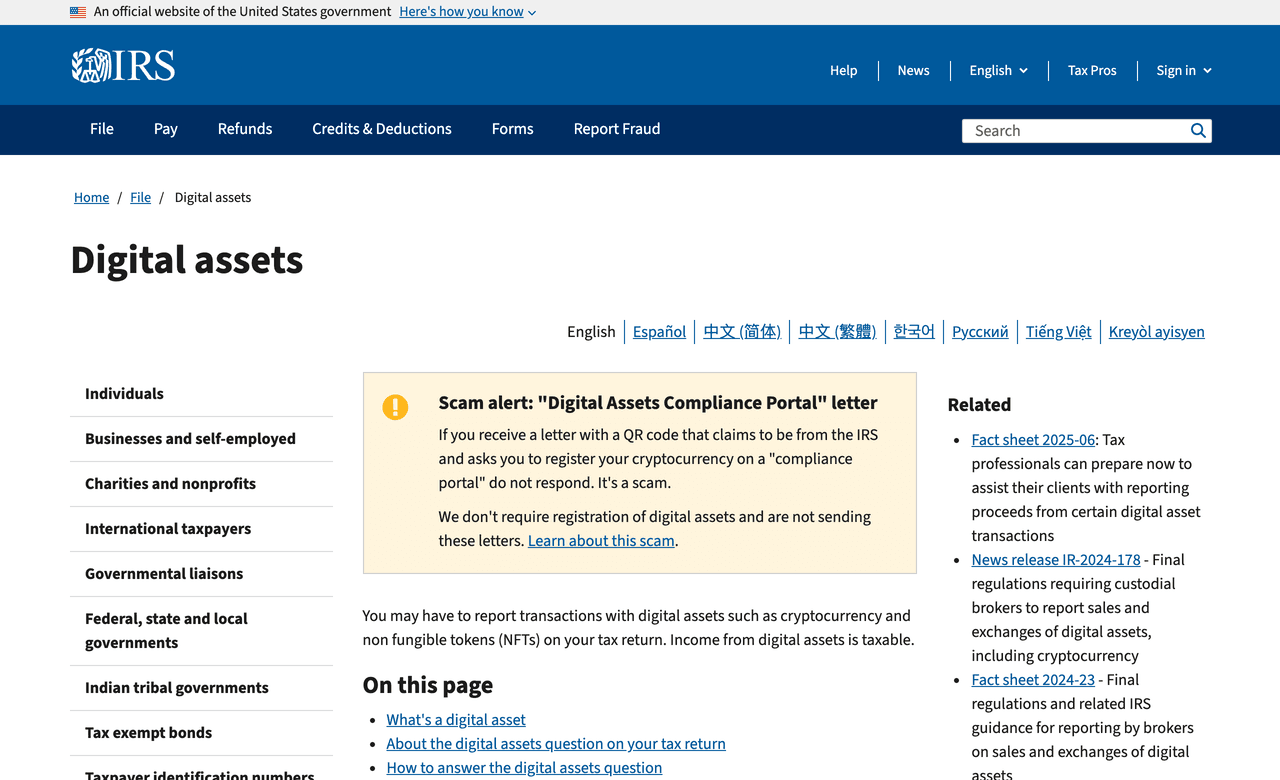
- 2026 is the first year the data flows. UK providers began collecting under the Cryptoasset Reporting Framework on 1 January and report by 31 May 2027; the EU's DAC8 started the same day.
On this page
- Three card designs, three taxable moments
- United States: every conversion is a property disposal
- Per-wallet basis made your card its own pool
- United Kingdom: £3,000 of gains, £50,000 of proceeds
- The EU is four answers, not one
- Italy's 2026 carve-out rewards euro cards
- 2026 is the year your card data starts moving
- Cashback, points and card tokens
- What to record, and what your issuer will not give you
- Final take
- FAQ
The awkward truth about crypto card taxes is that the swipe is rarely the taxable event, and almost every guide online gets that backwards. Tap a prefunded card and you are spending fiat that was already sold weeks ago. Tap a self-custody card and you have just disposed of a token at a coffee counter, with a US filing obligation attached to a $4 purchase and no dollar threshold to hide behind. The difference is worth real money in accountant hours: one design gives you twelve disposals a year, the other gives you six hundred.
We read the primary rules rather than the summaries — the IRS digital asset guidance, HMRC's Cryptoassets Manual and its Self Assessment notes, the European Commission's DAC8 page, Italy's 2026 budget law, Germany's § 23 EStG, France's 2026 rate change and Portugal's Article 10 CIRS — and lined them up against how the cards in our directory actually move money. Six regimes, one table each, and one finding that surprised us: as of 2026 Italy taxes a euro-stablecoin card at a lower rate than a Bitcoin one, and says the euro conversion leg is not a disposal at all.
Three Card Designs, Three Taxable Moments
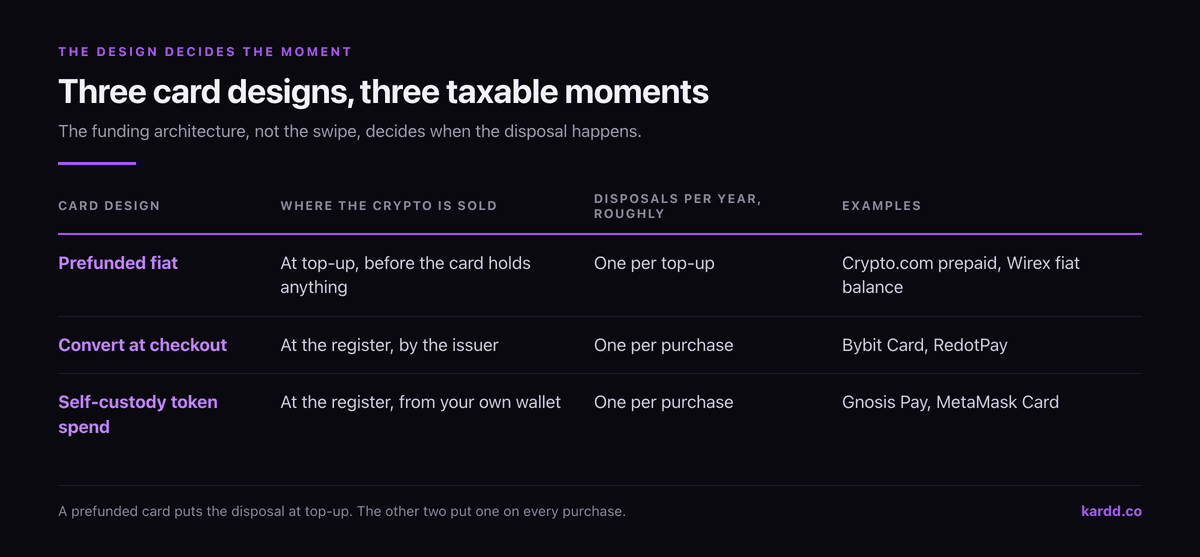
Start here, because everything else follows from it. A crypto card has to turn a token into something a terminal accepts, and the three ways of doing that put the disposal in three different places.
| Card design | Where the crypto is sold | Disposals per year, roughly | Examples |
|---|---|---|---|
| Prefunded fiat | At top-up, before the card holds anything | One per top-up | Crypto.com prepaid, Wirex fiat balance |
| Convert at checkout | At the register, by the issuer | One per purchase | Bybit Card, RedotPay |
| Self-custody token spend | At the register, from your own wallet | One per purchase | Gnosis Pay, MetaMask Card |
Crypto.com documents the first pattern plainly in its auto top-up help page: the crypto you nominate is automatically converted into an eligible fiat currency and then loaded onto the card. The sale happened in the app. By the time you are at the till, you are spending a fiat balance, and the purchase has no more tax significance than a supermarket gift card.
The third pattern is the opposite. Monerium, which issues the EURe token that Gnosis Pay and MetaMask Card settle in, describes users paying with stablecoins straight from their wallet while the merchant receives euros over the card networks. Nobody sold anything on your behalf in advance, so the disposal is yours, at the moment of purchase, at that day's rate. Our stablecoin card comparison sorts the market by exactly this mechanic.
United States: Every Conversion Is a Property Disposal
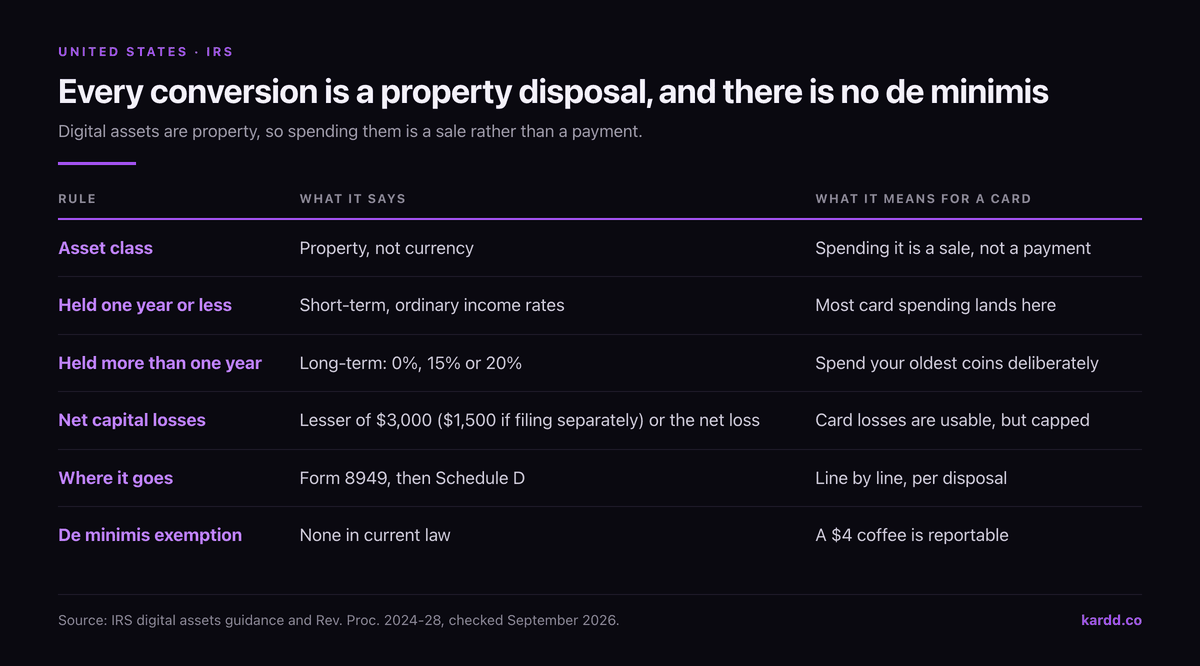
The US position is the strictest of the six and the least ambiguous. The IRS states that “for U.S. tax purposes, digital assets are considered property, not currency”, and the digital asset question on Form 1040 explicitly reaches an exchange or trade of a digital asset “for property, goods or services in any amount”. That last clause is the whole story: there is no floor.
| Rule | 2026 position | What it means for a card |
|---|---|---|
| Asset class | Property, not currency | Spending it is a sale, not a payment |
| Held one year or less | Short-term, ordinary income rates | Most card spending lands here |
| Held more than one year | Long-term: 0%, 15% or 20% | Spend your oldest coins deliberately |
| Net capital losses | Lesser of $3,000 ($1,500 if filing separately) or the net loss | Card losses are usable, but capped |
| Where it goes | Form 8949, then Schedule D | Line by line, per disposal |
| De minimis exemption | None in current law | A $4 coffee is reportable |
Whether that survives is a live question. Senator Lummis's S.2207, introduced on 30 June 2025, would exclude gain on personal-transaction disposals of up to $300, capped at $5,000 of excluded gain a year and indexed to inflation. It was referred to the Senate Finance Committee and has stayed there. Plan for the law as it is, not as it may become — a bill in committee is not a threshold.
Kraken puts it in one sentence to its own cardholders: using crypto to fund a card purchase is generally a disposal. That is an issuer telling you the swipe costs you a filing line, which is more candour than most card marketing manages.
Per-Wallet Basis Made Your Card Its Own Pool
One 2025 change quietly reshaped card record-keeping and barely appears in card coverage. Under Revenue Procedure 2024-28, the universal basis pool is gone: from 1 January 2025 US taxpayers track cost basis per wallet and per account, with a one-time safe-harbour allocation of the old pooled basis across those wallets.
This is the strongest practical argument for keeping one funding route into a card and leaving it alone. It also means the export you can get out of the card account matters more than it used to, which is the subject of the last section.
United Kingdom: £3,000 of Gains, £50,000 of Proceeds
HMRC settled the question years ago and states it in a list. CRYPTO22100 of the Cryptoassets Manual names four disposals: selling tokens for money, exchanging them for a different type of token, using tokens to pay for goods or services, and giving them away. A card payment is the third item verbatim.
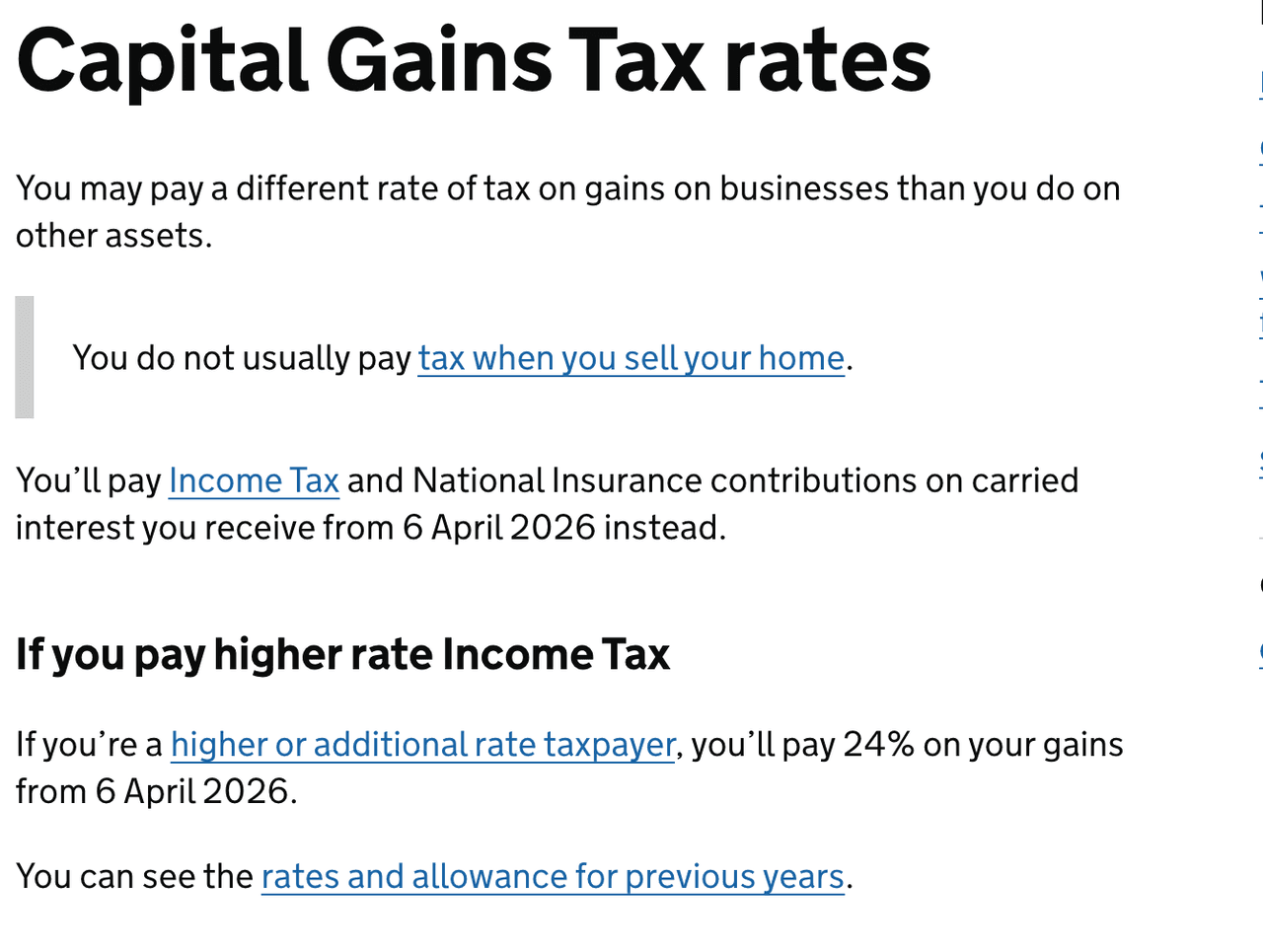
| UK rule | Figure | Source |
|---|---|---|
| Annual exempt amount, 2026–27 | £3,000 | GOV.UK, CGT rates |
| Rate within the basic rate band | 18% | GOV.UK, CGT rates |
| Rate above it / higher rate taxpayers | 24% | GOV.UK, CGT rates |
| Gains that force the CGT pages | Above £3,000 before losses | HMRC SA108 notes 2025–26 |
| Proceeds that force the CGT pages | Assets disposed of worth over £50,000 | HMRC SA108 notes 2025–26 |
That last row is the one nobody tells crypto card users. The proceeds test ignores whether you made a penny. Spend £1,000 a month from a USDC balance and you have disposed of £12,000 of chargeable assets with gains near zero; run a £4,200-a-month lifestyle through the card and you cross £50,000 of disposals inside a year, which pulls the capital gains pages into your return on volume alone. Prefunding does not escape it either, since the top-up is the disposal — it just makes the disposals larger and fewer.
Our UK crypto card guide covers which cards are actually available to UK residents after the 2025 availability shake-out, which is the question that has to be answered before the tax one matters.
The EU Is Four Answers, Not One
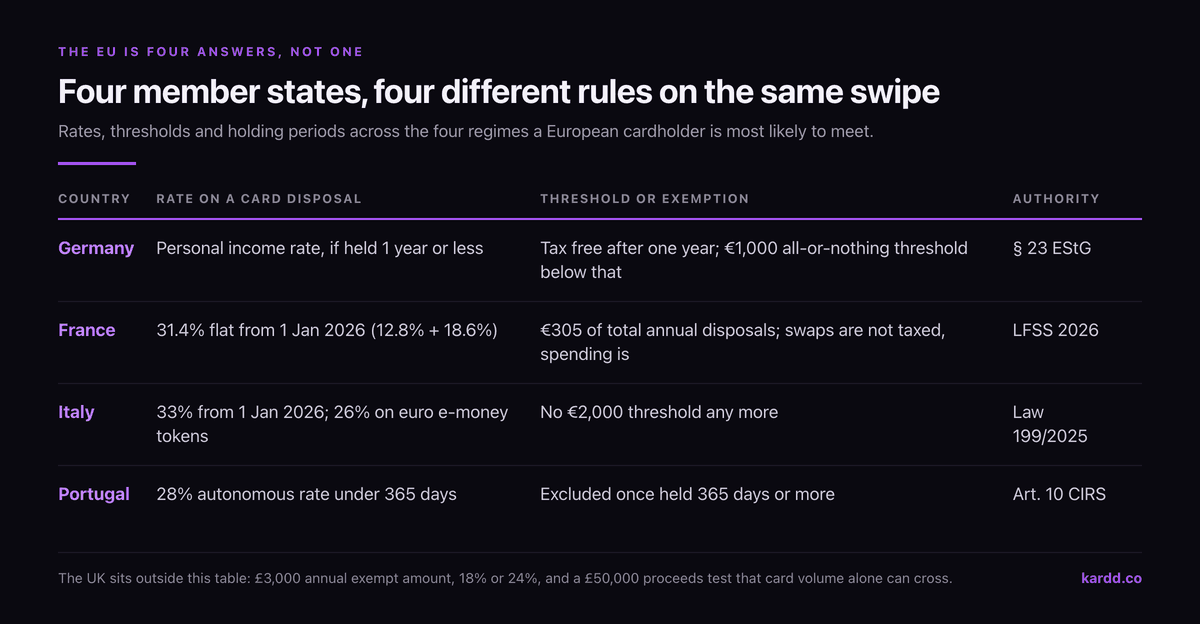
There is no EU capital gains regime. DAC8 harmonises the reporting from 2026 and leaves the taxing to member states, which is why the same card in two member states produces two different bills. Four regimes cover most of the cards in our directory.
| Country | Headline rate on card disposals | Relief that matters to a spender | Authority |
|---|---|---|---|
| Germany | Personal income rate, if held 1 year or less | Tax free after one year; €1,000 all-or-nothing threshold below that | § 23 EStG |
| France | 31.4% flat from 1 Jan 2026 (12.8% + 18.6%) | €305 of total annual disposals; swaps are not taxed, spending is | LFSS 2026 |
| Italy | 33% from 1 Jan 2026; 26% on euro e-money tokens | No €2,000 threshold any more | Law 199/2025 |
| Portugal | 28% autonomous rate under 365 days | Excluded once held 365 days or more | Art. 10 CIRS |
Two of those relieving rules reward the same behaviour and punish the opposite one. Germany and Portugal both hand you a total exemption for patience, so a card funded from coins you bought last year can be genuinely tax free in Berlin or Lisbon and fully taxable in Paris on the same purchase. France, meanwhile, produces the inversion that catches people: a crypto-to-crypto swap is not a taxable event there, but buying a sandwich with the same token is. A French holder rebalancing all day owes nothing; a French holder eating lunch owes 31.4% of the gain.
The German threshold deserves its own warning, because it is a Freigrenze and not an allowance. Reach €1,000 of short-term private-sale gains and the whole amount becomes taxable, not just the excess — the opposite of how the UK's £3,000 works. Our European crypto card guide tracks which programmes are licensed to serve EU residents at all under MiCA.
Italy's 2026 Carve-Out Rewards Euro Cards
This is the finding we did not expect, and it is the first tax rule we have seen that is effectively written around how a card works.
Italy's 2026 budget law, Law 199/2025, raises the substitute tax on crypto-asset gains to 33% from 1 January 2026. Article 13 then amends the previous year's provision to charge gains and other income from holding, transferring or using euro-denominated electronic money tokens at 26% instead — tokens whose value is anchored to the euro and whose reserves sit in euro assets with authorised EU entities. And it goes further: mere conversion between euro and a euro e-money token, and redemption of nominal value in euro, do not constitute a realisation of gain or loss.
Read the no-realisation clause carefully, because it is the part with teeth. If euro-to-token conversion is not a realisation event, the leg of a card payment that most resembles a foreign exchange conversion stops being a disposal, and what is left to measure shrinks to almost nothing. Our Gnosis Pay review covers how that card holds and spends EURe from a Safe you control.
2026 Is the Year Your Card Data Starts Moving
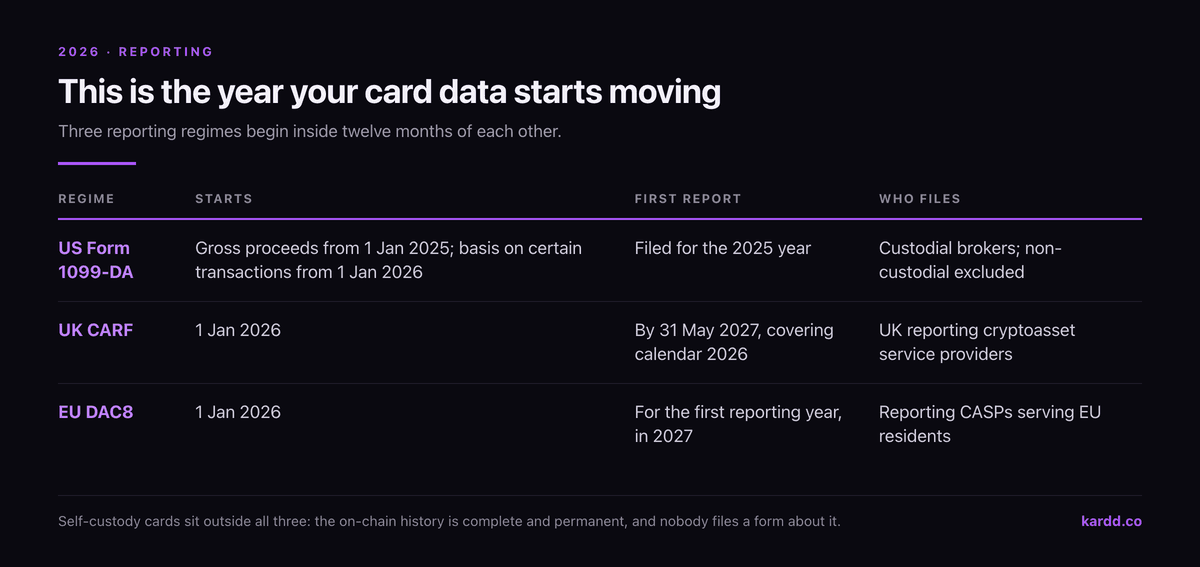
Until now, most crypto card spending was invisible to tax authorities unless a user volunteered it. Three regimes end that, and all three are running in 2026.
| Regime | Collection starts | First report | Who is caught |
|---|---|---|---|
| US Form 1099-DA | Gross proceeds from 1 Jan 2025; basis on certain transactions from 1 Jan 2026 | Filed for the 2025 year | Custodial brokers; non-custodial excluded |
| UK CARF | 1 Jan 2026 | By 31 May 2027, covering calendar 2026 | UK reporting cryptoasset service providers |
| EU DAC8 | 1 Jan 2026 | For the first reporting year, in 2027 | Reporting CASPs serving EU residents |
The asymmetry inside that table is the thing to notice. The US broker rules cover custodial brokers and, in the IRS's own words, do not include reporting requirements for brokers commonly known as decentralised or non-custodial. A self-custodial card generates the most taxable events and the least third-party paperwork — which cuts both ways, because an unreported disposal is still a disposal, and you are now the only party keeping the record.
Cashback, Points and Card Tokens
Rewards are where card taxation gets genuinely unsettled, and where you should be most suspicious of confident answers, including this one.
The mainstream professional position is that a reward you earn by spending resembles a purchase rebate rather than income, and Kraken says as much about its own card: fiat rewards are generally treated as non-taxable rebates. A reward paid in crypto is different in one specific way — it arrives with a cost basis set at the moment you receive it, so the move between then and the day you spend or sell it is a gain or loss you own.
What to Record, and What Your Issuer Will Not Give You
Four fields per disposal answer every question a tax authority can ask: the date, the asset and quantity, the fiat value at that moment, and your cost basis in that particular account. Get those and the return is arithmetic. Miss the fourth and you are reconstructing history from block explorers.
| Card type | What you can usually export | What is missing |
|---|---|---|
| Exchange-linked custodial | Statements, ledger and transaction history; a 1099-DA where US rules apply | Basis for coins you deposited from elsewhere |
| Standalone custodial card | Card statement in fiat | The crypto leg: which asset, what quantity, what rate |
| Self-custody card | On-chain history, complete and permanent | Fiat pricing, merchant detail and any tax form at all |
Kraken is refreshingly blunt about the limit of what an issuer does for you: asked whether it calculates your taxes, the answer is no. It gives you the documents. The arithmetic, the basis tracking and the filing are yours, and that is the industry norm rather than an outlier. If you want to understand what your statement is actually describing, our explainer on how crypto cards work walks the money through the conversion step by step.
Final Take
Card taxation is not complicated so much as badly explained. Two questions settle almost everything: where does the conversion happen, and does my country tax the disposal or the holding period? Prefunded card in Berlin with year-old coins, and the tax may genuinely be zero. Self-custody card in Paris, and every lunch is a 31.4% event.
What changed in 2026 is not the rates but the visibility. With CARF and DAC8 collecting from January and basis reporting arriving on 1099-DA, the gap between what you file and what your provider files is closing. Pick the card architecture that matches the paperwork you are willing to keep — and if you are choosing on tax alone, prefund in bulk and spend your oldest coins.
Compare cards by how they actually convert
Kardd tracks funding model, KYC level, fees and availability across the whole crypto card market — so you can pick the architecture that fits your records, not just the cashback rate.
Kardd may earn a commission on sign-ups. Affiliate disclosure.
Related Articles
- Best Crypto Card UK 2026: HMRC Rules and Availability
- Crypto Cards in Europe Under MiCA 2026
- Crypto Card Australia 2026 and the ATO Breakdown
- Crypto Cards in Canada 2026: CRA Implications
- USDT vs USDC Debit Cards Compared
- What Is a Crypto Card? The 2026 Pillar Guide
Frequently Asked Questions
Do you pay tax every time you use a crypto card?
It depends on when the crypto is sold, not on when you tap. If the card is prefunded, the conversion happened at top-up and that top-up was the disposal, so the swipe spends fiat. If the card converts at the register, or spends a token straight from your own wallet, each purchase is a disposal in its own right. Both designs create a similar lifetime tax; they differ enormously in how many events you have to record and price.
Does the IRS tax a $4 coffee bought with a crypto card?
Yes. The IRS treats digital assets as property rather than currency, and the Form 1040 digital asset question reaches an exchange or trade of a digital asset for property, goods or services in any amount. There is no de minimis exemption in current law. S.2207, introduced in June 2025, would exempt personal transactions up to $300 with a $5,000 annual cap on excluded gains, but it went to the Senate Finance Committee and has not been enacted.
Is spending crypto a disposal for UK Capital Gains Tax?
Yes. HMRC's Cryptoassets Manual at CRYPTO22100 lists using tokens to pay for goods or services as a disposal, alongside selling them, exchanging them for another token and giving them away. The annual exempt amount for 2026–27 is £3,000, and gains above it are charged at 18% within the basic rate band and 24% above it.
Do I have to report crypto card spending in the UK if I made no profit?
Possibly, because the second UK trigger is proceeds rather than profit. HMRC's Capital Gains Tax summary notes for 2025–26 say the summary pages must be completed if the chargeable assets you disposed of were worth more than £50,000, or if chargeable gains before losses were more than £3,000. Card spending accumulates disposal proceeds quickly, so a heavy spender can cross the £50,000 line while the gains stay near zero.
Are stablecoin card payments tax free?
Not automatically. A stablecoin disposal usually produces a gain or loss close to zero, but in most jurisdictions it is still a disposal that belongs in your records. Italy is the notable 2026 exception: its budget law charges euro-denominated e-money tokens at 26% rather than 33%, and provides that mere conversion between euro and a euro e-money token, and redemption at nominal value, do not realise a gain or loss at all.
Will my crypto card issuer send me a tax form?
Only if it is a custodial broker in a jurisdiction that requires one. Under the US rules, brokers report gross proceeds for transactions effected on or after 1 January 2025 and basis on certain transactions effected on or after 1 January 2026, and Kraken tells Krak cardholders it may issue Form 1099-DA. Those rules do not cover brokers commonly known as decentralised or non-custodial, so a self-custodial card programme sends you nothing.
Is crypto card cashback taxed as income?
The common professional position is that a reward earned by spending behaves like a purchase rebate rather than income, and Kraken states that fiat Krak card rewards are generally treated as non-taxable rebates. A reward paid in crypto still sets a cost basis when you receive it, so the gain or loss between that moment and the day you spend or sell it is taxable. Reward tokens and pre-launch points do not fit the rebate analysis cleanly and deserve an adviser's time.
Which crypto card creates the least tax paperwork?
A card you prefund in bulk. One monthly conversion into a fiat or e-money balance produces one disposal to price; a card that converts at the register produces one per purchase. The lifetime tax is similar, but the record-keeping differs by two orders of magnitude — and from 2026 both the UK Cryptoasset Reporting Framework and the EU's DAC8 mean your provider is handing its version of those records to a tax authority anyway.
Sources
Primary rules checked September 2026: IRS digital assets guidance (property treatment, the Form 1040 question, Form 8949 and the 1099-DA phase-in), IRS Topic 409 (holding period, rates and the $3,000 loss limit), Revenue Procedure 2024-28 (per-wallet basis), HMRC CRYPTO22100 and HMRC's cryptoasset disposal guidance, GOV.UK Capital Gains Tax rates, HMRC SA108 notes 2025–26 (the £50,000 proceeds test), GOV.UK CARF collection guidance, European Commission on DAC8, Italy's Law 199/2025 as analysed by Ratio Quotidiano, LegiFiscal on the 31.4% French flat tax, and the Portuguese tax authority's cryptoasset leaflet. Card mechanics from Crypto.com's auto top-up page, Monerium on EURe and Kraken's US Krak card tax page. Germany's one-year rule and €1,000 threshold sit in § 23 EStG; the German statute text and the Portuguese and Italian source PDFs could not be machine-read in full from this environment, so those three figures were corroborated across multiple independent tax-practice sources rather than quoted from the statute. Rates change with every budget — confirm yours before filing.