USDT vs USDC Debit Card 2026: Which Stablecoin to Fund Your Card With
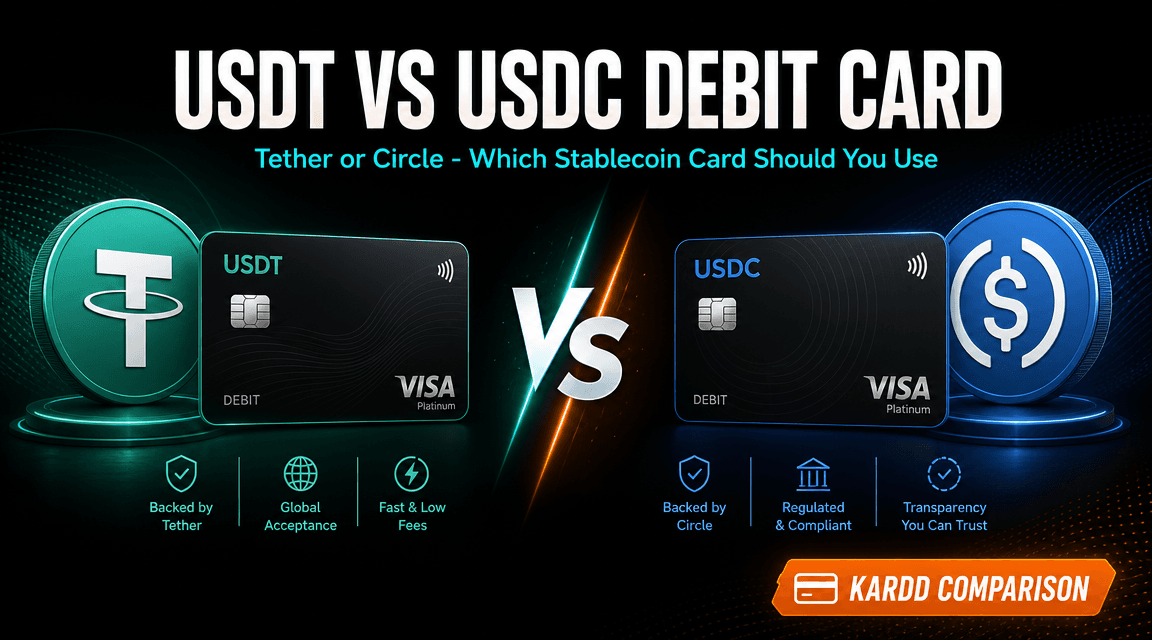
Short answer: If you want the highest cashback, fund your card with USDT via COCA at 8% cashback. If you want regulatory clarity and live in the US or EU, fund with USDC via Bleap, MetaMask Card, or Jupiter. Both stablecoins are safe for everyday spending in 2026 — USDC has stronger US regulation and monthly attestations, USDT has deeper liquidity and lower funding gas via Tron. Many crypto card users hold both to diversify issuer risk.
USDT and USDC are the two largest stablecoins in 2026, and they back the majority of crypto debit cards. The choice between them affects your cashback rate, your gas costs on top-ups, your regulatory exposure, and your ability to off-ramp. This guide breaks down the trade-offs based on issuer fundamentals, card support, depegging history, and tax treatment — with concrete picks for each common use case.
We compared USDT and USDC across 8 of the most popular crypto cards in 2026: KAST, COCA, Bleap, Gnosis Pay, MetaMask Card, Wirex, Crypto.com, and Jupiter. The choice is not always "pick one" — many cards support both.
Issuer Fundamentals: Tether vs Circle
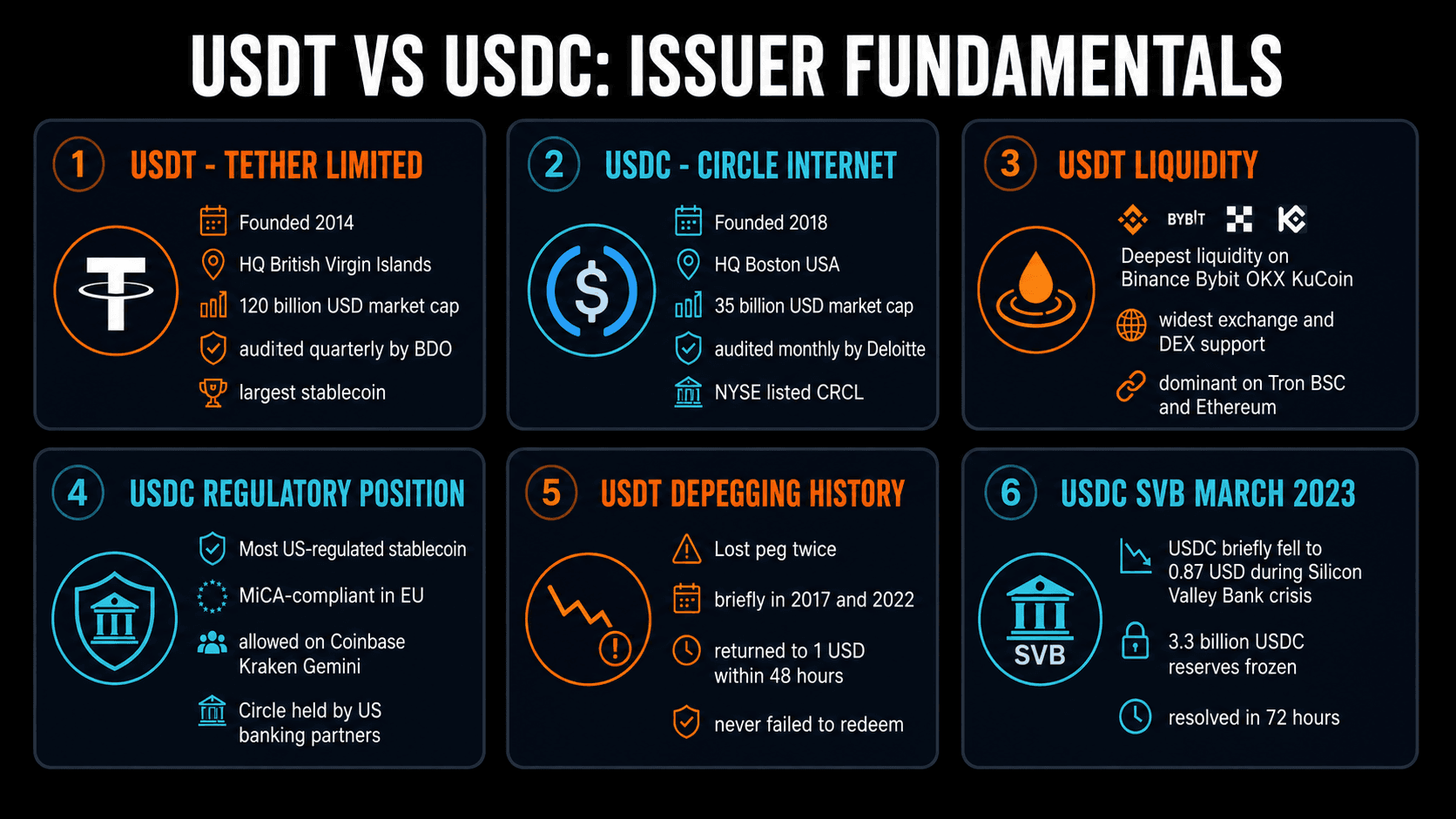
USDT — Tether Limited
- Founded: 2014 (oldest major stablecoin)
- Issuer: Tether Limited / iFinex Inc.
- HQ: British Virgin Islands; primary operations in El Salvador
- Market cap (June 2026): approximately 120 billion USD
- Attestations: Quarterly reports by BDO Italia
- Networks: Tron (largest), Ethereum, Solana, BNB Chain, Avalanche, Polygon, Algorand
- Key advantage: Deepest liquidity globally, dominant in emerging markets, near-zero gas on Tron
- Key concern: Lighter regulation than USDC; previous fines (NYAG 2021)
USDC — Circle Internet Financial
- Founded: 2018
- Issuer: Circle Internet Financial
- HQ: Boston, USA
- Market cap (June 2026): approximately 35 billion USD
- Attestations: Monthly reports by Deloitte
- Networks: Ethereum, Solana, Base, Polygon, Arbitrum, Optimism, Linea, Avalanche
- Key advantage: Most US-regulated stablecoin, MiCA-compliant in EU, Circle is NYSE-listed (CRCL)
- Key concern: Smaller market cap, slightly less liquid than USDT, gas fees on Ethereum can be high
Depegging History — Both Have Slipped
Both stablecoins have lost their 1 USD peg briefly in their history. Both recovered. Worth knowing before you fund a card with either.
USDT Depegging Events
- October 2017: USDT briefly fell to ~0.92 USD amid concerns about Tether reserves. Recovered within 24 hours.
- May 2022: Following the Terra/UST collapse, USDT briefly traded at 0.95 USD on some exchanges. Recovered within 48 hours. Tether processed over 10 billion USD in redemptions during this period without halting.
USDC Depegging Event
- March 2023: USDC fell to 0.87 USD on Saturday, March 11, after Circle disclosed 3.3 billion USD of USDC reserves were held at Silicon Valley Bank, which had just collapsed. The peg restored within 72 hours once the FDIC guaranteed SVB deposits. Circle has since diversified bank partners.
Lesson: Neither stablecoin is risk-free. Both depegging events lasted under 72 hours. For everyday card spending the risk is minimal, but for large idle balances (above 10,000 USD), consider diversifying across both issuers.
Which Cards Support Which Stablecoin
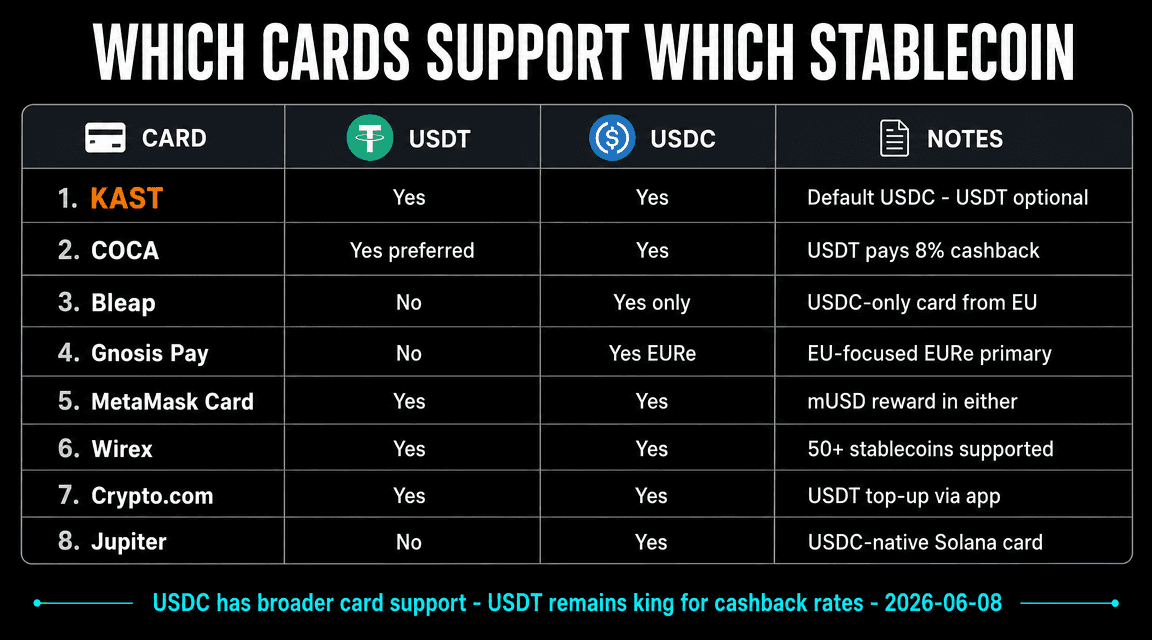
| Card | USDT | USDC | Notes |
|---|---|---|---|
| KAST | Yes | Yes | Default USDC, USDT optional |
| COCA | Yes preferred | Yes | USDT pays 8% cashback |
| Bleap | No | Yes only | USDC-only EU card |
| Gnosis Pay | No | Yes (+ EURe) | EU-focused EURe primary |
| MetaMask Card | Yes | Yes | mUSD reward in either |
| Wirex | Yes | Yes | 50+ stables total |
| Crypto.com | Yes | Yes | USDT top-up via app |
| Jupiter | No | Yes | USDC-native Solana card |
USDC has broader card support. Every card on this list accepts USDC. Only 5 of 8 accept USDT. If you want flexibility across multiple cards, USDC is the safer bet. If you want one card with highest cashback, COCA + USDT is the winning combination.
Verdict by Use Case
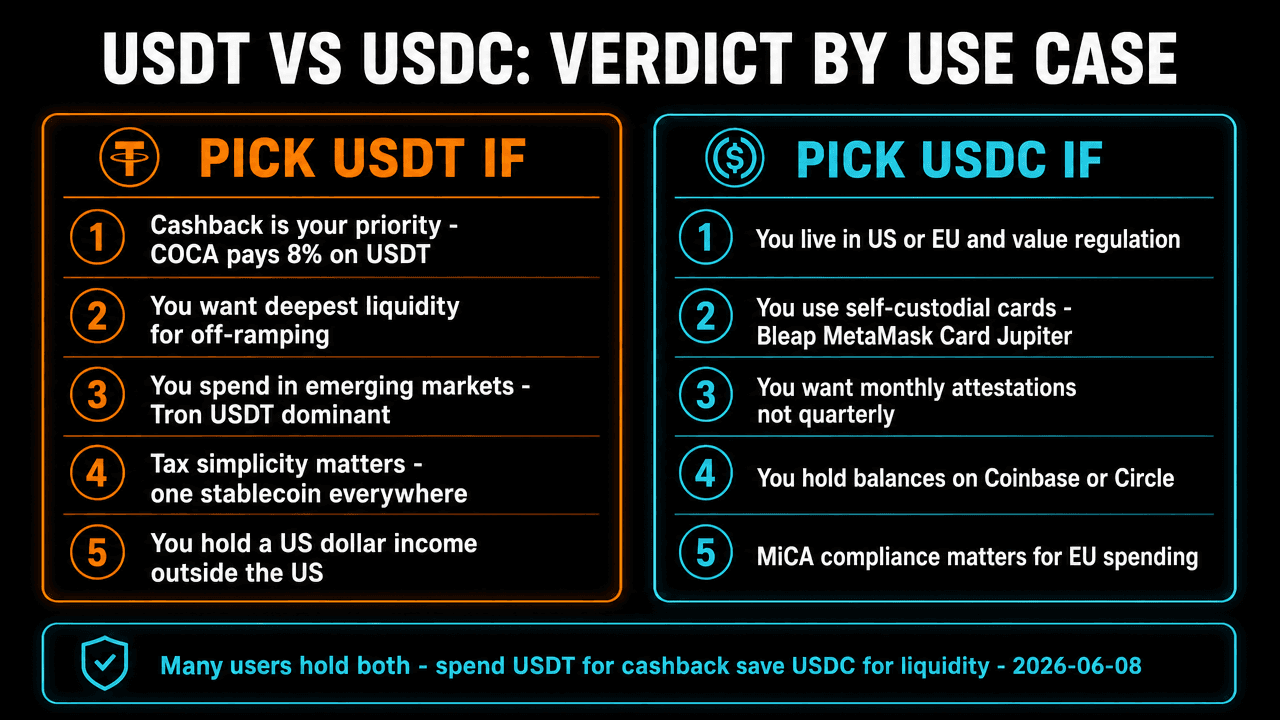
Pick USDT if
- Cashback is your priority — COCA pays 8% on USDT
- You want deepest off-ramp liquidity
- You spend in emerging markets where Tron USDT dominates
- Tax simplicity matters — use one stablecoin everywhere
- You hold US dollar income outside the US
- You want near-zero gas via Tron for top-ups
- You trade frequently — USDT is base pair on most exchanges
Pick USDC if
- You live in the US or EU and value regulation
- You use self-custodial cards — Bleap, MetaMask, Jupiter
- You want monthly attestations not quarterly
- You hold balances on Coinbase, Kraken, or Circle
- MiCA compliance matters for EU spending
- You use Solana — USDC is the default on Solana
- You want to fund a Gnosis Pay Safe with EURe paired
Hold Both, Diversify Issuer Risk
The honest answer for most users with non-trivial balances: hold both. The historical evidence is that single-issuer events (Tether NYAG fines, Circle SVB exposure) can briefly affect price even when reserves are fundamentally sound. By holding both USDT and USDC, you cap your exposure to any single issuer failure.
A practical split for an active crypto card user: 50% USDT (for cashback via COCA), 50% USDC (for spending via Bleap or MetaMask Card). Top up each card from the corresponding stablecoin. If either issuer has a depeg event, you still have a working card on the other.
Tax Treatment Is Identical
The IRS, HMRC, ATO, and CRA all treat USDT and USDC identically for tax purposes:
- Each spend is a disposal that triggers a capital gain or loss event.
- The cost basis is your acquisition price (usually 1 USD if bought direct from issuer or 1:1 from CEX).
- Because the disposal price is also ~1 USD, the capital gain or loss is near zero per transaction.
- The number of taxable events is identical between USDT and USDC spending.
- If you receive USDT or USDC as income (freelance pay, airdrops), it is ordinary income at fair market value when received.
Use Koinly, Kryptos, or CoinTracking to automate the reporting. All three handle USDT and USDC identically.
Final Recommendation
For most crypto card users in 2026, the right answer is "use whichever stablecoin your preferred card pays the highest cashback in." That means:
- If COCA is your card: fund with USDT (8% cashback).
- If Bleap is your card: fund with USDC (USDC-only, up to 20% cashback).
- If MetaMask Card is your card: either works (mUSD reward in either).
- If KAST is your card: USDC default, with SOL staking yield on idle balance.
- If Gnosis Pay is your card: USDC or EURe (no USDT support).
- If Jupiter is your card: USDC only (Solana native).
If you cannot decide, default to USDC for US/EU residents who value regulation, or USDT for users in emerging markets who want maximum liquidity. Either way, you are spending a stablecoin that has survived multiple stress tests and processed trillions of dollars in transactions safely.
Related Reading
- Best Stablecoin Debit Card 2026 — full ranking of 7 cards
- USDT to Debit Card — how to spend USDT directly
- Cheapest Way to Spend USDT
- COCA Card Review — 8% USDT cashback
- Bleap Card Review — 20% USDC cashback
- KAST Card Review
- What is a Crypto Card? (Pillar Guide)