Best Crypto Card Australia 2026: 7 Cards Tested + ATO Tax Breakdown
Quick answer: Best crypto cards for Australian residents in 2026 are Crypto.com Card (most mature AU support, direct AUD funding via PayID), MetaMask Card (self-custody, Feb 2026 launch), and CoinJar Card (Australian-issued via EML Payments). For privacy: XKard (email signup, 5% USDC cashback). Critical: every crypto-to-AUD tap is an ATO CGT event — use Koinly, Crypto Tax Calculator, or Kryptos to automate tracking. AUSTRAC-registered DCEs (CoinSpot, Swyftx, Independent Reserve) are the cleanest funding path.
Australia is one of the most active crypto markets per capita — and one of the most tax-aggressive. The ATO has explicit guidance that loading or topping up a crypto debit card is a CGT event. This guide covers the 7 crypto cards confirmed available to Australian residents in 2026, the exact ATO rules you can't ignore, the AUD on-ramp options that work, and the AUSTRAC compliance considerations behind each card.
Big shift in 2026: the ATO's crypto data-matching program now pulls transaction records from all AUSTRAC-registered Digital Currency Exchanges (DCEs). If you fund a crypto card via CoinSpot, Swyftx, or Independent Reserve, the ATO sees it. Voluntary tax compliance is no longer optional in practice.
6 Things to Check Before Picking a Crypto Card in Australia
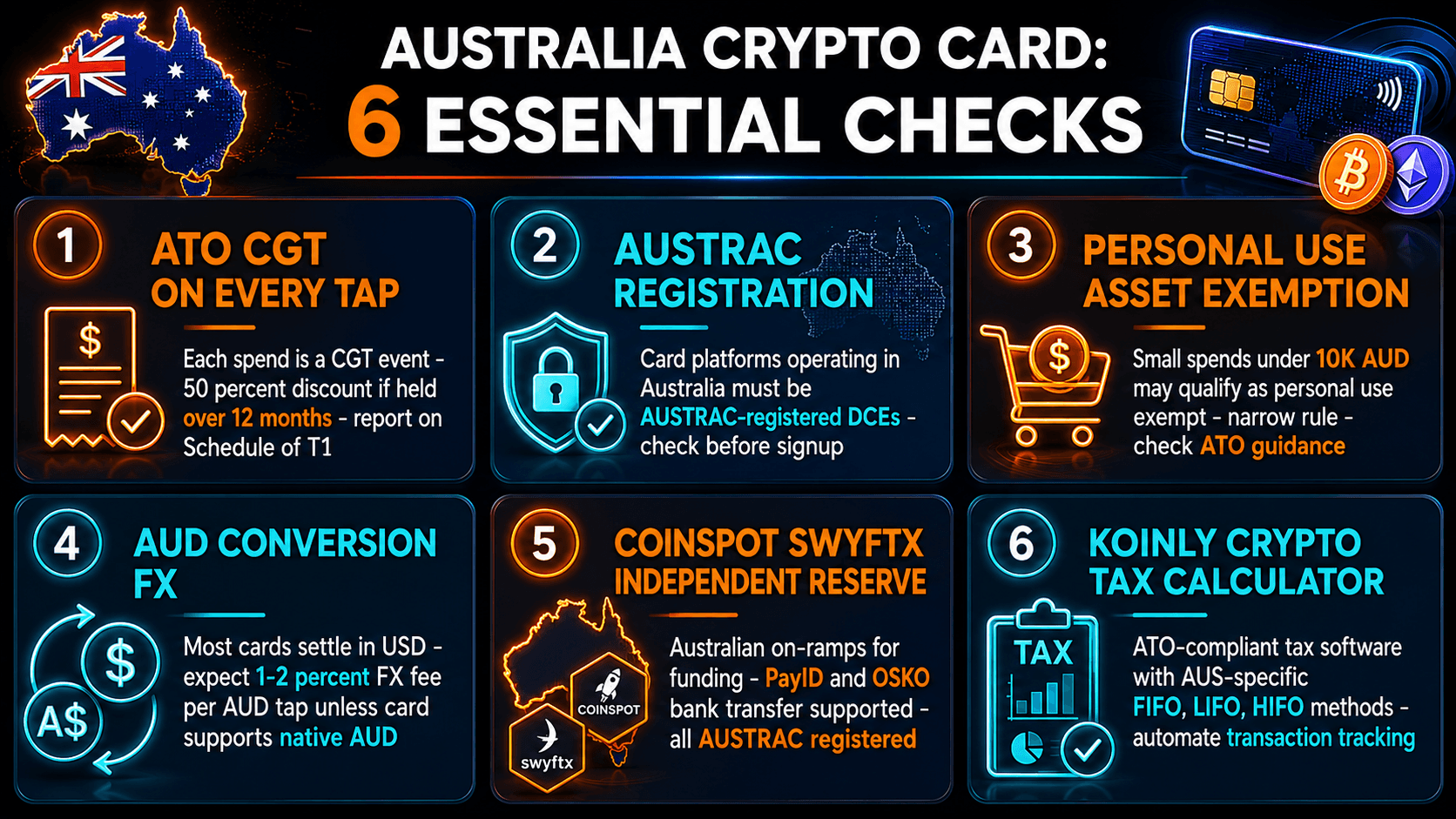
- ATO CGT on every tap. Each crypto-to-AUD spend is a disposal event. Capital gain or loss based on adjusted cost base (ACB). 50% CGT discount if held over 12 months. Stablecoin spends still trigger small gain/loss from USD-AUD FX movement. Report on Item 18 of the T1 individual tax return.
- AUSTRAC registration. Card platforms operating in Australia or routing funds through AU partners must be AUSTRAC-registered DCEs. Check the AUSTRAC public register before funding. Cards routed via overseas EMIs (e.g., MetaMask Card via Baanx) operate outside this rule but Australian on-ramps must still be AUSTRAC-registered.
- Personal use asset exemption (Section 108-20). Crypto held briefly and spent on personal items can be CGT-exempt if total cost was under $10,000 AUD. The ATO interprets "briefly" strictly — this is NOT a workaround for held-as-investment crypto. Most card users don't qualify.
- AUD direct funding vs FX hop. Crypto.com and CoinJar settle in native AUD with PayID and OSKO bank transfers. Most other cards (MetaMask, Coinbase) convert via USD — expect 1-2% FX fee per AUD tap.
- CoinSpot, Swyftx, Independent Reserve. The cleanest Australian crypto-to-card funding path is via an AUSTRAC-registered DCE. PayID (instant) and OSKO bank transfers supported. Spreads typically 0.5-1.5%. Card issuance is then via stablecoin top-up to the card platform.
- Crypto tax software. Koinly, Crypto Tax Calculator (Australian company), Kryptos, and CoinLedger all support ATO rules including FIFO/LIFO/HIFO cost basis methods and the 12-month CGT discount. Most offer free tiers for under 100 transactions/year.
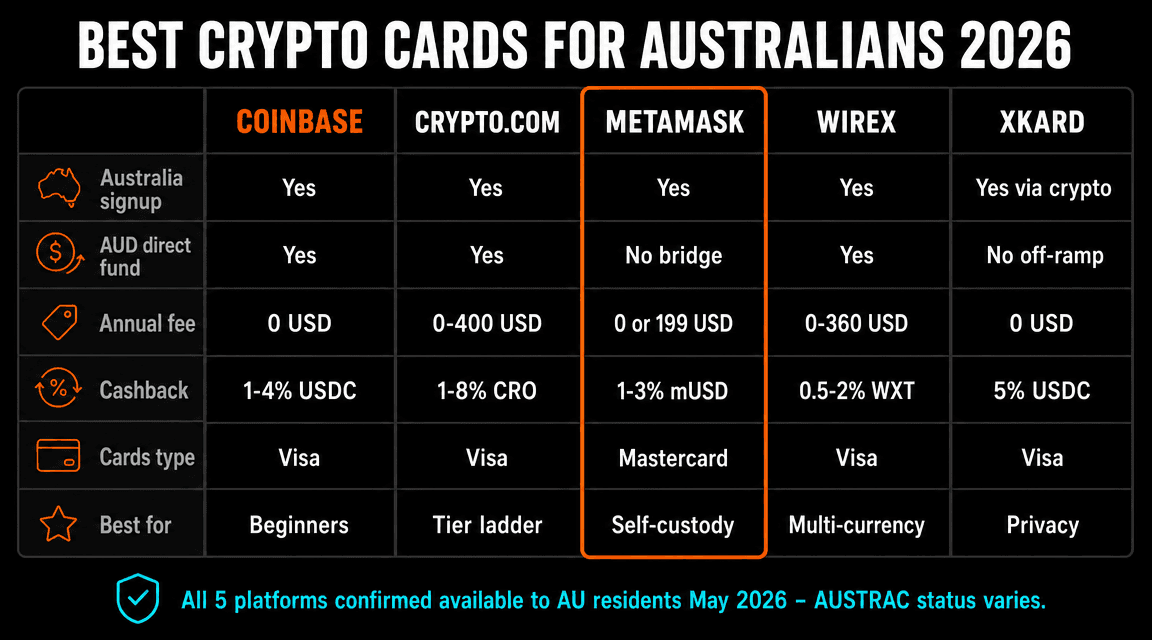
Top 5 Crypto Cards for Australian Residents (2026)
1. Crypto.com Card — Best Mature AU Pick
Crypto.com Card has the deepest Australian integration of any crypto card. AUD funding via PayID and OSKO. Free Midnight Blue tier. Ruby/Royal/Obsidian tiers require CRO staking for higher cashback (1-8%). Apple Pay and Google Pay supported. The platform's Australian fiat support is direct — no FX hop needed for AUD transactions.
- Pro: Native AUD funding (PayID, OSKO), AUSTRAC-registered partner, broad crypto support
- Con: Custodial (Crypto.com holds your balance), high-tier cards require CRO stake-lock
- Best for: Australians wanting simplicity and direct AUD funding
2. MetaMask Card — Best Self-Custody Pick
MetaMask Card launched in Australia in February 2026 as part of its global rollout. Free Virtual tier with 1% mUSD cashback. Funds stay in your MetaMask wallet on Linea, Base, Solana, or Monad until you tap. Settles via Mastercard's FX rate for AUD purchases. No native AUD funding — bridge USDC or USDT from CoinSpot/Swyftx.
- Pro: Self-custody, 9 supported tokens, Mastercard accepted everywhere
- Con: 1-2% effective FX on AUD purchases (Virtual tier), Metal tier with zero FX only ships to US addresses currently
- Best for: Australian crypto natives who want to keep funds on-chain
3. CoinJar Card — Best Aussie-Issued Card
CoinJar Card is issued by EML Payments under Australian Financial Services Licence. CoinJar Pty Ltd is AUSTRAC-registered. Direct AUD funding from your CoinJar Australian dollar wallet. The most regulatorily-clean option for Australian residents who want to know their card-issuing partner is an Australian financial services licensee.
- Pro: Australian-issued under AFSL, direct AUD funding, AUSTRAC-registered platform
- Con: Custodial, less generous cashback than international competitors, smaller crypto selection
- Best for: Australians prioritizing regulatory clarity over cashback rates
4. Wirex Card — Best Multi-Currency Pick
Wirex serves Australian residents via Wirex Australia Pty Ltd. Multi-currency accounts let you hold AUD/USD/EUR/GBP alongside crypto. WXT token cashback (price-volatile). Useful for cross-border spenders. Tiered subscription: Free Standard, Premium ($16.99/mo), Elite ($31/mo).
- Pro: Multi-currency accounts, mature platform, Wirex X-Accounts boost interest
- Con: WXT cashback price-volatile, monthly fees on higher tiers, custodial
- Best for: Australians who travel often and want a multi-currency hub
5. XKard — Best Privacy-Leaning Pick
XKard uses email-based signup (no government ID for base tier), offers 5% USDC cashback, and settles in USD/EUR. Australian users will pay ~1-2% effective FX when spending at AUD merchants. Sign up via Kardd. Note: light-KYC doesn't mean ATO-exempt — you still owe CGT on AUD-spend events; the privacy is from the card platform, not from the tax office.
- Pro: Light KYC, 5% USDC cashback, fast onboarding, multi-chain top-up
- Con: No AUD-native settlement, smaller brand, AUSTRAC status of overseas partner varies
- Best for: Australians prioritizing privacy and high USDC cashback
ATO Tax Reality: What You Actually Owe
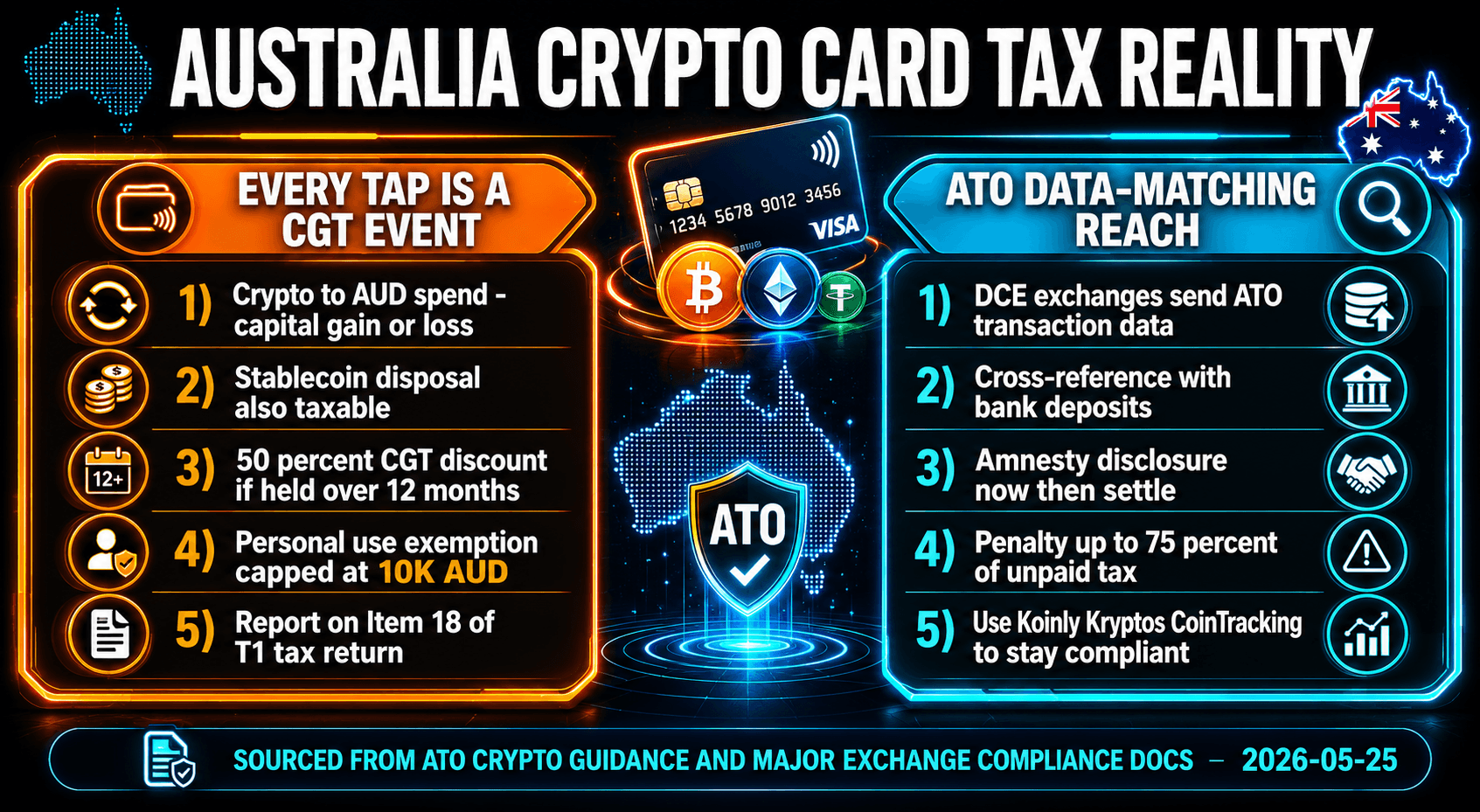
The Australian Taxation Office is explicit: "A CGT event happens when loading or topping up a gift or debit card using crypto assets." Cryptocurrency is a CGT asset, not a foreign currency. Every disposal triggers capital gain or capital loss.
- 12-month CGT discount. Hold crypto for over 12 months before spending and you get a 50% discount on the capital gain. For most card users, this discount only applies if you bought crypto well in advance and never traded/swapped it before spending.
- Capital losses offset gains. If you spent ETH at a loss vs purchase price, the loss reduces your other capital gains in the same year (or carries forward).
- Stablecoin spends still trigger small gain/loss. The gain/loss is driven by USD-AUD FX movement between your purchase and your spend.
- Report on Item 18 of T1. Australian Individual Tax Return. Net capital gain or net capital loss line. Many people miss this because card spending feels like "using your money", not "trading."
- ATO data-matching is active. AUSTRAC-registered DCEs send the ATO transaction-level customer data. The ATO cross-references this against tax returns. Penalties up to 75% of unpaid tax for false or misleading statements.
- ATO voluntary disclosure. If you've under-reported, the ATO's voluntary disclosure process carries materially lower penalties than discovery. Better to amend a prior return now than be caught later.
Funding Your Card from Australia (On-Ramps)
The cleanest funding path for most Australian users:
- Buy USDC or USDT on an AUSTRAC-registered DCE. CoinSpot, Swyftx, Independent Reserve, Kraken AU, and Binance AU are the main options. PayID and OSKO bank transfers settle instantly. Spreads 0.5-1.5%.
- Withdraw to the right chain for your card. MetaMask Card: USDC on Linea, USDT on Solana. Crypto.com Card: USDC on Ethereum/Polygon (or use platform direct). XKard: USDT on Tron (TRC20) or USDC on Polygon. Wirex: USDC on Ethereum. CoinJar: native AUD via PayID.
- Bridge if needed. If your DCE doesn't support your card's chain, use a bridge (Across, Stargate) to move tokens.
- Wait for confirmation. Linea/Base/Solana confirm in under 30 seconds. Ethereum can take 1-3 minutes.
Common Australian Gotchas
- Don't rely on the personal use asset exemption. The $10,000 AUD threshold and "briefly held" requirement are interpreted strictly. Crypto that sat in your wallet for months before being spent does not qualify.
- Stablecoin spends are still CGT events. Many Australian users assume USDC = USD and therefore no tax. False. The AUD-USD FX hop on each spend creates a small but reportable gain/loss.
- Cards routed via overseas EMIs aren't AUSTRAC-registered. MetaMask Card (Baanx/Monavate UK), Gnosis Pay (Monavate UK) are not AUSTRAC-registered themselves but their AU partners or routing must comply with the Anti-Money Laundering and Counter-Terrorism Financing Act 2006 for the Australian leg.
- Banks vary on crypto top-ups. CommBank, NAB, and Westpac generally accept transfers to AUSTRAC-registered DCEs. ANZ has historically been more restrictive. Bendigo Bank flags large crypto transfers.
- Australian financial year ends June 30. Your tax return is due Oct 31 (or May 15 next year if using a registered tax agent). Don't leave tax tracking to the last week.
Our Picks at a Glance
If you live in Australia and want…
- Native AUD simplicity: Crypto.com or CoinJar
- Self-custody: MetaMask Card
- Privacy + USDC cashback: XKard
- Multi-currency travel: Wirex
- Reward maximization: Crypto.com Royal/Obsidian (CRO stake required)
Skip in Australia:
- Gnosis Pay — EEA/UK/LatAm only, no AU support
- COCA Card — not currently AU-available
- Cards routing via non-AUSTRAC US-only entities
- Cards with high CRO/MCO staking requirements if you don't already hold the token
- Any card requiring US-only physical card shipping
Final Take
For most Australian residents in 2026, the right move is Crypto.com Card Midnight Blue (free) for everyday AUD spending plus MetaMask Card Virtual (free) as a self-custody backup. The Crypto.com card handles the AUD-native rail cleanly; MetaMask Card lets you spend stablecoins without ever giving them to a custodian. If you spend over $10K/year on the cards, the higher Crypto.com tiers start to pay for themselves on CRO cashback (if you can stomach the token lockup).
Whatever you pick: set up Koinly, Crypto Tax Calculator, or Kryptos from day one. Australian users who skip this typically spend 100+ hours reconciling transactions at tax time. All three platforms offer free tiers that handle the ATO basics.