Best Crypto Card Canada 2026: 7 Cards Tested for Canadian Residents
Quick answer: Best crypto cards for Canadian residents in 2026 are MetaMask Card (self-custody, US/EU/Canada launch Feb 2026, Mastercard, 1-3% cashback) and Crypto.com Card (custodial but the most mature Canadian crypto card with FINTRAC-registered rails). For privacy-leaning users: XKard (email-based signup, 5% cashback in USDC). Watch out for: (1) Quebec may be excluded by some issuers, (2) every crypto-to-CAD tap is a CRA disposal event for tax purposes, (3) most cards charge 1-2% FX fee converting USD-denominated stablecoins to CAD at the till.
Canada is one of the better-served countries for crypto debit cards in 2026 — but most guides written about it are outdated. The big shift happened in February 2026 when MetaMask Card officially added Canada to its supported regions, joining the long-standing Crypto.com offering. Together with FINTRAC-registered platforms like UPay and lighter-KYC options like XKard, Canadian residents now have a meaningful menu of crypto cards to choose from.
This guide covers 7 cards confirmed available to Canadian residents in May 2026, the CRA tax implications you can't ignore, the fees you'll actually pay when spending crypto in CAD, and the privacy trade-offs of each option.
The 6 Things to Check Before Picking a Crypto Card in Canada
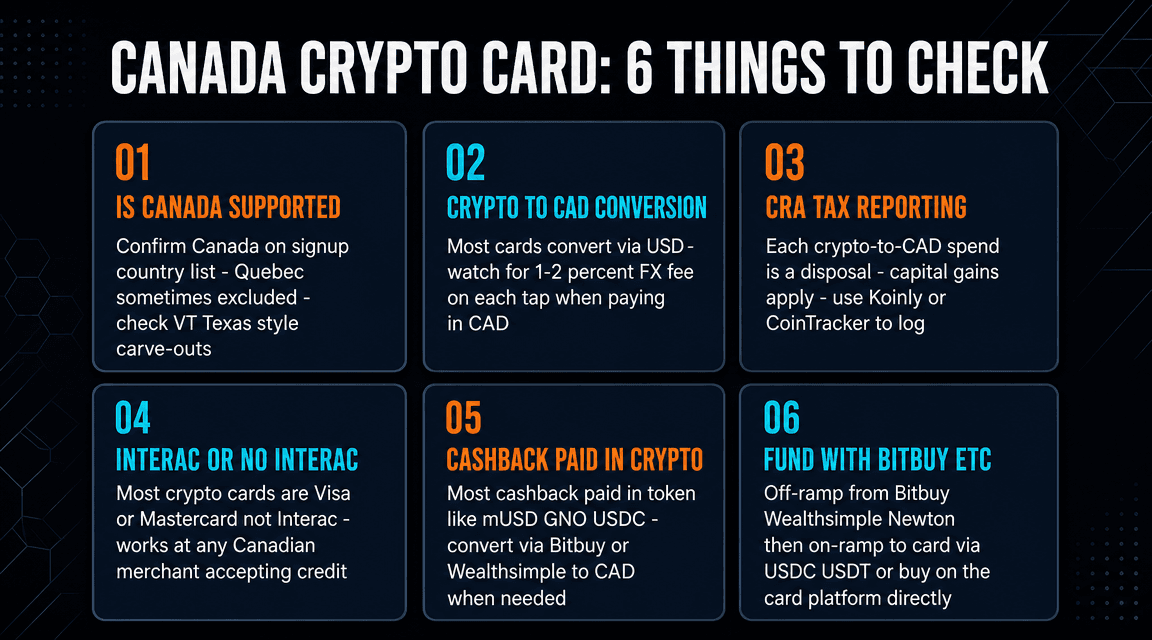
- Is Canada actually supported? Confirm Canada is on the issuer's signup country list. Some cards (Gnosis Pay, Coca Card) explicitly exclude Canada. Quebec is sometimes excluded due to provincial securities rules — check the fine print before applying.
- Crypto-to-CAD conversion path. Most crypto cards convert via USD (your USDT becomes USD, then the merchant converts USD to CAD at their FX rate). That's two FX hops — expect 1-2% total cost on each tap when paying in CAD. Cards that natively settle in CAD are rare.
- CRA tax reporting. Every crypto-to-CAD spend is a disposal event. Capital gain or loss applies based on your adjusted cost base (ACB). Stablecoins typically have small disposal impact but still need tracking. Use Koinly, CoinTracker, or Crypto Tax Calculator — all support Canadian rules.
- Interac vs Visa/Mastercard. Most crypto cards are Visa or Mastercard, not Interac. They work at any Canadian merchant accepting credit cards (effectively everywhere) but won't work for direct Interac payments like e-Transfer.
- What currency is cashback paid in? Most cards pay cashback in tokens: mUSD (MetaMask), CRO (Crypto.com), GNO (Gnosis Pay), USDC (XKard, KAST). Converting that back to CAD via Bitbuy or Wealthsimple has its own spread (~0.5-1%). Factor it into your effective cashback rate.
- How will you fund the card? Bitbuy, Wealthsimple Crypto, Newton, and Kraken are the easiest Canadian on-ramps. Buy USDC or USDT, then bridge to the card's supported network (Linea, Base, Solana, Polygon, Tron). Some cards (Crypto.com, Wirex) let you buy crypto on the platform directly with Interac — simpler but with platform-set spreads.
Top 5 Crypto Cards for Canadian Residents (2026)
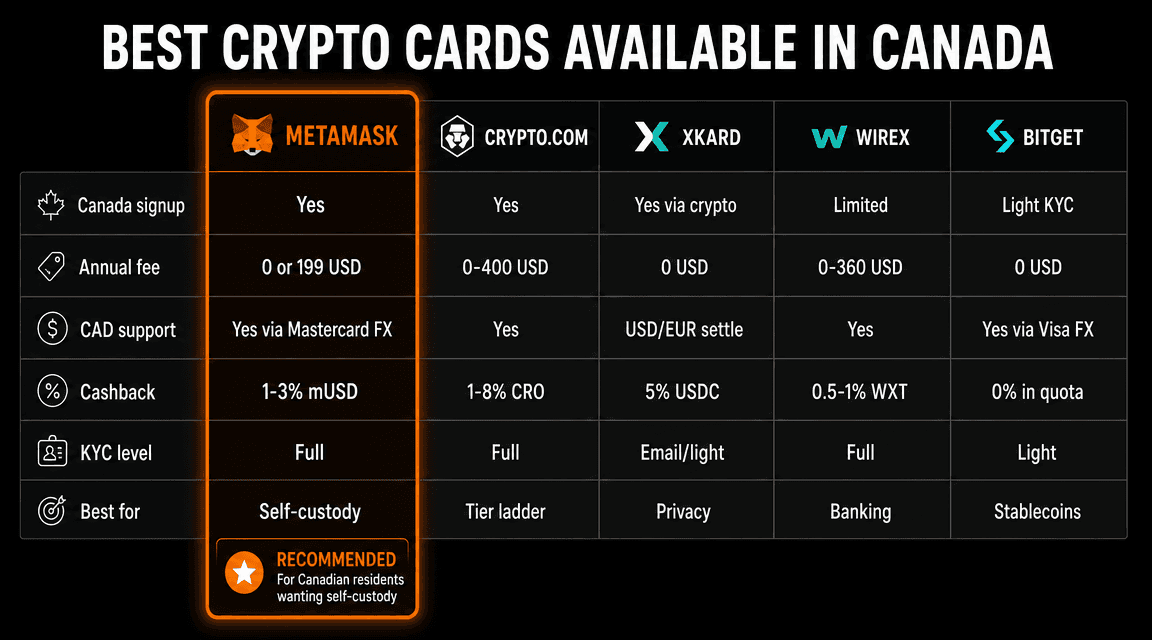
1. MetaMask Card — Best Self-Custody Pick
MetaMask Card went live in Canada in February 2026 as part of its global expansion. The Virtual tier is free with 1% mUSD cashback; the Metal tier is $199/year with 3% cashback on the first $10,000 (then 1%) and zero foreign transaction fees. Funds stay in your MetaMask wallet on Linea, Base, Solana, or Monad until you tap. Mastercard accepted everywhere in Canada.
- Pro: Self-custody, Mastercard rails, zero FX on Metal tier, 9 supported tokens
- Con: Cashback in mUSD (needs manual gas-paid claim), Metal physical card requires shipping address verification
- Best for: Canadian crypto users who want to keep funds on-chain and spend Mastercard-accepted merchants
2. Crypto.com Card — Best Mature Option
Crypto.com Card has supported Canadian residents for years. FINTRAC-registered. Free Midnight Blue tier; higher tiers (Ruby/Royal/Obsidian) require CRO token staking but offer 1-8% cashback. Works with Apple Pay and Google Pay. The platform's native Canadian fiat support means you can fund the card directly from CAD via Interac e-Transfer.
- Pro: Mature platform, direct CAD funding via Interac, FINTRAC-registered, broad crypto support
- Con: Custodial (Crypto.com holds your balance), cashback requires CRO stake-lock, higher tiers expensive ($400/yr Obsidian)
- Best for: Canadians who want simplicity and don't mind custodial trade-offs
3. XKard — Best Privacy-Leaning Pick
XKard uses email-based signup (no government ID for the base tier), offers 5% USDC cashback, and is the strongest pick for privacy-conscious Canadian users. Settle in USD/EUR, not native CAD — expect ~1-2% effective FX when spending at Canadian merchants. Accepts USDT/USDC top-ups on multiple chains. Sign up via Kardd for our standard referral.
- Pro: Light KYC, 5% cashback in USDC, fast onboarding, multi-chain top-up
- Con: No native CAD settlement (FX cost), smaller brand than Crypto.com or MetaMask
- Best for: Canadians prioritizing privacy and high USDC cashback
4. Wirex — Best for Multi-Currency Spenders
Wirex serves Canadian residents and offers multi-currency support that's useful for travel and cross-border spending. Free Standard tier, Premium ($16.99/month) and Elite ($31/month) for boosted rewards. Cashback paid in WXT token. Built-in multi-currency accounts make it easier to hold CAD/USD/EUR/GBP balances alongside crypto.
- Pro: Multi-currency accounts (CAD/USD/EUR/GBP), Wirex X-Accounts boost interest, mature platform
- Con: Cashback in WXT token (price-volatile), monthly fees on higher tiers, custodial
- Best for: Canadians who travel often and want a multi-currency hub card
5. Bitget Wallet Card — Best Light-KYC Bet
Bitget Wallet Card offers light KYC, multi-chain support (ERC20/BEP20/Polygon), Visa rails with Apple Pay integration. 2% reload fee. The 0% transaction fee within the $600/month quota is competitive for light spenders. Canadian availability is current as of May 2026 but the Bitget exchange is not formally registered with CIRO — spend, but don't use it as your primary CAD-on-ramp.
- Pro: Light KYC, multi-chain top-up, 0% in-quota transaction fee, Apple Pay
- Con: 2% reload, parent exchange not formally registered with CIRO, smaller Canadian user base
- Best for: Canadians who already use Bitget Wallet and want minimal-friction card
CRA Tax Implications: What You Actually Owe
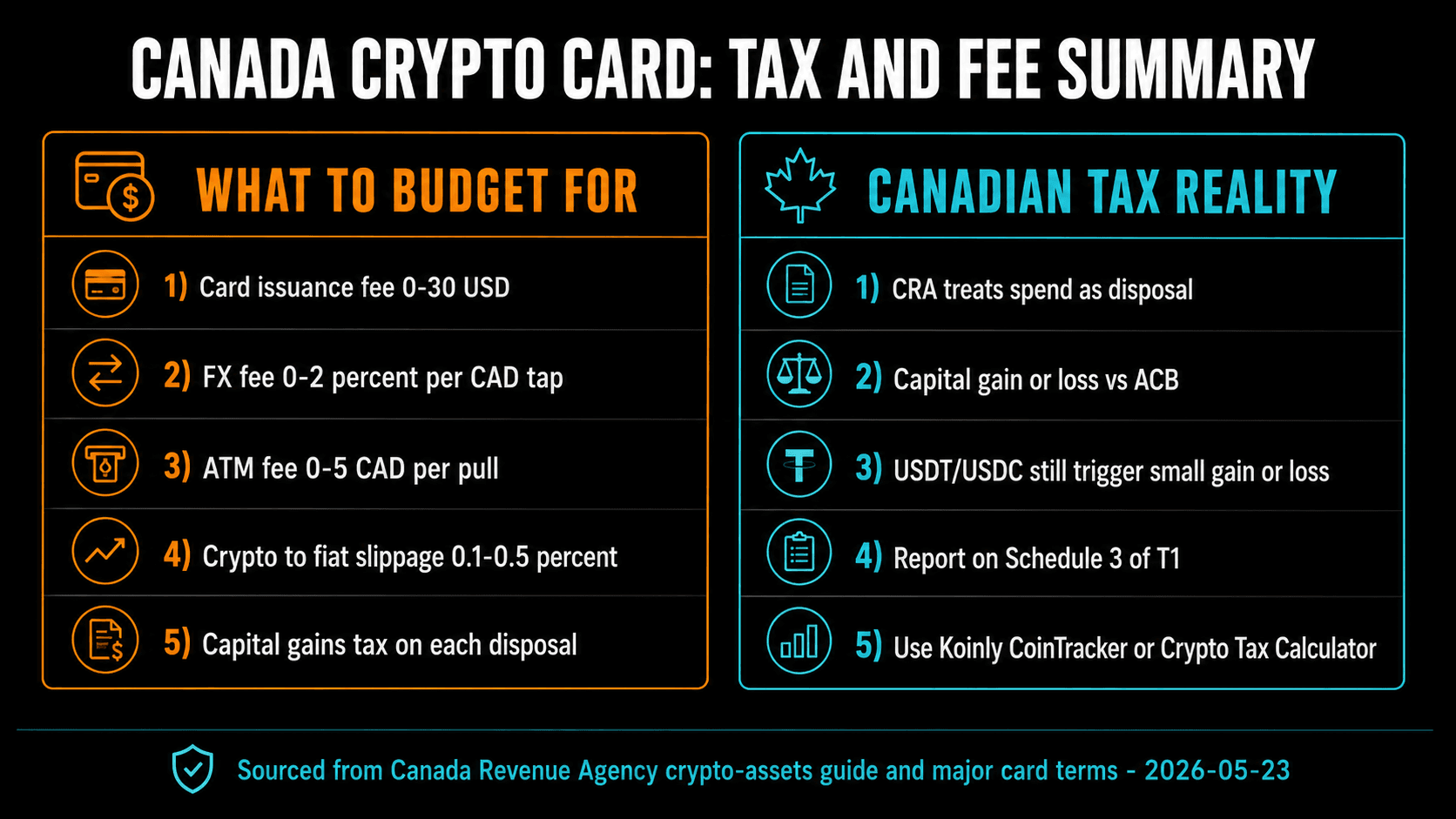
The Canada Revenue Agency treats cryptocurrency as a commodity for tax purposes, not a currency. That means every crypto-to-CAD conversion (which happens every time you tap a crypto card) is a disposal event. You owe capital gains tax on the difference between your adjusted cost base (ACB) and the disposal proceeds. Half of capital gains are taxable in Canada (50% inclusion rate).
Canadian residents with significant on-chain wealth sometimes pair their card setup with second-residency planning to optimize the overall tax footprint — Domicillia covers the practical mechanics of changing fiscal domicile, and Soveraine covers the broader sovereign-wealth playbook for crypto-native earners. Neither is a tax-evasion workaround — both are about legal residency restructuring that some Canadians use when their crypto activity outgrows the standard T1 setup.
- Stablecoins (USDT, USDC) still trigger disposal. The gain/loss is small (driven by FX between USD and CAD, not crypto volatility), but the event still needs reporting.
- Volatile crypto (BTC, ETH, SOL) creates larger gains/losses. Tap with ETH that's up 40% since you bought it — 40% of that tap is taxable gain.
- Report on Schedule 3 of your T1 General. Capital gains line. Many people miss this because the card transactions feel like "spending," not "trading."
- Use crypto tax software. Koinly, CoinTracker, and Crypto Tax Calculator all support CRA rules including adjusted cost base (ACB) calculation. Most offer a free tier for under 100 transactions per year.
Fees to Expect (Realistic Total Cost of Spending)
Here's what spending $100 CAD via a crypto card actually costs you:
| Cost Component | Typical Range | Notes |
|---|---|---|
| Card issuance fee | $0–$30 one-time | Many cards waive for virtual |
| Annual fee | $0–$400/year | $199 typical for premium tiers |
| FX fee (USD→CAD) | 1–2% per tap | Zero on MetaMask Metal |
| Network gas fee | $0.01–$0.10 per tap | Linea/Base/Solana lowest |
| ATM fee | $2–$5 per withdrawal | Free quota on premium tiers |
| Capital gains tax | Variable (50% inclusion) | CRA disposal on every spend |
Bottom line: for a typical $100 CAD purchase via a crypto card, you'll pay $1-2 in FX fee + a few cents in gas + the future capital gains tax (which depends on your crypto's appreciation since you bought it). The 1-3% cashback usually offsets the FX fee for most users.
Funding Your Card from Canada (On-Ramps)
The cleanest path for most Canadian users:
- Buy USDC or USDT on a CIRO-registered Canadian exchange. Bitbuy and Wealthsimple Crypto are the two most common. Both accept Interac e-Transfer. Spreads are typically 0.5-1.5%.
- Withdraw to the right chain for your card. MetaMask Card: USDC on Linea or USDT on Solana. Crypto.com Card: USDC on Ethereum or Polygon (the platform handles conversion). XKard: USDT on Tron (TRC20) or USDC on Polygon. Bitget Wallet Card: USDT on BEP20 or Polygon.
- Bridge if needed. If Bitbuy/Wealthsimple don't support the chain your card needs, use a bridge (Across, Stargate, official chain bridges) to move tokens from Ethereum/Polygon to Linea/Base/etc.
- Confirm on-card balance. Wait for at least one confirmation on the destination chain (usually under 30 seconds on Linea/Base/Solana) before attempting to spend.
Watch Out For: Common Canadian Gotchas
- Quebec carve-outs. Some card issuers exclude Quebec due to provincial securities and consumer-protection rules. Always check before applying if you live in QC.
- Bitget exchange not formally registered with CIRO. The Bitget Wallet Card is usable, but using the Bitget exchange itself to fund your card is operating in a regulatory grey area — prefer Bitbuy/Wealthsimple as the on-ramp.
- Coinbase Card status varies. Coinbase has paused and resumed its Canadian card product multiple times. Check the current state at coinbase.com/ca/card before assuming it's available.
- FINTRAC reporting thresholds. If you receive crypto on-ramps to the card totaling over $10,000 CAD from outside Canada in a single transaction, the receiving Canadian platform is required to report it under FINTRAC's Large Cash Transaction Report (LCTR) rules. This is the platform's obligation, not yours, but be aware your name will be on a report.
- Card "cashback" isn't taxable as employment income. Most card cashback is treated as a price reduction or rebate by CRA, not taxable income. However, when you eventually convert that mUSD/CRO/GNO/USDC cashback to CAD, the disposal of those tokens is a taxable event with capital gain/loss vs your ACB.
Our Picks at a Glance
If you live in Canada and want…
- Self-custody: MetaMask Card
- Mainstream simplicity: Crypto.com
- Privacy + USDC cashback: XKard
- Multi-currency travel: Wirex
- Light KYC stablecoin spending: Bitget Wallet Card
Skip in Canada:
- Gnosis Pay — EU/UK/LatAm only, no Canada support
- COCA Card — not currently available to Canadians
- Bancus — limited Canada coverage, $5/month fee
- Cards with high CRO/MCO staking requirements if you don't already hold the token
- Any card requiring a US-only shipping address for the physical version
Final Take
For most Canadian residents in 2026, the right move is MetaMask Card Virtual (free) for everyday crypto spending and Crypto.com Card Midnight Blue (also free) as a backup with native CAD funding. If you spend $10K+ per year on the card, the MetaMask Metal tier ($199) pays for itself via 3% cashback and zero FX fees. If you prioritize privacy, XKard's email-based signup is the strongest light-KYC option.
Whatever you pick: set up a crypto tax tracker from day one. Canadian users who skip this typically end up doing 200+ hours of manual reconstruction at tax time. Koinly's free tier handles up to 10,000 transactions/year of view-only tracking; CoinTracker and Crypto Tax Calculator are similar.