Crypto Card ATM Withdrawal Fees 2026: 9 Cards Compared
- Two cards charge nothing at all. Kraken Krak and the Coinbase Card add no issuer ATM fee; only the machine's own surcharge applies.
- 2% is the market rate, so the allowance decides the winner. Crypto.com, Nexo, Wirex, Gnosis Pay and Bybit all charge 2% — but the free monthly allowance in front of it ranges from €100 (Bybit) to €2,000 (Nexo Platinum).
- Flat fees punish small withdrawals. KAST charges $3 + 2% and caps each withdrawal at $250, which works out to about $192/yr on $500 a month of cash.
- The conversion fee is the hidden half. Bybit adds 0.9% and RedotPay 1% when the withdrawal has to sell crypto — on €500 a month that is another €54/yr on top of the ATM fee.
- Under €200 a month, most cards are free. Cash cost only becomes a deciding factor above roughly €300 a month.
On this page
- What you actually pay to pull cash
- Issuer ATM fees compared: all 9 cards
- The free allowance is the whole game
- Global and US cards: where the flat fee bites
- Three charges that are not called "ATM fee"
- Withdrawal caps matter more than fees on a big cash day
- Where no-KYC cards fit
- How to take cash out for close to nothing
- FAQ
The cash machine is where crypto cards quietly stop being cheap. A card advertising 0% FX and 5% cashback can still charge you 2% plus a 0.9% conversion fee the moment you ask it for banknotes, and at €500 a month of cash that is around €150 a year leaving your account through a door nobody reads about. Crypto card ATM withdrawal fees are the least-documented line on every card's pricing page, and they are the one fee that scales with exactly the behaviour most people fall back on when a merchant won't take the card.
We pulled the published fee schedules for nine cards straight from the issuers — Crypto.com's regional help-centre tables, Nexo's card page, Wirex's fees article, Gnosis Pay's help centre, Bybit's help centre, RedotPay's help centre, KAST's concierge docs, and Krak's pricing page — and ran the annual cost at three levels of cash use. Two cards charge nothing. One charges roughly €180 a year for the same behaviour. Every figure below is dated September 2026 and cited; where an issuer does not publish a number, we say so rather than guess.
What You Actually Pay to Pull Cash
A single ATM withdrawal on a crypto card can stack four separate charges, and only the first one is usually labelled as an ATM fee:
- The issuer ATM fee. Typically 2% of the amount above a free monthly allowance, or a flat fee plus a percentage. This is the number on the pricing page.
- The crypto-to-fiat conversion fee. Charged if the withdrawal has to sell crypto rather than draw on a fiat or stablecoin balance. Bybit charges 0.9%; RedotPay charges 1%.
- The FX fee, if the ATM dispenses a currency other than your card's base currency. KAST adds 0.5–1.75% here; Nexo charges 0.2% on weekdays in the EEA/UK/CH and 2% for the rest of the world, rising to 0.7% and 2.5% at weekends.
- The ATM operator's own surcharge. Nothing to do with your card. Independent machines in airports and tourist strips routinely add €3–€6. Crypto.com states that this surcharge also counts towards your ATM withdrawal limit, so it consumes allowance as well as cash.
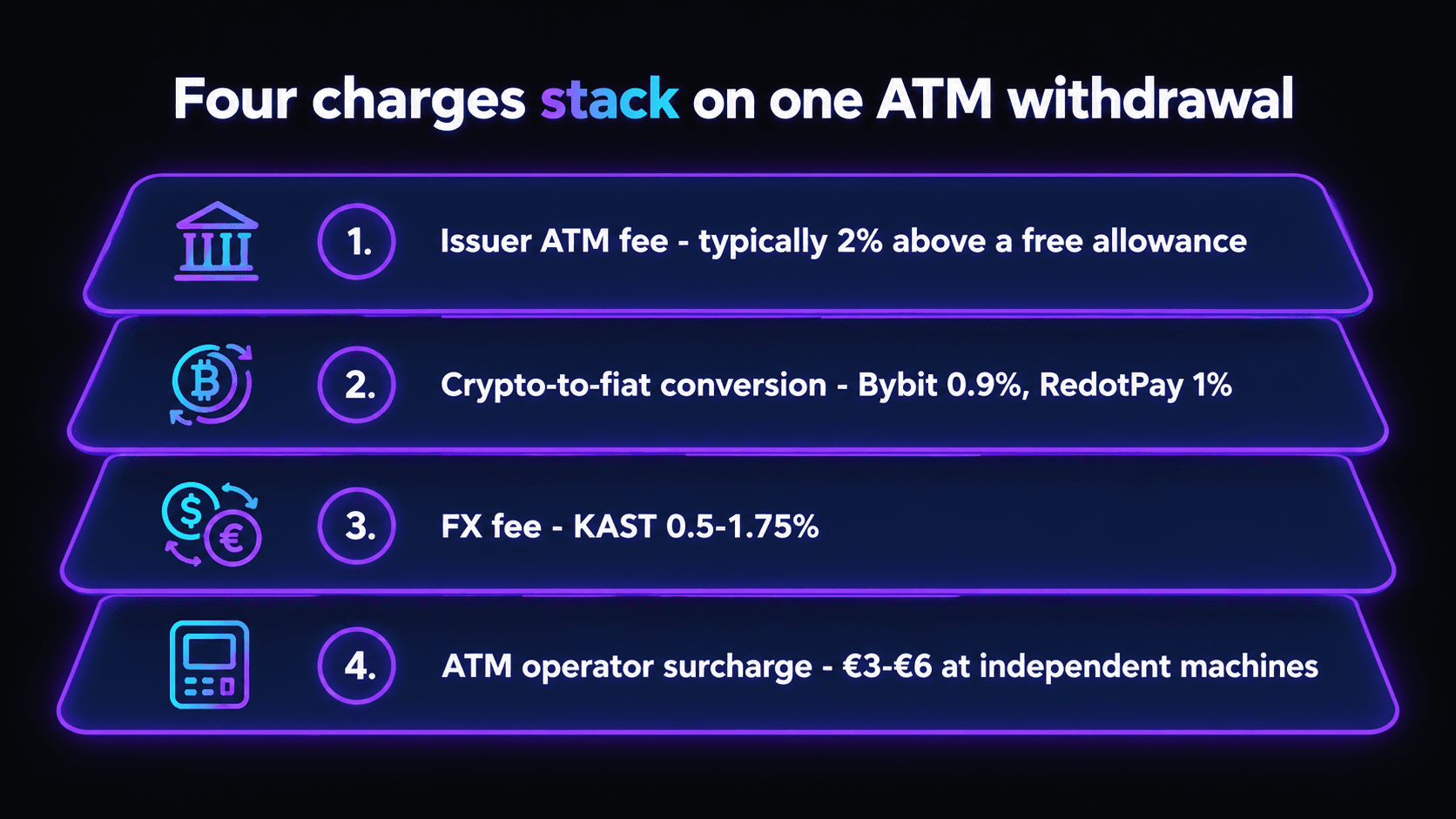
Layer 1 is the one people compare. Layers 2 and 3 are usually where the real money goes, and layer 4 is the one you can dodge for free by choosing a bank-operated machine. Keep that stack in mind while reading the tables — a 2% card funded from a stablecoin balance at a bank ATM often beats a 0% card funded from BTC at an airport kiosk.
Issuer ATM Fees Compared: All 9 Cards
Issuer fees only, as published in September 2026. Operator surcharges are excluded because they depend on the machine, not the card.
| Card | Issuer ATM fee | Free monthly allowance | Where |
|---|---|---|---|
| Kraken Krak | None | n/a — no issuer fee at any level | US (not NY, ME, MA, IN), EEA, UK |
| Coinbase Card | None | n/a — no issuer fee at any level | US |
| Nexo Card | 2%, min €1.99 / £1.99 | €200/£180 Base → €2,000/£1,800 Platinum | EEA, UK, CH |
| Crypto.com Visa | 2% above the free limit | US$200 Midnight → US$1,000 Obsidian (EU: €200 → €1,000) | US, EU, UK, AU, SG |
| Wirex | 2% above the free limit | £200 UK / €200 EEA / S$200 APAC / A$400 AU | UK, EEA, APAC, AU |
| Gnosis Pay | 2% per additional withdrawal | 5 withdrawals or 200 EURe/GBPe/USDCe, whichever comes first | EEA, UK |
| Bybit Card | 2% above the free limit (+0.9% conversion) | €100 EEA/CH; US$100 Australia and AIFC | EEA, CH, AU, AIFC, AR, BR |
| RedotPay | 2% USD card to $10,000/mo, 3% above; 2% HKD card | None | Global |
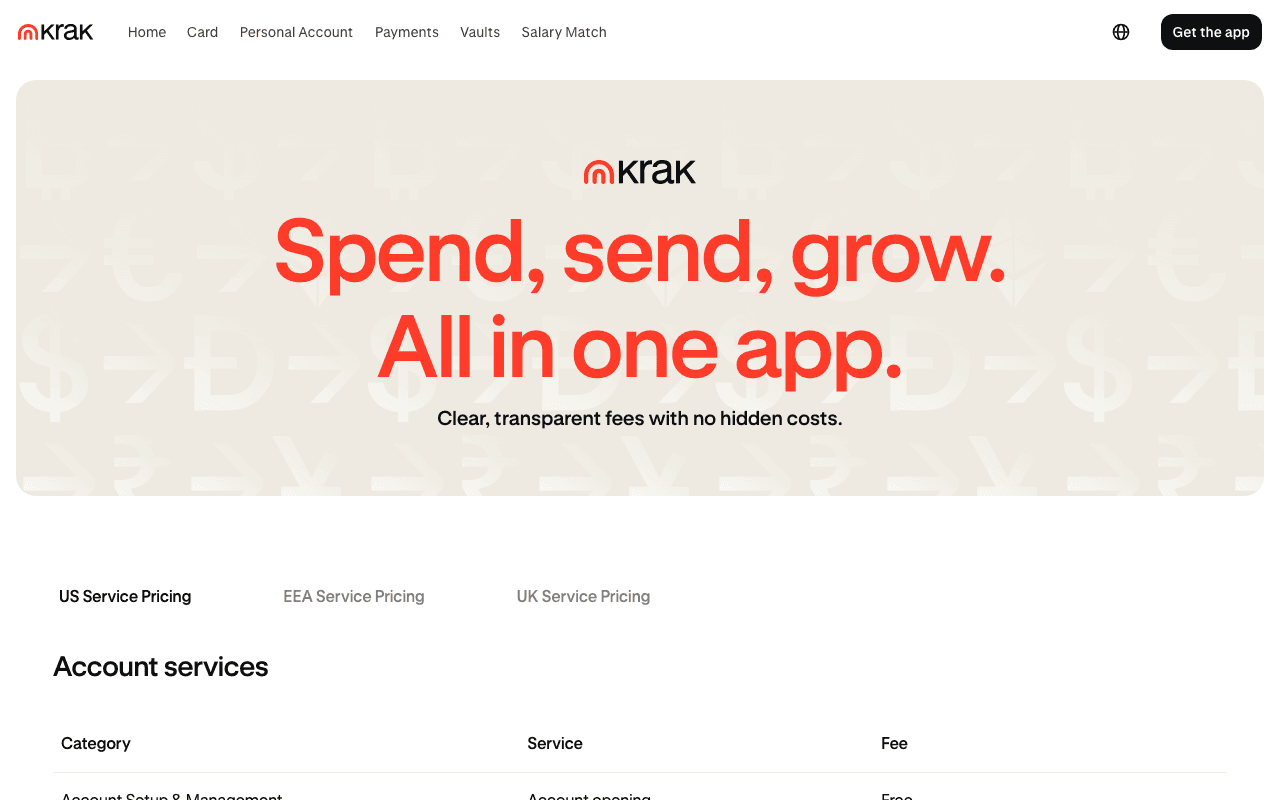
| KAST | $3 + 2% per withdrawal | None | Global |
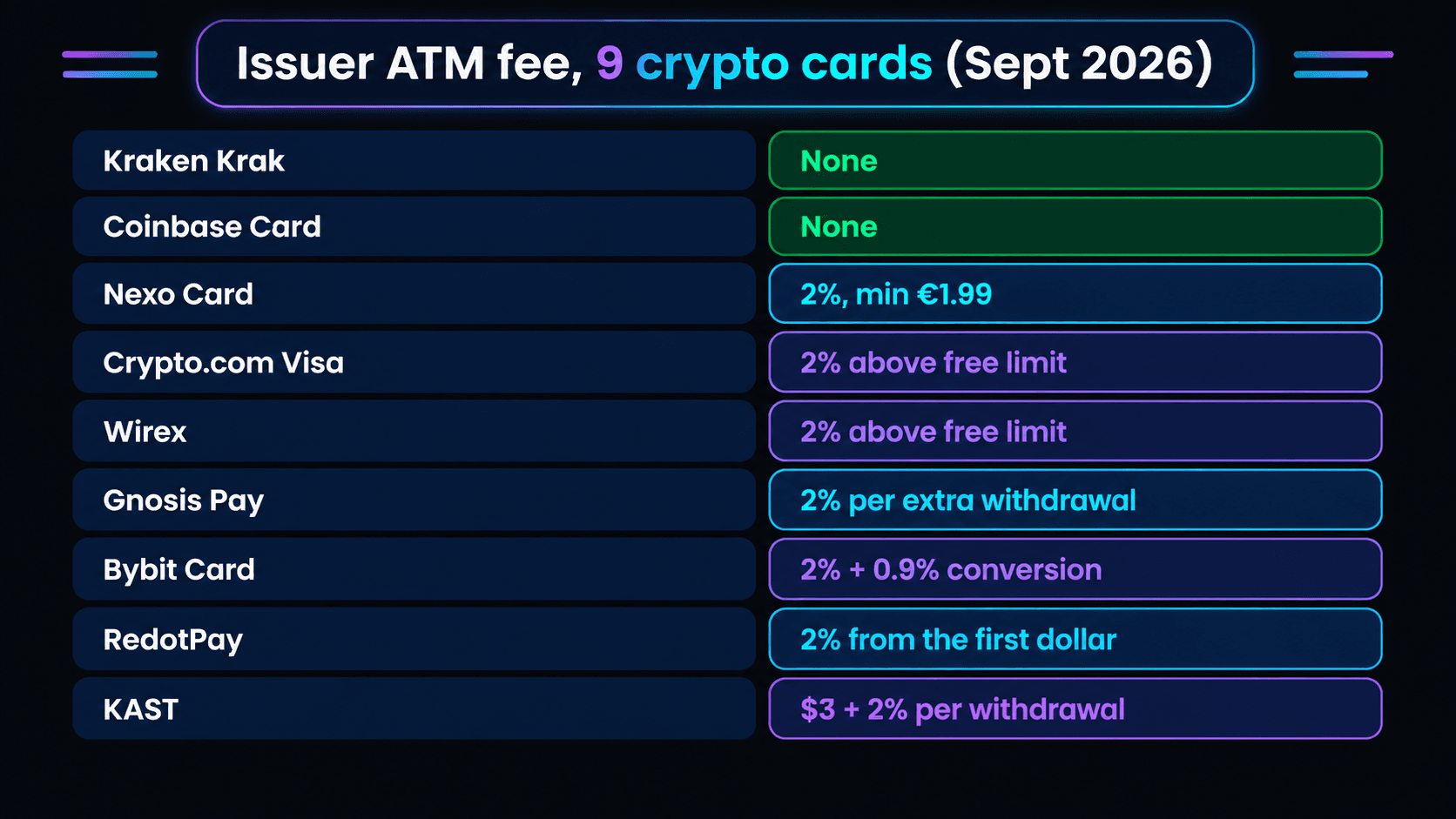
Read that table twice. Seven of the nine converge on 2%, which means the percentage is almost useless as a way to choose between them — the allowance column is where the real difference lives.
The Free Allowance Is the Whole Game
Here is the same set of cards priced as an annual cost, in euros, for someone in the EEA taking a fixed amount of cash every month. Issuer fees only, and conversion fees included where the card charges them.
| Card (EEA) | €150/mo | €300/mo | €500/mo |
|---|---|---|---|
| Kraken Krak | €0 | €0 | €0 |
| Nexo Gold (€1,000 free) | €0 | €0 | €0 |
| Crypto.com Ruby (€400 free) | €0 | €0 | €24 |
| Wirex (€200 free) | €0 | €24 | €72 |
| Crypto.com Midnight (€200 free) | €0 | €24 | €72 |
| Nexo Base (€200 free) | €0 | €24 | €72 |
| Gnosis Pay (€200 / 5 withdrawals) | €0 | €24 | €72 |
| Bybit (€100 free + 0.9% conversion) | €28 | €80 | €150 |
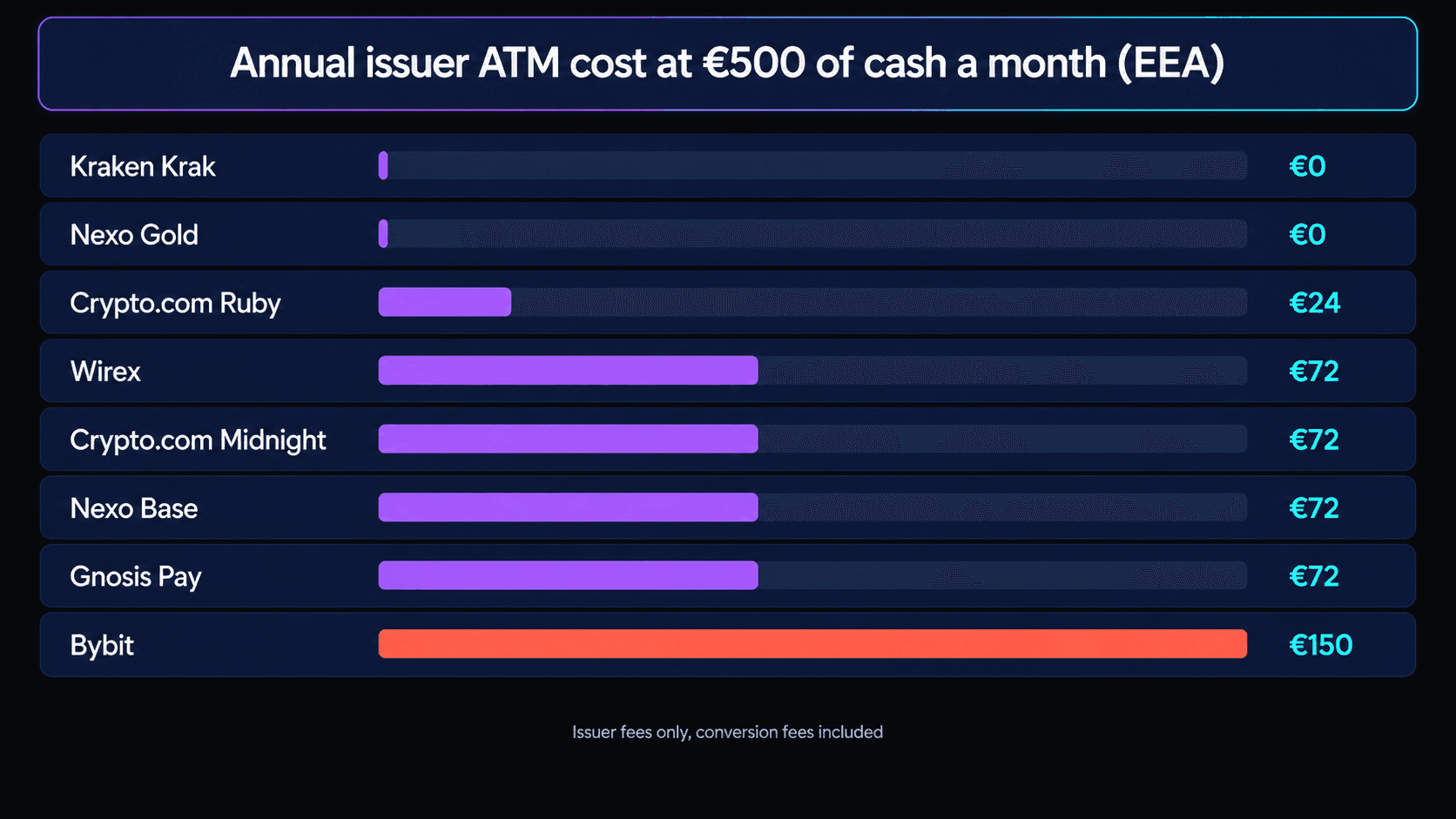
At €150 a month, seven of these eight cards cost you nothing. Cash is simply not a differentiator at that level, and you should be choosing on FX, cashback and custody instead. At €500 a month the spread opens to €150 a year between the cheapest and the most expensive — more than most cashback programmes return on a typical spending profile.
Global and US Cards: Where the Flat Fee Bites
The globally available cards price differently, and a flat per-withdrawal fee changes the shape of the cost curve entirely. Annual issuer cost in USD, conversion fees included where charged:
| Card | $150/mo | $300/mo | $500/mo | Structural limit |
|---|---|---|---|---|
| Coinbase Card (US) | $0 | $0 | $0 | Operator surcharge only |
| Kraken Krak (US) | $0 | $0 | $0 | Operator surcharge only |
| Crypto.com Obsidian ($1,000 free) | $0 | $0 | $0 | $2,000/day, 3 withdrawals/day |
| Crypto.com Midnight ($200 free) | $0 | $24 | $72 | $500/day, $5,000/mo |
| RedotPay USD (2% + 1% conversion) | $54 | $108 | $180 | 3% above $10,000/mo |
| KAST ($3 + 2%) | $72 | $144 | $192 | $250/withdrawal incl. fees, $750/day |
KAST's curve is the interesting one. Because the $3 is charged per withdrawal and each withdrawal is capped at $250 including fees, the fee per dollar actually falls as you withdraw more in one go — $150 in one withdrawal costs $6, but $500 across two costs $16 rather than $20. The flat fee makes small, frequent withdrawals the expensive pattern, which is the opposite of how percentage-only cards behave. If you carry a KAST card, take cash in the largest chunk the $250 cap allows.
RedotPay has no allowance at all, so the 2% starts on the first dollar and the 1% crypto conversion sits on top unless you already hold the card's base currency. That is a defensible price for a card with genuinely global reach, but it is the wrong card for anyone whose main use is cash.
Three Charges That Are Not Called "ATM Fee"
Every card above is honest about its headline percentage. The costs that surprise people are the ones filed under a different name.
1. The conversion fee that fires only at the ATM
Bybit is explicit about this: if you withdraw fiat from an ATM while holding only crypto in your funding account, you pay a 0.9% conversion charge plus the 2% ATM fee. RedotPay charges 1% for crypto conversion on the same logic. On €500 a month, Bybit's conversion layer alone is €54 a year — more than the ATM fee itself at some levels. Holding a matching fiat or stablecoin balance removes it completely, and costs nothing to arrange.
2. The minimum fee that makes small withdrawals irrational
Nexo charges 2% with a minimum of €1.99 or £1.99 per withdrawal once your allowance is spent. Pull €40 and you have paid 5%, not 2%. Any card with a minimum fee or a flat component — Nexo and KAST here — rewards fewer, larger withdrawals, and quietly punishes the habit of topping up your wallet with €20 at a time.
3. Dynamic Currency Conversion at the machine
When an ATM offers to dispense in your home currency instead of the local one, it is offering to handle the conversion itself at a markup that commonly runs 5–8%. That bypasses your card's FX rate entirely, and it will outweigh every fee in this article. Always decline and choose the local currency. We cover the same trap on card purchases in our guide to crypto debit cards with no foreign transaction fees.
Withdrawal Caps Matter More Than Fees on a Big Cash Day
If you ever need a meaningful cash sum — a deposit, a private sale, a country where cards are decorative — the limit is the binding constraint, not the fee. A 2% fee on €2,000 is €40. A card that will not dispense more than $750 a day is simply unusable for that transaction.
| Card | Per withdrawal | Daily ATM cap | Withdrawals/day | Monthly ATM cap |
|---|---|---|---|---|
| Crypto.com Midnight (US) | — | US$500 | 3 | US$5,000 |
| Crypto.com Ruby and above (US) | — | US$2,000 | 3 | US$10,000 |
| Crypto.com (Europe, all tiers) | — | €2,000 | 3 (30/mo) | €10,000 (€75,000/yr) |
| KAST | US$250 incl. fees | US$750 | 3 | — |
| Gnosis Pay | — | — | 5 free/mo, then 2% each | — |
| RedotPay USD | — | Set in app | — | 2% to $10,000, then 3% |
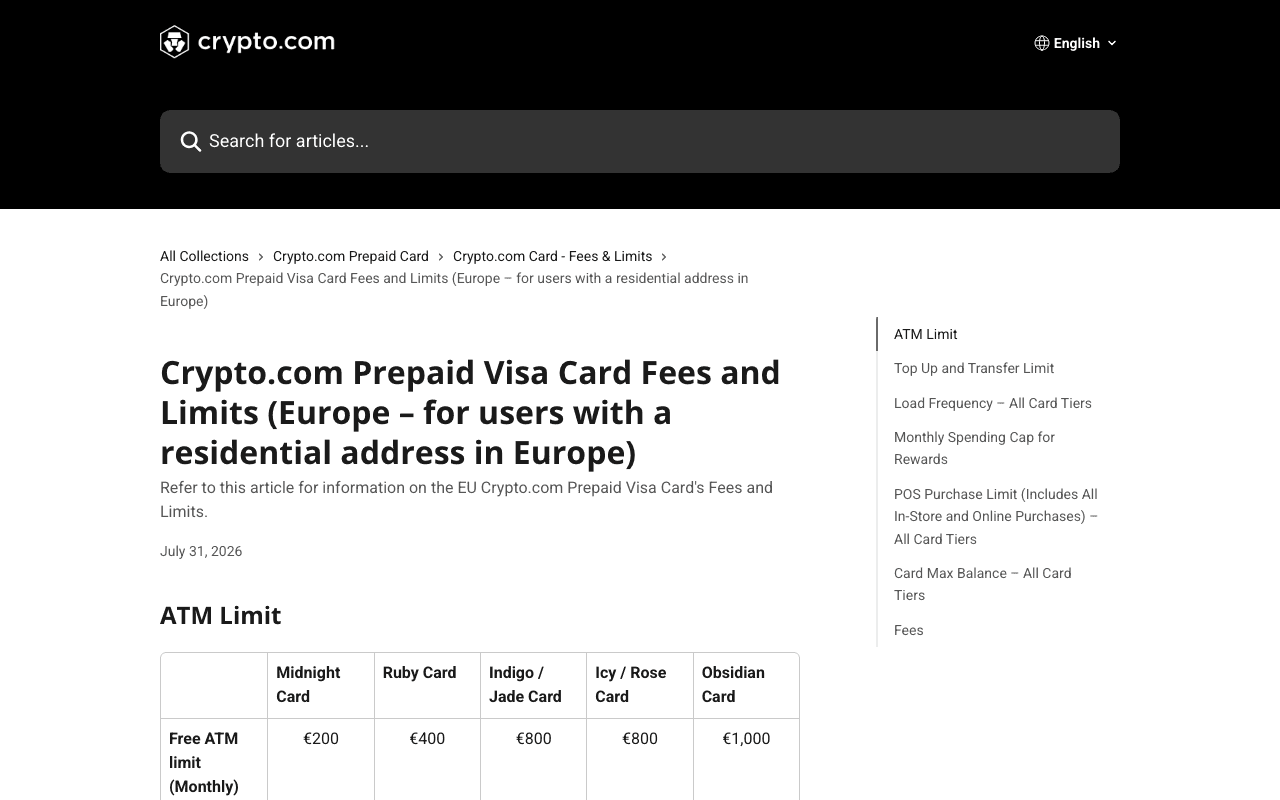
Crypto.com's European tables are the most generous published caps in this group: €2,000 a day and €10,000 a month on every tier, including the free Midnight card. In the US the free tier is throttled to $500 a day, which is a real functional gap rather than a pricing one. Where an issuer sets limits in-app rather than publishing them — Kraken and Coinbase both do — check yours before you rely on the card for a large withdrawal, because there is no public figure to plan against.
Where No-KYC Cards Fit
Cash is the hardest thing for a no-KYC card to offer cheaply, and the reason is structural rather than hostile. Virtual-only cards cannot dispense cash at all, which rules out most of the category immediately. The ones that do issue a physical card fund themselves through reload commission rather than interchange, so the cost of getting money onto the card is already 2–5% before an ATM is involved.
XKard is the clearest example. It issues a physical card and its plan pricing is public — $9, $19 or $49 a month billed annually, with reload commission of 4.5%, 3.5% and 2.3% respectively — but it does not publish an ATM fee schedule as of September 2026. We are not going to invent one. The honest read is that on a reload-fee model the cash-out cost is dominated by the reload commission you already paid, so a no-KYC card is a poor primary choice for someone whose main need is banknotes, and a reasonable one for someone who wants private card spending with occasional cash access. Test with a small withdrawal before you rely on it.
If cash access with minimal identity friction is the actual requirement, KAST publishes its ATM terms in full and works globally, at the cost of the tightest limits here. For the wider trade-off between identity and functionality, our no-KYC card fee comparison and Best Crypto Cards 2026 go deeper.
How to Take Cash Out for Close to Nothing
- Hold the card's base currency. A fiat or stablecoin balance matching the card removes the 0.9–1% conversion layer on Bybit and RedotPay entirely.
- Know your allowance and stay under it. €200 a month covers most people's cash use, and seven of the nine cards here give you that for free.
- Withdraw in one chunk, not three. Decisive on any card with a flat or minimum fee (KAST, Nexo), and neutral everywhere else.
- Use a bank-operated ATM. Independent machines add €3–€6 that no card can absorb, and on Crypto.com that surcharge also eats your allowance.
- Always decline dynamic currency conversion. Choose the local currency at the machine, every time.
- Carry a zero-fee card as the cash card. Kraken Krak in the EEA/UK or Coinbase in the US costs nothing at the issuer level, even if you spend day to day on a higher-cashback card.
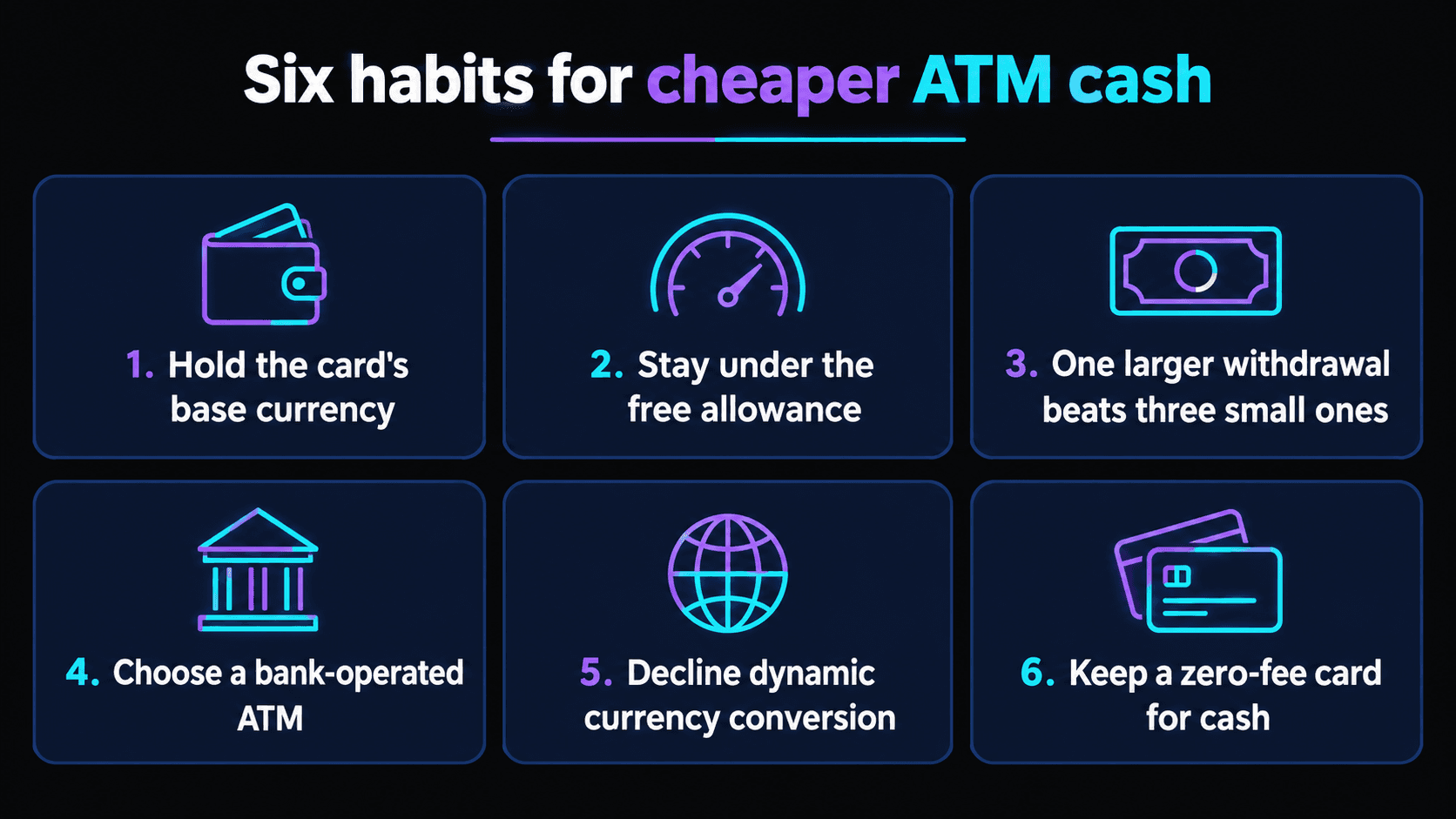
Two cards in a wallet is the cheapest arrangement available in 2026: one optimised for spending rewards, one that dispenses cash at cost.
Our Picks
Best for cash
- EEA/UK: Kraken Krak — no issuer ATM fee at any volume
- US: Coinbase Card — no Coinbase ATM fee
- Heavy cash + rewards: Crypto.com Ruby or above
- Large allowance: Nexo Gold/Platinum, if you already hold NEXO
Wrong card for cash
- RedotPay — no allowance, 2% from the first dollar
- KAST — $3 flat + $250 per-withdrawal cap
- Bybit — smallest allowance plus 0.9% conversion
- Virtual-only cards — no ATM access at all
Final Take
The ATM fee is the fee nobody markets on, which is exactly why it is worth checking before you commit. The percentages have converged on 2% almost everywhere, so the decision is really about two numbers: the free monthly allowance, and whether the card charges you to convert crypto at the moment of withdrawal. Get those two right and the fee stops mattering.
For most people pulling under €200 a month, this is a non-issue and you should pick on FX and cashback instead. Above €300 a month it becomes the largest single avoidable cost on the card, and a zero-fee card in the second slot of your wallet solves it permanently for nothing.
Compare every card's fees side by side
Kardd tracks fees, limits, KYC level and availability across the whole crypto card market — filter by what actually matters to you.
Kardd may earn a commission on sign-ups. Affiliate disclosure.
Related Articles
- Crypto Debit Cards With No Foreign Transaction Fees 2026
- No-KYC Crypto Card Fees Compared
- Best Crypto Cards 2026: The Complete Independent Comparison
- Best Crypto Card for Digital Nomads 2026
- Best Crypto Off-Ramps in 2026
- What Is a Crypto Card? The 2026 Pillar Guide
Frequently Asked Questions
Which crypto card has the lowest ATM withdrawal fee in 2026?
The Kraken Krak card charges no issuer ATM fee at all, in the US, the EEA and the UK — only the ATM operator's own surcharge applies. The Coinbase Card is the same in the US: Coinbase charges nothing for an ATM withdrawal, though the machine may. Every other card here either meters a free monthly allowance or charges a percentage from the first euro.
Why do so many crypto cards charge exactly 2%?
2% is the settled market rate for cash-out on a prepaid card programme, and it appears almost identically across Crypto.com, Nexo, Wirex, Gnosis Pay and Bybit. What actually differs is the free monthly allowance sitting in front of it: €100 on Bybit, €200 on Wirex, Gnosis Pay and entry-tier Crypto.com, up to €2,000 on Nexo Platinum. Compare allowances, not percentages.
Does the 2% apply to the whole withdrawal or only the excess?
It depends on the card, and it changes the maths. Crypto.com and Bybit charge 2% on the amount above the monthly free limit, so a €300 withdrawal against a €200 allowance costs €2. Gnosis Pay charges 2% per additional withdrawal once the allowance is used, so the fee attaches to the full value of that withdrawal. Nexo charges 2% with a €1.99 minimum, which makes small withdrawals disproportionately expensive.
Do ATM operator fees stack on top of the card's fee?
Yes, and they come from the machine's owner rather than your issuer. Independent ATMs in tourist areas commonly add €3–€6 per withdrawal. Crypto.com states that ATM surcharge fees count towards your ATM withdrawal limit, so an operator surcharge consumes allowance as well as cash. A zero-fee card at an expensive machine is not a zero-fee withdrawal.
Is it cheaper to fund the card with stablecoins before withdrawing?
Usually yes. Bybit charges 0.9% if the withdrawal has to liquidate crypto from your funding account, and RedotPay charges 1% for crypto conversion. Holding a fiat or stablecoin balance matching the card's base currency removes that layer entirely — on €500 a month of cash, that single change saves roughly €54 a year on Bybit.
What per-withdrawal and daily limits should I watch?
KAST is the tightest: $250 maximum per withdrawal including fees, $750 per day, three withdrawals per 24 hours. Crypto.com's Midnight tier caps at $500 a day in the US while Ruby and above reach $2,000 a day and $10,000 a month, with three withdrawals a day on every tier. In Europe all Crypto.com tiers share €2,000 daily and €10,000 monthly. For a large cash sum, the cap matters more than the fee.
Can I withdraw cash with a no-KYC crypto card?
Only with a physical card, and only where the issuer publishes ATM support — virtual-only cards cannot dispense cash. XKard issues a physical card but does not publish an ATM fee schedule as of September 2026, so its cash-out cost is genuinely unknown; its published cost structure runs on reload commission of 2.3–4.5% depending on plan. Treat an unpublished ATM fee as a reason to test with a small withdrawal first.
Should I choose a card on ATM fees or on spending fees?
For most people, spending fees matter more, because cash is a small share of total spend. ATM cost only dominates above roughly €300 a month. Below that, nearly every card with a €200 allowance costs you nothing and you should choose on FX and cashback. Above €500 a month, the gap between Kraken Krak at zero and KAST at around $192 a year outweighs what most cashback programmes pay.
Sources
All fees checked September 2026 against the issuers' own published schedules: Crypto.com card fees and limits (US), Crypto.com card fees and limits (Europe), Nexo Card, Wirex fees, Bybit Card fees and limits, RedotPay ATM withdrawals, Krak pricing, KAST cards, plus the Gnosis Pay and Coinbase help centres. Fees change without notice — verify with the issuer before you rely on a figure.