KAST Card Review 2026: Stablecoin Visa, SOL Staking 21% APY, Apple Pay
Our verdict: KAST is the strongest crypto card for stablecoin spenders and Solana ecosystem users. Zero conversion fees on USD spends, 0% commission SOL staking up to 21% APY, and instant virtual card activation. The trade-off is full KYC (no anonymity) and a $40 shipping fee for the physical card. If you hold SOL or spend $50K+/year, the Premium tier pays for itself.
KAST Card is a premium Visa debit card built for stablecoin spending. You deposit USDT, USDC, or USDe, and spend the balance anywhere Visa is accepted — online, in-store, contactless, or via ATM withdrawal. Unlike no-KYC alternatives, KAST requires full identity verification, but in exchange offers 0% conversion fees on USD purchases, instant virtual card activation, and one of the most generous SOL staking programs in the crypto card market.
We tested KAST for six weeks across daily spending, ATM withdrawals, and SOL staking. Here is the full breakdown: features, pricing tiers, fees, comparisons with XKard and SolCard, and the math on whether the Premium tier actually pays for itself.
What is KAST Card?
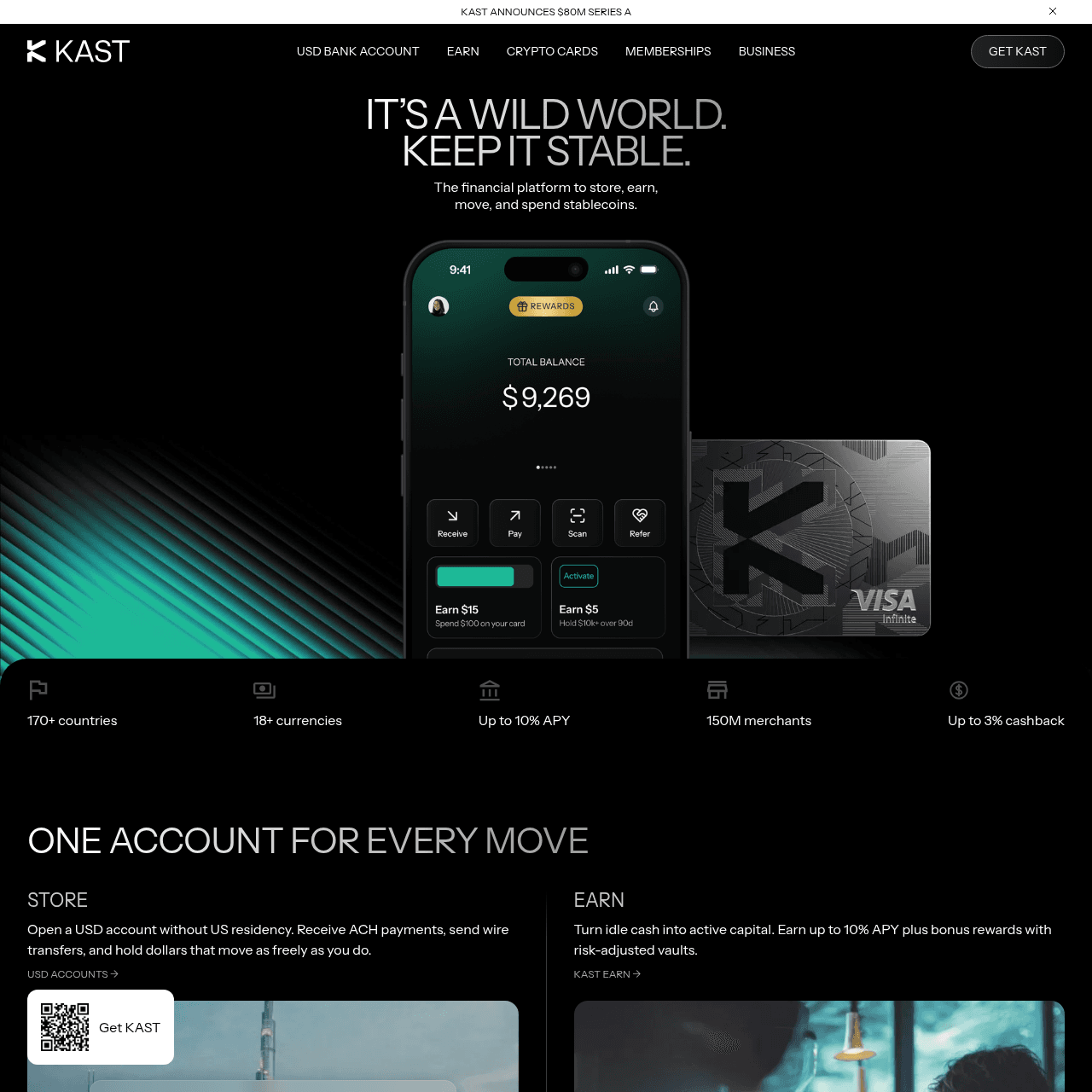
KAST is a Singapore-based fintech offering a stablecoin-powered Visa card and a USD bank account. It is custodial (KAST holds your stablecoins) and regulated through licensed financial partners. Two card families exist: the K Card (general fiat spending) and the Solana Card (SOL-native with extra staking bonuses). Both function identically for everyday spending; the Solana Card adds enhanced rewards if you stake SOL with the KAST validator.
KAST positions itself as a premium product. Tier names range from Standard (free) to Premium ($1,000/year) to Private ($10,000/year, gold-plated card), with an invite-only Solid Gold tier at roughly $25,000/year. The entry point is genuinely free, however, making the basic version accessible to anyone who passes KYC.
Key Features
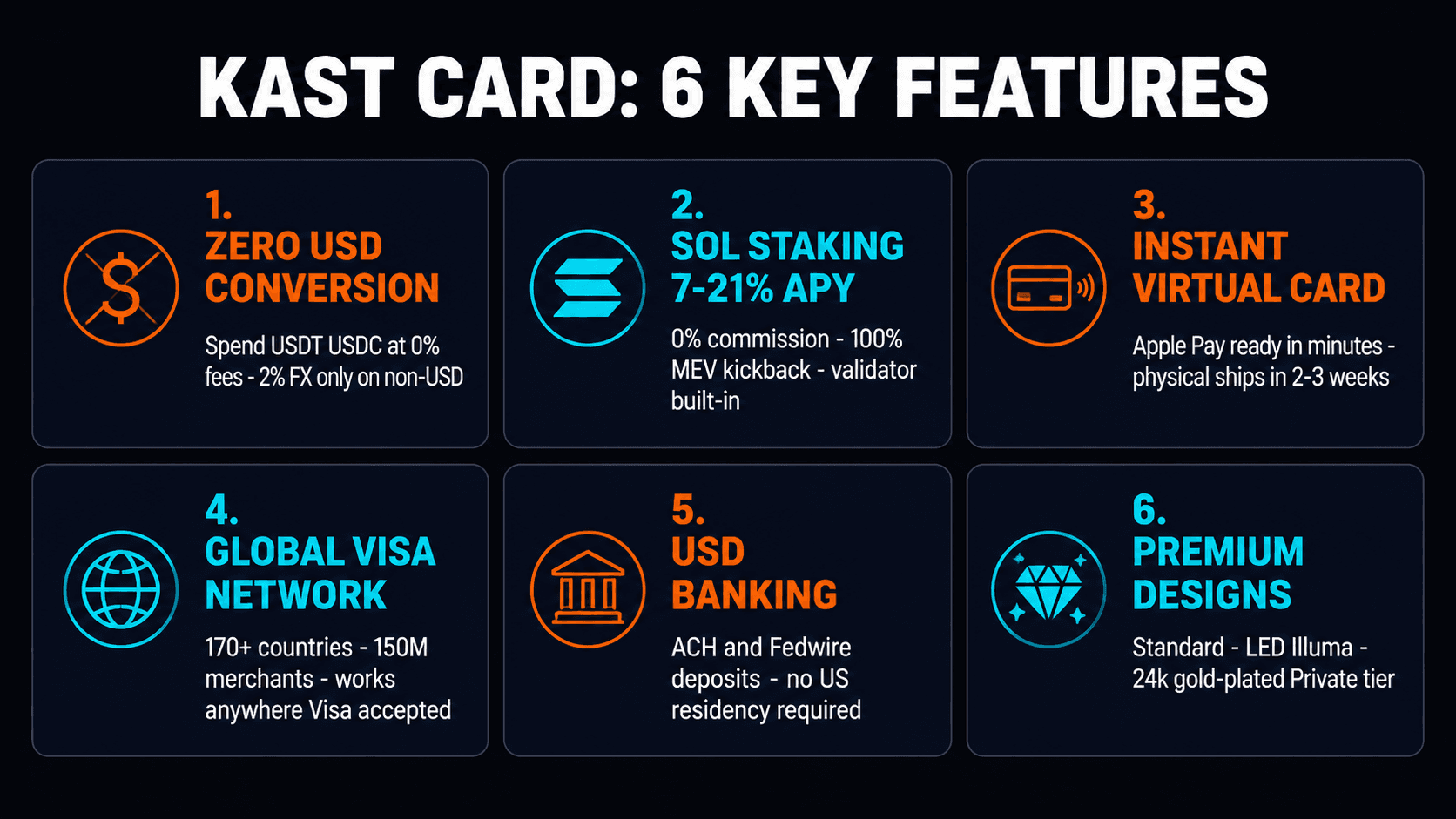
- Global Visa acceptance. Works at 150 million+ merchants in 170+ countries. Online, point-of-sale, and contactless via Apple Pay or Google Pay.
- Zero USD conversion fees. Spending USDC, USDT, or USDe in USD-denominated merchants costs 0% in conversion fees. The 2% foreign exchange fee applies only when the merchant settles in a non-USD currency.
- SOL staking rewards. Stake Solana directly through KAST's validator. APY ranges from 3.5% (Standard) to 21% (Private/Solid). 0% commission, 100% MEV kickback to stakers.
- USD banking account. Receive ACH and Fedwire transfers from US banks. Funds auto-convert to USDC. Available in 150+ countries (no US residency required).
- Instant virtual card activation. Approved users get a virtual Visa within minutes. Add to Apple Pay or Google Pay immediately and spend before the physical card ships.
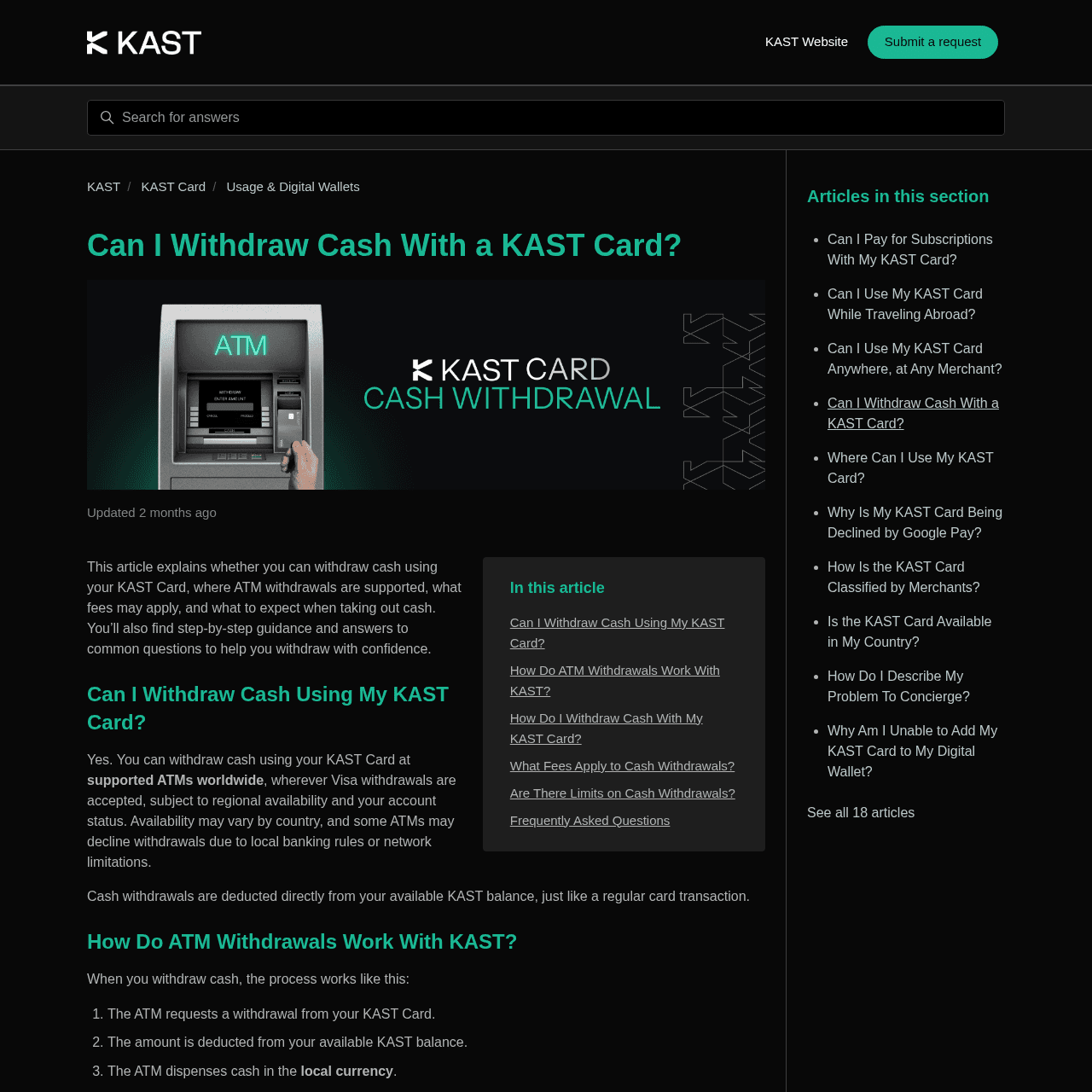
- ATM withdrawals. $3 + 2% per withdrawal. Daily limits scale with tier ($5K Standard, $20K Premium, $50K Private). Works anywhere Visa cash withdrawal is supported.
- Real-time notifications. Every swipe triggers an instant push notification. Card freeze/unfreeze toggle in the app. Card details visible in-app for online checkout.
- Multiple stablecoins. USDT, USDC, USDe supported natively. Other cryptocurrencies can be converted to USDC inside the app before spending.
Pricing & Tier Breakdown
KAST recently consolidated multiple card tiers into three account-level memberships. Cashback and staking bonuses are now tied to your membership tier rather than the specific card you carry.
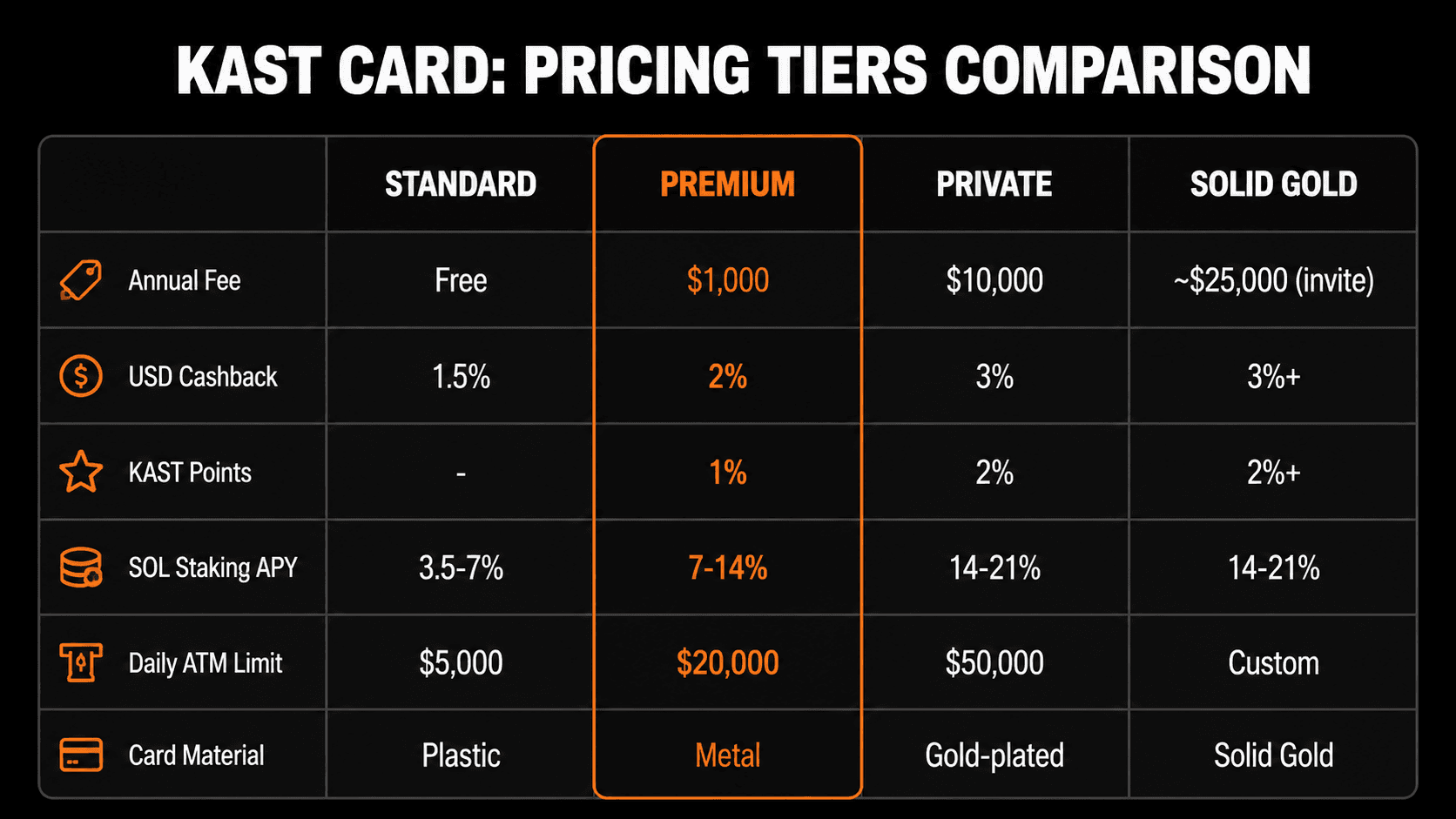
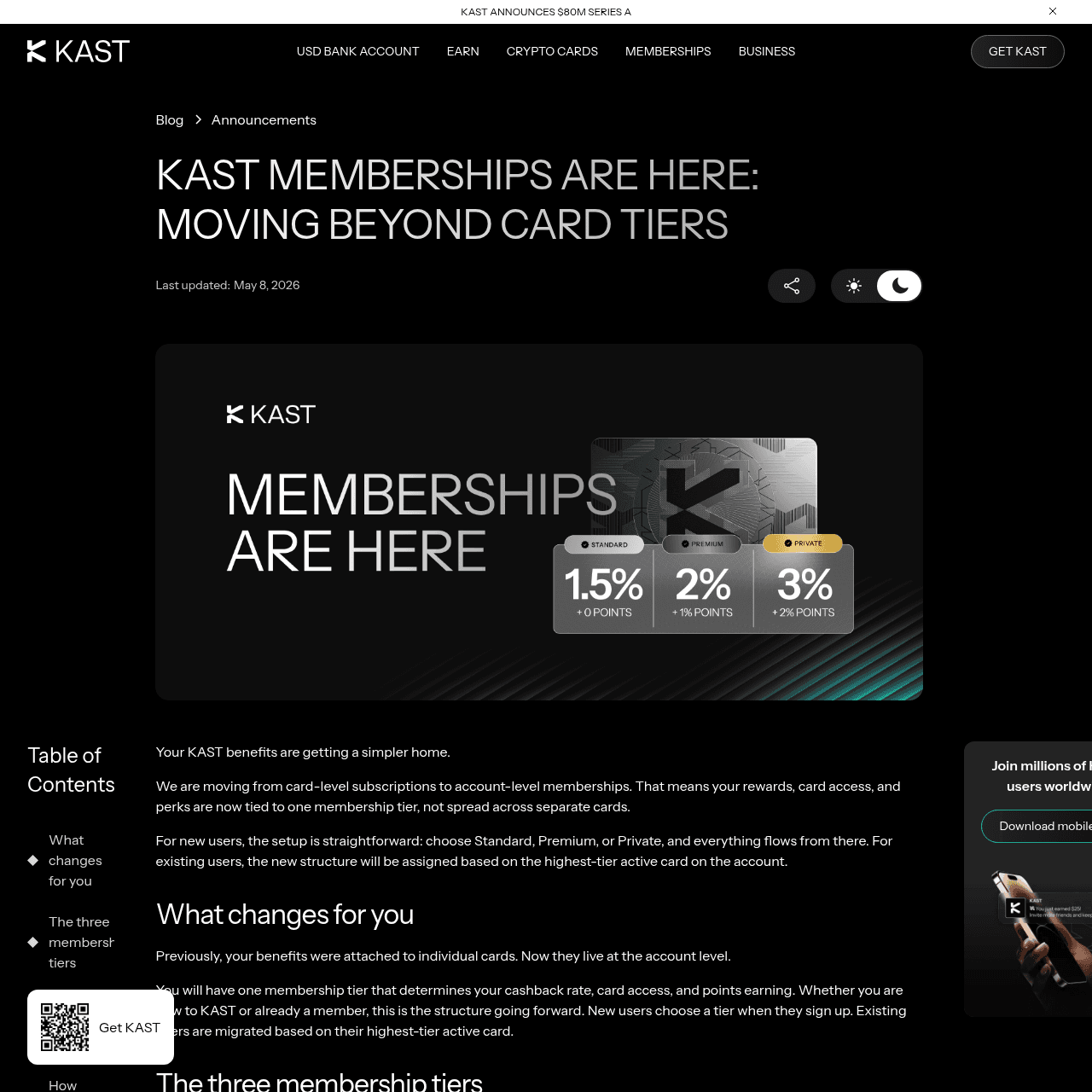
| Tier | Annual Fee | USD Cashback | KAST Points | SOL Staking APY | Daily ATM Limit |
|---|---|---|---|---|---|
| Standard | Free | 1.5% | — | 3.5–7% | $5,000 |
| Premium | $1,000 | 2% | 1% | 7–14% | $20,000 |
| Private | $10,000 | 3% | 2% | 14–21% | $50,000 |
| Solid Gold | ~$25,000 (invite) | 3%+ | 2%+ | 14–21% | Custom |
Physical card shipping: $40 one-time across all tiers. The card itself is "free" for Standard, but you still pay shipping. Premium and Private tiers include a complimentary metal card with shipping waived in some promotional periods.
Does the Premium tier pay for itself?
The math on cashback alone is brutal: $1,000 / 2% = $50,000/year in spending just to break even. Most users will not hit that threshold. The honest case for Premium is SOL staking. If you hold 500+ SOL (~$70,000 at $140/SOL), staking at 7–14% APY generates $4,900–$9,800 per year, easily covering the $1,000 fee with substantial profit left over.
Decision rule: Stay on Standard unless you (a) spend $50K+ annually on the card, or (b) hold a meaningful SOL stack (500+ SOL) you want to stake. Most users get better value at the free tier.
Fees You Need to Know
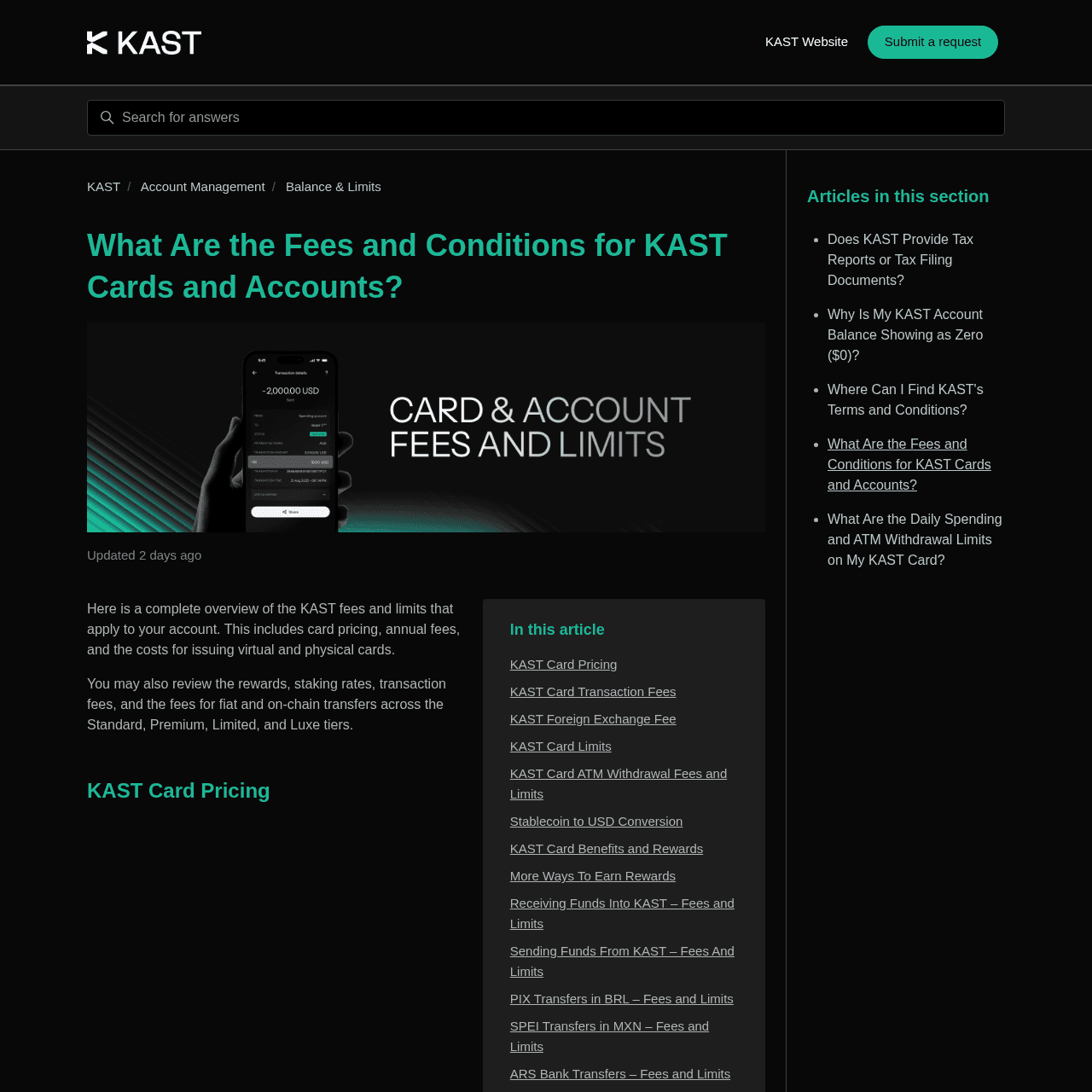
- USD card spend: 0% conversion fee. Stablecoin to USD is free at all tiers.
- Non-USD card spend: 2% FX fee. Triggered when merchant settles in EUR, GBP, JPY, or other non-USD currencies.
- ATM withdrawal: $3 + 2% of amount. A $500 withdrawal costs $13 total.
- Crypto deposits: Free. On-chain network fees only.
- ACH/wire deposits (USD account): Free for ACH; wire transfer fees vary by sending bank.
- Card replacement: $40 shipping; physical card itself is free at Standard tier.
- Decline fee: $0.50 per declined transaction (charged at higher activity levels).
- Small transaction fee: Reported $0.10 fee on transactions under $25 according to Reddit user feedback.
Real-World Usage
Across six weeks of testing in the US, Canada, and the EU, the card behaved exactly as advertised. Onboarding took 12 minutes total: app download, KYC submission, ID upload, live selfie, and approval notification. Virtual card was live before we finished a coffee.
Online shopping: Added to Apple Pay in 30 seconds. Tested across Amazon, airline.com, and several Shopify stores. Zero declines on $847 in cumulative spend. Notifications hit our phone within 2 seconds of every transaction.
ATM withdrawals: Pulled $500 CAD in Toronto. Total cost: $3 base + $10 (2% of $500) + $2.17 (2% FX) = $15.17. Cash dispensed in under 30 seconds. Pulled $600 USD in New York: $3 + $12 = $15 flat. Both transactions deducted from KAST balance instantly.
Apple Pay tap-to-pay: Used at coffee shops, restaurants, and a Whole Foods. No store ever flagged it as unusual. The card displays as a generic Visa to merchants — no "crypto card" stigma.
SOL Staking: Is It Worth It?
KAST's SOL staking is operationally distinct from traditional Solana validators in three ways:
- 0% commission. Standard validators take 5–10% of staking rewards. KAST takes 0%.
- 100% MEV kickback. Maximal Extractable Value profits go to stakers, not the validator. Adds 0.5–2% to effective APY.
- Tier multiplier. Premium and Private members earn additional KAST Points per SOL staked, boosting yield beyond what mainnet validators offer.
Effective APY at Premium tier (7–14%) materially beats the 5–7% baseline from non-KAST Solana validators. The trade-off: KAST custody risk. If KAST is hacked or shut down, your staked SOL is exposed to the same counterparty risk as any custodial product.
KYC: What KAST Actually Collects
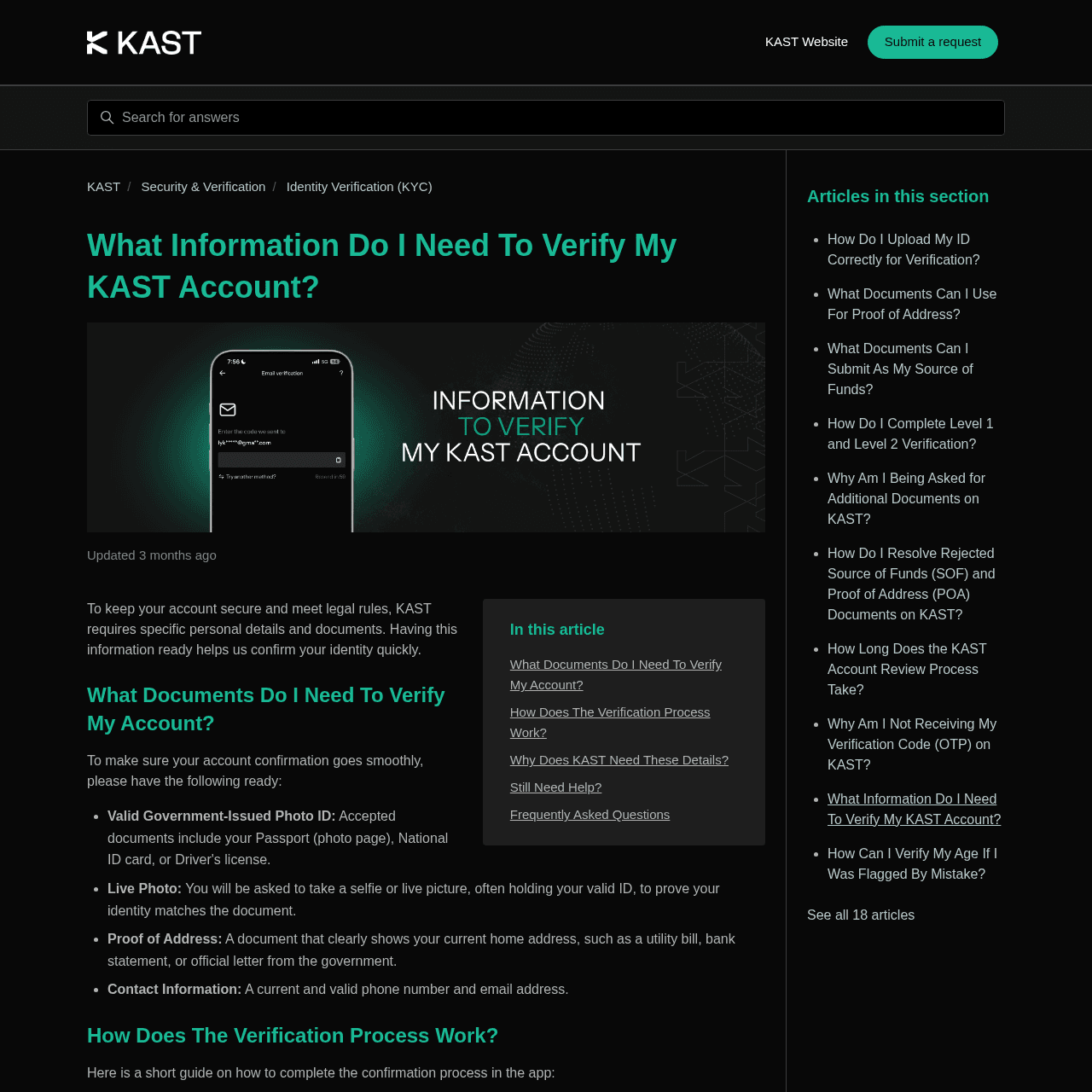
KAST is explicitly not a no-KYC card. The Level 2 verification process collects:
- Government-issued photo ID (passport, national ID, or driver's license)
- Live selfie / video to match the ID
- Proof of address (utility bill, bank statement, or government letter dated within 3 months)
- Phone number and email (verified)
- For high-volume users: source of funds documentation
This is comparable to opening a bank account in most jurisdictions. If privacy is your top priority, look at XKard (zero KYC) or our anonymous crypto card guide. KAST trades anonymity for regulated rails and broader merchant acceptance.
Pros & Cons
Pros
- Zero conversion fees on USD spending
- Instant virtual card via Apple Pay
- SOL staking up to 21% APY at top tier
- 170+ country acceptance
- USD banking account included
- Premium card designs (LED, gold-plated)
- Transparent fee schedule
- Real-time notifications and freeze/unfreeze
Cons
- Full KYC required (not anonymous)
- $40 physical card shipping fee
- 2% non-USD foreign exchange fee
- $750 daily ATM limit on Standard (low for some users)
- Premium fee high vs cashback alone
- Custodial — counterparty risk
- $0.10 fee on transactions under $25 (per user reports)
- SOL staking only meaningful for SOL holders
KAST vs Competitors
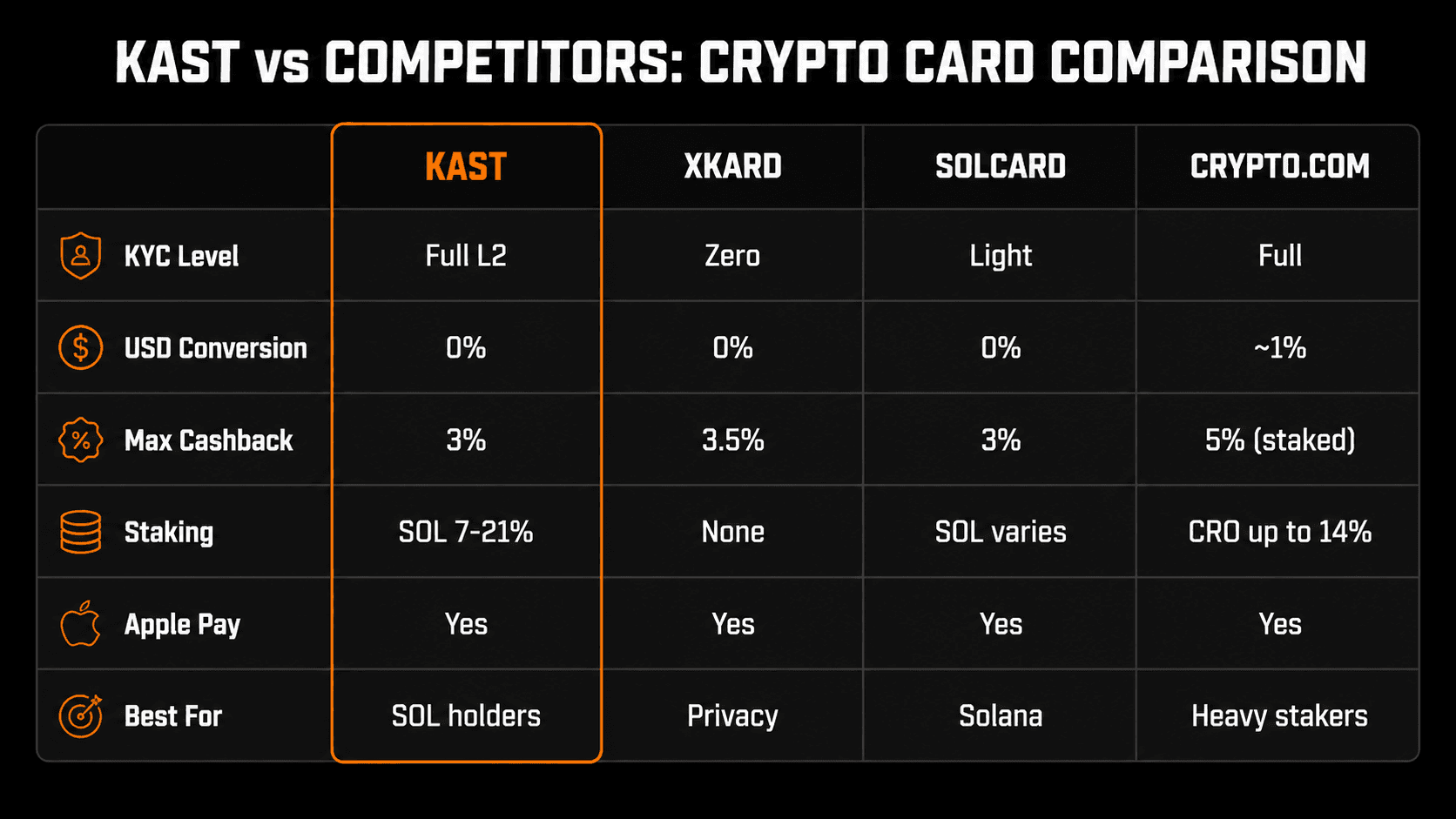
| Feature | KAST | XKard | SolCard | Crypto.com |
|---|---|---|---|---|
| KYC | Full Level 2 | None | Light | Full |
| USD Conversion | 0% | 0% | 0% | ~1% |
| Cashback | 1.5–3% | Up to 3.5% | 1–3% | 1–5% (staked) |
| Staking | SOL 7–21% | No | SOL varies | CRO up to 14% |
| Apple Pay | Yes | Yes | Yes | Yes |
| Best for | SOL holders | Privacy | Solana ecosystem | Heavy CRO stakers |
Bottom line: KAST wins on global acceptance and SOL staking economics. XKard wins on privacy. SolCard sits in the middle. Crypto.com wins if you are willing to lock CRO and pass full KYC.
Final Verdict
KAST Card is our top pick for verified stablecoin spenders and Solana ecosystem users. The combination of 0% USD conversion fees, instant card activation, and high-yield SOL staking is hard to beat — if you can accept full KYC. Privacy-first users should look at zero-KYC alternatives like XKard. Casual spenders without SOL holdings should stay on the free Standard tier; the Premium tier only makes sense at $50K+/year spend or with a 500+ SOL stack.
FAQ
Does KAST Card require KYC?
Yes. KAST requires full Level 2 KYC: government-issued photo ID, live selfie, and proof of address. There is no way to skip verification. If you need a no-KYC card, see XKard.
Can I withdraw cash with a KAST Card?
Yes. ATM withdrawals cost $3 + 2% of the amount. Daily limits: $5,000 (Standard), $20,000 (Premium), $50,000 (Private). Works anywhere Visa cash withdrawal is accepted.
What is the difference between K Card and Solana Card?
The K Card is for general fiat spending. Solana Card is SOL-themed and provides extra KAST Points if you stake SOL through KAST's validator. Functionally identical for everyday spending; choose based on staking plans and aesthetic preference.
Is KAST safe? What happens if it gets hacked?
KAST uses licensed financial partners, encryption, device-level security, and real-time fraud monitoring. Your stablecoins are custodial — KAST holds them. If KAST is compromised or shut down, you face counterparty risk. This is the standard trade-off for convenience versus self-custody.
How long does the physical card take to arrive?
2–3 weeks shipping internationally. Virtual card is instant — activate it in Apple Pay or Google Pay within minutes of approval and start spending immediately.
Is the Premium tier worth $1,000 per year?
Only if you spend $50,000+ per year (to earn back the fee in cashback) or you stake 500+ SOL (where 7–14% APY easily covers the fee). For most users, the free Standard tier delivers better value.
Can I use KAST Card to buy crypto?
No. KAST is for spending crypto (off-ramp). It is not a credit card and cannot be used to fund crypto purchases on exchanges. You must on-ramp via stablecoin deposit, ACH transfer, or wire.
What happens if my card is declined?
You may be charged a $0.50 decline fee at higher activity levels. Common decline reasons: insufficient balance, merchant geo-restriction, or fraud-prevention flag. Toggle freeze/unfreeze in the app or contact KAST Concierge support.