Crypto Card Negative Balance 2026: Five Ways Below Zero
- “No overdraft” describes the authorisation, not the settlement. All five agreements ban overdrafts; four then set out what happens when one occurs anyway.
- Two platforms say they cannot refuse the charge. Adyen: “Adyen cannot decline forced captures and must process the transaction and deduct the funds.” Stripe: “you can’t block them.”
- The hold expires in about 7 days; a hotel can collect for 31. That gap is a route below zero on its own.
- Recovery is the clause nobody reads. SwissBorg may take the shortfall “from other available digital or fiat assets”; Crypto.com’s US card allows 30 days, then debits your USD account.
- Freezing the card does not stop it. Stripe: card status and spending controls “don’t apply for capture”.
On this page
- Every one of these cards says it cannot be overdrawn
- Five ways a card with no overdraft goes below zero
- The charge that arrives with no authorisation at all
- When the network answers on your issuer’s behalf
- The settlement that is bigger, and later, than the hold
- What five programmes say they will take back
- Freezing the card does not stop it
- The no-KYC cards have no clause for this
- How to check your own card
- Final take
- Sources
- Related articles
- FAQ
A prepaid card is sold on one promise: you cannot spend money that is not there. So a crypto card negative balance reads like a contradiction — until you notice that four of the five card agreements we read on 12 November 2026 carry a clause about what happens when it occurs. Crypto.com's US agreement bans overdrafts at clause 5(b) and spends clause 12 on your liability for them. SwissBorg's rulebook has a section headed “Overdraft Account”. Monavate onChain lists four circumstances that produce a negative balance on a card it has just told you has no overdraft feature.
We went a layer down for the reason. Three card-issuing platforms — Stripe, Adyen and Lithic — publish the mechanics, and two state outright that they cannot refuse the charge. Adyen: “Adyen cannot decline forced captures and must process the transaction and deduct the funds.” Stripe, on the same class of transaction: “you can’t block them.” Below: the five routes below zero, the windows that let a purchase arrive weeks later, and a table of what each programme may take off you to clear it.
Every one of these cards says it cannot be overdrawn
Start with the promise, because it is consistent and not quite what it sounds like. Crypto.com's US Prepaid Visa Cardholder Agreement, effective 1 September 2026, heads clause 5(b) “No Overdrafts Permitted”; its fee schedule is blunter still, “No overdraft/credit feature.” Monavate onChain's agreement of 16 September 2026 says at §4.2 that “The Card does not have overdraft or credit features”. Coinbase Card's agreement puts it in capitals.
Notice what those sentences are about. Each describes a decision: a request arrives, the balance is checked, the request is declined. They are promises about the authorisation step, not about the moment the money moves — a separate message, sent later, and sometimes sent alone.
The same documents, a few pages on:
- Crypto.com (US), cl. 12: “if any transactions cause the balance in your Card Account to go negative, including any purchase transactions where the retailer or merchant does not request authorization, you shall remain fully liable to us”.
- Monavate onChain, §10: “in certain circumstances, transactions may result in a negative balance”, the first being “Transactions where the merchant does not request authorization”.
- SwissBorg, §7.7: “one or more card transactions were processed without sufficient funds to cover the full amount”.
Three programmes, three jurisdictions, same culprit: a merchant that never asked. That is the documented exception to the rule printed on the front of the product, and it is worth knowing before you fund a card — the same way a hold is not a charge is worth knowing before a hotel takes one.
Five ways a card with no overdraft goes below zero
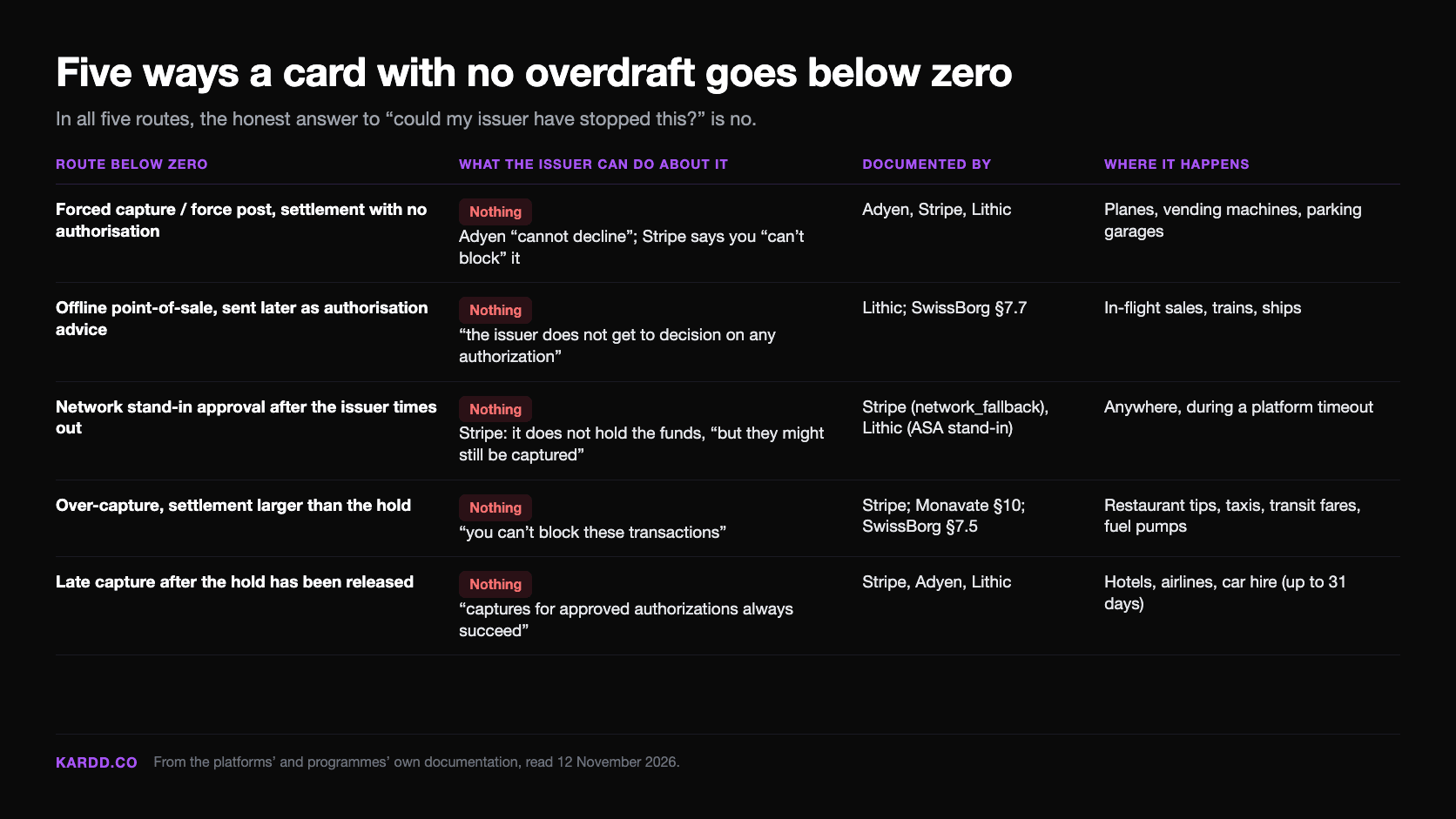
The three platforms' documentation and the four programmes that publish a clause give five distinct routes. None is a variation on “you spent too much”; each is a different message arriving in a different order, and only two involve a merchant behaving badly.
| Route below zero | What the issuer can do about it | Documented by | Where it happens |
|---|---|---|---|
| Forced capture / force post — settlement with no authorisation | Nothing. Adyen “cannot decline”; Stripe says you “can’t block” it | Adyen, Stripe, Lithic | Planes, vending machines, parking garages |
| Offline point-of-sale, sent later as authorisation advice | Nothing — “the issuer does not get to decision on any authorization” | Lithic; SwissBorg §7.7 | In-flight sales, trains, ships |
| Network stand-in approval after the issuer times out | Nothing. Stripe: it does not hold the funds, “but they might still be captured” | Stripe (network_fallback), Lithic (ASA stand-in) | Anywhere, during a platform timeout |
| Over-capture — settlement larger than the hold | Nothing: “Because over capturing is often legitimate, you can’t block these transactions” | Stripe; Monavate §10; SwissBorg §7.5 | Restaurant tips, taxis, transit fares, fuel pumps |
| Late capture after the hold has been released | Nothing — “captures for approved authorizations always succeed” | Stripe, Adyen, Lithic | Hotels, airlines, car hire (up to 31 days) |
From the platforms’ and programmes’ own documentation, 12 November 2026. A sixth route, fees charged after a transaction is authorised, is listed by Monavate at §10 but is not a settlement mechanism, so it is out of this table.
Column two is the finding: in all five routes, the honest answer to “could my issuer have stopped this?” is no.
The charge that arrives with no authorisation at all
A card payment is normally two messages: an authorisation, where your issuer checks the balance and answers, and a capture days later, which moves the money. A forced capture is the second without the first. Adyen defines it as a transaction “captured without a valid authorisation because the authorisation was declined or never received”, and names three settings: “Offline environments, such as when buying snacks on an airplane”, automated environments “like vending machines or parking garages”, and technical failures.
Then the sentence that makes this an article rather than a footnote: “Adyen cannot decline forced captures and must process the transaction and deduct the funds.” The reason follows — a forced capture “skips the balance check because balance checks occur during authorisation, not during capture” — and so does the consequence: “If there are not enough funds in the balance account at the time of capture, the transaction can lead to a negative balance.” Its advice to card programmes is to keep the account funded. There is no other advice to give.
Stripe documents the identical mechanism under “Force capture”: merchants “might initiate a capture despite receiving a declined authorization, or even without an authorization”, and either way “we deduct the captured amount from your Issuing balance and send it to the merchant”. Its example is Adyen's too: “The terminals used on airplanes are usually not connected to the internet. Purchases on flights aren’t able to create authorizations and instead create transactions that are sent after the plane lands.” Because some are legitimate, “you can’t block them”.
Lithic is bluntest on what that means for the cardholder. It calls the message a Force Post, and says it lets a transaction “potentially settle for an amount above the cardholder’s balance, without affording the user an opportunity to decline”. The one consolation is a dispute right: where the balance is exceeded the transaction “may be subject to chargeback” — a different fight with a different timetable.
When the network answers on your issuer’s behalf
The second route is stranger: here the issuer does get asked, and the answer still does not count. Card networks hold a fallback position for the seconds when an issuer is unreachable or slow, and both platforms that document it describe the same chain.
Stripe lists an authorisation outcome called network_fallback, for when it “timed out or encountered an error when responding to the card network”. The guidance underneath is remarkable: “If the card network approved an authorization that Stripe declined, treat the authorization as approved.” Then the money sentence — “Stripe doesn’t hold the funds, but they might still be captured.” No hold was placed, because as far as the issuer is concerned the transaction was refused. The capture arrives anyway.
Lithic calls it stand-in and spells out the sequence: the client “responds to an ASA request with a decline”, Lithic “times out and does not pass that response to the networks in time”, and “the networks then generate an authorization advice approval on the client’s behalf”. Its default is kinder — “For most Lithic clients, the networks will stand-in to decline” — but “Certain Enterprise clients can customize their stand-in behavior so that the networks approve rather than decline on their behalf”.
Which stance your card takes is a configuration choice made by a company whose name is probably not on it, and nobody in this niche publishes it — the same invisible layer that decides whether you can pass a 3D Secure check at all, and the reason our issuers round-up leaves so many cells empty.
The settlement that is bigger, and later, than the hold
Routes four and five need no misbehaviour at all, only the ordinary timetable of card payments, which is slower and looser than an app balance suggests.
Over-capture first. Stripe explains that merchants in some categories — “vehicle rentals, bars and restaurants, and ground transportation” — “can authorize a card for an amount and then capture funds greater than that amount”. For a restaurant the gap is a tip; for ground transportation it is the whole fare, since “the authorized amount is typically a minimal amount, whereas the captured amount reflects the actual transaction”. Monavate lists “Final settlement amounts that exceed authorization holds” as its second route to a negative balance, and SwissBorg's §7.7 names the transit version: an incremental charge after a tap-in, when the journey crosses more zones than the estimate. Its fuel-pump section asks for a minimum spending balance of 150 EUR, “as recommended by the Card Networks”, for exactly this reason.
Then the clocks, which disagree with each other by weeks.
| Clock | Published window | Source |
|---|---|---|
| Authorisation hold expiry | “7 days in most cases” (varies by scheme and type) | Adyen, payment stages |
| Settlement message after the authorisation | “typically arrives between 0-7 days” | Lithic, transaction flow |
| Normal capture | “normally happens within 24 hours” | Stripe, Issuing transactions |
| Capture by hotels, airlines, car rental | “up to 31 days after authorization” | Stripe, Issuing transactions |
| Merchant bank’s collection window vs hold release (worked example) | 7 days to collect, hold released after 10 | Osper negative-balance help page |
Each figure is the window that source publishes for that step; the rows measure different stages and are not alternatives to one another.
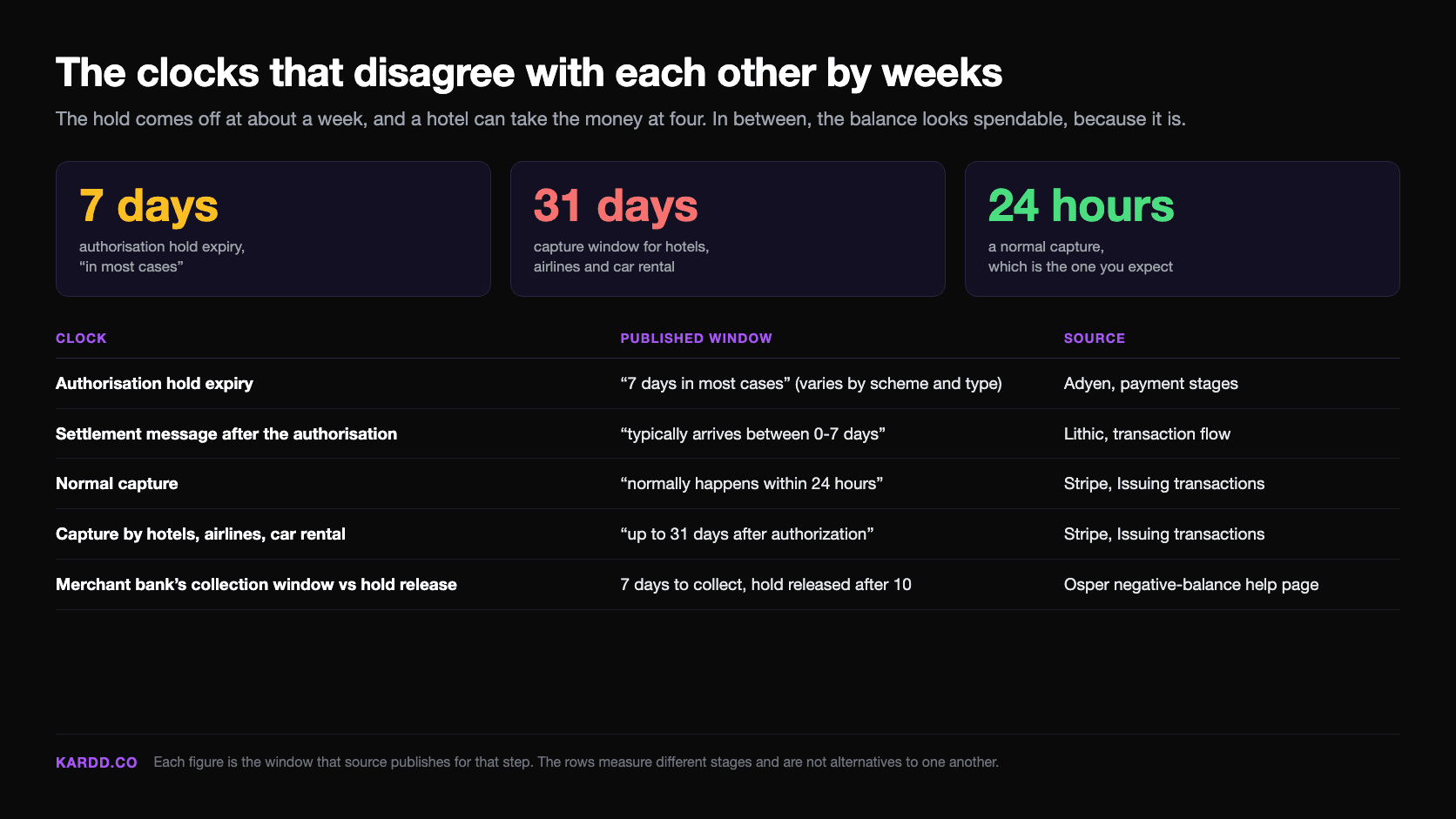
Put rows one and four together and the arithmetic is unavoidable: the hold comes off at about a week, and a hotel can take the money at four. In between, the balance looks spendable, because it is. Osper's help page — the clearest public explanation of this we found, on a prepaid card for teenagers — describes the consequence exactly: if the merchant's bank collects after the hold was released and you have spent the returned money, the balance goes negative. Stripe keeps the same door open, noting that an expired authorisation's amount represents “any remaining amount authorized for possible late captures”.
What five programmes say they will take back
All of the above is mechanics. The part that costs money is the recovery clause, and the programmes differ sharply — in deadline, in reach, and in whether they say anything at all.
| Programme (document date) | Clause | What it may recover from | Deadline / consequence |
|---|---|---|---|
| SwissBorg Card Rulebook v0.1 (22 Jul 2026) | §7.7 “Overdraft Account” | Fiat account in the card’s base currency first; then “other available digital or fiat assets in the user’s account” | Card frozen; withdrawals of digital and fiat assets and Smart Send restricted until cleared |
| Crypto.com US Prepaid Visa (1 Sep 2026) | cl. 12 | Billed to you; “any other Card we have issued to you”; after 30 days, your USD Account by debit | Pay within 30 days; possible NSF fee; card may be cancelled for “one or more negative balances” |
| Crypto.com EU/EEA prepaid card (30 Apr 2025) | cl. 9.7 | Not stated — you must top up the Prepaid Card Wallet yourself | “immediately”; failure is “a material breach” and the card may be cancelled immediately |
| Monavate onChain Visa Debit (16 Sep 2026) | §4.2, §9, §10 | Your Funding Source, which “may be a cryptocurrency balance”; collection pursued if unpaid | Repay “immediately”; card suspended or cancelled; fees for “negative balance occurrences” |
| Coinbase Card cardholder agreement (undated v1) | Card use / negative balance paragraph | Any later deposits; “any deposit or balance on another Card you have with us” | Pay “promptly”; offset applied automatically against incoming funds |
Clause numbers and dates as printed in each document, read 12 November 2026. Crypto.com’s EU card is issued by Foris MT Limited under a Maltese financial institution licence; its US card is a Visa prepaid product with a separate agreement.
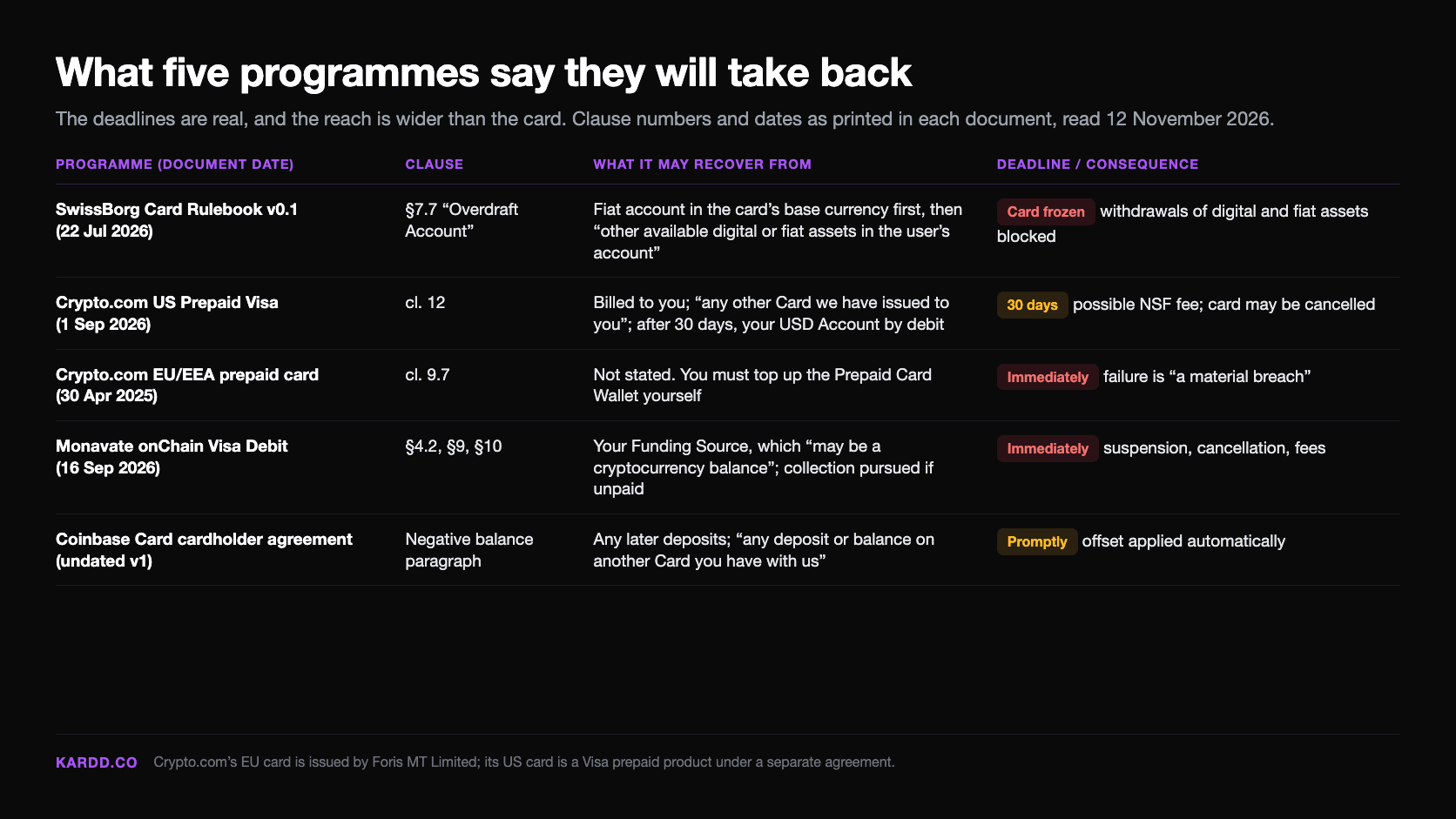
Two things are worth staring at. The deadlines are real: 30 days on the US Crypto.com card before it debits a different account of yours, “immediately” on two others, with material breach as the stated consequence. And the reach — SwissBorg may recover “from other available digital or fiat assets” if the overdraft is not resolved “within a reasonable timeframe”, and on a crypto-funded card your other available assets are your portfolio. That is the conversion risk we traced through crypto card exchange rates, arriving from the opposite direction at a moment you did not choose. SwissBorg is also the only one of the five that says what the experience will be: a notification, a support contact, a freeze, and a list of which account functions stop working.
Freezing the card does not stop it
The instinct, on discovering any of this, is to freeze the card in the app. Every crypto card we track offers the button, and on this class of charge it does nothing — the single most useful line in this article.
Stripe is explicit. Spending controls, real-time authorisation controls and card status “don’t apply for capture”: they “can be used to determine whether authorizations are approved, but captures for approved authorizations always succeed”. A hold taken on Monday against a card you froze on Tuesday still becomes a debit on Wednesday. Adyen adds the mirror case: if a forced capture hits a balance account that is “inactive or blocked”, it debits the platform's liable balance account instead.
Cancellation is not much better. Stripe permits recurring authorisations on expired cards, and says “captures on previously approved authorizations always succeed”. Monavate says the same in cardholder language: pending transactions may still be charged to your funding source, and “any outstanding negative balance or fees remain your responsibility and must be paid”. If you are closing a card, leave the float in place for a cycle rather than sweeping it to zero — a point that belongs beside the exit fees we costed earlier this year.
The no-KYC cards have no clause for this
Every document quoted above belongs to a programme that knows who you are. That is not a coincidence, and it is the part of this subject that matters most on a site about cards that ask for as little identity as possible.
We looked for the equivalent clause on the no-KYC side and did not find one. XKard's terms page served no readable text to a plain fetch. COCA's loaded in full and mentioned no overdrafts, negative balances or offline transactions. The KAST and SolCard terms URLs we tried returned 404. That is an absence of evidence, not evidence of absence: none has said a negative balance cannot happen, and the platform documentation says it can happen on these rails.
What is missing is the second half of the mechanism. Every recovery route in the table needs something the programme already holds — a fiat account in your name, a second card it issued you, a funding source it can debit, an incoming deposit to offset. A card opened with an email address and funded from a self-custodied wallet gives a programme none of those. Which leaves two possibilities, both worth knowing: either it can reach the crypto balance it holds for you, in which case that balance is less yours than the marketing implies, or it cannot, and its only remedy is the card itself — freeze, suspend, close.
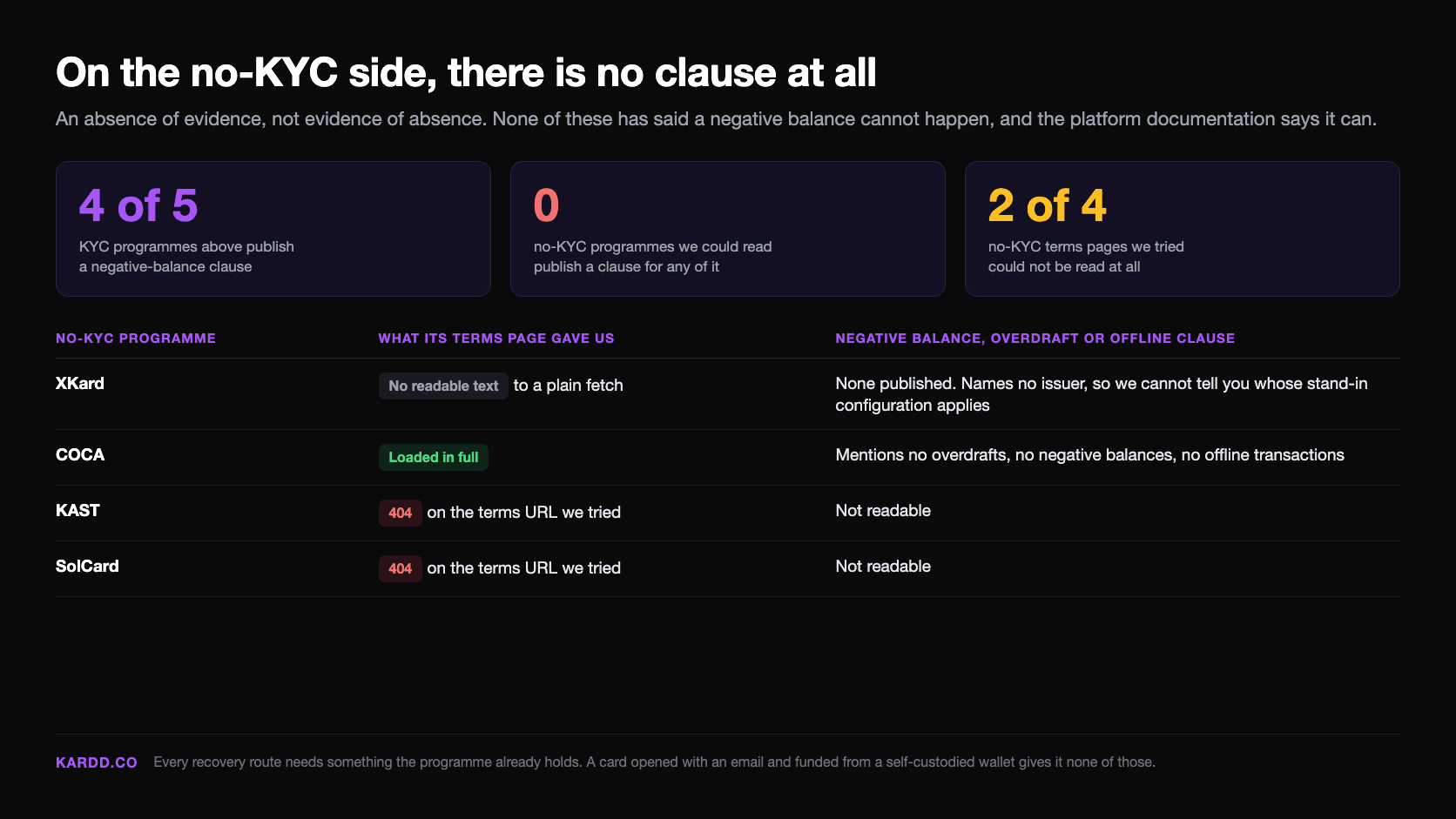
Our own records say as little as the vendors do, and we would rather print that than guess. XKard, the card this site has an affiliate relationship with, publishes no negative-balance clause and names no issuer, so we cannot tell you whose stand-in configuration applies to it. On a card with no published clause, treat a cleared balance as the only safe balance.
How to check your own card
Five minutes in a help centre, before a flight rather than after one, settles most of this. Cheapest checks first.
- Search the terms for “negative”, “overdraft” and “offline”. Not the FAQ — the agreement. In all five documents, the clause sits in the terms and is absent from the marketing site.
- Find out what it may recover from. Not whether you will owe it, but which of your balances it can debit without asking. Only SwissBorg answered that in a sentence.
- Leave a buffer on anything automated. SwissBorg asks for 150 EUR at a fuel pump, on the card networks’ own recommendation. Planes, trains, tolls and parking are the same shape of risk.
- Do not drain a card the day you use it in those places. The settlement can be a week behind you, and up to 31 days behind a hotel.
- Do not rely on the freeze button. It governs authorisations, and these charges are not authorisations.
- If the balance does go negative, read the deadline before you argue. Thirty days and “immediately” are both in the documents above, and one escalates to a stated material breach.
See which cards publish their clauses at all
Kardd reads what each card actually publishes — issuer, KYC level, fees, limits and the terms behind them — so you can tell a programme that documents the awkward cases from one that stays quiet.
Kardd may earn a commission on sign-ups, including XKard, which publishes no negative-balance clause we could read. Affiliate disclosure.
Final take
“No overdraft” is true of the authorisation and silent about the settlement, and the gap between those two messages is where every negative balance here lives. The platforms running these cards say so without euphemism: one cannot decline the charge, one says you cannot block it, one says it settles with no opportunity to decline.
For a KYC'd card the result is a bill with a deadline and a clause naming what gets debited if you miss it. For a no-KYC card it is unknown, because nobody has written it down. That is not a reason to avoid them. It is a reason to keep a buffer, stop treating the freeze button as a remedy, and remember that the plane, the train and the parking garage are the three places a prepaid card is not really prepaid.
Sources
All read in full on 12 November 2026. Adyen, “Payment stages” (forced captures, the skipped balance check, the negative-balance consequence, the 7-day expiry). Stripe, “Issuing transactions” (force capture, the aeroplane terminal, over-capture, the 24-hour and 31-day windows). Stripe, “Issuing authorizations” (network_fallback, late captures, recurring authorisations on expired cards). Lithic, “Transaction flow” (Force Posts, the offline point-of-sale case, stand-in, the 0–7 day settlement message). SwissBorg Card Rulebook v0.1 (§7.5–§7.7: transit charges, the 150 EUR fuel-pump minimum, the overdraft state and recovery order). Crypto.com US Prepaid Visa Cardholder Agreement (clauses 5(b) and 12). Crypto.com EU/EEA prepaid card terms (clause 9.7). Monavate onChain Visa Debit Card Cardholder Agreement (§4.2, §9, §10). Coinbase Card Cardholder Agreement (liability and the offset against deposits and other cards). Osper, “Negative balance” (the worked collection-versus-hold-release example, on a non-crypto prepaid card). Not readable tonight: eur-lex.europa.eu returned an empty body, so no e-money credit provision is quoted; the Bybit help centre returned 403.
Related Articles
- Crypto Card Pre-Authorisation Holds 2026: Three Deadlines That Disagree
- Crypto Card Declined? 9 Reasons and Fixes for 2026
- Crypto Card Chargebacks 2026: What You Can Actually Dispute
- Crypto Card Frozen Funds: What To Do When Your Card Is Blocked
- Crypto Card Exchange Rates 2026: The Spread Nobody Quotes
- Crypto Card Issuers 2026: 16 Programmes Checked
Frequently Asked Questions
Can a prepaid crypto card go negative?
Yes, and the programmes that publish detailed terms all say so. Crypto.com's US agreement forbids overdrafts and then devotes clause 12 to what happens when transactions go negative anyway, naming purchases where the merchant does not request authorization. SwissBorg's rulebook has a section titled “Overdraft Account”.
Why did my crypto card charge me when I had no balance?
Most likely the merchant never asked. Adyen calls this a forced capture and says it “skips the balance check because balance checks occur during authorisation, not during capture”. On a plane, a train or at a vending machine the terminal often has no live connection, so the charge arrives days later as a settlement with no authorisation attached.
How long after a purchase can a crypto card still take the money?
Longer than the hold lasts. Stripe says capture normally happens within 24 hours, but hotels, airlines and car rental companies can capture up to 31 days after authorisation. The hold itself expires much earlier — 7 days in most cases on Adyen — and Lithic puts the settlement message at 0 to 7 days after the authorisation response. That gap is where a cleared balance gets spent twice.
What will a crypto card do to clear a negative balance?
It depends which programme you hold. SwissBorg recovers from your fiat account first, freezes the card, blocks withdrawals, and may then recover from other available digital or fiat assets. Crypto.com's US card allows 30 days, can recoup from any other card it has issued you, and after 30 days can debit your USD Account. Coinbase Card applies later deposits and balances on your other cards.
Does freezing or cancelling the card stop these charges?
No. Stripe states that spending controls, real-time authorisation controls and card status do not apply at capture, and that captures for approved authorisations always succeed. Monavate's cancellation terms say pending transactions may still be charged to your funding source, and that any outstanding negative balance or fees remain your responsibility.
Do no-KYC crypto cards publish a negative balance clause?
Not in anything we could read on 12 November 2026. XKard's terms page served no readable text to a plain fetch, COCA's terms carried no mention of overdrafts, negative balances or offline transactions, and the KAST and SolCard terms URLs we tried returned 404. That is an absence of evidence rather than a clause saying it cannot happen — and the recovery routes the documented programmes rely on are exactly what a no-KYC card does not hold.