Best No-KYC Crypto Cards in 2026: The Independent Comparison Guide
Crypto was built for financial sovereignty. But the moment you try to spend it at a coffee shop, you’re asked to hand over your passport, a selfie, and your mother’s maiden name.
No-KYC crypto cards promise a way around that — load crypto, get a Visa or Mastercard, spend anywhere. No identity documents required. But which ones actually deliver? What do they really cost? And what happens when one gets shut down overnight?
We compared 11 no-KYC crypto cards across fees, limits, mobile pay support, and real-world reliability so you don’t have to learn the hard way.
What Is a No-KYC Crypto Card?
A no-KYC crypto card is a prepaid debit card (usually Visa or Mastercard) that lets you load cryptocurrency and spend it at any merchant — without submitting government-issued identification. You fund the card with Bitcoin, USDT, ETH, or other supported tokens, and the card converts your crypto to fiat at the point of sale.
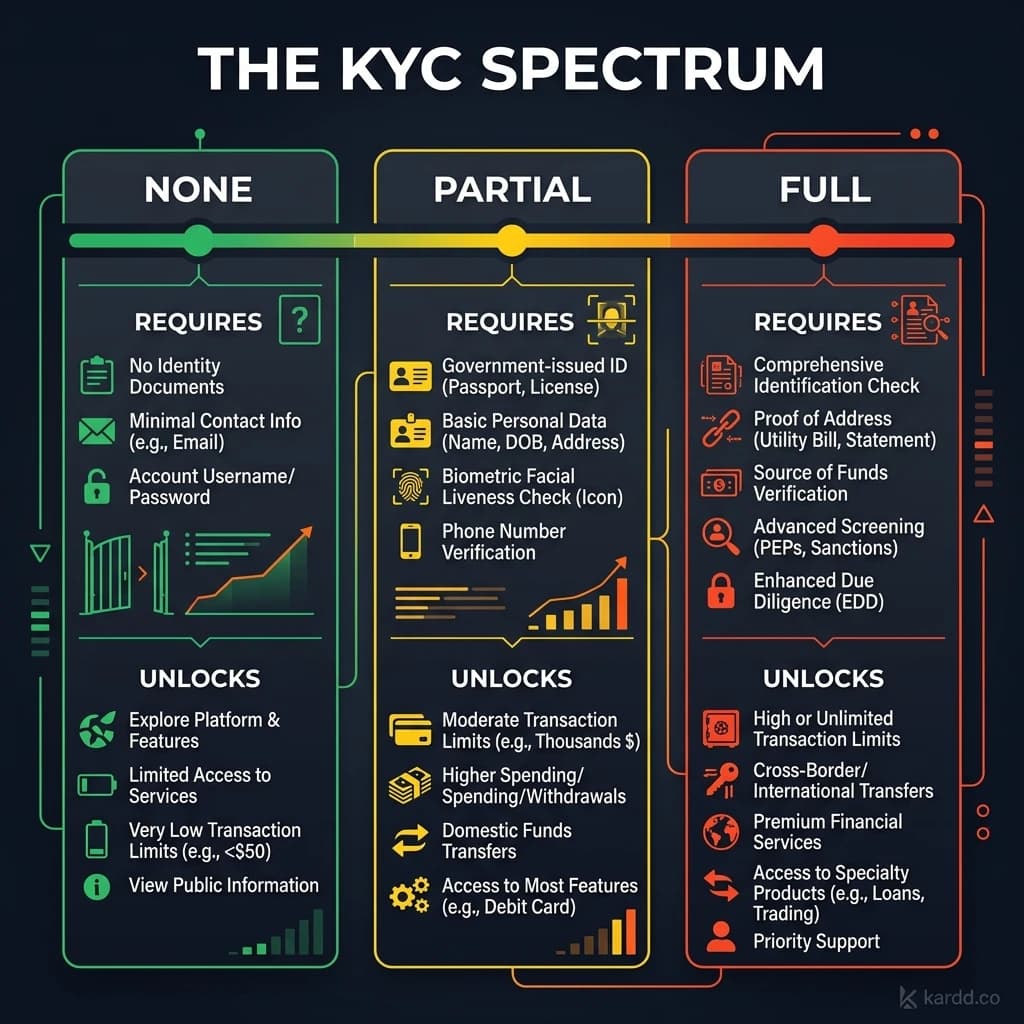
The term “no-KYC” is a spectrum, not a binary. Most cards fall into one of three tiers:
- No verification — email only (or nothing at all). Lowest limits, highest fees.
- Partial verification — email + phone number. Moderate limits and fees.
- Full KYC — government ID, selfie, proof of address. Highest limits, lowest fees.
The cards in this guide focus on the first two tiers: options where you can start spending crypto without handing over your identity documents.

Best No-KYC Crypto Cards Compared (2026)
Here’s what most “best no-KYC card” articles won’t give you: an actual side-by-side comparison with real numbers. We track these weekly on Kardd.co — here’s the current snapshot.
| Card | KYC Level | Top-Up Fee | Monthly Limit | Crypto Supported | Apple/Google Pay | Type |
|---|---|---|---|---|---|---|
| XKard | Zero KYC | 2.3-4.5% | Up to $100K (Whale) | USDT (BNB/TRON) | Yes (Both) | Virtual + Physical |
| SolCard | Zero KYC | 5% | $5,000 | SOL, USDT, USDC (Solana) | Yes (Both) | Virtual |
| Laso Finance | None | 2-3% | $2,000 | USDT, USDC (ERC20/BEP20/TRC20) | Yes (Both + Samsung) | Virtual |
| KAST | Minimal KYC | 2% | $3,000 | USDT, USDC | Yes (Apple Pay) | Virtual + Physical |
| Goblin Card | None | 3-4% | $5,000+ | BTC, ETH, SOL, XMR, USDT | No | Virtual + Physical |
| BingCard | Minimal KYC | 1% | $1,000 | USDT (TRC20/BEP20) | No | Virtual + Physical |
| Bancus | Minimal | 2.5% | $2,500 | BTC, ETH, USDT | No | Virtual |
| COCA Card | Minimal KYC | 2.5% | $3,000 | Multi-chain (ERC20/BEP20/Solana/Polygon) | Yes (Apple Pay) | Virtual + Physical |
| Bitsika | None | 2% | $1,000 | BTC, USDT | No | Virtual |
| Bitget Wallet Card | Partial | 1-2% | $5,000 | Multi-chain | Yes (Google Pay) | Virtual |
| Coinsbee | None | 0-5% | Varies | 50+ cryptos | N/A | Gift cards |
Key Takeaways From the Data
- Best overall: XKard — zero KYC, supports Apple Pay + Google Pay, Visa and Mastercard options, and limits up to $100K/month on the Whale tier. The effective rate of 2.8% for high-volume users makes it the most cost-efficient for serious spenders.
- Lowest entry fee: BingCard at 1% — but limited to $1,000/month and no mobile pay.
- Highest limits without KYC: XKard Whale tier ($100K/month) or Goblin Card ($5,000+) for those who also want Monero (XMR) support.
- Best mobile pay support: XKard, SolCard, and Laso Finance all support Apple Pay and Google Pay.
- Most crypto options: Coinsbee supports 50+ cryptocurrencies, but through gift cards rather than a traditional debit card.
Which No-KYC Cards Support Apple Pay and Google Pay?
This is one of the most-searched questions in the space — and one of the least-covered by other guides. Here’s the definitive answer.
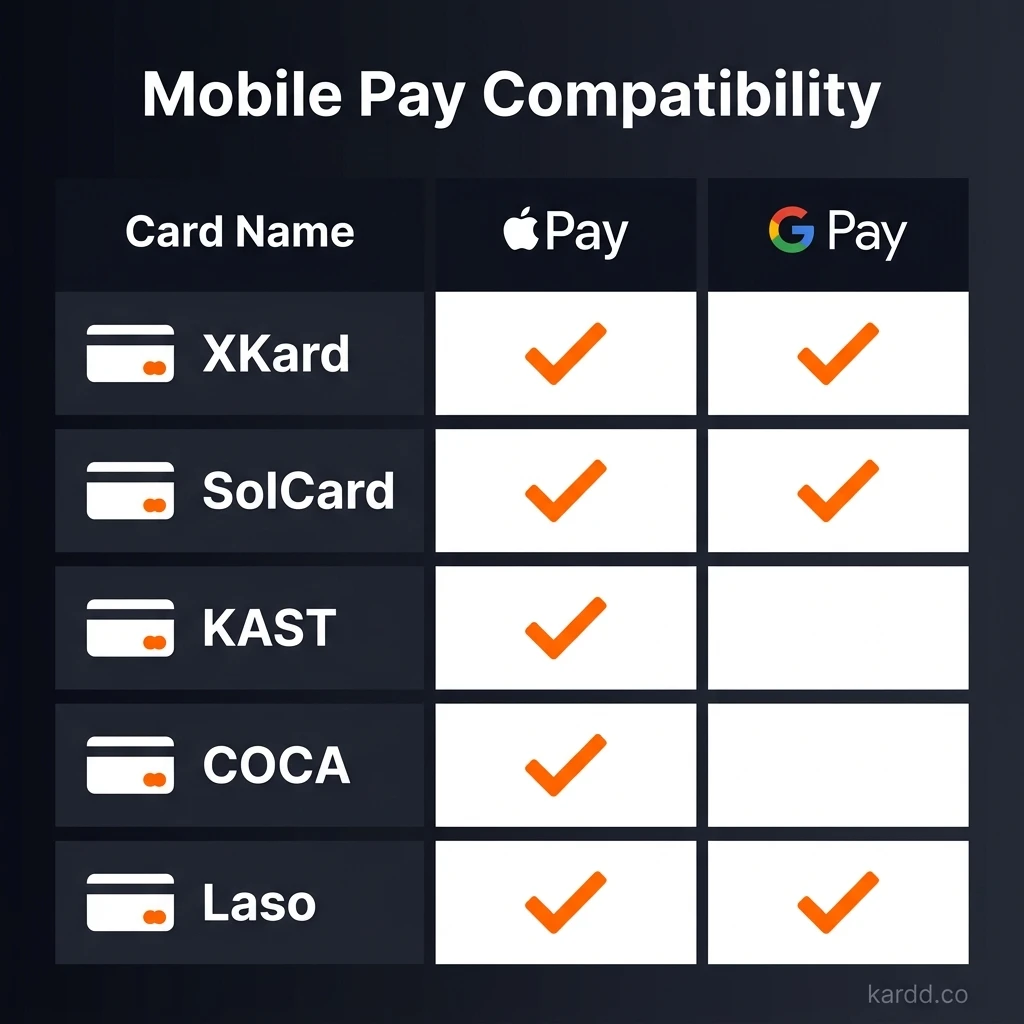
Apple Pay Compatible (No or Minimal KYC)
- XKard — Full Apple Pay + Google Pay support. Zero KYC. The only card with both mobile wallets AND zero verification.
- SolCard — Add to Apple Wallet after card creation. Works at NFC terminals worldwide.
- Laso Finance — Full Apple Pay + Samsung Pay support. Virtual card loads instantly.
- KAST — Apple Pay supported. USDT and SOL funding.
- COCA Card — Apple Pay via their non-custodial wallet app.
Google Pay Compatible
- XKard — Full Google Pay integration. Zero KYC.
- SolCard — Full Google Pay integration.
- Laso Finance — Google Pay + Samsung Pay.
- Bitget Wallet Card — Google Pay only (no Apple Pay). Requires partial KYC.

How it works: The crypto card acts as a bridge. You’re not paying with crypto directly through Apple Pay — you’re adding a Visa/Mastercard (funded by crypto) to your phone’s wallet. Apple and Google don’t see crypto; they see a standard card transaction.
The catch: Apple Pay and Google Pay both have their own compliance requirements. Cards that run afoul of these policies can lose mobile pay support even if the card itself still works. SolCard and Laso Finance have maintained the most consistent mobile pay access through 2026.
The Real Cost: No-KYC Crypto Card Fees Explained
“No KYC” doesn’t mean “no fees.” In fact, the privacy premium is real — you’re paying 2-10x more per transaction compared to a verified crypto card like Crypto.com or Coinbase Card.
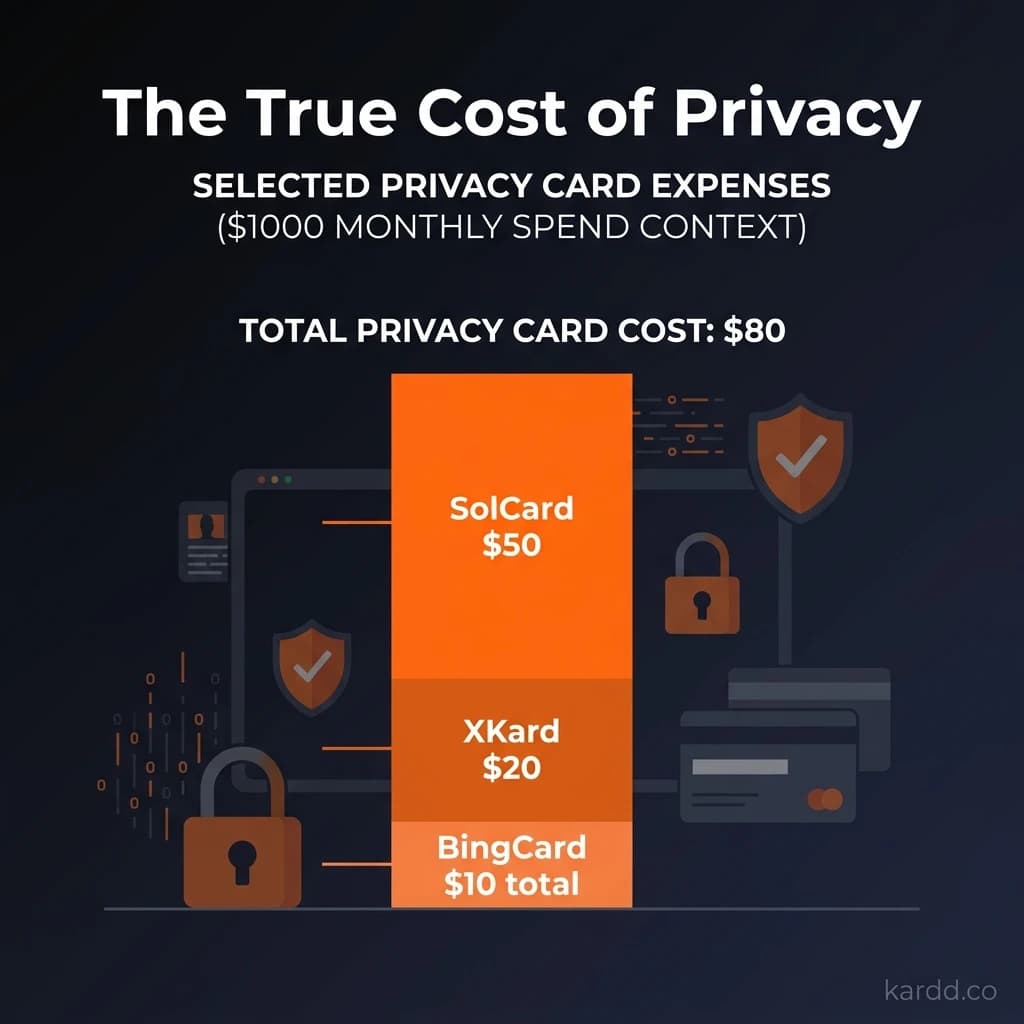
Here’s what a typical $1,000 spend actually costs:
| Fee Type | Range | Notes |
|---|---|---|
| Top-up fee | $10-$50 (1-5%) | Charged when loading crypto onto the card |
| FX fee (non-USD) | $0-$20 (0-2%) | If spending in euros, pounds, etc. |
| ATM withdrawal | $2-$5 flat | Physical cards only |
| Exchange rate spread | $5-$15 | Hidden — the real exchange rate vs. what you get |
| Total per $1,000 | $17-$90 | Depends on the card and how you use it |

The hidden cost most people miss: Exchange rate spreads. When you load USDT onto a card, the provider converts it to USD at their rate — not the market rate. The difference is typically 0.5-1.5%, and it’s never listed as a “fee.” On a $1,000 load, that’s $5-$15 in invisible cost on top of the stated top-up fee.
Fee Rankings (Lowest to Highest Top-Up)
- BingCard — 1% (but $1,000/month cap, no mobile pay)
- Bitget Wallet Card — 1-2% (partial KYC required)
- KAST / Bitsika — 2%
- XKard — 2.3-4.5% (drops to ~2.8% effective on Whale tier with $100K limits)
- Laso Finance / Bancus / COCA — 2-3%
- Goblin Card — 3-4%
- SolCard — 5%
The best value depends on volume. BingCard’s 1% is cheapest but caps at $1,000/month. For serious spenders, XKard’s Whale tier at ~2.8% effective with $100K limits and full mobile pay support is the strongest overall package.
Are No-KYC Crypto Cards Actually Safe?
Most guides gloss over the risks. We won’t. No-KYC crypto cards operate in a regulatory gray zone, and that comes with real consequences.
Risk 1: Account Freezes
If a transaction gets flagged — unusual amount, sanctioned country, merchant category mismatch — the card provider can freeze your funds. Without KYC on file, you have no recourse. Frozen funds typically sit for 90-180 days before being returned to the original funding source, minus fees.
Risk 2: Card Program Shutdowns
Visa and Mastercard regularly audit their issuing partners. If a no-KYC card program is seen as facilitating anonymous financial activity, the network can terminate the partnership. When this happens, all active cards stop working — sometimes with 24 hours notice, sometimes with none.
Risk 3: Operator Disappearance
Some no-KYC card issuers are small operations with minimal regulatory oversight. They can — and do — disappear. Your loaded funds go with them.
Risk 4: Low Limits Force Bad Habits
With $500-$1,000 monthly caps, some users spread across multiple cards. This creates more points of failure and more exposure to the risks above.

How to Mitigate These Risks
- Never store large balances. Load only what you plan to spend in the next few days.
- Use established providers. Cards tracked on Kardd.co are monitored for uptime and status weekly.
- Diversify across 2-3 cards. Don’t rely on a single provider.
- Check Kardd.co before loading. We flag cards that are experiencing issues or have recently changed terms.
No-KYC vs. KYC Crypto Cards: The Real Difference
The decision isn’t just about privacy. Here’s how the two categories stack up across everything that matters:
| Factor | No-KYC Cards | KYC Cards |
|---|---|---|
| Privacy | High — no identity linked | Low — full ID on file |
| Setup time | Instant to minutes | Hours to days |
| Fees | 1-5% top-up | 0-1% (some zero-fee) |
| Monthly limits | $500-$5,000 | $10,000-$50,000+ |
| Customer support | Limited or none | Full support, dispute resolution |
| Stability | May shut down with little notice | Regulated, insured |
| Legal status | Gray area in most jurisdictions | Fully compliant |
| Chargeback protection | None | Standard Visa/MC protections |

When No-KYC Makes Sense
- You need to make small, private purchases ($50-$500 range)
- You’re testing a card before committing to full verification
- You’re in a jurisdiction where crypto card access is limited
- Privacy is a non-negotiable priority for your use case
When KYC Is the Better Choice
- You’re spending over $5,000/month consistently
- You need chargeback protection and customer support
- Long-term stability matters more than initial privacy
- You want the lowest possible fees
How to Choose the Right No-KYC Crypto Card
Best overall no-KYC card?
→ XKard — Zero KYC, Apple Pay + Google Pay, Visa and Mastercard options, limits up to $100K/month on Whale tier.
Want the lowest fees for small amounts?
→ BingCard (1% top-up) — Best for cost-conscious users under $1,000/month. No mobile pay though.
Want Apple Pay + Google Pay without XKard?
→ SolCard or Laso Finance
Want maximum anonymity?
→ Goblin Card ($5,000+/month) — The only card supporting Monero (XMR) for end-to-end privacy.
Want multi-chain support?
→ COCA Card or Bitget Wallet Card
Want an alternative to traditional cards?
→ Coinsbee (gift cards) — Not a debit card, but lets you spend 50+ cryptos at major retailers through gift card purchases.
Can’t decide?
→ Compare cards side-by-side on Kardd.co — Filter by what matters to you and see the latest fees and status.
FAQ
What is a no-KYC crypto card?
A no-KYC crypto card is a prepaid Visa or Mastercard funded with cryptocurrency that doesn’t require government-issued identification to activate. Most require only an email address or nothing at all. They’re designed for users who prioritize financial privacy when spending crypto in the real world.
Do no-KYC crypto cards really exist in 2026?
Yes, but with important caveats. Truly zero-verification cards exist (like BingCard and Goblin Card), but they come with lower limits and higher fees. The regulatory landscape is tightening — Visa and Mastercard compliance requirements mean fully anonymous card programs face increasing pressure. Kardd.co tracks 11 active options as of March 2026.
What are the spending limits on no-KYC crypto cards?
Limits range from $500 to $5,000+ per month depending on the card and verification tier. Cards with zero verification typically cap at $1,000/month. Partial verification (email + phone) can unlock $3,000-$5,000. To access $10,000+ monthly limits, most providers require full KYC.
Can I use a no-KYC crypto card with Apple Pay?
Yes — five cards currently support Apple Pay without full KYC: XKard, SolCard, Laso Finance, KAST, and COCA Card. XKard is the standout — it supports both Apple Pay and Google Pay with zero verification. The card is added to your Apple Wallet like any other debit card. Apple doesn’t see crypto — it processes a standard Visa/Mastercard transaction.
Are no-KYC crypto cards legal?
Using a no-KYC crypto card is not illegal in most jurisdictions. However, the issuers operate in a regulatory gray area. Card programs can be shut down by payment networks (Visa/Mastercard) if they’re deemed non-compliant with anti-money-laundering standards. Users should be aware that loaded funds may be at risk if a program is terminated.
Conclusion
No-KYC crypto cards are real, functional, and available in 2026 — but they come with real trade-offs. Higher fees, lower limits, and the ever-present risk of shutdowns are the price of spending crypto privately.
The key is making an informed choice. Not all cards are equal, and the landscape changes fast. A card that works perfectly today might freeze funds or shut down next month.
That’s why we built Kardd.co — an independent, weekly-updated directory where you can compare all 11 no-KYC crypto cards on the metrics that actually matter: fees, limits, mobile pay support, and operational status.
Cards Mentioned in This Guide
XKard
Zero-KYC, Apple Pay & Google Pay, 15% affiliate
View full details →SolCard
Solana-native, virtual card, 40% referral
View full details →KAST
Minimal KYC, competitive fees, virtual card
View full details →Laso Finance
No-KYC stablecoin prepaid, ERC-20 support
View full details →BingCard
Zero KYC for virtual, BTC/ETH/USDT support
View full details →Last verified: March 18, 2026. Card details, fees, and KYC requirements may change without notice. Always verify current terms directly with the card issuer before loading funds. Kardd.co is an independent comparison site — we are not affiliated with any card issuer except through publicly available affiliate programs. Full affiliate disclosure