Crypto Card Cashback Exclusions 2026: 22 Blocked Codes
- Approval and reward are two separate decisions. The card authorises the payment; a second check reads the merchant's four-digit category code against an exclusion list. A purchase can clear normally and earn nothing.
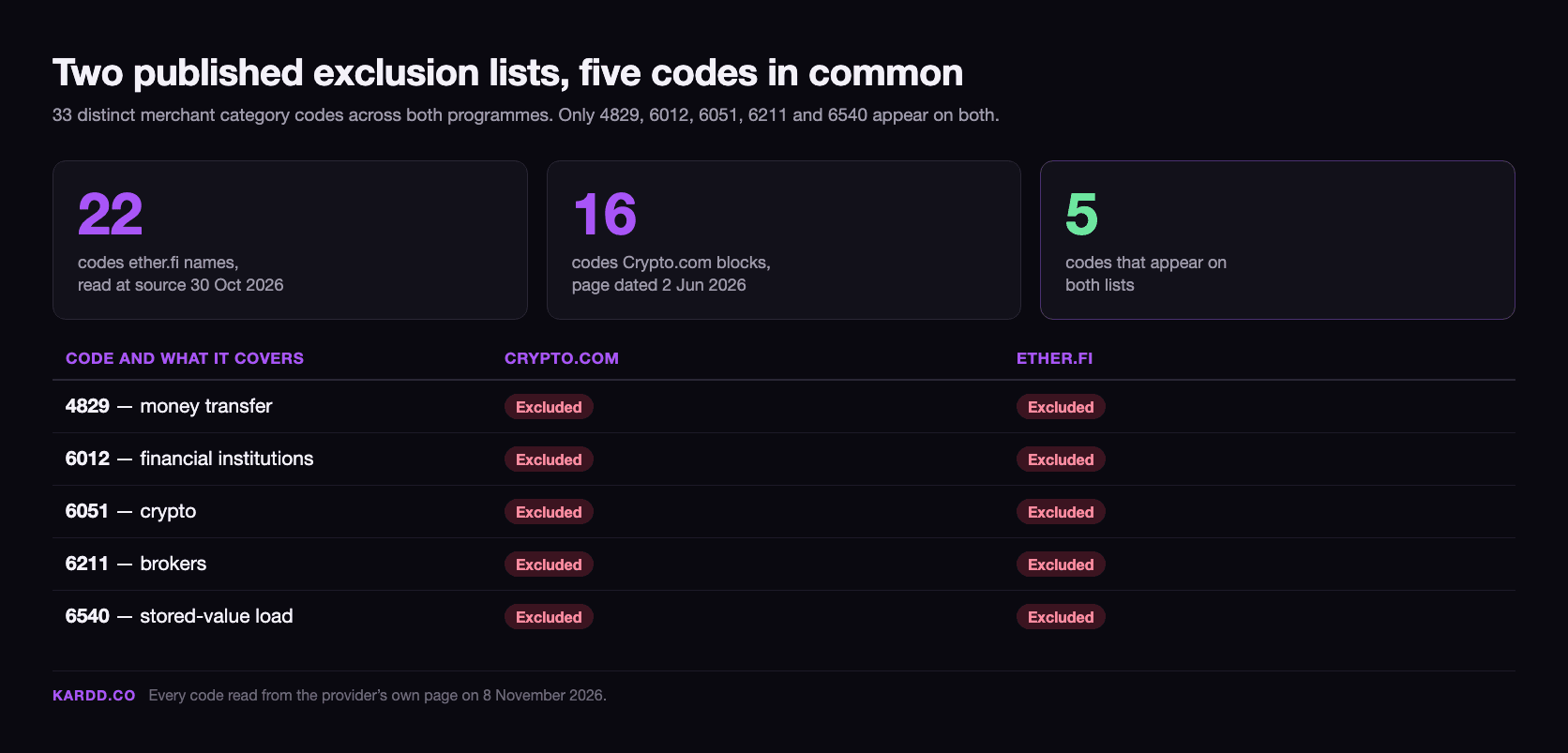
- Two programmes publish their lists, and they overlap on five codes out of 33. ether.fi names 22, Crypto.com 16, and only 4829, 6012, 6051, 6211 and 6540 appear on both.
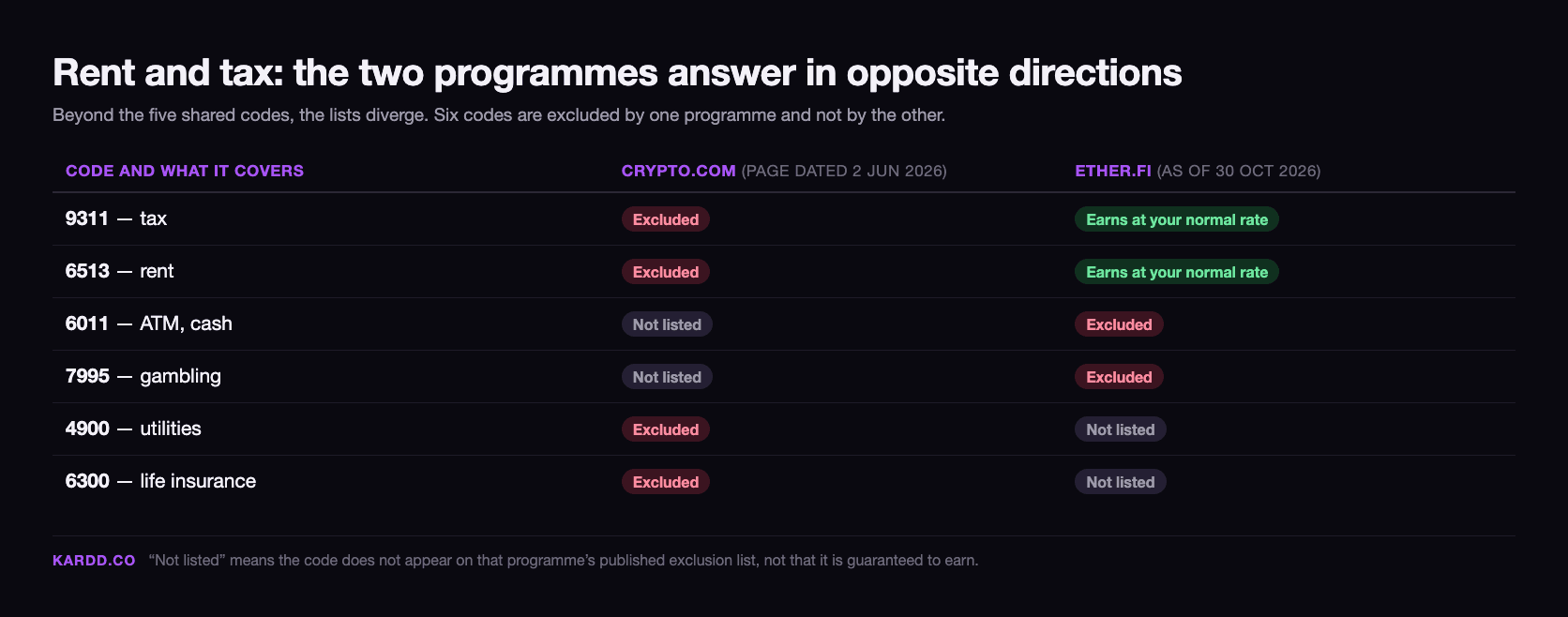
- They answer rent and tax in opposite directions. Crypto.com excludes 6513 and 9311; ether.fi says that from 30 October 2026 both earn at your normal rate.
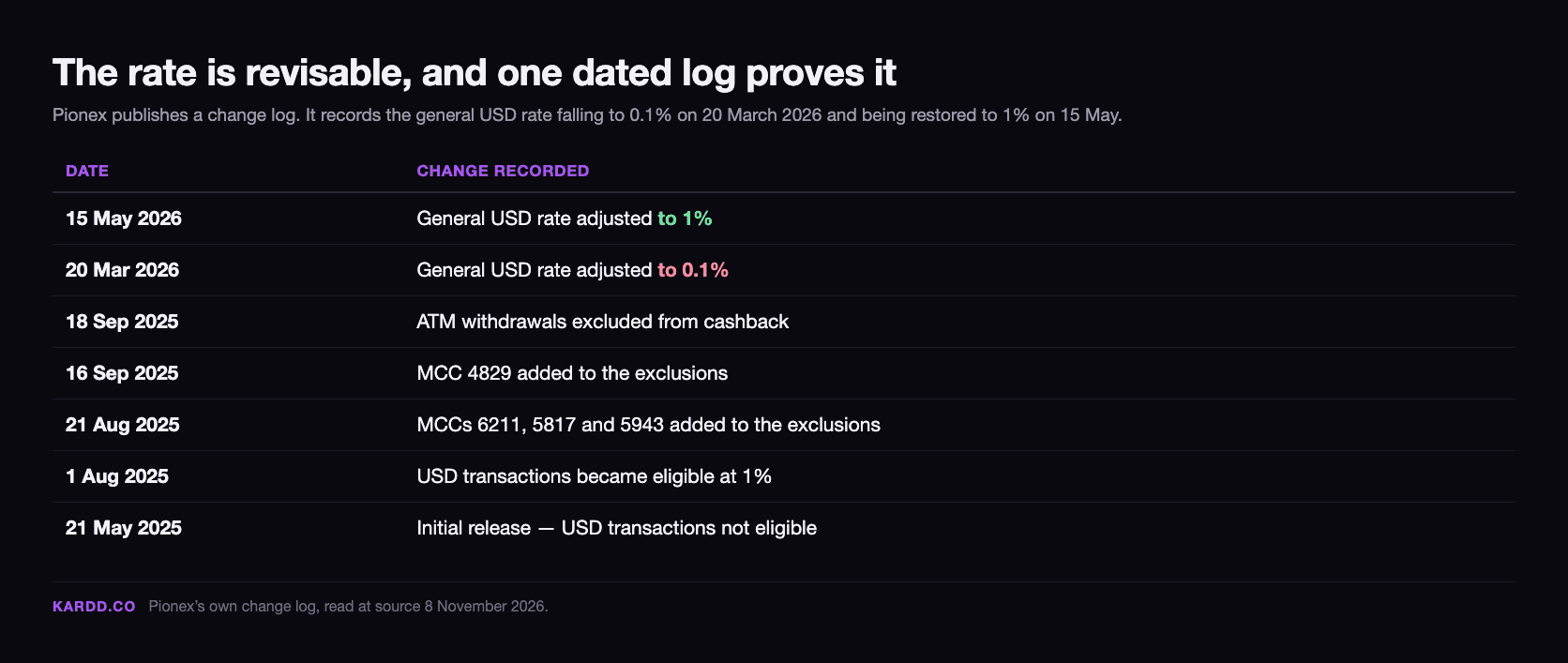
- The rate is revisable, and one dated log proves it. Pionex cut its general USD rate from 1% to 0.1% on 20 March 2026 and restored it on 15 May.
- Earned is not paid. ether.fi converts cashback to ETHFI at the price when the purchase clears, then locks it 7 days. Tria pays quarterly, “around three months after the Token Generation Event”.
On this page
- Approval and earning are separate decisions
- The one list published in full: 22 exclusions
- Crypto.com blocks 16, and reserves more
- The same two codes, opposite answers
- Some exclusions are a merchant, not a category
- The rate itself is revisable
- Earned is not paid
- Refunds take the cashback back
- What this means on a no-KYC card
- How to check your own crypto card cashback exclusions
- Final take
- Sources
- Related articles
- FAQ
The payment went through and the reward never arrived, and nothing in the app explains why. That gap is where crypto card cashback exclusions live, and it costs real money: on a 3% card, spending in an excluded category does not pay a reduced rate, it pays nothing. We went looking for the lists on 8 November 2026 and found that almost nobody publishes them — the best-ranking page on this exact subject is titled after merchant category codes and prints not one. Two programmes do publish in full, and this article is built from those two documents plus the network rulebook that explains why the lists exist at all.
Three mechanisms turn up, worth separating before any list makes sense. A category exclusion blocks a four-digit code. A merchant exclusion blocks one named company, sometimes in one country only. A timing rule decides when a reward you have earned becomes yours. The first is the one people hit; the third quietly costs the most.
Approval and earning are two different decisions
What makes this confusing is a reasonable assumption: that if the card worked, its rewards worked. They are separate checks, and the second is not looking at you at all. It is looking at a four-digit number attached to the shop.
Read that carefully, because it contains the whole problem. Your card programme does not choose the code. The merchant's acquirer does, and it assigns one code for the merchant's highest-volume line of business. So a shop that mostly sells something excluded, and also sells what you bought, can carry the excluded code for your purchase too. You can do everything right and earn nothing, with nobody having made a mistake.
The manual lists 938 codes. A rewards programme picks some, writes them into a list, and most never show you that list — which is what makes the two that do unusually useful.
The one list published in full: 22 exclusions
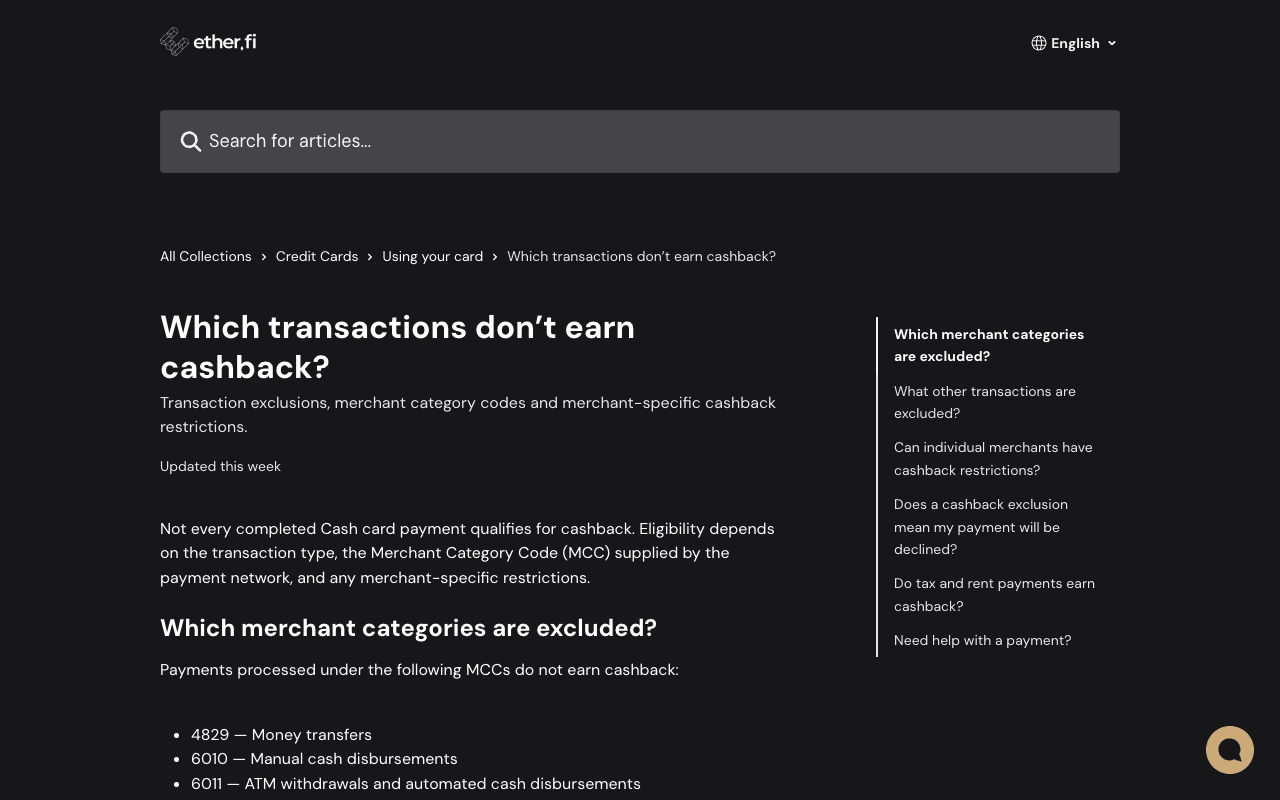
ether.fi publishes its exclusions as a help article of its own, codes written out — the most complete disclosure we found in this niche. Twenty-two codes, grouped as the page groups them, each checked against Visa's October 2026 listing.
| Code(s) | Label ether.fi publishes | In Visa's Oct 2026 listing? |
|---|---|---|
| 4829 | Money transfers | Yes |
| 6010 | Manual cash disbursements | Yes |
| 6011 | ATM and automated cash disbursements | Yes |
| 6012 | Financial institutions: merchandise and services | Yes — adds “and Debt Repayment” |
| 6050, 6051 | Quasi-cash transactions | 6051 only — incl. “Cryptocurrency Assets” |
| 6211 | Securities brokers and dealers | Yes |
| 6529, 6530 | Stored-value loading | Neither |
| 6535–6539 | No label published | None of the five |
| 6540 | Point-of-interaction funding | Yes — “Stored Value Card Purchase/Load” |
| 6611, 6760 | No label published | Neither |
| 7800 | Government-owned lotteries | Yes |
| 7801 | Government-licensed online casinos | Yes |
| 7802 | Licensed horse and dog racing | Yes |
| 7994 | Video game arcades | Yes |
| 7995 | Betting and gambling | Yes — “incl. Lottery” |
Two things stand out, and both are checks anyone can repeat. Seven of the 22 codes are published with no label at all — 6535 to 6539, 6611 and 6760 are bare numbers, so a reader cannot tell what is being excluded. And ten of the 22 appear nowhere in Visa's October 2026 listing of 938 codes: 6050, 6529, 6530, the 6535–6539 block, 6611 and 6760. ether.fi does not name its network, so the fair reading is that the list draws on more than one network's code set rather than that it is wrong.
The same page carries four exclusions written as transaction types rather than codes: ATM withdrawals, peer-to-peer transfers, currency exchange service providers, and “purchases of gift cards, money orders or other cash equivalents”. If you were planning to route spending through vouchers, our guide to buying gift cards with crypto is the place to start. The page adds that eligibility can change, and that a merchant with an otherwise eligible code “may still be excluded or have a different rate”.
Crypto.com blocks 16, and reserves the right to add more
Crypto.com's restriction page, dated 2 June 2026, is the other full disclosure — a shorter list reaching into very different territory. Where ether.fi concentrates on cash and gambling, this one blocks ordinary household and professional spending.
| Code | Category as Crypto.com describes it | What it catches in practice |
|---|---|---|
| 4829 | Wire Transfer | transfers |
| 4900 | Electric and water utilities, garbage collectors | household bills |
| 5734 | Computer Software Programs | software |
| 5947 | Novelty, memorabilia and souvenir shops | gift shops |
| 6012 | Account Funding – Financial Institution | account funding |
| 6051 | Currency – Non-Fiat (for example, Cryptocurrency) | buying crypto |
| 6211 | Licensed Foreign Exchange; Binary Options | brokers |
| 6300 | Life Insurance – Sales | premiums |
| 6513 | Real Estate Agents and Managers | rent and letting fees |
| 6532 | Payment Transaction – Customer Financial Institution | processors |
| 6540 | Stored Value Card/Load (Non-Financial Institutions) | card top-ups |
| 7372 | Computer Software Design | dev services |
| 8999 | Financial Planners | advice |
| 9222 | Fines | penalties |
| 9311 | Customs Bureaus | tax payments |
| 9399 | Police Departments | government |
Four of those will surprise people holding the card. Utilities, software, life insurance and rent are not cash-equivalent spending by any reading — they are the recurring bills a cashback card is most obviously useful for. Put 4900, 5734, 6300 and 6513 together and a real share of a household's outgoings earns zero, under a headline rate that never mentions it. If subscriptions dominate your spending, our note on paying subscriptions with crypto belongs alongside this.
And the list is not the limit. The page says the excluded transactions “include, but are not limited to” those listed, and that Crypto.com “reserves its right to exclude any other merchant categories or channels” at “its sole discretion”. A list with that wording around it is a disclosure of current practice, not a commitment.
The same two codes, opposite answers
Set the two lists side by side and the finding is not the overlap. It is that on the two codes an ordinary person is likeliest to care about, they disagree outright.
| Code and what it covers | Crypto.com (page dated 2 Jun 2026) | ether.fi (as of 30 Oct 2026) |
|---|---|---|
| 9311 — tax | Excluded | Earns at your normal rate |
| 6513 — rent | Excluded | Earns at your normal rate |
| 4829 — money transfer | Excluded | Excluded |
| 6012 — financial institutions | Excluded | Excluded |
| 6051 — crypto | Excluded | Excluded |
| 6211 — brokers | Excluded | Excluded |
| 6540 — stored-value load | Excluded | Excluded |
| 6011 — ATM, cash | Not listed | Excluded |
| 7995 — gambling | Not listed | Excluded |
| 4900 — utilities | Excluded | Not listed |
| 6300 — life insurance | Excluded | Not listed |
One basis throughout: whether the code appears on that programme's own published exclusion list on the dates shown. “Not listed” means exactly that, and is not a promise the spending earns.
Across the two documents there are 33 distinct codes and only five appear on both, which means there is no industry standard here to learn. The cash-and-funding core is universal; everything else is one company's policy choice. ether.fi's 30 October 2026 note proves these are choices rather than network rules: it announced that it had decided to start paying on two codes its competitor blocks. If rent is the spending you hoped to earn on, our guide to paying rent with crypto covers the routing side.
Some exclusions are a merchant, not a category
Category lists are not the only filter. Pionex's guidelines exclude named companies, in particular countries only, leaving the same category eligible everywhere else.
That design is more honest in one respect — it names the company — and harder to use in another, because nothing tells you which country code your transaction will be stamped with. It also carries a small contradiction worth knowing if you rely on it: the rules table lists 5945 for TikTok while the changelog entry adding it records 5943, and the page does not reconcile them.
The mechanism also answers a question headline rates never address: who pays. A rate funded out of interchange applies wherever the code qualifies; an offer funded by a named merchant lasts only while that merchant funds it, so it can be withdrawn one company at a time. We met the same structure in the BitPay card agreement, whose rewards section names its merchant-offers provider and then states no rate at all.
The rate itself is revisable
Every comparison page treats the advertised rate as a property of the card. Pionex keeps a dated changelog, and it shows a setting someone adjusts.
| Date | Change recorded |
|---|---|
| 15 May 2026 | General USD rate adjusted to 1% |
| 20 Mar 2026 | General USD rate adjusted to 0.1% |
| 18 Sep 2025 | ATM withdrawals excluded from cashback |
| 16 Sep 2025 | MCC 4829 added to the exclusions |
| 21 Aug 2025 | MCCs 6211, 5817 and 5943 added to the exclusions |
| 1 Aug 2025 | USD transactions became eligible at 1% |
| 21 May 2025 | Initial release — USD transactions not eligible |
A tenfold cut on 20 March 2026 and a full restoration on 15 May is the clearest evidence we found that a published rate is a current setting, not a term of the product. Anyone who chose the card in February for 1% spent two months earning 0.1%, and the log is the only record of it. Three of the seven entries narrow eligibility instead — the quieter half of the same lever, where the marketing number stays put while the spending it applies to shrinks.
Credit where due: publishing the log at all is better practice than either bigger programme manages. Crypto.com's page carries one date and no history, so a reader cannot tell which of its 16 codes were added last month. The cuts we documented in crypto card perks followed the same pattern, and the caps analysis shows what surviving rates are worth once the bands bite.
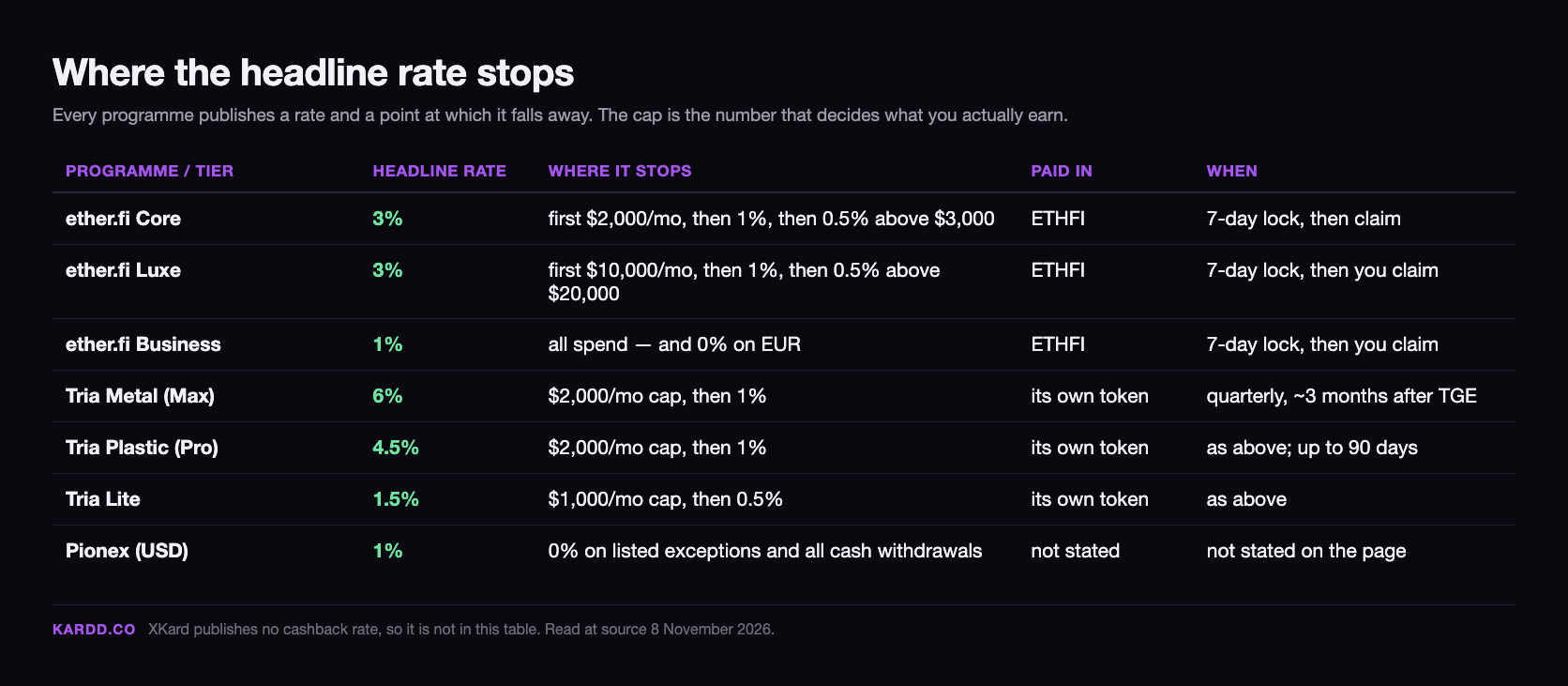
Earned is not paid
Suppose the code qualifies and the rate holds. One question remains that the rate cannot answer: what you receive, and when. Both programmes publishing detail here pay in their own token, on a delay, under conditions.
| Programme / tier | Headline rate | Where it stops | Paid in | When |
|---|---|---|---|---|
| ether.fi Core | 3% | first $2,000/mo, then 1%, then 0.5% above $3,000 | ETHFI | 7-day lock, then claim |
| ether.fi Luxe | 3% | first $10,000/mo, then 1%, then 0.5% above $20,000 | ETHFI | 7-day lock, then you claim |
| ether.fi Business | 1% | all spend — and 0% on EUR | ETHFI | 7-day lock, then you claim |
| Tria Metal (Max) | 6% | $2,000/mo cap, then 1% | its own token | quarterly, ~3 months after TGE |
| Tria Plastic (Pro) | 4.5% | $2,000/mo cap, then 1% | its own token | as above; up to 90 days |
| Tria Lite | 1.5% | $1,000/mo cap, then 0.5% | its own token | as above |
| Pionex (USD) | 1% | 0% on listed exceptions and all cash withdrawals | not stated | not stated on the page |
One basis: each programme's own published rate card, read on 8 November 2026. Where a page does not state something we have written that rather than filled it in.
ether.fi's mechanism is precise, and it moves the risk onto you. Cashback is “calculated in dollar terms when the purchase is authorized”, then on clearing “converts to ETHFI at the current price” and enters a 7-day lock period before you can claim it. The dollar figure at the till is interim; what you own is a quantity of token fixed at a moment you do not pick.
Tria's 6% is the highest headline here, and its own FAQ says distributions “take place quarterly, typically around three months after the Token Generation Event” and may “take up to 90 days to be distributed”. A rate paid in a token not yet issued, anchored to an event with no date, is not comparable to one paid in dollars next month, and no comparison table we found makes that distinction. It is conditional too: cashback is “available only while you have an active membership”. Our Tria card review covers the rest, and token-reward cards covers the pre-issuance pattern.
Refunds take the cashback back
The last rule is the one nobody checks until it happens, and the most consistent of all of them: a reward is provisional until the purchase behind it is final.
ether.fi states that if a transaction is refunded or reversed “the associated cashback may also be reversed”, and gives the arithmetic plainly — a refund returns the amount less the cashback already paid. Tria puts it as “refunds will deduct the cashback earned on returned items”, and says part of the reason its payout window is long is so chargebacks can be accounted for. Pionex reserves the right to withhold cashback on transactions it suspects of being cash advances, fraud or abuse.
None of that is unreasonable, and all of it is worth knowing before returning something expensive. The wrinkle for token-paid programmes is units: if your reward converted at one price and the refund is calculated in dollars at another, neither page explains how the two are squared. Our guides to crypto card refunds and chargebacks set out the process itself.
One programme publishes nothing usable. Rizon's page, dated 22 January 2026, says only that exclusions are based on merchant category codes and “typically include categories such as financial services, cash equivalents, and other restricted merchant types”. “Typically” is doing a lot of work in a sentence whose job is to say what does not earn.
What this means on a no-KYC card
This site is a no-KYC directory, so the honest observation is that every programme in this article is an identity-verified product, and that is not a coincidence. A cashback rate has to be funded — out of interchange, a token treasury, or a named merchant's marketing budget — and each route needs a customer relationship the programme can account for.
Which makes the trade-off cleaner than it looks. XKard, the card we have an affiliate relationship with, publishes no cashback rate; our own record carries none and we will not invent one. It charges a visible subscription and reload fee instead, both calculable before you sign up. Set that against a 6% headline paid in an unissued token, quarterly, only while a subscription stays active, and only on codes absent from a revisable list.
So the comparison that matters is not rate against rate. It is a known cost against an estimated reward carrying four separate conditions. Our cashback card comparison ranks the rates for people who want them; this article is why those rankings carry caveats, and no-KYC versus KYC covers the wider trade.
How to check your own crypto card cashback exclusions
All of this is checkable on your own card in about ten minutes, and the order matters because the cheapest checks rule out the most.
- Search the help centre for “MCC” before “cashback”. The rate page is marketing; the exclusion list is a separate support article, and it decides what you earn.
- If the list names no codes, treat it as unpublished. “Financial services and cash equivalents” is not something you can check a purchase against.
- Look for “not limited to” and “sole discretion”. Both appear on the biggest list we read, and both mean current practice rather than a term.
- Assume 6012, 6051 and 6540 are excluded. They were on every list we read, so topping up and buying crypto earn nothing until shown otherwise.
- Check what the reward is paid in, and when. A token converted at clearing, locked a week, or paid quarterly after an unscheduled event is not the dollar figure in the app.
- Find the refund clause and the changelog. The first almost always takes the cashback back out; without the second you cannot tell how long the current rate has been current.
Compare what each card actually charges
Kardd reads what each card publishes — issuer, KYC level, fees, limits and the clauses behind them — so you can weigh a known cost against a conditional reward instead of comparing two headline percentages.
Kardd may earn a commission on sign-ups, including XKard, which publishes no cashback rate. Affiliate disclosure.
Final take
The useful answer to “why did I not get my cashback” is that you were never the one being assessed. A number assigned to the shop by somebody else's bank, describing that shop's highest-volume line of business, was tested against a list your programme may not publish.
What makes it worth an article is how little of this is standardised: 33 codes across two published lists with five in common, two programmes answering rent and tax in opposite directions, a rate cut tenfold and restored inside eight weeks, a 6% headline payable in a token that does not exist yet. The cash-and-funding core is the only part that carries from one card to the next, and it is the part that says topping up never earns.
Which makes the number on the marketing page the least informative figure in the arrangement. The informative ones are which codes are on the list, whether the list is published at all, and what arrives in your account when it finally arrives.
Sources
All read in full on 8 November 2026. Visa Merchant Data Standards Manual, October 2026 (the MCC definition, the acquirer's assignment duty, the highest-sales-volume rule, and the 938-code listing used to check the first table). ether.fi, “Which transactions don't earn cashback?” (the 22 codes, the seven unlabelled, the four transaction-type exclusions) and “How does cashback work?” (tier bands, ETHFI conversion at clearing, the 7-day lock, the refund reversal, and the 30 October 2026 inclusion of 9311 and 6513). Crypto.com, “Restriction of CRO Rewards Program” (the 16 codes in its own wording, the “not limited to” framing and the sole-discretion reservation; dated 2 June 2026). Pionex, “Card Global Cashback Program Guidelines” (the four country-and-merchant exceptions, the cash-withdrawal exclusion, and the changelog including the 5943/5945 discrepancy). Tria, “Cashbacks FAQs” (three tier rates and caps, quarterly distribution around three months after the Token Generation Event, the 90-day window, the refund deduction and the active-membership condition). Rizon, “What transactions count toward the cashback reward?” (publishes no codes; dated 22 January 2026).
Recorded rather than guessed, because we could not read them: Revolut's published MCC exclusion page returned 403 and the body served carried no codes; Bitpanda's cashback-applicability article returned 403; the KuCoin support page search results cite for KuCard forfeiture carries no cashback terms; and Xapo Bank's cashback FAQ names no rate, currency or exclusions. Where a programme publishes nothing we say so rather than infer a list.
Related Articles
- Crypto Card Cashback Caps 2026: When 10% Pays 2.4%
- Best Crypto Cashback Card 2026: Real Rates, Real Trade-Offs
- Crypto Card Perks 2026: What Survived the Cuts
- Crypto Card Blocked Merchants 2026: The Full List
- Crypto Card Top-Up Fees 2026: The Cost to Load $100
- Crypto Card Exchange Rates 2026: Two Conversions
Frequently Asked Questions
Why did I not get cashback on a crypto card purchase?
Almost always the merchant's category code, not anything you did. The card approves the payment, then a separate check reads the four-digit code the merchant's acquirer assigned and tests it against an exclusion list. On the list, the purchase clears normally and earns nothing.
Which merchant categories are excluded from crypto card cashback?
Cash and funding codes almost everywhere: 4829 money transfer, 6012 financial institutions, 6051 non-fiat currency and 6540 stored-value loading are on both lists we read. Beyond that they diverge — ether.fi adds ATM, manual cash and gambling; Crypto.com adds utilities, software, life insurance, rent, fines and tax.
Does topping up a crypto card earn cashback?
No, on every programme whose list we could read. Crypto.com excludes 6012 account funding and 6051 non-fiat currency; ether.fi excludes 6012, 6051, 6540 and the stored-value codes 6529 and 6530. Buying crypto with the card is a funding transaction in the network's eyes.
Can I earn crypto card cashback on rent or tax?
It depends on the programme, and this is the clearest disagreement we found. Crypto.com excludes 6513 real estate and 9311 tax. ether.fi says that as of 30 October 2026 both earn at your normal rate. Same two codes, opposite answers.
Can a crypto card take back cashback it has already paid?
Yes. ether.fi says a refund or reversal may reverse the associated cashback, and that a refund returns the amount less the cashback already paid. Tria deducts cashback earned on returned items. Earning is provisional until the purchase behind it is final.
Is an advertised crypto card cashback rate guaranteed?
Not on any programme we read. Pionex's own changelog shows its general USD rate cut from 1% to 0.1% on 20 March 2026 and restored on 15 May. Crypto.com says its exclusions “include, but are not limited to” those listed, revisable at its sole discretion.
Do no-KYC crypto cards pay cashback?
Generally not, and that is the trade-off. Every programme here with a published rate and a published exclusion list is identity-verified, because the reward is funded out of a relationship the programme needs a known customer for. XKard publishes no cashback rate, and our card record carries none.