
- You cannot get this card, and BitPay does not say so.
bitpay.com/card/returns HTTP 200 and serves the app homepage — no card, no application, no waitlist, no notice. - The cardholder agreement is still published: 10,035 words, stamped
GPRMVP 02.28.23. No page ranking for this card quotes it. - Three of the four live reviews we scored get the fees wrong. Schedule A prices the card and every load at $0.00; competitors print a $10 order fee and 1% on loads, and the “15%” cashback figure appears nowhere in the agreement.
- The programme did not fail. Its bank left. Metropolitan Bank Holding Corp told the SEC on 9 January 2023 that its crypto clients were ~1.5% of revenues and that it was exiting.
- Two protections were switched on by your identity file, not your card. FDIC insurance applied “once we have verified your identity”, and Mastercard zero liability expressly excludes anonymous prepaid cards until the holder is registered.
On this page
- The card you cannot get
- What is still published, and what it is dated
- Schedule A against the reviews
- The limits the document actually sets
- Section 4: one card, no authorised users
- Why it ended: the issuer, not the programme
- Section 28 and the cheque to your old address
- Zero liability and the anonymous-prepaid carve-out
- Two defects in the drafting
- What to read instead
- Final take
- Sources
- Related articles
- FAQ
Every BitPay card review on the first page of results is a review of something you cannot obtain. That is not a technicality: it decides whether the fee table you are reading is a buying guide or an archive, and three of the four pages we scored present it as the former. So on 6 November 2026 we did the thing none of them did and read BitPay's own cardholder agreement — all 10,035 words of it, still published, still downloadable, and stamped with a template reference of 02.28.23. The document is in better order than the reviews of it. The card it governs stopped working on 15 June 2023.
So this is two things at once: the honest answer to the query, and a reading of the best-drafted US crypto card agreement we have come across — which happens to contain this market's clearest statement of what an identity file actually buys you.
The card you cannot get
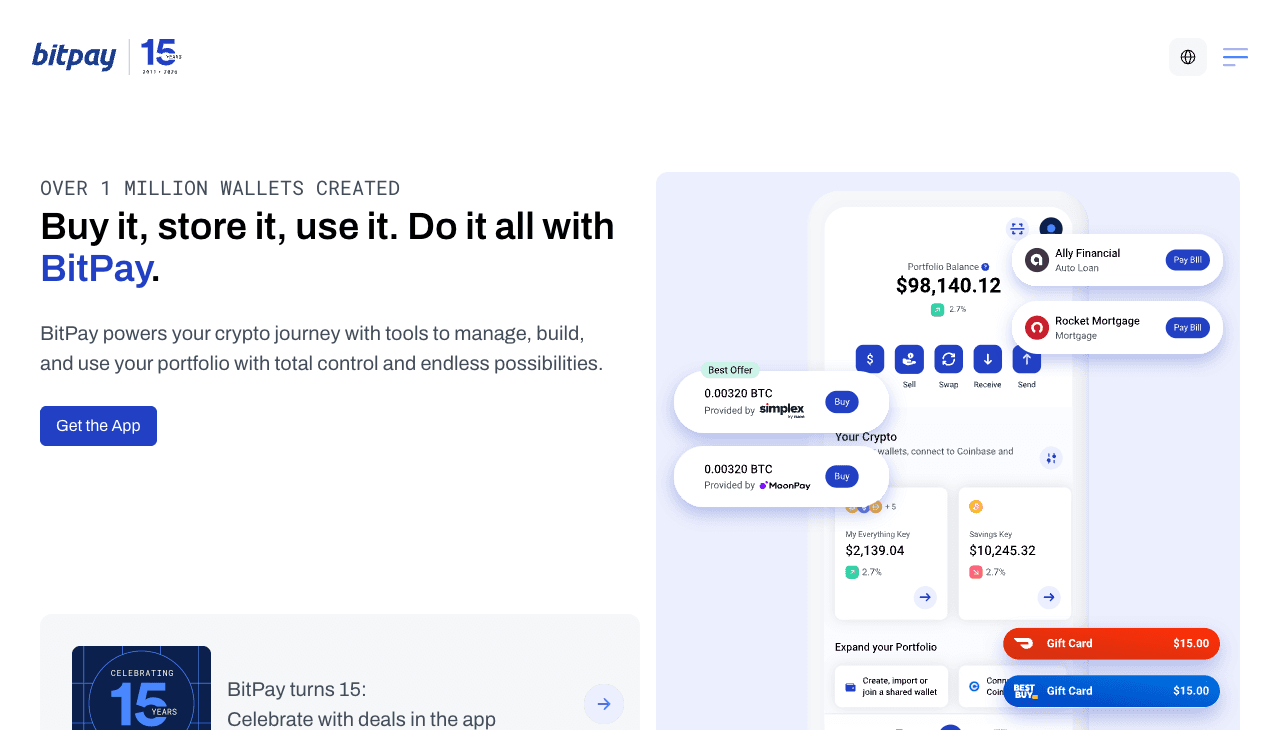
Start where a buyer starts. bitpay.com/card/ still resolves, and it still returns HTTP 200, which is the whole problem: a status code is not a product. What it serves is BitPay's general app homepage — “Buy it, store it, use it. Do it all with BitPay.” — with calls to action to get the app, buy crypto, swap crypto and pay bills. We looked for three things on it and found none of them: a card, an application or waitlist form, and any notice that a card programme ever existed or ended.
That is also why the bad reviews persist. A URL that 200s looks alive to every automated check, every affiliate feed that verified a link rather than a page, and every writer working from another writer. Nothing here is a lie; the card page quietly became the homepage, and the web kept pointing at it.
Compare the one programme that wound down loudly: Gnosis Pay published dates and instructions, which is why our guide to what Gnosis Pay cardholders must do could be written from the provider's own notice. BitPay's went out by email and tweet in May 2023 and was never given a permanent home, so the only BitPay document about the BitPay card is now the contract.
What is still published, and what it is dated
The agreement is easy to find once you know it exists. bitpay.com/assets/pdfs/mc-cardholder-agreement.pdf returns a 302 to /assets/docs/bitpay-prepaid-debit-cha-022823.pdf, which returns 200 and a complete PDF. The filename carries a date, 022823, and every footer repeats GPRMVP 02.28.23. Read that as a version stamp, not an effective date: the document states no effective date at all, which is itself a small failing in a consumer contract.
Here is the whole documentary estate of this card, with what each item tells you, checked at source on the date of writing.
| What we fetched | Status, 6 Nov 2026 | What it contains |
|---|---|---|
bitpay.com/card/ | 200 — app homepage | No card, no form, no waitlist, no notice |
/assets/pdfs/mc-cardholder-agreement.pdf | 302 → the file below | The link still quoted in older write-ups |
/assets/docs/bitpay-prepaid-debit-cha-022823.pdf | 200 — 10,035 words | 34 sections, Schedule A, privacy notice; stamp GPRMVP 02.28.23 |
| Issuer named inside it | Metropolitan Commercial Bank | Member FDIC, under licence from Mastercard |
| Programme manager named | BitPay, Inc. | Customer service 1-855-398-1373 |
| Rewards terms it points to | A dosh.com URL | Responds, but returned no readable text to us |
| Issuer's own exit announcement | 200 at sec.gov | Exhibit 99.1, dated 9 January 2023 |
Two structural points. It was a prepaid Mastercard, not a credit card and not a debit card against an account: section 2 says so, adds that you earn no interest, and notes that funds do not expire regardless of the date on the plastic. And physical and virtual were one instrument, sharing a single Primary Access Number with “the same rights and responsibilities” either way. For the broader map of which bank stands behind which card, see crypto card issuers.
Schedule A against the reviews
Section 3 is a block of capitals putting the fees in “Schedule A”, incorporated by reference and charged “so long as there is a remaining balance in your card account”. Unlike several agreements we read this year, the schedule is genuinely there — the CL Card agreement behind our piece on holding multiple crypto cards refers to a Schedule B absent from the file. BitPay's is complete, itemised and mostly zeroes.
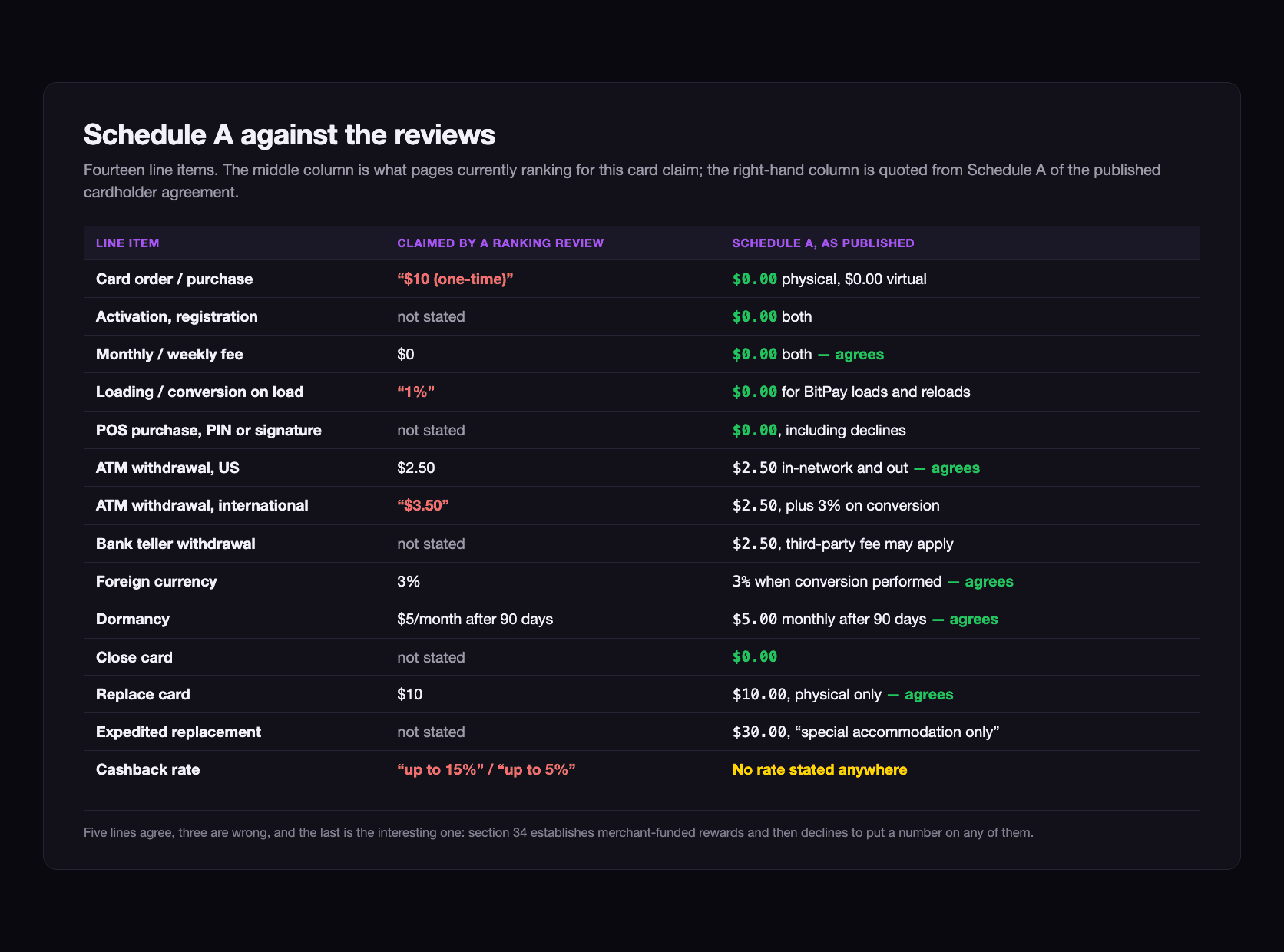
So we can do what no ranking page has: put the published schedule beside what the reviews claim. The right-hand column is quoted from Schedule A, the middle column from pages currently ranking for this card.
| Line item | Claimed by a ranking review | Schedule A, as published |
|---|---|---|
| Card order / purchase | “$10 (one-time)” | $0.00 physical, $0.00 virtual |
| Activation, registration | not stated | $0.00 both |
| Monthly / weekly fee | $0 | $0.00 both — agrees |
| Loading / conversion on load | “1%” | $0.00 for BitPay loads and reloads |
| POS purchase, PIN or signature | not stated | $0.00, including declines |
| ATM withdrawal, US | $2.50 | $2.50 in-network and out — agrees |
| ATM withdrawal, international | “$3.50” | $2.50, plus 3% on conversion |
| Bank teller withdrawal | not stated | $2.50, third-party fee may apply |
| Foreign currency | 3% | 3% when conversion performed — agrees |
| Dormancy | $5/month after 90 days | $5.00 monthly after 90 days — agrees |
| Close card | not stated | $0.00 |
| Replace card | $10 | $10.00, physical only — agrees |
| Expedited replacement | not stated | $30.00, “special accommodation only” |
| Cashback rate | “up to 15%” / “up to 5%” | No rate stated anywhere |
Five lines agree, three are wrong, and the last is the interesting one. Section 34 establishes the rewards — “BitPay Cash Back Rewards powered by Dosh® on qualifying purchases at participating merchants” — then declines to put a number on it, sending you to the app for the merchant list and to dosh.com for terms. It also reserves the right to claw rewards back if you later return, charge back, cancel or dispute the purchase. The honest statement of this cashback is therefore merchant-funded offers at rates BitPay never published — a different product from “up to 15%” in a headline. The dormancy fee is real, and belongs with the charges in crypto card inactivity fees.
The limits the document actually sets
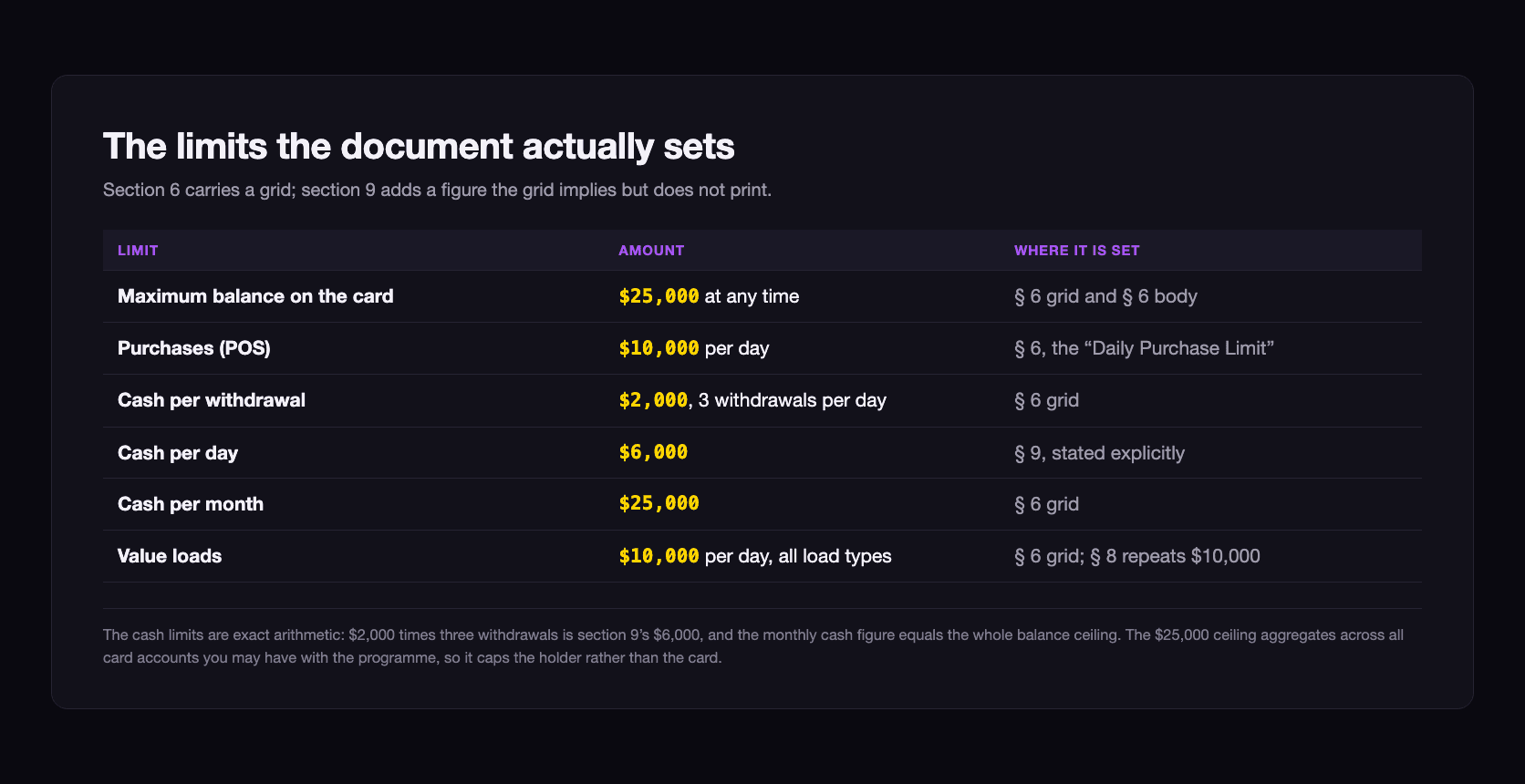
Section 6 carries a grid, and section 9 adds a figure the grid implies but does not print. Together they describe a card built for genuinely large US spending, which is the one respect in which the enthusiastic reviews were right about the product.
| Limit | Amount | Where it is set |
|---|---|---|
| Maximum balance on the card | $25,000 at any time | § 6 grid and § 6 body |
| Purchases (POS) | $10,000 per day | § 6, the “Daily Purchase Limit” |
| Cash per withdrawal | $2,000, 3 withdrawals per day | § 6 grid |
| Cash per day | $6,000 | § 9, stated explicitly |
| Cash per month | $25,000 | § 6 grid |
| Value loads | $10,000 per day, all load types | § 6 grid; § 8 repeats $10,000 |
Three things to notice. The $25,000 ceiling aggregates across “all Card Accounts you may have with the Program”, so it caps you, not a card. The cash limits are exact arithmetic: $2,000 times three withdrawals is section 9's $6,000, and the monthly cash figure equals the whole balance ceiling. And the grid carries a reservation — “for security reasons, we may further limit the number or dollar amount of transactions” — the clause we unpack in crypto card spending limits. Loads by cheque or money order were refused outright.
Section 4: one card, no authorised users
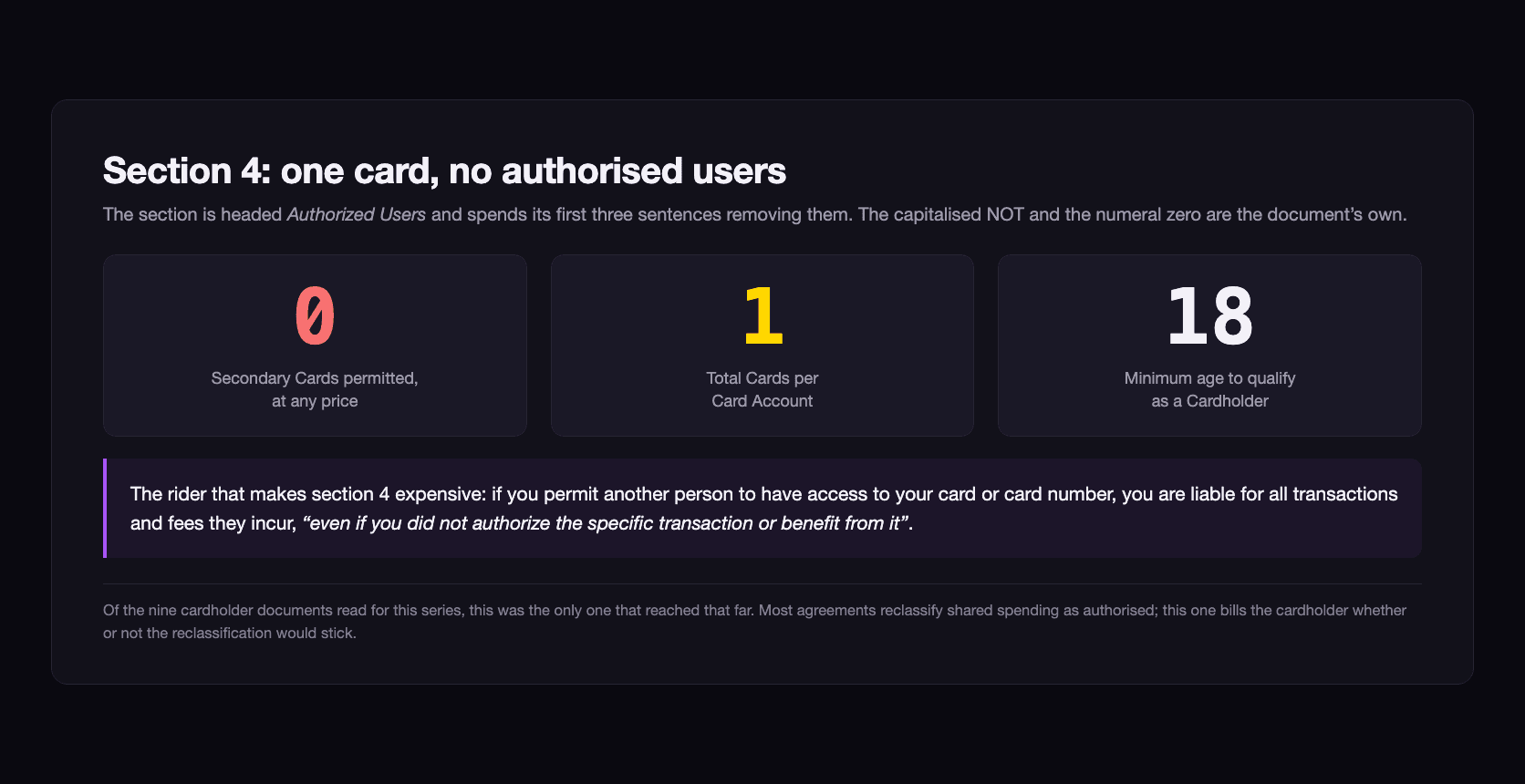
Section 4 is headed Authorized Users and spends its first three sentences removing them. “You may NOT request an additional Card (‘Secondary Card’) to allow another person to access the funds in your Card Account. The maximum number of Secondary Cards permitted is 0. You must be 18 years old to qualify as a Cardholder. The total number of Cards per Card Account is limited to 1.” The capitalised NOT and the numeral zero are the document's own.
That makes BitPay the strictest programme we have counted. Several competitors sell card counts by subscription tier; BitPay offered no compliant way to let anyone else spend, at any price. The age bar sits here too as a qualification rather than a promise — better drafting than the warranty-style clauses we found across nine programmes on crypto card age limits.
Section 18 completes the picture: the bank may “refuse to issue a Card, revoke Card privileges or cancel your Card with or without cause or notice”, and section 1 adds that the card stays the bank's property, liable to be “canceled, repossessed, or revoked at any time without prior notice”. Standard prepaid terms — and, as it turns out, the terms under which this programme ended.
Why it ended: the issuer, not the programme
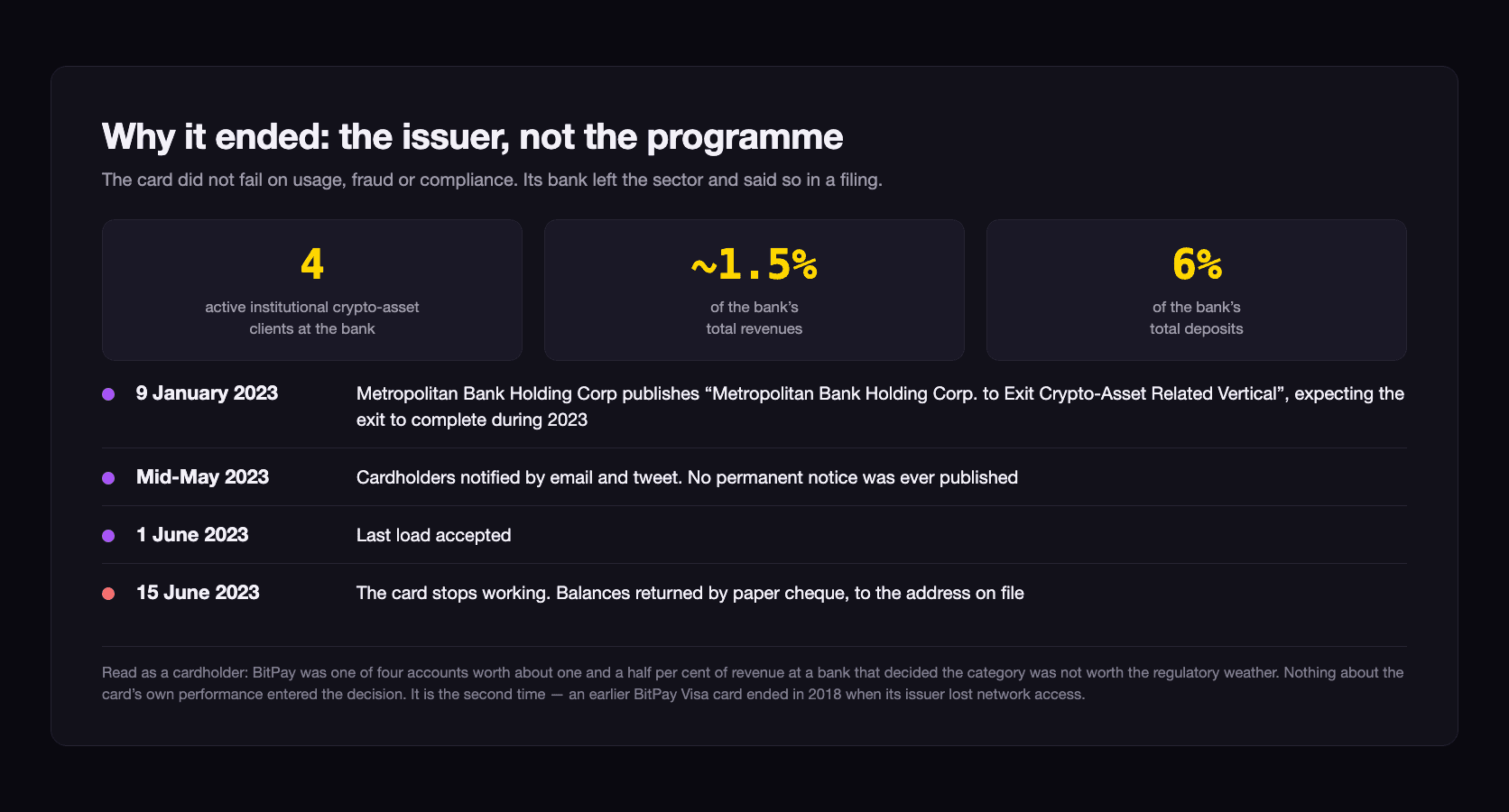
This is where the reviews stop and the primary sources start. The card did not fail on usage, fraud or compliance. Its bank left the sector, and said so in a filing.
Metropolitan Bank Holding Corp, parent of Metropolitan Commercial Bank, published a release dated 9 January 2023, headed “Metropolitan Bank Holding Corp. to Exit Crypto-Asset Related Vertical”. It states that “MCB currently has four active institutional crypto-asset related clients” who “in the aggregate currently account for approximately 1.5% of total revenues and 6% of total deposits”, that those relationships “are limited to providing debit card, payment and account services”, and that the exit was expected “to be completed during 2023”. Chief executive Mark R. DeFazio added that “crypto-related clients, assets and deposits have never represented a material portion of the Company's business”.
Read as a cardholder, that is uncomfortable. BitPay was one of four accounts worth one-and-a-half per cent of revenue at a bank that decided the category was not worth the regulatory weather, and nothing about the card's own performance entered the decision. The wind-down followed: notice in mid-May 2023, last load 1 June, the card dead on 15 June, balances returned by paper cheque. BitPay said it was “not going away, just taking some time to change banks and enhance the card program”. Nothing has been published since.
It is the second time: an earlier BitPay Visa card ended in 2018 when its issuer lost network access. Two cards, two issuer failures, no failure of the product itself — the pattern we traced in why crypto cards shut down. The brand on the plastic is almost never what breaks.
Section 28 and the cheque to your old address
The clause that executed the wind-down still binds anyone whose money never arrived. Section 28: “if your Card is canceled by us when your Card Account has a balance, we will send you a check in the amount of your Card Account balance for no charge”. Section 18 feeds it — cancel “through no fault of yours” and you are entitled to that refund.
Then the sentence that matters in 2026: “In all events, any check we send will be sent to the address we have for you in our records.” No alternative route, no payment back to the wallet the money came from, no duty to confirm the address is current. Anyone who moved between opening the card and June 2023 had a cheque posted to a flat they had left, with no other remedy in the document. The programme's customer-service line is still 1-855-398-1373, and the agreement prints the CFPB complaint line, 1-855-411-2372 — which, as nineteen rulings for crypto card complaints showed, is more than most programmes offer.
The mechanics also settle a detail the reviews garble: closing the card yourself cost nothing, and a bank-initiated closure with a balance produced a free cheque. No exit penalty at all, which puts it at the clean end of the range in crypto card closure fees.
Zero liability and the anonymous-prepaid carve-out
This is the part that earns a dead card a place in a no-KYC directory. Section 26 sets the usual US ladder: report a lost or stolen card within two business days and you can lose no more than $50.00; miss that, and if the bank can prove it could have stopped the use, you “could lose as much as $500.00”; leave it past 60 days from the first statement showing the error and you may recover nothing after that.
Then the agreement recites Mastercard's own policy, with its exclusions intact: zero liability “does not apply to Mastercard payment cards that are used for commercial purposes or anonymous prepaid cards (until such time as the identity of the cardholder has been registered with us)”. The protection is not a property of the card. It is a property of your identity file being complete.
That is the Mastercard counterpart of what we documented on the Visa side, where the operating regulations exclude “Anonymous Prepaid Card Transactions” from the obligation outright — the detail is in our guide to a lost or stolen crypto card. Both networks land in the same place, and BitPay's wording is the more useful because it names the switch: registration.
The same conditionality governs the deposit insurance. Section 2 says funds “will be FDIC-insured once we have verified your identity”, and Schedule A repeats it: register the card for “FDIC insurance eligibility and other protections”, to $250,000, “if specific deposit insurance requirements are met and your card is registered”. So two of the protections a buyer cares about — fraud cover and deposit insurance — were unlocked by the identity check, not the plastic. Price that honestly against a minimal-KYC card, which is the argument of no-KYC versus KYC crypto cards.
Two defects in the drafting
For a document this tidy, two cross-references do not land.
The arbitration provision is not where the agreement says it is. Section 1 says the terms include “an Arbitration Provision in Section 31”. Section 31 is headed Prefunded Check Transactions (“Check Terms”) and is one sentence disapplying itself: “This is not applicable to the BitPay card program.” The real arbitration provision sits immediately after section 30, unnumbered. It is consequential — a 45-day rejection window, by signed notice sent certified mail, return receipt requested, to 8000 Avalon Blvd, Suite 300, Alpharetta, GA 30009 — and the only pointer to it sends you to a disapplied section.
Section 28 charges a fee Schedule A never prices. Close the card yourself and ask for your balance by cheque, and section 28 says the bank will do it “for a fee as set forth in the ‘Schedule of Fees and Charges (Schedule A)’”. Schedule A has no cheque-issuance line: it prices closure at $0.00, a replacement at $10.00, an expedited replacement at $30.00, and stops. The charge is left unquantified by the one document meant to quantify it. A third, cosmetic: Schedule A is headed with a blank State: field nobody filled.
What to read instead
- Check obtainability before fees. Fetch the application flow, not the marketing URL: a 200 on
/card/told four reviewers this product was alive. - Treat an undated agreement as a warning. This one states no effective date; the only date on it is a template stamp in the footer and a filename.
- Find the issuing bank, then ask what else it does. These cardholders were collateral in a decision about 1.5% of a bank's revenue.
- Read the zero-liability carve-outs before choosing anonymity. Both networks withdraw the guarantee for unregistered prepaid cards, and the agreement says so.
- Price a cashback claim from the contract, not the headline. “Up to 15%” survived three years past a programme whose own section 34 states no rate at all.
If you came for a working card rather than a post-mortem, the directory lists what each current programme publishes — issuer, regulator, fees, limits and the clauses behind them — including the best no-KYC crypto cards.
Compare cards you can actually get
Kardd reads what each card publishes and records when we last checked it, so a programme that quietly stopped issuing does not sit in a comparison table for three years.
Kardd may earn a commission on sign-ups, including XKard. Affiliate disclosure.
Final take
The BitPay card was a good prepaid product and is now not a product. Nothing in the agreement reads like a programme in trouble: fees close to nil, limits among the highest in this market, a complete schedule, a refund clause that did what it promised. It ended because a bank with four crypto clients decided they were not worth the regulatory weather, and one was BitPay.
What is left is a reading lesson, not a buying one. A contract can outlive its product by three years and still be the most accurate thing written about it, while four reviews copied from each other quote an order fee, a load fee and a cashback rate the contract contradicts or never mentions. The fix is dull and it works: before the fee table, check whether anyone can still get the thing. Here the answer has been no since 15 June 2023 — and the page that would have said so is the one BitPay replaced with its homepage.
Sources
All fetched and read on 6 November 2026. BitPay Prepaid Mastercard Cardholder Agreement — 10,035 words, footer stamp GPRMVP 02.28.23; § 1, § 2, § 3 and Schedule A, § 4, § 6, § 9, § 18, § 26, § 28, § 31 with the unnumbered Arbitration Provision, and § 34. Reached via the older agreement URL, which 302s to it. bitpay.com/card/ — HTTP 200, serving the app homepage, no card, application, waitlist or notice. Metropolitan Bank Holding Corp., Exhibit 99.1 — New York, 9 January 2023. FDIC guidance on prepaid accounts and the CFPB complaint route, both named in Schedule A. Wind-down dates from contemporaneous reporting of 19 May 2023 quoting BitPay's cardholder email and tweets — a news report, not a BitPay notice, because BitPay published none that survives.
Competitor claims in the fee table are quoted from pages live and ranking on 6 November 2026 at cryptoslate.com, spendnode.io and bitcoin.diy; a fourth, coinsoncards.com, now returns 404. The dosh.com page section 34 points to responds but returned no readable text to us, so we report the rate as unpublished rather than as any figure.
Related Articles
- Crypto Card Issuers 2026: Who Actually Issues Your Card
- Gnosis Pay Shutting Down 2026: What Cardholders Must Do
- Why No-KYC Crypto Cards Shut Down
- Crypto Card Lost or Stolen 2026
- Crypto Card Closure Fees 2026
- No-KYC vs KYC Crypto Cards
Frequently Asked Questions
Is the BitPay card still available in 2026?
No. On 6 November 2026 bitpay.com/card/ returns HTTP 200 but serves BitPay's app homepage: no card product, no application form, no waitlist and no discontinuation notice. The card stopped working on 15 June 2023 after its issuer, Metropolitan Commercial Bank, left the crypto-asset business. BitPay said it would relaunch with a new bank partner; no replacement has been published since.
What were the BitPay card fees?
Schedule A, which BitPay still publishes, prices most of the card at zero: card purchase physical and virtual, activation, account registration, the monthly and weekly fees, loads and reloads, and both POS purchase types are all $0.00. The charges that exist are $2.50 per ATM or bank-teller withdrawal, 3% on currency conversion, $5.00 monthly dormancy after 90 days, $10.00 to replace a physical card and $30.00 to expedite one. Closing the card is free.
Why did the BitPay card shut down?
Its bank left the sector; the programme did not fail on its own terms. Metropolitan Bank Holding Corp announced on 9 January 2023 that it was exiting its crypto-asset vertical, describing four active institutional crypto clients worth about 1.5% of total revenues and 6% of total deposits, served with debit card, payment and account services. BitPay notified cardholders in May 2023: last load 1 June, last spend 15 June.
How many BitPay cards could you have?
One. Section 4 says you may NOT request an additional Card, that the maximum number of Secondary Cards permitted is 0, and that the total number of Cards per Card Account is limited to 1. A physical and a virtual card share one Primary Access Number, so holding both is still one card. No named authorised user was offered at any price.
Did the BitPay card require KYC?
Yes, fully. The agreement's federal notice says BitPay will ask for your name, address, date of birth, social security number or country identification number, and may ask for a driver's licence or other photo document. It also requires a valid U.S. mailing and residential address, so the card was US-only. Two protections hung on that file: FDIC insurance applies only once identity is verified, and Mastercard zero liability excludes anonymous prepaid cards until the holder is registered.
What is the best BitPay card alternative?
It depends which half of BitPay you are replacing. For a US-issued, FDIC-eligible, fully identified prepaid card, the comparable programmes are the other KYC cards with named issuer banks. If the appeal was spending crypto without a full identity file, that is a different product class, and this agreement is a fair warning about two of its costs: zero-liability cover and deposit insurance both switch on only at registration.