Quick answer: Three working methods to pay rent with crypto in 2026: (1) Crypto debit card through the landlord's normal rent portal (zero landlord setup, 1-2% FX cost); (2) Bill-pay service like Spritz Finance (send USDC, service ACHs fiat to landlord, 0.99-1.5% fee); (3) Direct stablecoin transfer to a crypto-accepting landlord (zero fees beyond gas, but landlord must opt in). Every option triggers a capital gains tax event — track in Koinly or CoinTracker.
Rent is the #1 monthly expense most people have, and crypto-paid rent is finally practical in 2026. Three methods now work reliably: a crypto debit card via the landlord's normal portal, a bill-pay service like Spritz Finance, or a direct stablecoin transfer to a crypto-accepting landlord. The choice depends on (1) whether your landlord is willing to accept crypto directly, and (2) how much friction you want to absorb.
This guide walks through all three methods in detail, the realistic fees you'll pay on a typical $2,000 USD rent payment, the tax implications you can't skip, and the safety steps to take when your monthly rent depends on the transaction succeeding.
The 3 Methods Explained
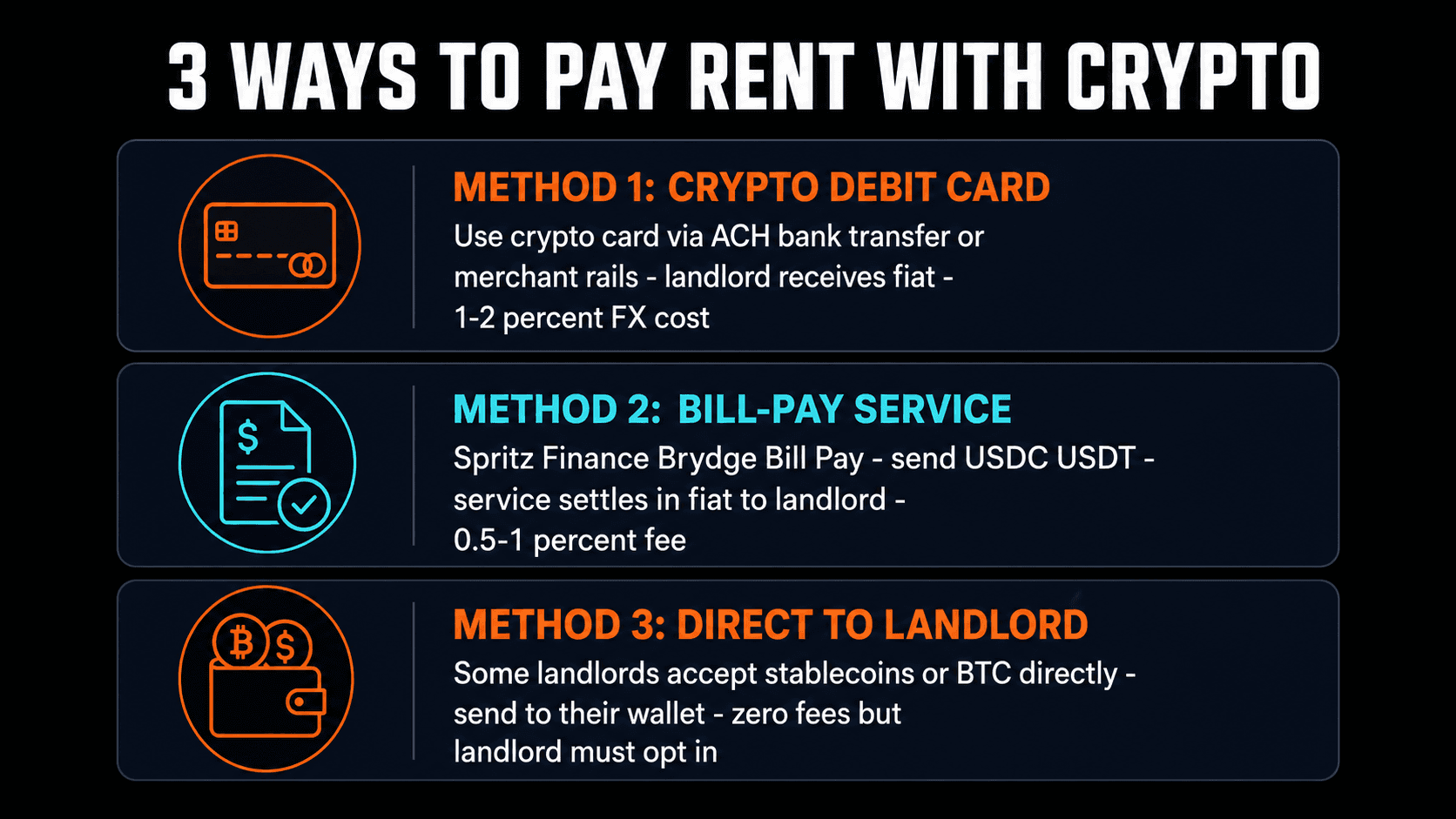
Method 1: Crypto Debit Card (Most Practical)
Use a crypto debit card via the landlord's normal rent-payment portal — the card converts crypto to fiat at the moment of payment, the landlord receives USD/GBP/EUR exactly as they would from any other debit card. The landlord doesn't need to know or care that crypto is involved.
Best for: Renters whose landlords accept debit/credit card payment via portals like Zelle, RentRedi, Buildium, AppFolio, or the landlord's direct payment processor. Cards work everywhere Visa/Mastercard does.
Tools: MetaMask Card (Metal tier: 3% cashback, zero FX), Crypto.com Card (CRO cashback), COCA, KAST.
Cost on $2,000 USD rent: $0-40 in FX (depending on card tier and currency). Net of cashback, Metal tier owners can earn $60 in mUSD on the transaction. Most users net a small positive vs paying with fiat ACH.
Watch out: Some landlord portals charge a 2-3% "debit card surcharge". Check this before switching from ACH to card — it might wipe out your cashback. Also: some landlords don't accept debit cards at all (only ACH, check, or wire).
Method 2: Bill-Pay Service (Best for Recurring Rent)
Services like Spritz Finance, Brydge, and BitPay Bill Pay let you send USDC or USDT from your wallet and have them deliver fiat to the landlord's bank via ACH, wire, or check. The landlord receives normal fiat — they don't know crypto was involved.
Best for: Recurring monthly rent. Spritz supports automated monthly bill-pay setup so you don't have to remember each month. Useful for tenants whose landlord doesn't accept cards.
Tools: Spritz Finance (recommended — ACH and wire support, recurring auto-pay), Brydge, BitPay Bill Pay.
Cost on $2,000 USD rent: Spritz fee 0.99-1.5% = $20-30 per month. No FX (you're sending USDC, Spritz sends USD). Comparable to a Venmo/PayPal transaction fee.
Watch out: Service downtime is rare but possible — have a backup payment method for rent emergencies. Service limits may apply to large rents (above $5,000/month).
Method 3: Direct Stablecoin Transfer (Lowest Cost)
If your landlord is crypto-friendly (increasingly common with newer landlords, crypto-native real estate companies, and short-term rental platforms), send USDC or USDT directly to their wallet. Zero fees beyond gas (typically $0.05-$2 depending on chain).
Best for: Crypto-native landlords, short-term rental platforms with crypto support, international tenants/landlords avoiding bank wire fees. Crypto-paid rent is especially useful for digital nomads operating under a non-traditional residency setup — if that’s you, Palau Digital Residency covers the e-residency angle and Domicillia covers the broader domicile-planning side for tenants paying rent in a country other than their tax-resident jurisdiction.
Tools: Any wallet that supports stablecoins on a major chain (MetaMask, Phantom, Trust Wallet, hardware wallets). Use a fast/cheap chain — Solana, Base, Polygon, Linea, Tron (TRC20).
Cost on $2,000 USD rent: $0.05-$2 in gas. Zero fees if the landlord accepts the crypto directly.
Watch out: Wrong wallet address = rent is gone permanently. Triple-check the address every time. Use ENS (yourname.eth) or wallet whitelisting where possible. Send a $5 test transaction first time — confirm receipt — then send the rest.
Comparison of the 5 Best Tools
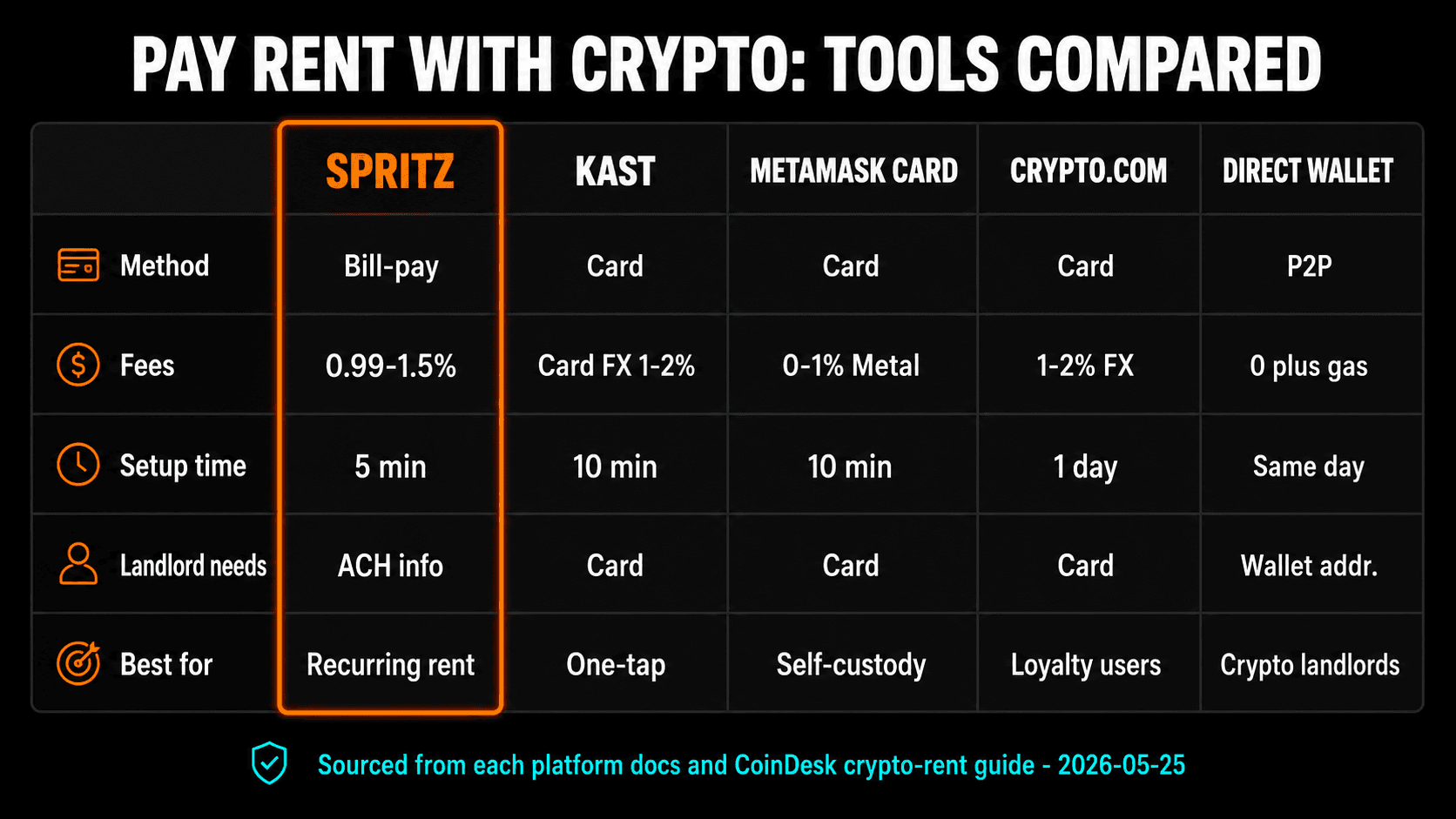
| Tool | Method | Fees | Best For |
|---|---|---|---|
| Spritz Finance | Bill-pay | 0.99-1.5% | Recurring rent, ACH-only landlords |
| KAST | Card | Card FX 1-2% | One-tap stablecoin spend |
| MetaMask Card | Card | 0-1% (Metal) | Self-custody, 3% cashback offsets cost |
| Crypto.com Card | Card | 1-2% FX | High cashback if CRO staked |
| Direct wallet | P2P | $0 + gas | Crypto-native landlords |
Tax Reality: Every Method Triggers a Disposal
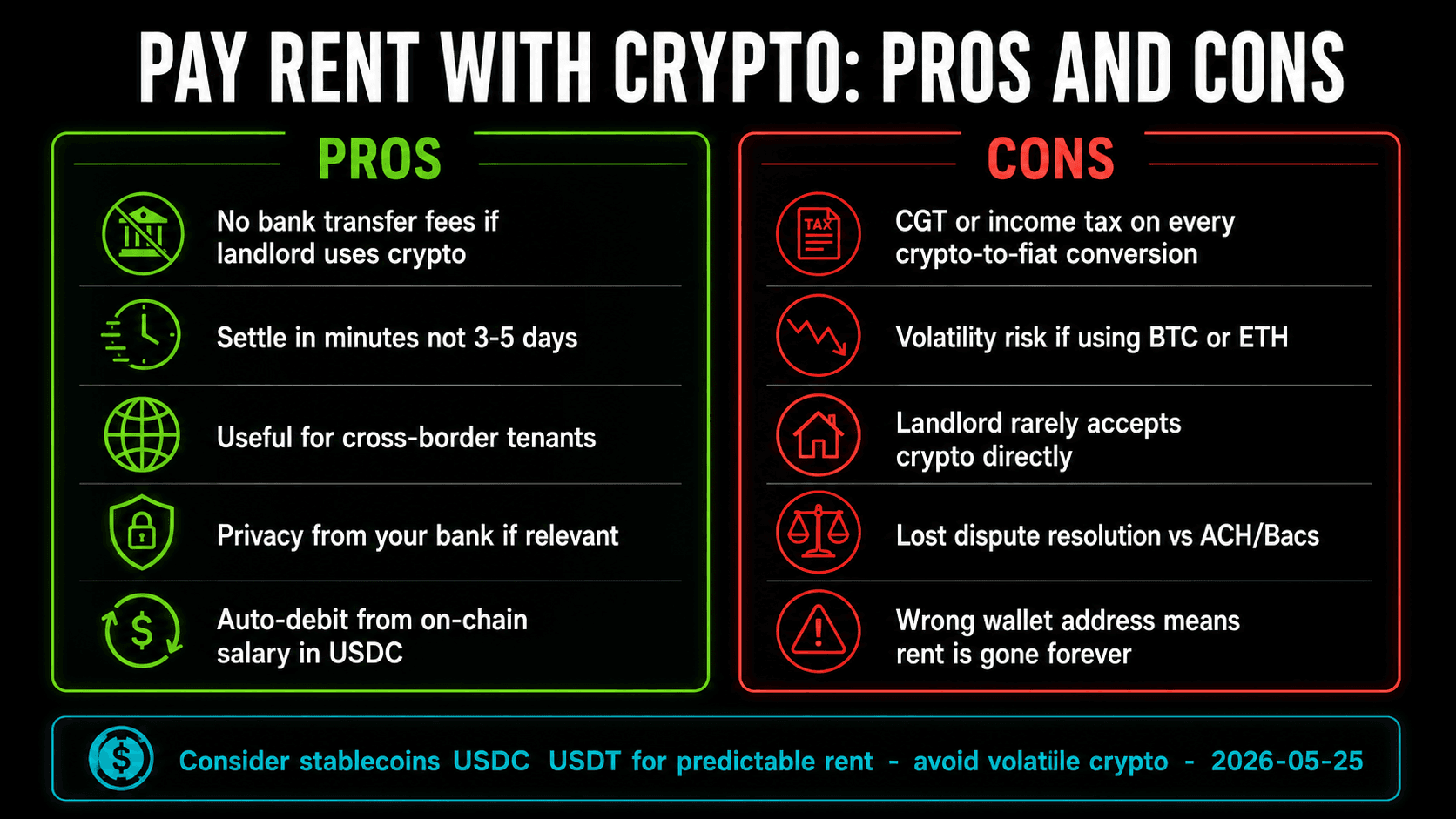
Every method of paying rent with crypto triggers a capital gains tax event in every major jurisdiction:
| Country | Tax Type | Rate | Reporting |
|---|---|---|---|
| US | CGT short/long | 0-37% short, 0-20% long | Form 8949 + Schedule D |
| UK | CGT | 10-20% (after £3K AEA) | SA108 supplementary |
| Canada | CGT 50% inclusion | Marginal rate | Schedule 3 of T1 |
| Australia | CGT 50% discount over 12 months | Marginal rate | Item 18 of T1 |
| Germany | Income tax | 0% if held over 1 year | Anlage SO |
The takeaway: Paying rent in stablecoins minimizes the tax impact (small gain/loss from USD-local FX only). Paying rent in volatile crypto (BTC, ETH, SOL) creates real capital gains that need careful tracking.
Step-by-Step: Pay Your First Crypto Rent
- Pick your method. Card if your landlord takes cards; bill-pay if not; direct if your landlord is crypto-friendly.
- Confirm landlord details. Card: nothing needed on landlord side. Bill-pay: get landlord's name + ACH routing/account or wire details. Direct: get landlord's wallet address — triple-check it.
- Fund your card or wallet. Buy USDC or USDT on a regulated exchange (Coinbase, Kraken, Binance, etc.). Withdraw to the chain your card/service supports.
- Test with $5 first. Especially for direct wallet sends. Confirm landlord received the test. Only then send the full rent.
- Save the receipt. Transaction hash, timestamp, amount in fiat and crypto, the recipient's wallet/account. Email yourself a copy.
- Log for tax. Enter the disposal in Koinly, CoinTracker, or your preferred tax tracker. Tag it as "rent payment" for easier categorization.
- Set up auto-pay if recurring. Spritz supports automated monthly bill-pay. For cards, your landlord's portal likely supports recurring debit card charges.
Safety Checks (Don't Skip These)
- Lease must specify fiat amount. Even if you pay in crypto, the lease should state the rent in USD/GBP/EUR/etc. The crypto is the payment method, not the unit of account. Protects you and the landlord from price volatility disputes.
- Get a written payment-method clause. "Tenant may pay rent via stablecoin transfer to Landlord's designated wallet, with payment deemed received upon on-chain confirmation." Standardizes the payment moment.
- Use a hardware wallet for direct rent payments. If you're sending $1K-$5K monthly to the same address, the security upgrade is worth it. Ledger or Trezor with the rent address on the "trusted contacts" list.
- Have a fiat backup. Crypto rails go down occasionally (RPC issues, chain congestion, bridge outages). Always have enough fiat in your bank to cover one month's rent as a fallback.
- Don't pay rent with airdrops or unvested tokens. Many failure modes — volatility, vesting cliffs, sudden token unlocks crashing the price. Always pay rent in stablecoins or BTC you've held cleanly.
- Track ATM fees if cashing out for rent. Some users withdraw fiat from ATMs to pay rent — rare but worth noting that ATM fees compound on rent-size withdrawals.
Who Should Pay Rent with Crypto
Good fit:
- Crypto-native earners (you're paid in USDC/USDT, want to minimize off-ramping)
- International tenants paying foreign landlords (saves wire fees, faster settlement)
- Users earning meaningful cashback (3% mUSD on MetaMask Metal, 5-8% CRO on Crypto.com Royal/Obsidian)
- Tenants whose landlords already accept crypto directly
Poor fit:
- Users with primarily volatile crypto holdings (creates significant tax tracking burden)
- Tenants whose landlords charge a debit card surcharge that exceeds your cashback
- Users without a fiat backup (single-point-of-failure risk)
- Renters in jurisdictions where the lease must explicitly permit crypto payment (check state law)
Final Take
Paying rent with crypto is genuinely useful in 2026, but only if you pick the right method for your specific situation. For most tenants, the highest-leverage move is to use a crypto debit card with cashback that offsets the small FX cost — especially if you can hit MetaMask Metal's 3% rate or Crypto.com's Royal/Obsidian CRO tier. If your landlord only accepts ACH/check, Spritz Finance is the cleanest bridge at ~1% fee. Direct wallet transfers are best for crypto-native landlords and international rent.
Whatever you pick: set up crypto tax tracking from day one and have a fiat backup. Rent is the one payment you can't afford to bounce.