- Two programmes publish a real list; the rest publish a sentence or nothing. OKX prints 23 declined merchant category codes plus 26 no-cashback categories, effective 8 June 2026. Karta Personal names 46 categories and no codes. Bybit, RedotPay and XKard publish no list at all.
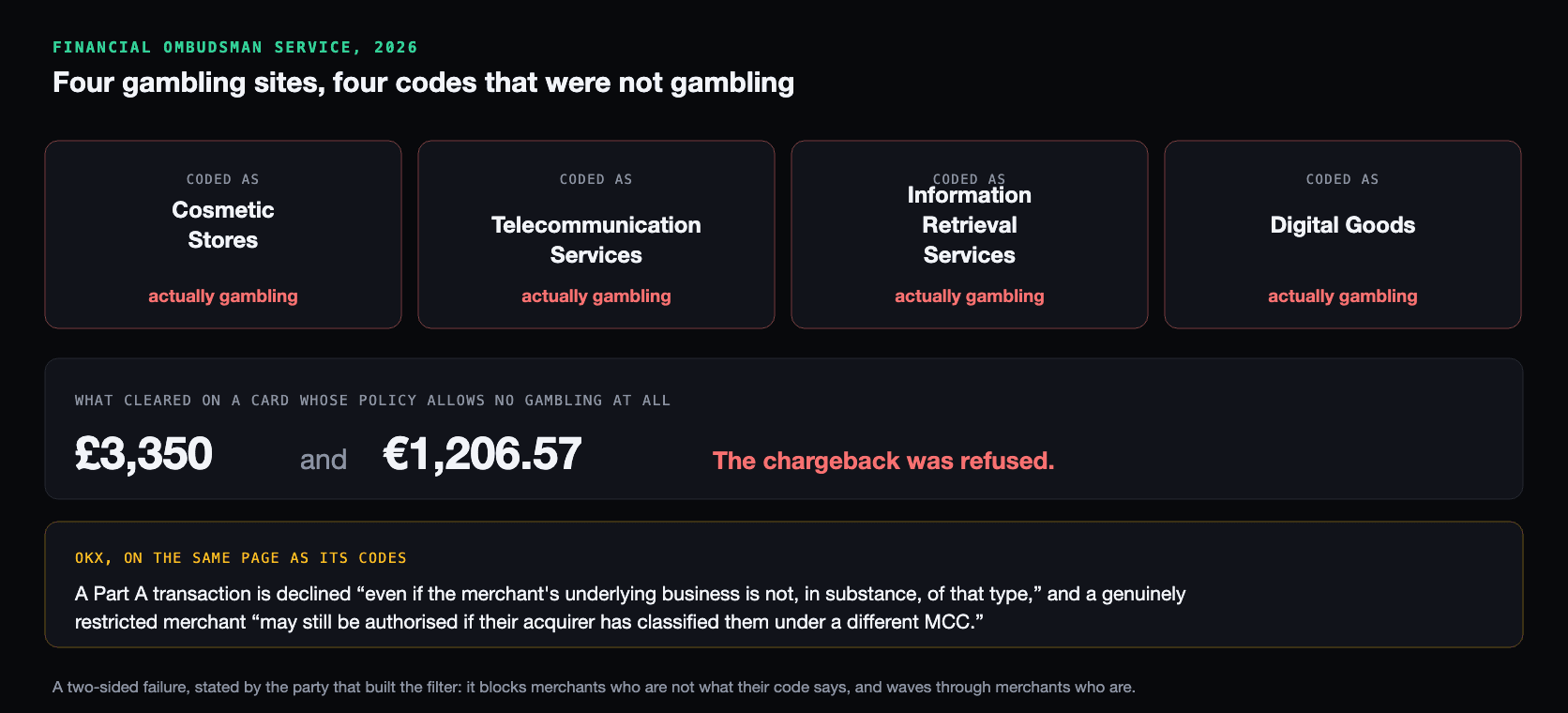
- The filter reads the code, not the business — and OKX says so in writing. A Part A transaction is declined “even if the merchant's underlying business is not, in substance, of that type,” and a genuinely restricted merchant “may still be authorised if their acquirer has classified them under a different MCC.”
- A 2026 ombudsman decision shows that costing real money. Four gambling sites were coded Cosmetic Stores, Telecommunication Services, Information Retrieval Services and Digital Goods. Around £3,350 and €1,206.57 cleared on a Crypto.com card whose policy allows no gambling at all. The chargeback was refused.
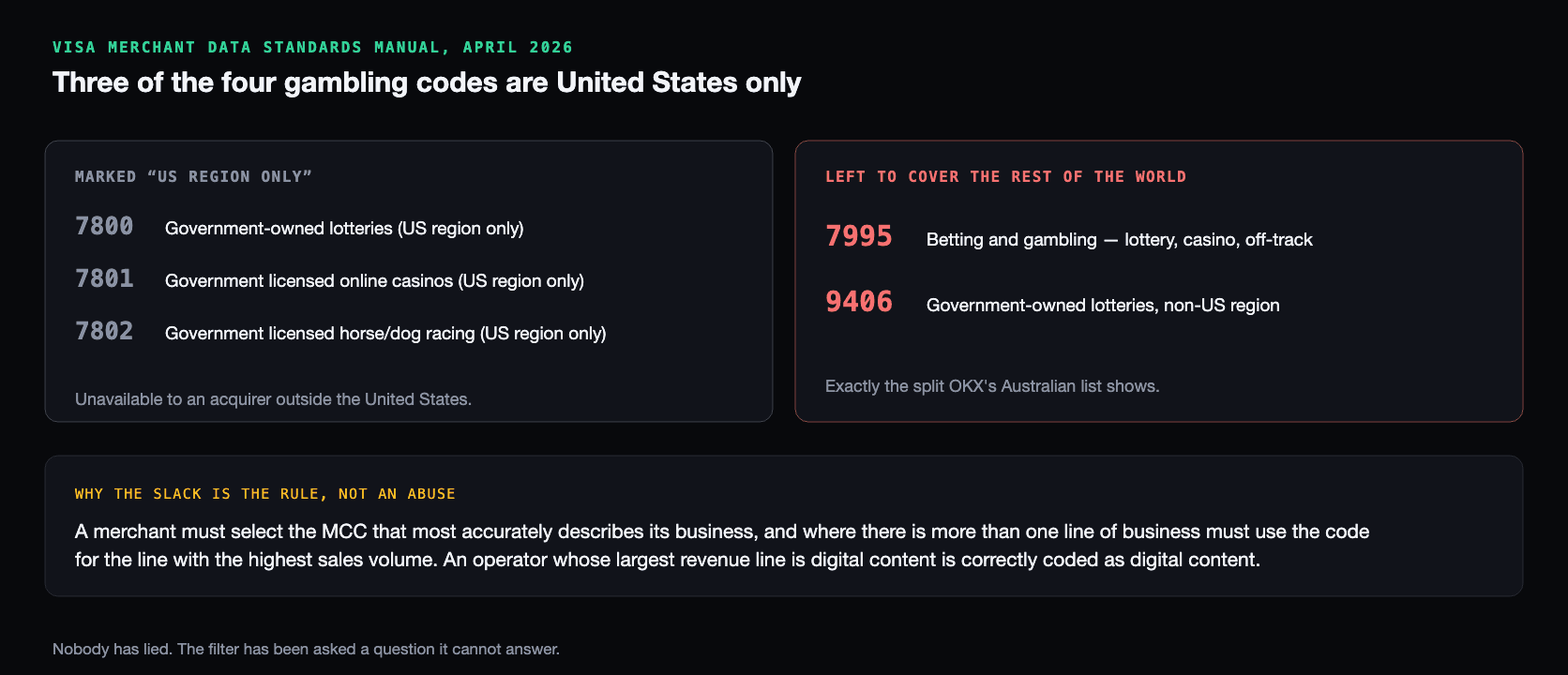
- Three of the four gambling codes are United States only. Visa's April 2026 manual marks 7800, 7801 and 7802 “US Region only”, leaving 7995 and non-US lottery code 9406 to cover the rest of the world — which is exactly the split OKX's Australian list shows.
- The surprises are not vice, they are errands. OKX declines jewellers (5944), precious metals (5094), pawn shops (5933), bail bonds (9223) and tax payments (9311). Karta's 46 categories reach furriers, antique shops, cigar shops, debt collectors, labour unions, political parties and churches.
On this page
A card that works at eighty million merchants will still refuse some of them, and almost nobody will tell you which. Searching for crypto card blocked merchants turns up one explainer with no tables and a single code in it, plus help-desk pages that give decline reasons without the list. So we went to the documents: two issuer block lists, five more programmes' terms, Visa's Merchant Data Standards Manual of April 2026, and a Financial Ombudsman Service decision in which about £3,350 of gambling cleared on a card that forbids gambling. What came back is one mechanism and 23 numbers, and a hole the best-documented issuer describes in its own help centre.
Crypto card blocked merchants: what the issuers actually publish
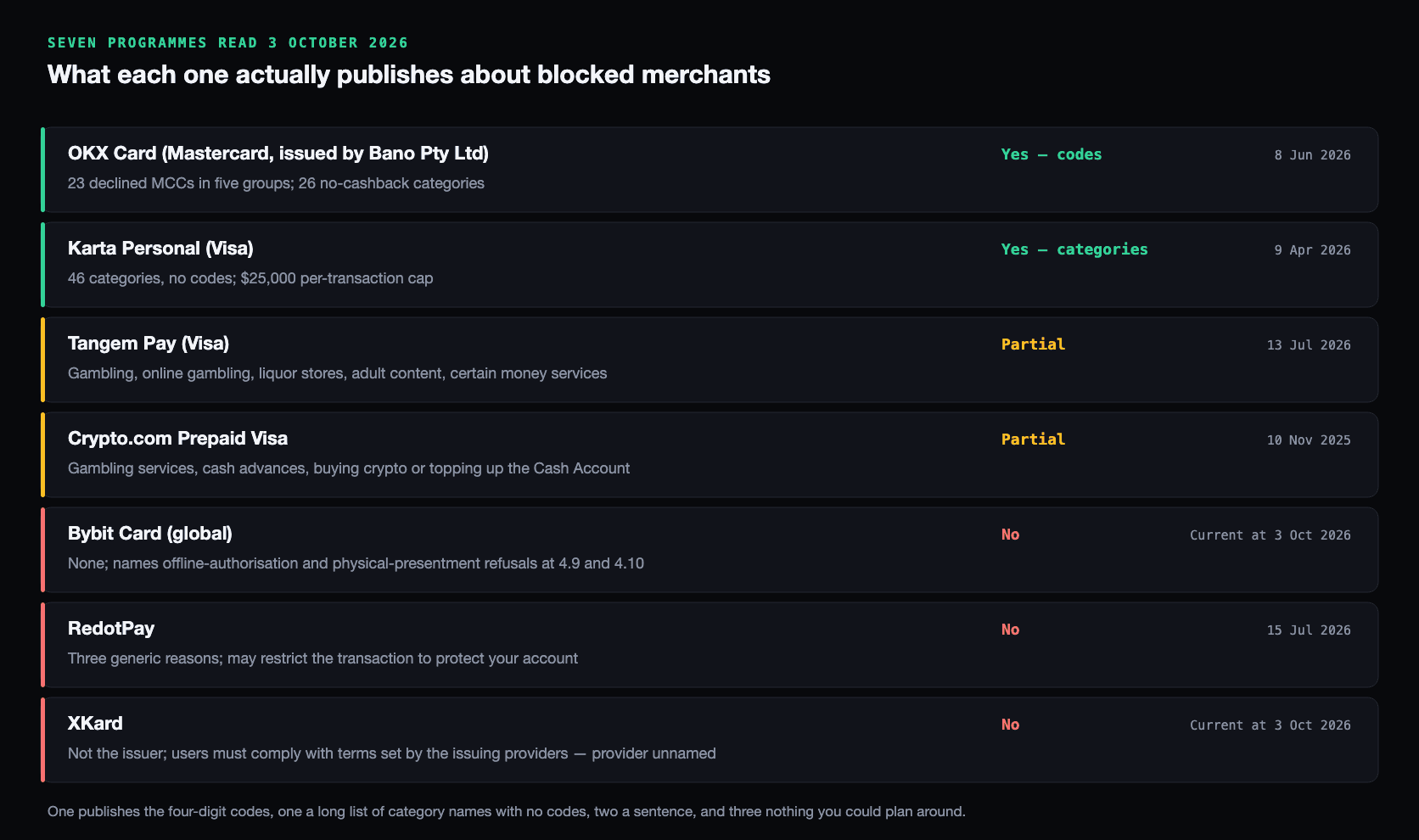
Start with disclosure, because it sorts the market faster than any feature table. Of seven programmes read on 3 October 2026, one publishes the four-digit codes, one a long list of category names with no codes, two a sentence, and three nothing you could plan around.
| Programme | Published block list? | What it names | Document date |
|---|---|---|---|
| OKX Card (Mastercard, issued by Bano Pty Ltd) | Yes — codes | 23 declined MCCs in five groups; 26 no-cashback categories | 8 Jun 2026 |
| Karta Personal (Visa) | Yes — categories | 46 categories, no codes; $25,000 per-transaction cap | 9 Apr 2026 |
| Tangem Pay (Visa) | Partial | Gambling, online gambling, liquor stores, adult content, certain money services | 13 Jul 2026 |
| Crypto.com Prepaid Visa | Partial | Gambling services, cash advances, buying crypto or topping up the Cash Account | 10 Nov 2025 |
| Bybit Card (global) | No | None; names offline-authorisation and physical-presentment refusals at 4.9 and 4.10 | Current at 3 Oct 2026 |
| RedotPay | No | Three generic reasons; RedotPay “may restrict the transaction to protect your account” | 15 Jul 2026 |
| XKard | No | Not the issuer; users “must comply with the terms set by the issuing providers” — provider unnamed | Current at 3 Oct 2026 |
That last row deserves its own sentence, because XKard is the card we rank first here and the honest reading is not flattering to anyone's marketing. Its terms page runs to roughly 1,400 characters and says plainly that it provides access to third-party virtual prepaid card services and is not a card issuer. The block list that decides where your money works therefore belongs to a provider you cannot read, because it is not named. That is the market norm, not an outlier, and it is why this page had to be built from the two programmes that publish.
The one complete list: all 23 codes OKX declines
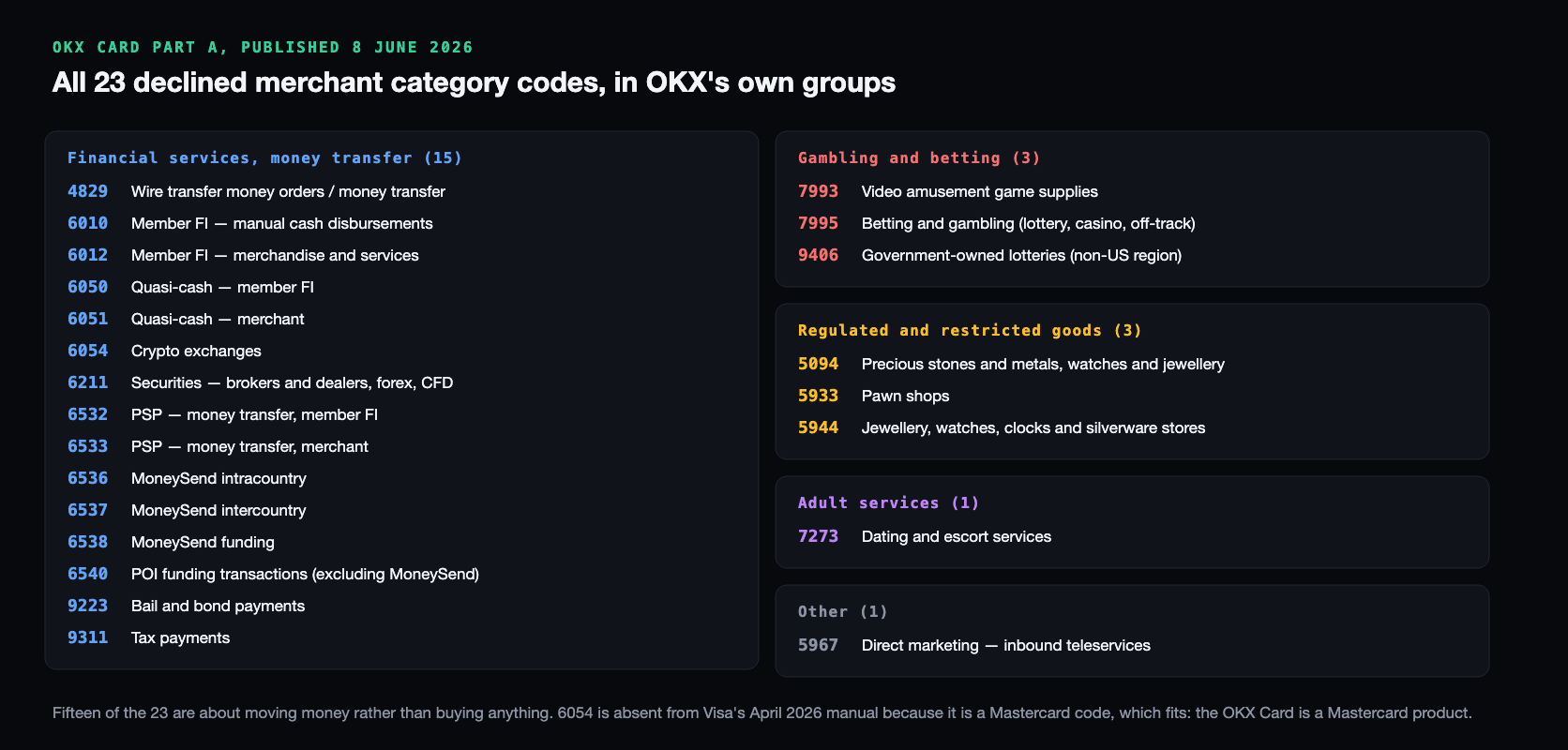
OKX's Australian card page is the most useful document in the category. It splits restrictions into Part A, declined, and Part B, authorised but earning no cashback. Here is Part A in full as published on 8 June 2026, under OKX's own group headings. We checked every code against Visa's April 2026 manual; the one absent there, 6054, is a Mastercard code — which fits, since the OKX Card is a Mastercard product.
| Group | MCC | Description as published |
|---|---|---|
| Financial services, money transfer (15) | 4829 | Wire transfer money orders / money transfer |
| 6010 | Member FI — manual cash disbursements | |
| 6012 | Member FI — merchandise and services | |
| 6050 | Quasi-cash — member FI | |
| 6051 | Quasi-cash — merchant | |
| 6054 | Crypto exchanges | |
| 6211 | Securities — brokers and dealers, forex, CFD | |
| 6532 | Payment service provider — money transfer, member FI | |
| 6533 | Payment service provider — money transfer, merchant | |
| 6536 | MoneySend intracountry | |
| 6537 | MoneySend intercountry | |
| 6538 | MoneySend funding | |
| 6540 | POI funding transactions (excluding MoneySend) | |
| 9223 | Bail and bond payments | |
| 9311 | Tax payments | |
| Gambling and betting (3) | 7993 | Video amusement game supplies |
| 7995 | Betting and gambling (lottery, casino, off-track) | |
| 9406 | Government-owned lotteries (non-US region) | |
| Regulated and restricted goods (3) | 5094 | Precious stones and metals, watches and jewellery |
| 5933 | Pawn shops | |
| 5944 | Jewellery, watches, clocks and silverware stores | |
| Adult services (1) | 7273 | Dating and escort services |
| Other (1) | 5967 | Direct marketing — inbound teleservices |
Read the shape rather than the rows. Fifteen of the 23 are about moving money rather than buying anything, which says what the issuer is actually afraid of: not vice, but a card used as a funding rail. Gambling gets three codes, adult services one, and jewellery — the classic resale category — two. For the fee side of the same picture, our ATM withdrawal fee comparison covers cash that is permitted but priced.
It is a category filter, not a merchant filter
Here is the sentence that should change how you read every list above. It is OKX's, on the same page as the codes:
“MCCs are assigned to merchants by Mastercard and their acquiring banks, not by OKX. Where a merchant is classified under an MCC in Part A, the transaction will be declined even if the merchant's underlying business is not, in substance, of that type. Equally, a transaction at a merchant whose business falls within Part A may still be authorised if their acquirer has classified them under a different MCC.”
That is a two-sided failure, stated by the party that built the filter: it blocks merchants who are not what their code says and waves through merchants who are. Tangem puts the first half the same way — the code “is set by the merchant's acquiring bank when the business configures card acceptance; the merchant doesn't choose it themselves.”
Visa's manual explains why the slack exists, and it is not an abuse — it is the rule. A merchant must “select the MCC that most accurately describes the Merchant's business”, and where there is more than one line of business must either “use the MCC that describes the business with the highest sales volume” or use different codes per line. An operator whose largest revenue line is digital content is correctly coded as digital content, and the gambling arm inherits that code. Nobody has lied; the filter has been asked a question it cannot answer.
The case where that cost someone £3,350
There is a published decision that puts numbers on this. In 2026 the UK Financial Ombudsman Service decided complaint DRN-6308165 against FORISGFS UK Limited, trading as Crypto.com. The cardholder made a run of transactions over a few days in July 2025 on a Crypto.com prepaid Visa card — around £3,350 in sterling and €1,206.57 in euros — at what were in fact unlicensed gambling websites.
Crypto.com's policy, confirmed to the ombudsman, “is not to allow any gambling transactions via its platform.” Every payment went through anyway. The ombudsman asked for each merchant's category code, and the answer is this whole article in four rows.
| What the merchant was | Category it was coded as | Matching Visa code (Apr 2026 manual) | Caught by a gambling filter? |
|---|---|---|---|
| Gambling website | Cosmetic Stores | 5977 Cosmetic Stores | No |
| Gambling website | Telecommunication Services | 4814 Telecommunication Services | No |
| Gambling website | Information Retrieval Services | 7375 Information Retrieval Services | No |
| Gambling website | Digital Goods — Audiovisual Media (books, movies, music) | 5815 Digital Goods Media | No |
The decision names the categories, not the numbers; column three gives the codes those names carry in Visa's manual. Crypto.com told the ombudsman that while its systems automatically decline recognised gambling MCCs, it is “unable to pre-emptively block gambling platforms that operate under non-gambling codes.” The ombudsman accepted that, noting such a block “is dependent on the gambling merchant having the correct MCC to identify itself, and, therefore, does have limitations.”
The chargeback failed too, and the reason matters if you ever plan to rely on one. Visa has an invalid-data reason code — rule 12.7 — covering an authorisation request that “contained an incorrect transaction date, MCC, merchant or transaction type indicator”. It was unavailable here for want of evidence that the wrong code had been used, and because “the merchant code itself isn't assigned by the merchant — rather it is something that the relevant merchant acquirer's (i.e. bank) decides based on the primary business of the merchant.” Our chargeback guide covers which reason codes are realistically open; this is the one that looks open and is not.
Three of the four gambling codes are US-only
A block list is also a map of where the issuer operates, and the gambling codes make that visible. Visa's April 2026 manual carries four gambling-related categories, and three are restricted to one region.
| MCC | Visa's description | Regional scope | On OKX's declined list? |
|---|---|---|---|
| 7800 | Government-Owned Lotteries | US Region only | No — no-cashback list only |
| 7801 | Government Licensed On-Line Casinos (On-Line Gambling) | US Region only | No — no-cashback list only |
| 7802 | Government-Licensed Horse/Dog Racing | US Region only | No — no-cashback list only |
| 7995 | Betting, including lottery tickets, casino gaming chips, off-track betting and wagers at race tracks | Global | Yes |
| 9406 | Government-Owned Lotteries (non-US region) | Non-US | Yes |
That explains a split in OKX's document that would otherwise look arbitrary: an Australian programme declines 7995 and 9406 and relegates 7800, 7801 and 7802 to the no-cashback list, because those three describe merchants licensed by a US government entity and registered with Visa. A licensed online casino outside the United States has no equivalent code to be filed under. It gets 7995 if its acquirer calls it betting, and something else if not.
If you are here to fund a crypto casino, that is the practical answer, and it is a dead end both ways: the betting code is blocked on the programmes that publish a list, and the crypto-exchange route around it is blocked too, as the next section shows. Our sister site's guide to crypto casino programmes covers that side of the market; what it cannot change is which code your issuer sees.
Why you cannot buy crypto with a crypto card
The strangest entry is the one most new cardholders trip over: a crypto card that will not buy crypto. Crypto.com says it directly — you are “restricted from using your card to purchase crypto or to top-up your Cash Account on the Crypto.com App” — and OKX puts 6050, 6051 and 6054 in the declined column.
The reason is a classification rule, not a policy whim. Visa's manual requires that a merchant selling quasi-cash use MCC 6051 or 6012 “even if selling quasi-cash is not the Merchant's primary business”, and that “purchases of cryptocurrency must use MCC 6012 or 6051, as applicable”, carrying special condition indicator 7 and the quasi-cash transaction indicator in the authorisation request. Quasi-cash is the oldest high-risk bucket in card acceptance, and crypto was placed inside it rather than beside it.
Two things follow. The block is on the transaction type, so it holds even at your own issuer's sister exchange. And the same indicator makes these transactions plainly visible to anyone reading the authorisation record — worth knowing if you chose a card for discretion, and a different question from identity verification, which we cover in the KYC rules guide.
The second list: authorised, but no cashback
Part B is the list nobody reads and the one that quietly costs a heavy spender most. These 26 categories are authorised — the payment clears — but earn nothing under the cashback programme. It is longer than the declined list and reaches places a rewards calculator never does.
| Category | MCC(s) | Earns cashback? |
|---|---|---|
| ATM cash withdrawals | 6011 | No |
| Foreign currency, crypto, account funding | 6050, 6051, 6054 | No |
| Insurance sales and premiums | 6300 | No |
| Stored value card load, e-wallet top-up | 6540 | No |
| Charitable and social service bodies | 8398 | No |
| Political organisations | 8651 | No |
| Religious organisations | 8661 | No |
| Court costs, alimony, child support | 9211 | No |
| Fines | 9222 | No |
| Government and postal services | 9399, 9402 | No |
| Professional and business services, n.e.c. | 7399, 8999 | No |
Note what “not elsewhere classified” does in that last row. MCC 7399 and 8999 are catch-alls, and Visa's manual tells acquirers to use codes ending in 99 “only if there is no MCC specific to the Merchant's business”. That is where small and unusual merchants land, so a headline rate can miss a tier of ordinary spending through no decision of yours. If cashback is why you picked a card, read this list before the rate — and compare it with the cashback card roundup.
Blocked merchants nobody expects: chemists, churches, jewellers
Ask a cardholder what a crypto card blocks and you will hear casinos, drugs and pornography. The lists do include those. They also include errands no marketing page prepares you for, and Karta's 46-item list is where it gets strange.
| Category | Visa code | Where it appears |
|---|---|---|
| Jewellery, watches, clocks and silverware | 5944 | OKX declined |
| Precious stones and metals | 5094 | OKX declined |
| Tax payments | 9311 | OKX declined |
| Bail and bond payments | 9223 | OKX declined; Karta restricted |
| Pawn shops | 5933 | OKX — declined; Karta — restricted |
| Druggist sundries / drug stores | 5122, 5912 | Karta restricted (category named, no code) |
| Furriers and fur shops | 5681 | Karta restricted |
| Antique shops and antique reproductions | 5932, 5937 | Karta restricted; OKX no cashback (5937) |
| Stamp and coin stores | 5972 | Karta restricted |
| Cigar stores and stands | 5993 | Karta — restricted |
| Religious organisations | 8661 | Karta restricted; OKX no cashback |
| Political organisations and labour unions | 8651, 8699 | Karta — restricted; OKX — no cashback |
The chemist row needs a caveat rather than a headline. Karta names “Drug Stores and Proprietary Drugs” without printing a code, and Visa's manual carries two neighbours — 5122 for druggist sundries and 5912 for drug stores and pharmacies. Which one a given chemist carries is the acquirer's call, so whether a prescription clears depends on a classification neither you nor Karta chose. Karta is at least clear about the chain of command: the restrictions “are applied by our provider bank” and the list “may change over time.”
One more line from the same page is worth keeping: “very frequent transactions to the same merchant may be rejected.” That is a velocity rule, not a category rule, and the quietest of the lot, because it appears on no list at all. It explains a decline pattern that looks like a merchant block and is not — a distinction we untangle in the declined-transaction guide.
What to do when a payment is refused
No programme we read offers a cardholder-facing allowlist, so the realistic move is diagnosis and a different route, not an appeal. In order of what each tells you for the effort:
- Try a small amount at the same merchant. A category block declines every amount identically. A limit, a balance shortfall or a velocity rule does not. That one test separates a merchant block from everything else.
- Try a second card on a different programme. Issuers block different codes, and the OKX and Karta lists barely overlap outside money transfer and gambling. A decline on one and an approval on another puts the problem at the issuer, not the merchant.
- Check whether the merchant is really the merchant. Many platforms route payments through a processor whose code is what your issuer sees. A “digital goods” descriptor on a bill from a shop selling physical items is the signature of that.
- Rule out the offline and physical-presentment cases first. Bybit's terms are candid here: its card cannot be used where a merchant cannot obtain online authorisation — naming trains, ships, some in-flight purchases and tollbooths — and its virtual card cannot buy anything that later needs a physical card to collect, naming certain theatre tickets, hotel stays and car rentals.
- Ask for the code, not the reason. “Which MCC did that authorisation carry?” is answerable from a log; “why was I declined?” invites a template. OKX tells cardholders to contact support in the app when a transaction they expected to clear is declined.
- Treat a chargeback as a last resort. The invalid-data route exists, and the decision above shows how much evidence it needs. If the payment succeeded and you got what you bought, it is almost certainly closed.
Final take
The honest summary of crypto card blocked merchants in 2026: the lists are real, short, mostly unpublished and weaker than they look. Two programmes of seven let you plan around them. The one publishing codes blocks 23, fifteen of them about moving money rather than buying goods, and says in its own help centre that the filter refuses the wrong merchants and admits the right ones.
So judge a card on what it discloses, not on what it promises to protect you from. A programme that prints its codes has told you where your card will fail before you load it; one that says nothing has left the question to a bank it will not name. On the published evidence, the gap between a stated no-gambling policy and what the filter stops can be a four-figure sum — and the cardholder carried it.
See what each card actually discloses
Kardd tracks the issuer, the KYC level, the custody model and the published fee stack for every card we cover, so you can see what you are signing up to before you load it.
Kardd may earn a commission on sign-ups, including XKard. Affiliate disclosure.
Related Articles
- Crypto Card Declined? 9 Reasons and Fixes for 2026
- Crypto Card Chargebacks 2026: What You Can Actually Dispute
- Crypto Card KYC Rules 2026: The July 2027 EU Deadline
- OKX Card Review 2026: Fees, Limits and Cashback
- Crypto Card Supported Countries 2026: The Three Lists
- Business Crypto Cards 2026: What the Terms Actually Say
Frequently Asked Questions
Why was my crypto card declined at a shop that takes Visa?
Acceptance and authorisation are two gates. A merchant can accept your network and still sit in a merchant category code your issuer refuses. OKX is the clearest example: a transaction under any of the 23 codes in Part A is declined outright, and OKX says that happens even where the merchant's underlying business is not, in substance, of that type. The list was published on 8 June 2026 and may change at any time.
What is an MCC, and who decides which one a shop gets?
A four-digit number describing a merchant's primary business, which the merchant does not choose: the acquiring bank assigns it when card acceptance is configured. Visa's April 2026 manual says to pick the code that most accurately describes the business, and that a merchant with more than one line must either use the code for its highest-volume line or separate codes per line.
Can I use a crypto card for online gambling?
Not by design on most programmes. Crypto.com has restricted its cards for gambling services and cash advances for compliance reasons, Tangem Pay lists gambling establishments and online gambling as blocked, and OKX declines 7995 and 9406. But the filter reads the code: the decision above shows four gambling sites coded as cosmetics, telecoms, information retrieval and digital goods whose payments cleared on a card with a blanket no-gambling policy.
Why can't I buy crypto with my crypto card?
Because the network treats it as quasi-cash, and most programmes decline quasi-cash. Visa requires crypto purchases to use MCC 6012 or 6051 with special condition indicator 7. OKX declines 6050, 6051 and 6054; Crypto.com restricts using the card to buy crypto or top up your Cash Account. The block is on the transaction type, so it holds even at the issuer's own sister exchange.
Which crypto card publishes the fullest list of blocked merchants?
OKX for codes, Karta Personal for categories. OKX prints 23 declined four-digit codes plus 26 categories that are authorised but earn no cashback. Karta names 46 restricted categories and no codes at all. Of the other five programmes we read, two publish a short category list and three publish nothing you could plan around.
Do the gambling merchant category codes work everywhere?
No. Visa's April 2026 manual marks 7800 government-owned lotteries, 7801 government-licensed online casinos and 7802 government-licensed horse and dog racing as US Region only. Outside the United States the main gambling code is 7995, with 9406 for non-US government lotteries. That is why OKX's Australian programme declines 7995 and 9406 but leaves the three US codes on its no-cashback list.
Can a blocked category be appealed or allowlisted?
Not by the cardholder, on any programme we read. Karta says the restrictions and risk checks are applied by its provider bank and may change over time. OKX invites you to contact support if a transaction you expected to clear is declined. Neither offers an allowlist, so a mis-coded merchant is something to route around, not argue about.
If a wrongly coded transaction goes through, can I charge it back?
There is a reason code, and the evidential burden sits with you. Visa's invalid-data rule 12.7 covers an authorisation request containing an incorrect MCC. In DRN-6308165 the cardholder argued exactly that and lost, for want of evidence that the wrong code had been used and because the code is set by the acquirer on the merchant's primary business.
Sources
Every code, category and quotation above was read on 3 October 2026 from the primary documents: the OKX Card restricted merchant categories list, Visa's Merchant Data Standards Manual (April 2026), Financial Ombudsman Service decision DRN-6308165, the Crypto.com prepaid card usage page, Karta Personal's card limits page, Tangem's merchant category restrictions page, RedotPay's merchant acceptance article, the Bybit Card legal terms and XKard's terms and conditions.