Crypto Card Age Limits 2026: Warranty, Not a Check
- The age bar is a promise you give, not a check they run. Eight of the nine documents put it in a list of things you “represent and warrant” at sign-up. None of them describes verifying it.
- It is 18 everywhere a figure appears — and the “21” you have read is wrong. Crypto.com's EU, Australian, Singaporean and Brazilian terms all say eighteen, at clauses 2.1(c), 2.1(c), 3.1(c) and 2.1(c).
- One agreement sets no age at all. Crypto.com's US Prepaid Visa Cardholder Agreement, effective 1 September 2026, runs about 13,800 words without the word “eighteen”, “minor” or “guardian” in it.
- Two cards share one copy-pasted clause, and the copy is visible. Exodus and Ledger's CL Card both read “the age of majority in your state of residence”; the EU and UK edit dropped a verb, leaving “that you in an eligible jurisdiction”.
- Breaching it costs the balance, not the card. Clause 18 lets the issuer freeze the wallet without notice, void your cashback, keep debiting charges after termination and owe you no compensation.
On this page
- What the age clause actually is
- Nine documents, and what each one says
- The one agreement that sets no age at all
- The same clause, copy-pasted across jurisdictions
- The warranty list that also forbids an alias
- What happens if the promise is untrue
- Why a no-KYC card changes nothing here
- What to check before you load a card
- Final take
- Sources
- Related articles
- FAQ
Search for crypto card age limits and you will be told “18, mostly” by a page that has not read a single cardholder agreement — and on the biggest card in the market, by pages repeating a figure of 21 that none of its documents contain. The stakes are not the sign-up, which is easy; they are the balance sitting on the card when somebody checks. So on 31 October 2026 we read nine programmes' own documents, clause by clause, and the finding is structural rather than numerical: the age rule is something you promise about yourself, in a list of promises, and not one of the nine describes testing it. We quote every clause number below, including the one agreement that contains no age rule whatsoever.

What the age clause actually is
Open almost any crypto card agreement at its onboarding section and the age bar is not phrased as a condition the issuer checks. It is phrased as a statement you make. Crypto.com's European terms open clause 2.1 with “By signing up for the Prepaid Card, you represent and warrant that:” and then run a list from (a) to (g). Age is (c).
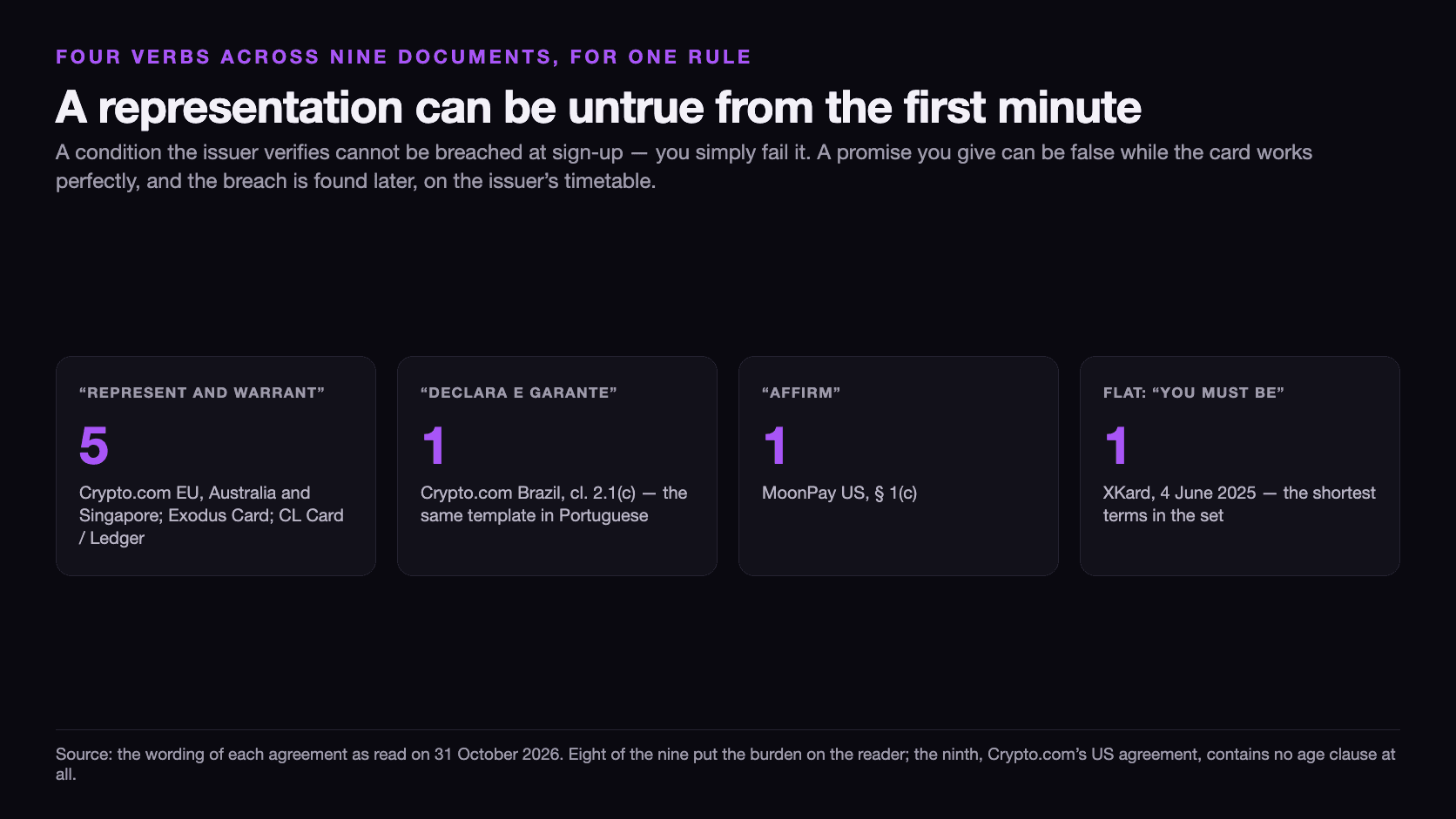
The distinction matters because a representation is a thing that can be false. A condition that the issuer verifies cannot be breached at sign-up — you simply fail it and get no card. A representation you give can be untrue from the first minute, with the card working perfectly throughout, and the breach is discovered later, on the issuer's timetable rather than yours. That is the whole mechanism, and it is the reason this page is about contract wording rather than about a number.
Nine documents, and what each one says
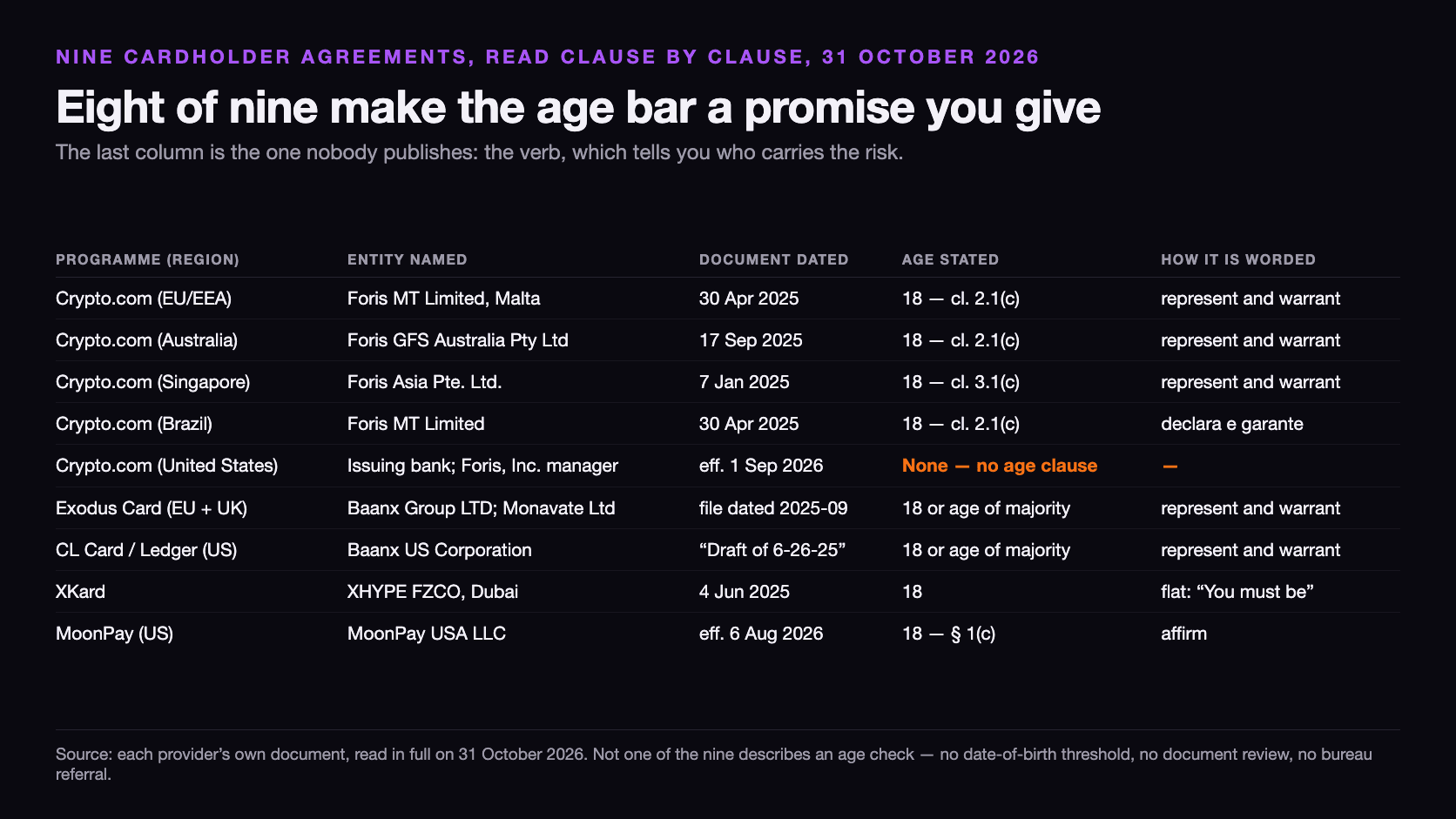
Here is every document we could read in full, with the entity that would be enforcing it. The last column is the one nobody publishes: the verb, which tells you who carries the risk.
| Programme (region) | Entity named | Document dated | Age stated | How it is worded |
|---|---|---|---|---|
| Crypto.com (EU/EEA) | Foris MT Limited (C 90348), Malta — MFSA licence | 30 Apr 2025 | 18 — cl. 2.1(c) | represent and warrant |
| Crypto.com (Australia) | Foris GFS Australia Pty Ltd (ACN 150 651 004) — AFSL 467462 | 17 Sep 2025 | 18 — cl. 2.1(c) | represent and warrant |
| Crypto.com (Singapore) | Foris Asia Pte. Ltd. (UEN 201630381R) — MAS major payment institution | 7 Jan 2025 | 18 — cl. 3.1(c) | represent and warrant |
| Crypto.com (Brazil) | Foris MT Limited | 30 Apr 2025 | 18 — cl. 2.1(c) | declara e garante |
| Crypto.com (United States) | Issuing bank, with Foris, Inc. as program manager | eff. 1 Sep 2026 | None | — no age clause in the document |
| Exodus Card (EU + UK) | Baanx Group LTD; issuer Monavate Ltd — FCA 901097 | file dated 2025-09 | 18 or age of majority | represent and warrant |
| CL Card / Ledger (US) | Baanx US Corporation | header reads “Draft of 6-26-25” | 18 or age of majority | represent and warrant |
| XKard | XHYPE FZCO, Dubai — “not a card issuer” | 4 Jun 2025 | 18 | flat statement: “You must be” |
| MoonPay (US) | MoonPay USA LLC | eff. 6 Aug 2026 | 18 — § 1(c) | affirm |
Four verbs across nine documents, for one rule. Eight of the nine put the burden on the reader; the ninth does not mention it. What none of them contains is a sentence describing an age check — no date-of-birth threshold, no document review step, no referral to a bureau. The only gate any of them describes is identity verification, which is a different test with a different purpose, and which we cover separately in what crypto cards actually ask for at KYC.
The one agreement that sets no age at all
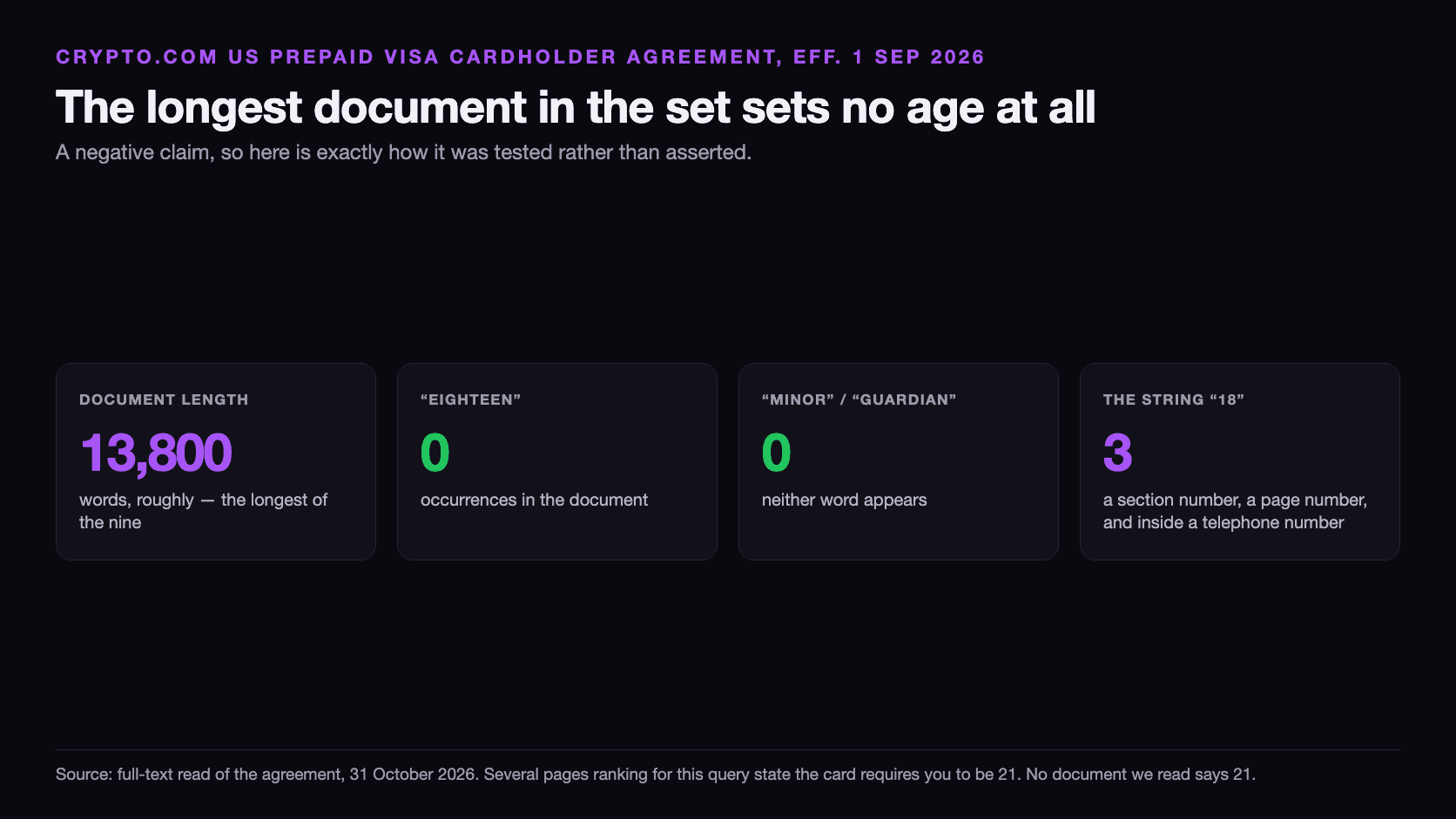
Crypto.com's US Prepaid Visa Cardholder Agreement is the longest document in this set, at roughly 13,800 words, and it is the only one with no age requirement in it. That is a negative claim, so it is worth saying exactly how it was tested rather than asserting it: the word “eighteen” does not appear; neither does “minor” nor “guardian”; and the string “18” occurs three times, as a section number, as a page number, and inside a telephone number.
This is not a drafting slip so much as a different drafting tradition. The US document is a bank-style cardholder agreement — it carries FDIC deposit insurance language, an error-resolution procedure and a long arbitration clause with a class-action waiver — and agreements in that family tend to leave capacity to the general law of contract rather than restating it. The practical effect for a reader is still worth knowing: on the US card the age term is not in the document you accept, so there is nothing to point at either way, and the question of who may hold the card is answered somewhere other than the agreement.
It also disposes of a claim that circulates widely. Several pages ranking for this query state that the Crypto.com Visa card requires you to be 21 in most jurisdictions. No document we read says 21. The four that state an age say eighteen, and the fifth says nothing.
The same clause, copy-pasted across jurisdictions
Two of the nine cards are run by the same programme manager, Baanx, and reading them side by side shows the copy happening. These are different products in different regions under different corporate entities, and the eligibility sentence is the same sentence.
| CL Card / Ledger — US | Exodus Card — EU + UK | |
|---|---|---|
| Entity | Baanx US Corporation | Baanx Group LTD; issuer Monavate Ltd |
| Age wording | “at least 18 years of age (or the age of majority in your state of residence)” | identical — “state of residence” retained |
| Residency half | “that you reside in the United States” | “that you in an eligible jurisdiction” — verb missing |
| Wallet sentence | “must have a self-custody wallet”, clcards.com | same sentence, “an Exodus wallet”, exodus.com |
| Document status | “Attorney Client Privileged / Draft of 6-26-25 / Subject to Revision”, printed on the page | no draft marking |
| File vs title | — | served at a URL named row (rest of world), titled “EU+UK” |
Three things follow, and the first is the only one that changes what you should do. The phrase “age of majority in your state of residence” is United States drafting — the age of majority is 18 in most US states and 19 or 21 in a few — and it has been left standing in a document governing European and UK cardholders, for whom a “state of residence” has no meaning. If you hold the Exodus card in Europe, the alternative limb of your own age clause refers to a legal concept that does not apply to you.
The second is the dropped verb. Editing “that you reside in the United States” into “that you in an eligible jurisdiction” left the sentence without a verb, which tells you the direction the copy went and how closely it was read on the way. The third is the header: a live cardholder agreement for a card you can get today is still marked as a privileged draft subject to revision. None of that makes the 18 bar unenforceable. It does tell you how much weight the document will bear.
The warranty list that also forbids an alias
Age is item (c) of seven in the Crypto.com onboarding warranty, and for anyone shopping in this market the neighbours are more interesting than the age itself. The same list, in the same breath, has you promise this:
- (f) “You do not currently hold a Prepaid Card (under any same or different name)” — one card per person, and the parenthesis is doing real work.
- (g) “You are not impersonating any other person, operating under an alias or otherwise concealing your identity.”
Read (c) and (g) together and the shape of the thing is clear. A single clause list asks you to warrant your age and to warrant that you are not concealing who you are, and both are enforced the same way: not at the gate, but afterwards, as a breach. The Brazilian document carries the identical pair at 2.1(f) and 2.1(g), and the Australian one at the same numbers — this is one template applied across four regions, which is also why the entity enforcing it differs in every one. We traced that corporate layer in who actually issues your crypto card.
What happens if the promise is untrue
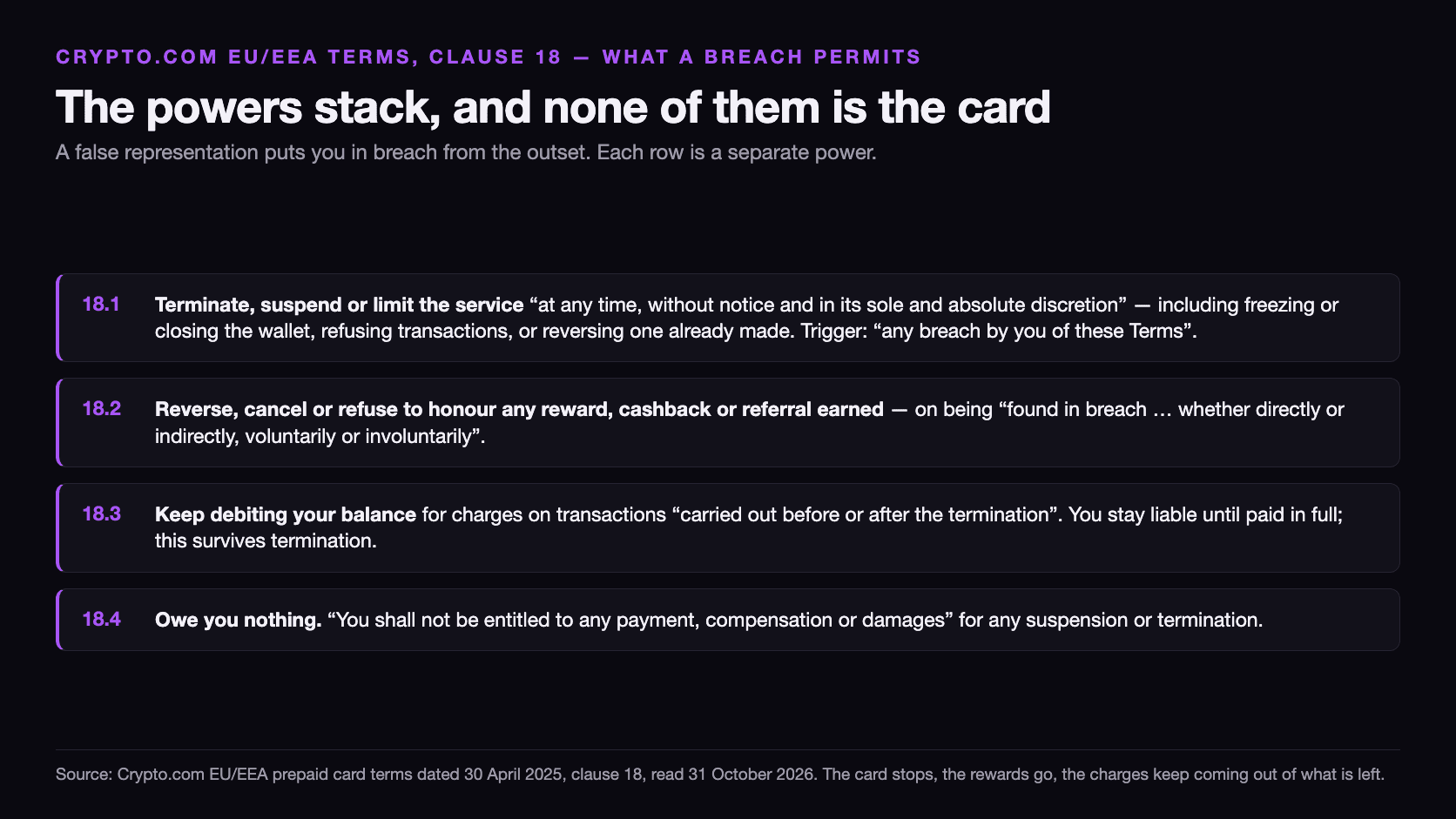
This is the part no competing page covers, and it is the part with a cost attached. A false representation puts you in breach from the outset, and the Crypto.com European terms set out what that permits in clause 18. Each row below is a separate power, and they stack.
| Clause | What the issuer may do | On what trigger |
|---|---|---|
| 18.1 | Terminate, suspend or limit the service “at any time, without notice and in its sole and absolute discretion”, including freezing or closing the wallet, refusing transactions, or reversing one already made | “any breach by you of these Terms” |
| 18.2 | Reverse, cancel or refuse to honour any reward, cashback or referral earned | “found in breach of any of these Terms, whether directly or indirectly, voluntarily or involuntarily” |
| 18.3 | Keep debiting your balance for charges on transactions “carried out before or after the termination”; you stay liable until paid in full | survives termination |
| 18.4 | Owe you nothing — “You shall not be entitled to any payment, compensation or damages” | any suspension or termination |
Note the sequence rather than any single clause. The card stops, the rewards you accrued go, the charges keep coming out of what is left, and there is no compensation for the sequence having happened. That is a materially worse outcome than being refused at sign-up, and it is the predictable result of a rule that is promised rather than checked. What it costs to get a frozen balance back out is a separate question, and we priced it in what it costs to close a crypto card.
Why a no-KYC card changes nothing here
The obvious inference from everything above is that a card with no identity check has no age rule either. It is wrong, and the documents say so plainly. No-KYC describes the verification, not the contract, and removing the first does not remove the second.
XKard's terms are the shortest in this set by a wide margin — a few hundred words, last updated 4 June 2025, operated by XHYPE FZCO in Dubai Silicon Oasis, stating that it is “not a card issuer” and that disputes go to the courts of Dubai. They publish no complaints procedure. They run a “Zero Data model”. And they still say: “You must be at least 18 years old to use the platform.” A document with room for almost nothing else found room for the age bar.
So the honest description of a no-KYC card is not that the age rule is absent but that it is unverified and still enforceable. The term binds; the check that would have caught a breach at the gate has been removed; and the enforcement therefore happens later, when there is a balance on the card and a reason to look. For an under-18 reader that is the worst available combination, because the easy sign-up and the eventual freeze are the same product feature seen at two different times. Our wider guide to the category covers the rest of that trade-off in how no-KYC crypto cards work.
What to check before you load a card
- Read your own region's document, not the marketing page. Crypto.com publishes a separate PDF per region and they do not agree with each other; four state an age and one does not.
- Find the onboarding or eligibility clause and check the verb. “Represent and warrant” means the risk is yours and the breach is retrospective.
- Check the date on the document. Two in this set predate 2026, and one is still marked a draft.
- Read the termination section before the fees section. That is where the cost of a breach lives — freeze powers, reward forfeiture, surviving liability, no compensation.
- Note the entity, not the brand. Four regions of one card are four different companies under four different regulators.
Check the terms before you load the card
Kardd reads what each programme publishes — issuer, regulator, fees, limits and the clauses behind them — so you can tell a card whose document will bear weight from one that is still marked a draft.
Kardd may earn a commission on sign-ups, including XKard. Affiliate disclosure.
Final take
The number is boring and the mechanism is not. Eighteen is the answer on every card in this market that gives one, so anyone arriving here to compare age limits between programmes will find there is nothing to compare. What there is to compare is how the rule is written, because that is what decides who carries the risk when it turns out to be untrue — and on eight of nine documents the answer is you, retrospectively, with the balance still on the card.
Which makes the eligibility clause a reading test for the rest of the agreement. A programme that states its age bar in a dated document under a named, regulated entity is a programme whose other clauses are probably worth reading too. A clause still carrying another country's legal concepts, a sentence missing its verb, or a header reading “Subject to Revision” tells you what standard of care went into the document you are about to be bound by. Check that before the cashback rate, because the cashback is a clause too, and clause 18.2 can take it back.
Sources
All read in full on 31 October 2026. Crypto.com EU/EEA prepaid card terms (cl. 2.1(c); cl. 18.1–18.4; Foris MT Limited C 90348; last update 30 April 2025), Australia (cl. 2.1(c); Foris GFS Australia Pty Ltd, AFSL 467462; 17 September 2025), Singapore (cl. 3.1(c); Foris Asia Pte. Ltd., UEN 201630381R; 7 January 2025), Brazil (cl. 2.1(c); 30 April 2025) and the US Prepaid Visa Cardholder Agreement (effective 1 September 2026; no age clause). Exodus Card EU+UK terms (§ 2 Eligibility; Baanx Group LTD, issuer Monavate Ltd, FCA 901097) and the Crypto Life “CL” Card US terms (Baanx US Corporation). XKard terms and conditions (XHYPE FZCO; last update 4 June 2025) and MoonPay US terms of use (§ 1(c); MoonPay USA LLC; effective 6 August 2026).
Not readable, and therefore not counted: Plutus's help domain was outside this run's network allowances; the Nexo and Wirex help centres served no terms text; KAST's support host returned HTTP 522; and Coinbase, Moon and Bitrefill refused the request at a bot wall, which we did not work around. Age figures for those programmes appear in third-party summaries only, so they are left out rather than repeated.
Related Articles
- Crypto Card KYC Rules 2026
- Crypto Card Issuers 2026
- Crypto Card Closure Fees 2026
- Crypto Card Complaints 2026
- Crypto Card Data Retention 2026
- No-KYC Crypto Cards: The Full Guide
Frequently Asked Questions
What is the minimum age for a crypto card in 2026?
Eighteen, in every document we read that states an age at all. Crypto.com's European, Australian, Singaporean and Brazilian card terms each put it in the same place — a list of things you represent and warrant at sign-up. Exodus and Ledger's CL Card share one sentence from their common programme manager, Baanx. XKard states it in a single line. The exception is Crypto.com's US agreement, which sets no age at all.
Can you get a crypto card under 18?
Not without breaching the agreement you accept at sign-up. The clause is not a filter applied to you; it is a statement you make about yourself, which is why a card can be issued and working and still be in breach from day one. On the Crypto.com European terms the consequence is clause 18: freeze or close the wallet without notice, cancel accrued cashback and referral rewards, keep debiting the balance for charges after termination, and owe no compensation for any of it.
Do no-KYC crypto cards have an age requirement?
Yes. No-KYC describes the identity check, not the contract. XKard's terms run to a few hundred words, name no complaints procedure and send disputes to the courts of Dubai — and they still say “You must be at least 18 years old to use the platform.” What a no-KYC programme removes is the document check that would have tested the claim, which leaves the age term enforceable but unverified.
Is the Crypto.com card age limit 18 or 21?
Eighteen, in all four jurisdiction documents that state a figure: the EU terms at 2.1(c), Australia at 2.1(c), Singapore at 3.1(c) and Brazil at 2.1(c). The widely repeated “21 in most jurisdictions” claim does not appear in any document we read. The US Prepaid Visa Cardholder Agreement states no age requirement anywhere in roughly 13,800 words.
What happens if you lie about your age to get a crypto card?
You have given an untrue representation, so you are in breach from the outset rather than from the day someone notices. Clause 18.1 of the Crypto.com European terms permits termination, suspension or limitation “at any time, without notice and in its sole and absolute discretion”, including freezing the wallet and reversing transactions, on “any breach”. Clause 18.4 removes any entitlement to payment, compensation or damages for it.
Does the age of majority matter instead of 18?
On two cards it is written in as an alternative limb. Exodus and the CL Card both read “at least 18 years of age (or the age of majority in your state of residence)” — US drafting, where the age of majority is 18 in most states and 19 or 21 in a few. The phrase survives unchanged in the Exodus EU and UK document, where a “state of residence” has no equivalent, because that document is the US one with its residency sentence edited.
Which crypto card document should you check before signing up?
Your own region's cardholder agreement, not the marketing page, because one brand can publish five documents that do not agree. Check four things: the date on it, the entity named as issuer, whether an age is stated at all, and the termination section, which is where the cost of a breach is set. Crypto.com publishes a separate PDF per region; Baanx programmes publish one per territory and reuse the wording between them.