- The brand on your card is never the respondent. The rulings name FORISGFS UK Limited, Foris DAX MT Limited, Optimus Cards UK Limited and Wirex Limited.
- Your issuer has 15 days, not eight weeks. The UK ombudsman allows 8 weeks on most complaints but only 15 days on payment services, e-money and scams — where a crypto card sits.
- Two of six UK card complaints were upheld; none of four in Malta. The awards were £200 and £250 plus 8% simple interest, both for a block that ran too long rather than for the block.
- The same complaint got opposite answers four months apart. An underpaid promotion was heard on the merits in the UK (DRN-6054093) and dismissed for want of competence in Malta (ASF 224/2024).
- Your coins are valued on the day you lost them, never today. One decision refused interest on cryptoassets as “not money”; another refunded at the date-of-loss rate.
On this page
- The brand on the card is never the respondent
- The clock nobody in this market prints
- Eight published UK decisions about crypto cards
- Eleven decisions against Crypto.com in Malta
- The same complaint, two answers
- What your crypto is worth when they value it
- Australia prints the route on the product
- In the US it is a database and an arbitration clause
- Where there is no route at all
- How to complain so the complaint survives
- Final take
- Sources
- FAQ
Your card stops working and support stops answering, and the next step is the thing nobody in this market has written down. Crypto card complaints have an escalation ladder, free at every rung, and the published guidance is too generic to use: complain to the firm, then the ombudsman, without saying which firm, which ombudsman, or what either has decided. So on 29 October 2026 we read nineteen published rulings — eight from the UK Financial Ombudsman Service and eleven against Crypto.com's Maltese entities — plus the complaint clauses in nine programmes' own terms. The clocks are shorter than anyone prints, and the outcomes are narrow in a useful way.

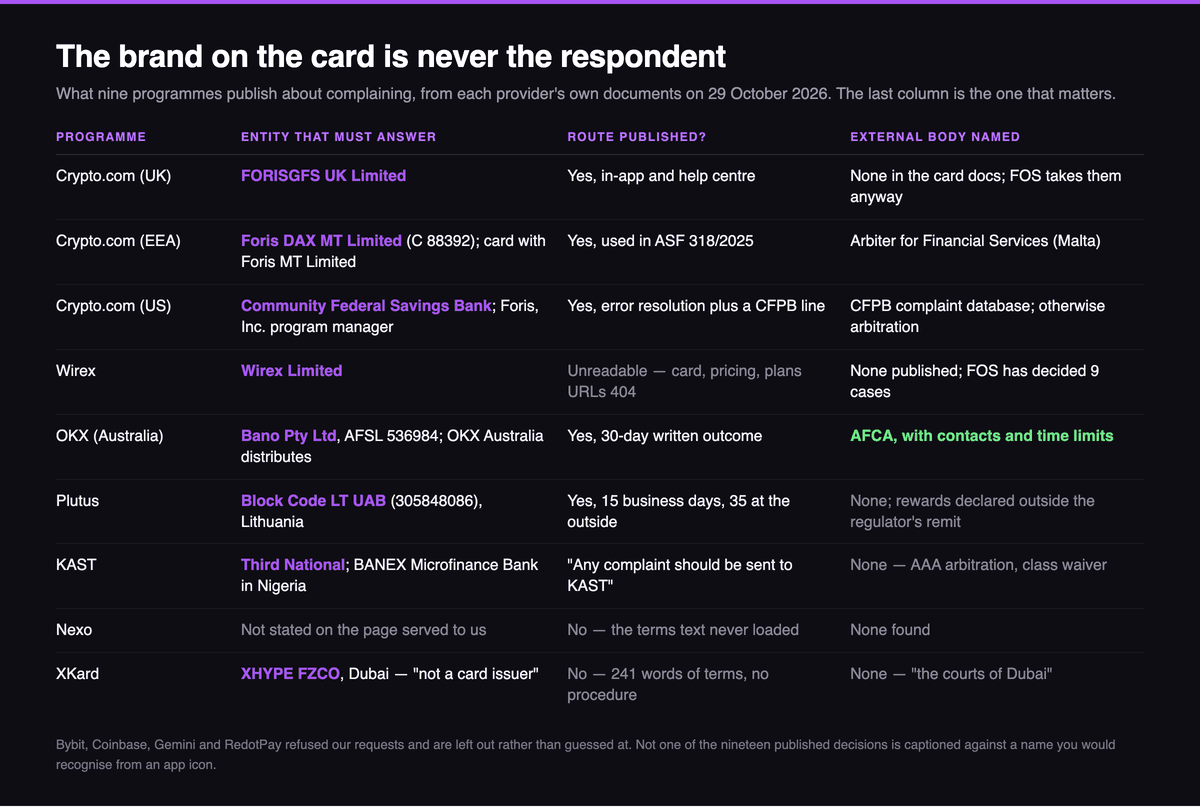
The brand on the card is never the respondent
Not one of the nineteen decisions is captioned against a name you would recognise from an app icon. They name FORISGFS UK Limited trading as Crypto.com, Foris DAX MT Limited, Foris MT Limited, Wirex Limited and Optimus Cards UK Limited, the firm behind the Uphold card. The entity you contracted with is the one that has to answer, so identifying it is step one of a complaint — see who actually issues your crypto card.
Here is what nine programmes publish about complaining. The last column is the one that matters: an external body, named by the provider, that will look at the complaint after the provider says no.
| Programme | Entity that must answer | Route published? | External body named |
|---|---|---|---|
| Crypto.com (UK) | FORISGFS UK Limited | Yes, in-app and help centre | None in the card docs; FOS takes them anyway |
| Crypto.com (EEA) | Foris DAX MT Limited (C 88392); card with Foris MT Limited | Yes — used in ASF 318/2025 | Arbiter for Financial Services (Malta) |
| Crypto.com (US) | Community Federal Savings Bank; Foris, Inc. program manager | Yes, error resolution plus a CFPB line | CFPB complaint database; otherwise arbitration |
| Wirex | Wirex Limited | Unreadable — card, pricing, plans URLs 404 | None published; FOS has decided 9 cases |
| OKX (Australia) | Bano Pty Ltd, AFSL 536984; OKX Australia distributes | Yes — 30-day written outcome | AFCA, with contacts and time limits |
| Plutus | Block Code LT UAB (305848086), Lithuania | Yes — 15 business days, 35 at the outside | None; rewards declared outside the regulator's remit |
| KAST | Third National; BANEX Microfinance Bank in Nigeria | “Any complaint should be sent to KAST” | None — AAA arbitration, class waiver |
| Nexo | Not stated on the page served to us | No — the terms text never loaded | None found |
| XKard | XHYPE FZCO, Dubai — “not a card issuer” | No — 241 words of terms, no procedure | None — “the courts of Dubai” |
From each provider's own documents, 29 October 2026. Bybit, Coinbase, Gemini and RedotPay refused our requests and are left out rather than guessed at.
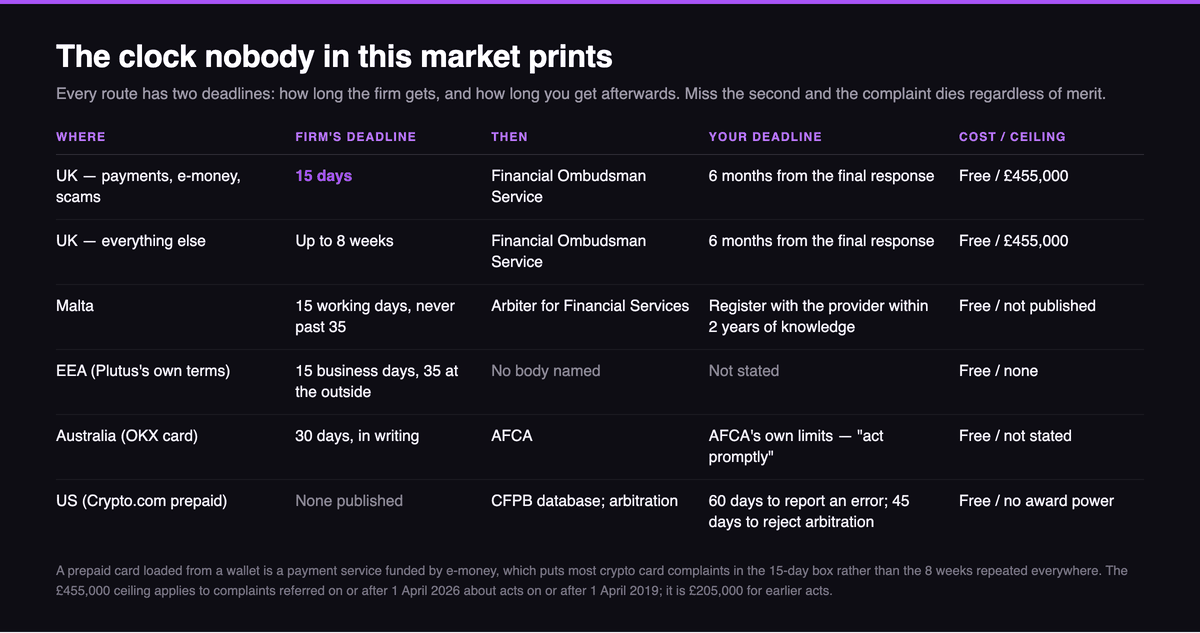
The clock nobody in this market prints
Every route has two deadlines: how long the firm gets, and how long you get afterwards. Miss the second and the complaint dies regardless of merit. The UK figure repeated everywhere is eight weeks, and for a crypto card it is the wrong one.
The Financial Ombudsman Service is explicit: a business has up to 8 weeks on most complaints, but on fraud and scams, payment services and electronic money it has only 15 days. A prepaid card loaded from a wallet is a payment service funded by e-money, which puts most crypto card complaints in the 15-day box. You then have 6 months from the final response to refer it, and must have complained to the firm within 6 years of the problem or 3 years of realising you had cause.
| Where | Firm's deadline | Then | Your deadline | Cost / ceiling |
|---|---|---|---|---|
| UK — payments, e-money, scams | 15 days | Financial Ombudsman Service | 6 months from the final response | Free / £455,000 |
| UK — everything else | Up to 8 weeks | Financial Ombudsman Service | 6 months from the final response | Free / £455,000 |
| Malta | 15 working days, never past 35 | Arbiter for Financial Services | Register with the provider within 2 years of knowledge | Free / not published |
| EEA (Plutus's own terms) | 15 business days, 35 at the outside | No body named | Not stated | Free / none |
| Australia (OKX card) | 30 days, in writing | AFCA | AFCA's own limits — “act promptly” | Free / not stated |
| US (Crypto.com prepaid) | None published | CFPB database; arbitration | 60 days to report an error; 45 days to reject arbitration | Free / no award power |
The £455,000 ceiling applies to complaints referred on or after 1 April 2026 about acts on or after 1 April 2019; it is £205,000 for earlier acts. Nothing in nineteen decisions came within three orders of magnitude of either.
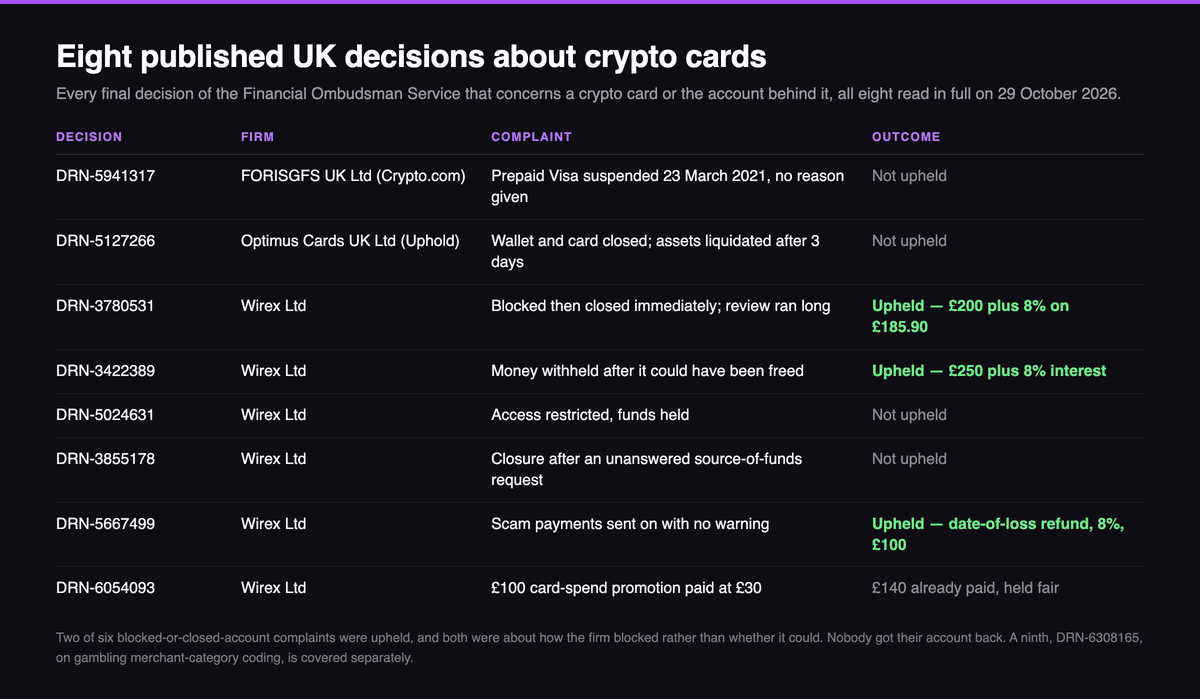
Eight published UK decisions about crypto cards
The service publishes its final decisions in full, which makes it the only place you can read what an independent body did with a crypto card complaint. Eight concern the card or the account behind it: six about a block or closure, one a scam, one a promotion.
| Decision | Firm | Complaint | Outcome |
|---|---|---|---|
| DRN-5941317 | FORISGFS UK Ltd (Crypto.com) | Prepaid Visa suspended 23 March 2021, no reason given | Not upheld |
| DRN-5127266 | Optimus Cards UK Ltd (Uphold) | Wallet and card closed; assets liquidated after 3 days | Not upheld |
| DRN-3780531 | Wirex Ltd | Blocked then closed immediately; review ran long | Upheld — £200 plus 8% on £185.90 |
| DRN-3422389 | Wirex Ltd | Money withheld after it could have been freed | Upheld — £250 plus 8% interest |
| DRN-5024631 | Wirex Ltd | Access restricted, funds held | Not upheld |
| DRN-3855178 | Wirex Ltd | Closure after an unanswered source-of-funds request | Not upheld |
| DRN-5667499 | Wirex Ltd | Scam payments sent on with no warning | Upheld — date-of-loss refund, 8%, £100 |
| DRN-6054093 | Wirex Ltd | £100 card-spend promotion paid at £30 | £140 already paid, held fair |
All eight read in full, 29 October 2026. A ninth, DRN-6308165, on gambling merchant-category coding, is covered in our blocked merchants guide.
Read the pattern, not the scores. Both wins were about how the firm blocked the account, never whether it could: in DRN-3780531 the ombudsman accepted Wirex was entitled to block and close, but found the review took “perhaps, a few weeks more than it should have”. That is what £200 buys, and nobody got their account back.
DRN-5941317 is the most instructive. The card was suspended in March 2021, the complaint raised in August 2024, and the decision asked the cardholder to accept or reject by 19 February 2026. It was not upheld: the service may take evidence in confidence, and “the evidence provided by Crypto.com in confidence demonstrates a clear and legitimate reason” he was never allowed to see. On timing it is blunt — “reviews of this nature do not have a prescriptive timeframe”.
Jurisdiction sinks more of these complaints than the merits do, and DRN-5127266 has the clearest statement of the test: “although cryptocurrency itself isn't regulated, this service can consider complaints involving cryptocurrency where it is ancillary to another regulated activity.” The Uphold account held fiat, e-money and crypto on one platform, so closing it was ancillary to e-money services.
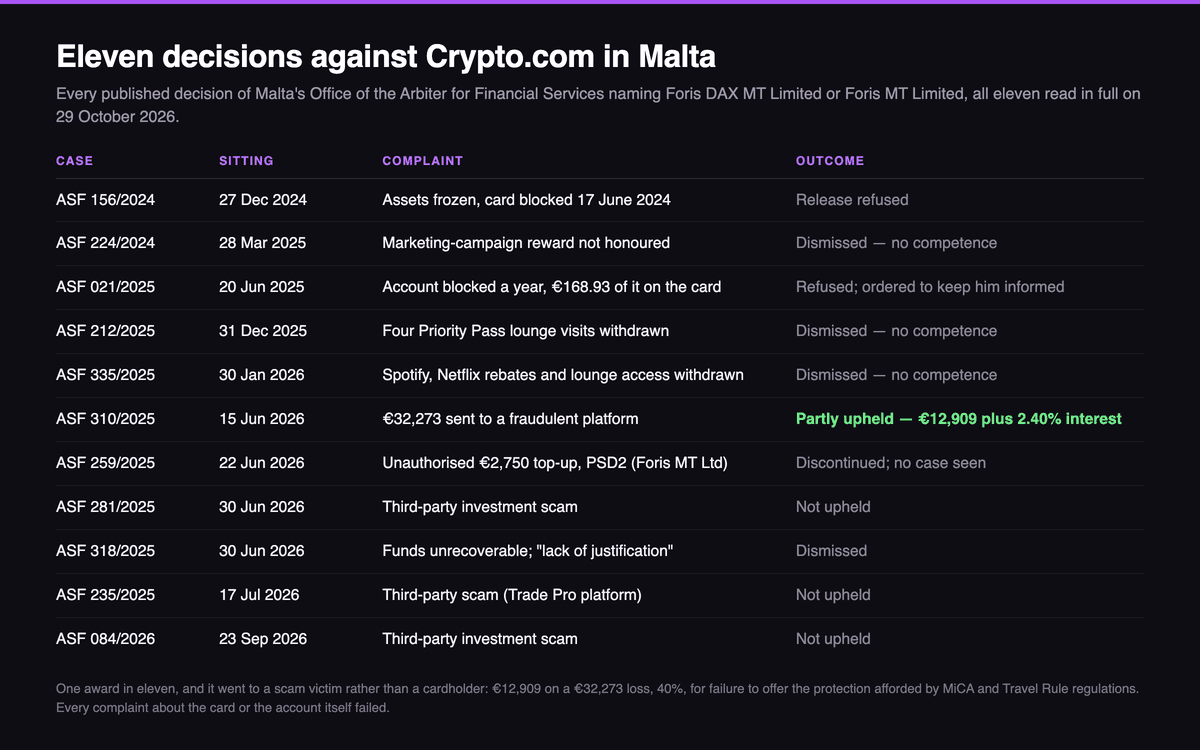
Eleven decisions against Crypto.com in Malta
Crypto.com's European arm is Maltese, so EEA cardholders escalate to Malta's Office of the Arbiter for Financial Services, which also publishes in full. Eleven decisions name Foris DAX MT Limited or Foris MT Limited — the largest public record of decided complaints against any crypto card operator, and as far as we can tell nobody has collected it.
| Case | Sitting | Complaint | Outcome |
|---|---|---|---|
| ASF 156/2024 | 27 Dec 2024 | Assets frozen, card blocked 17 June 2024 | Release refused |
| ASF 224/2024 | 28 Mar 2025 | Marketing-campaign reward not honoured | Dismissed — no competence |
| ASF 021/2025 | 20 Jun 2025 | Account blocked a year, €168.93 of it on the card | Refused; ordered to keep him informed |
| ASF 212/2025 | 31 Dec 2025 | Four Priority Pass lounge visits withdrawn | Dismissed — no competence |
| ASF 335/2025 | 30 Jan 2026 | Spotify, Netflix rebates and lounge access withdrawn | Dismissed — no competence |
| ASF 310/2025 | 15 Jun 2026 | €32,273 sent to a fraudulent platform | Partly upheld — €12,909 plus 2.40% interest |
| ASF 259/2025 | 22 Jun 2026 | Unauthorised €2,750 top-up, PSD2 (Foris MT Ltd) | Discontinued; no case seen |
| ASF 281/2025 | 30 Jun 2026 | Third-party investment scam | Not upheld |
| ASF 318/2025 | 30 Jun 2026 | Funds unrecoverable; “lack of justification” | Dismissed |
| ASF 235/2025 | 17 Jul 2026 | Third-party scam (Trade Pro platform) | Not upheld |
| ASF 084/2026 | 23 Sep 2026 | Third-party investment scam | Not upheld |
All eleven read in full, 29 October 2026. A twelfth, ASF 328/2025, is cited in the dismissals above but was not read for this article.
One award in eleven, and it went to a scam victim rather than a cardholder: ASF 310/2025 ordered €12,909, 40% of a €32,273 loss, for “failure to offer Complainant the protection afforded by MiCA and Travel Rule regulations”, the rest resting on contributory negligence, and sent the decision to the MFSA. Every complaint about the card or account itself failed. ASF 021/2025 carries the reasoning to know: because the conduct complained of “is very specific to the Complainant and has no general application to the great majority of clients”, it did not follow that the provider was “acting capriciously, unethically or illegally”. That cardholder had fourteen asset lines frozen, €1,766.98 in a cash wallet and €168.93 on the card, and won an order that he be kept “regularly informed, within the limits allowed by law”.
Two scope rules before filing in Malta: the provider must be licensed by the Malta Financial Services Authority, and the complaint must be in Maltese or English. The decision is then “legally binding on the parties”, subject only to appeal within 20 days.
The same complaint, two answers
Put two rulings side by side and the map stops being abstract. Both are complaints that a card promotion paid less than promised, decided within four months of each other, and they came out opposite ways for a reason that has nothing to do with either complainant.
In Malta, ASF 224/2024 concerned a reward that fell due on 19 October 2024 and was paid as 4,800 CRO at a later price, which the provider called an exception on the basis that nothing was owed. The Arbiter accepted its argument that he had “no competence to adjudge a matter concerning marketing terms and conditions not related to any financial service or products” and dismissed it unheard; ASF 212/2025 and ASF 335/2025 followed it — the thread our crypto card perks audit picks up.
In the UK, DRN-6054093 concerned a £100 reward for 20 card transactions that paid £30. Wirex argued the promotion belonged to Wirex Digital Services s.r.l rather than Wirex Limited, and pointed at a clause disclaiming liability to participants. The ombudsman took jurisdiction anyway — “Wirex offered the promotion to its UK customers as part of opening up a Wirex UK account” — read the four reward tiers, found 16 qualifying transactions when the promotion was pulled early and so £70 due, and held the £140 already paid to be fair. He did not win the full amount; he got a hearing, and £40 of it for the inconvenience of chasing it.
What your crypto is worth when they value it
Every blocked-account complaint arrives with the same hope attached: the coins were worth more while they were frozen. Two decisions answer it, in the same direction.
In DRN-3780531 the complainant said the restrictions stopped her selling at a peak. The ombudsman awarded 8% simple interest on the £185.90 of fiat returned and refused interest on the cryptoassets, because “these assets were not money, nor were they converted into money. These are speculative assets — their value fluctuates.” In DRN-5667499, where the complaint was upheld, the refund was ordered as “the equivalent in pounds of the cryptocurrency sent, with the exchange calculated on the day of the loss (not based on the value of the cryptocurrency today)”.
Australia prints the route on the product
One programme in nine puts the whole ladder on the product page, and it is not one of the big brands. OKX's Australian card ships a Product Disclosure Statement naming the issuer (Bano Pty Ltd, ABN 93 643 260 431, AFSL 536984) and distributor (OKX Australia Pty Ltd), giving a complaints email and phone number, undertaking a “written response providing the final outcome no later than 30 days”, and naming the external body: the Australian Financial Complaints Authority, with website, email, free phone line and postal address, plus a warning that “time limits may apply”.
It is candid about what you are not getting, too: the issuer “is not currently a subscriber to the voluntary ePayments Code”, the card is not a deposit account and carries no depositor protection, and your contractual relationship is with the issuer, not OKX. Each of those the other eight leave you to work out.
In the US it is a database and an arbitration clause
The US picture differs in kind. Crypto.com's US prepaid agreement names Community Federal Savings Bank as issuer and Foris, Inc. as program manager, gives you 60 days from first access or statement to report an error, and carries the disclosure every prepaid card must: “If you have a complaint about a prepaid account, call the Consumer Financial Protection Bureau at 1-855-411-2372 or visit cfpb.gov/complaint.”
That is a database, not an adjudicator: it forwards your complaint and publishes the firm's response, and cannot order a refund. Filling the gap is Section 31, which mentions arbitration 65 times, with a class-action waiver, JAMS or the AAA as administrator, and one way out — a signed rejection sent “by certified mail, return receipt requested” and received within 45 days after the date you receive the first Card. Almost nobody does that in their first 45 days, which is the point of the window. For a disputed transaction rather than conduct, our chargebacks guide has the Regulation E deadlines.
Where there is no route at all
Three programmes have no external body at all, and they fail in three different ways. KAST's non-US cardholder agreement names Third National as issuer, says “any complaint should be sent to KAST”, then routes every dispute into binding individual arbitration under the American Arbitration Association's Commercial Arbitration Rules, with a class waiver and no jury trial. For Nigerian users it adds BANEX Microfinance Bank Limited, licensed by the Central Bank of Nigeria. So a non-US cardholder contracts with a US issuer and arbitrates under US rules.
Plutus does the opposite and says so plainly. Its complaints clause is one of the better ones — free of charge, a documented response inside 15 business days and never past 35 — and it then states that complaints about its rewards system “and other crypto-asset-related matters are not generally within the remit of financial regulators such as the Bank of Lithuania”. Disclosed, which is more than Malta's cardholders had before they filed.
XKard is the shortest answer in the set: 241 words of terms, last updated 4 June 2025, stating that the operator is XHYPE FZCO of Dubai Silicon Oasis, that “we are not a card issuer”, and that disputes go to “the courts of Dubai” under UAE law. No procedure, no deadline, no named issuer, no ombudsman. Nexo fails differently: its terms page never served its own text, so we cannot report a clause either way.
How to complain so the complaint survives
Nineteen decisions is enough to see what separates a complaint that gets decided from one that gets forgotten. None of this is legal advice.
- Name the right company — the entity in your cardholder agreement, not the app name.
- Use the word “complaint”, in writing. A support ticket does not start the clock; ASF 318/2025 turned on having gone through the internal procedure to a final response.
- Frame it around the regulated part — the card, the e-money balance, the payment, the closure. The coins are the part that falls outside jurisdiction.
- Diarise the deadline: 15 days in the UK for payments and e-money, 15 working days in Malta, 30 days on the OKX Australian card. When it passes with no final response, escalate anyway.
- Escalate inside 6 months of the final response in the UK; register in Malta within 2 years of learning what happened.
- Ask for what these decisions award: release of the fiat, 8% simple interest for the period you were kept out of it, and a sum for distress and inconvenience.
- Export everything first. Statements, your tier, the promotion terms, every dated reply. Several cases turned on what the firm could evidence and the complainant could not.
Check the route before you load the card
Kardd reads what each programme publishes — issuer, regulator, fees, limits and the clauses behind them — so you can tell a card with an ombudsman behind it from one with a court in another country.
Kardd may earn a commission on sign-ups, including XKard. Affiliate disclosure.
Final take
The ladder exists and is worth climbing, but read the nineteen rulings for what they are. A free, independent body will hear you if your issuer is authorised somewhere that runs one — and on the published record it usually finds the firm was entitled to block, close and decline to explain, paying a few hundred pounds when it took too long about it.
Which makes the route a selection criterion rather than a safety net. A named external body in the terms, like AFCA on the OKX Australian card, tells you the firm expects to answer to somebody. Binding arbitration with a class waiver, a rewards programme disclosed as outside the regulator's remit, or 241 words ending at the courts of Dubai tell you the opposite. Check that column before you put a balance on the card, because the complaint you cannot make is the cheapest one for everybody but you.
Sources
All read on 29 October 2026. Financial Ombudsman Service, “How to complain” (8 weeks, 15 days for payments, e-money and scams; 6 months; free), “Time limits” (6 and 3 years) and “Compensation” (£455,000 / £205,000); decisions DRN-5941317, DRN-5127266, DRN-3780531, DRN-3422389, DRN-5024631, DRN-3855178, DRN-5667499 and DRN-6054093. Arbiter for Financial Services, step 1 (15 working days, 35 maximum, 2 years from knowledge) and step 3 (free; MFSA-licensed providers only); decisions ASF 224/2024, ASF 021/2025 and ASF 310/2025, with ASF 156/2024, 212/2025, 235/2025, 259/2025, 281/2025, 318/2025, 335/2025 and 084/2026 from the same decisions register. Provider documents: Crypto.com Prepaid Visa Cardholder Agreement, OKX Card Product Disclosure Statement, Plutus terms and conditions, KAST Cardholder Agreement and XKard terms and conditions. Nexo served no terms text; Wirex's card, pricing and plans URLs returned 404; Bybit, Coinbase, Gemini and RedotPay refused the request.
Related Articles
- Crypto Card Issuers 2026
- Crypto Card Chargebacks 2026
- Crypto Card Shutdowns 2026
- Crypto Card Lost or Stolen 2026
- Crypto Card Perks 2026
- Crypto Card Balance Protection 2026
Frequently Asked Questions
Can I take a crypto card complaint to the Financial Ombudsman Service?
Yes, if the entity that ran your card is UK-authorised: there are published decisions against FORISGFS UK Limited, Wirex Limited and Optimus Cards UK Limited. Crypto itself is unregulated, but per DRN-5127266 the service hears complaints involving it “where it is ancillary to another regulated activity”.
How long does a crypto card issuer have to answer my complaint?
In the UK, 8 weeks for most complaints but only 15 days for payment services, e-money and scams — where a crypto card complaint sits. Malta allows 15 working days, never more than 35; Plutus publishes the same; OKX promises 30 days on its Australian card. Crypto.com's US agreement publishes none.
How much can an ombudsman award over a crypto card?
The UK ceiling is £455,000 for complaints referred on or after 1 April 2026 about acts on or after 1 April 2019, and £205,000 for earlier acts. Real awards are nowhere near it: the largest of eight were £250 and £200 plus 8% interest, and Malta's largest of eleven was €12,909, in a scam case.
Who do I complain about if the brand and the issuer differ?
The regulated entity. The rulings name FORISGFS UK Limited, Foris DAX MT Limited, Optimus Cards UK Limited and Wirex Limited; the terms name Community Federal Savings Bank, Bano Pty Ltd and Third National. Complain to whichever your cardholder agreement names.
Will an ombudsman get my frozen crypto card funds released?
Usually not. Two of six UK blocked-account complaints were upheld, both over the speed rather than the block, and all four Maltese ones failed. In ASF 021/2025 the Arbiter refused release but ordered the provider to keep the complainant “regularly informed”.
Will they compensate me for the crypto price I missed?
No. DRN-3780531 awarded 8% interest on the fiat and refused it on the cryptoassets, which were “not money” but “speculative assets”. DRN-5667499 refunded at the sterling equivalent on the day of the loss, “not based on the value of the cryptocurrency today”.
What if my provider is not regulated anywhere I can complain?
Then it is a court, and you want to know that before you load the card. XKard's 241 words of terms name no procedure and send disputes to the courts of Dubai; KAST routes them into binding AAA arbitration with a class waiver; Plutus says its rewards sit outside the Bank of Lithuania's remit.