No-KYC Crypto Card ID Checks 2026: Nobody Says Never

- Eight of ten documents reserve a later ID request. KAST's say information “might be requested continually”; UPay's list ends “(f) for any other reasons”.
- The two that do not reserve it say nothing at all. XKard's seven-section terms and Karta's carry no verification clause, so none of the ten rules a request out.
- The exit is gated by the same check. Bitsika may hold funds up to 180 days and limit access “until verification is completed”; BingCard requires ID “during the withdrawal process”.
- A tier is a timer, not an exemption. SolCard publishes $10,000/month unverified and “KYC + liveness” for Platinum; RedotPay calls verification “mandatory for all”.
- Already verified is not finished. RedotPay documents re-verification by ID photos plus a new video selfie, spoken aloud; silent videos are rejected.
You signed up with an email address and a wallet, and nine months later the app wants a passport. The fear that a no-KYC crypto card will demand ID later is the commonest objection to the whole category, and every page ranking for it answers with an opinion — that no-KYC is “usually temporary”, that freezes come first and explanations later. Nobody reads the contract. So on 28 November 2026 we went looking for the cardholder terms of twelve programmes, read the ten we could, and found the answer already written down.
Of the ten documents we could read, eight expressly reserve the right to ask for more information after you are already a customer. The other two say nothing about identity verification at all — which is not a promise, but a clause living in an issuer agreement you were never shown. And the finding that costs money is not about access: in six of the ten, the route your balance takes out is gated by the same verification you avoided on the way in. That is what decides whether a no-KYC crypto card ID verification request is an annoyance or a loss.
- What ten cardholder agreements actually reserve
- Why the request arrives after you are already a customer
- The seven triggers the documents name
- The exit is gated by the same check
- A no-KYC tier is a deferred ID check, not an exemption
- The documents that say nothing
- What being unverified costs you besides access
- What to do before you load, and when the request lands
- Final take
- Sources
- Related articles
- FAQ
What ten cardholder agreements actually reserve about no-KYC crypto card ID checks
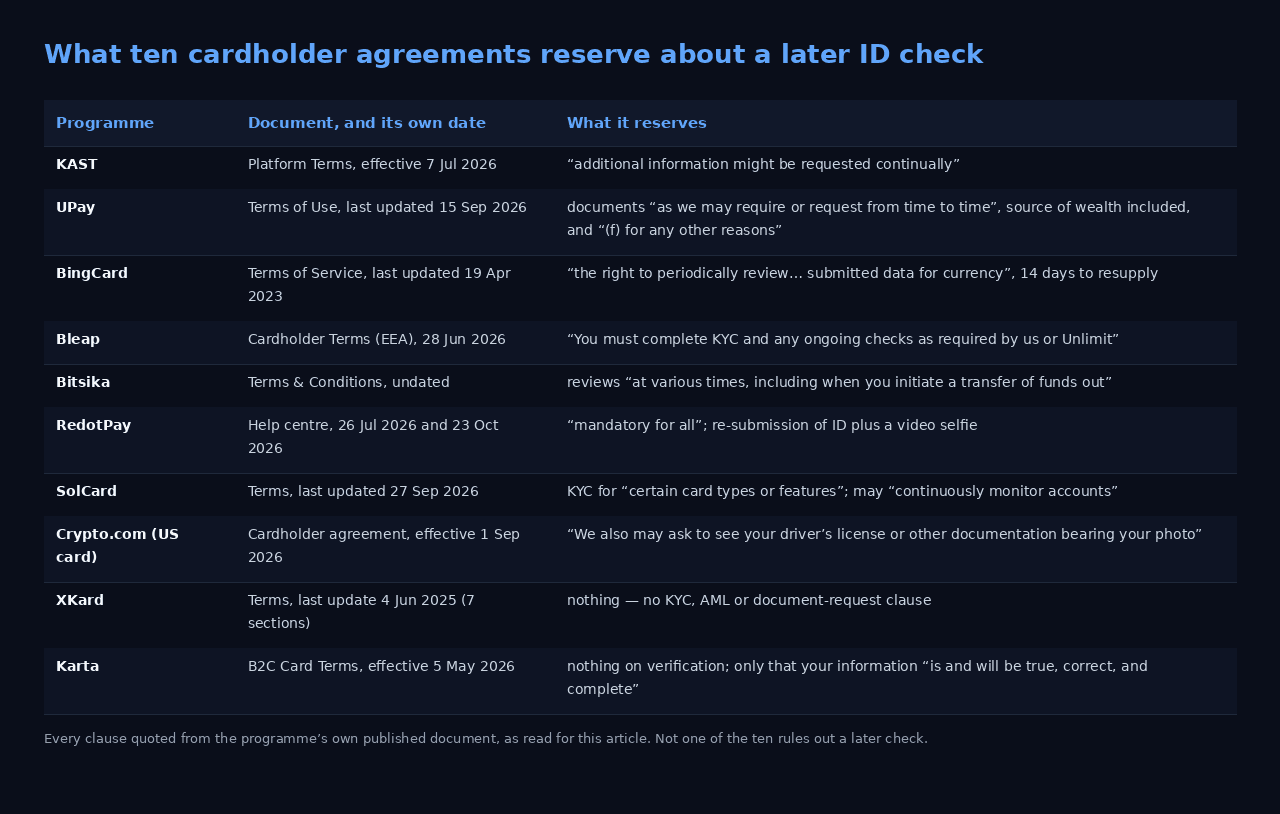
This is the table the market does not publish. Each row is a programme's own live document, and the quoted words are the operative ones — the clause a support agent points at when the request arrives.
| Programme | Document, and its own date | What it reserves | What it says happens |
|---|---|---|---|
| KAST | Platform Terms, effective 7 Jul 2026 | “additional information might be requested continually” | “restricted access… or termination”; may “freeze part or all assets in any Custodian Wallet” |
| UPay | Terms of Use, last updated 15 Sep 2026 | documents “as we may require or request from time to time”, source of wealth included, and “(f) for any other reasons” | “we may suspend or close your UPay Account”; suspension includes “freezing and locking funds” |
| BingCard | Terms of Service, last updated 19 Apr 2023 | “the right to periodically review… submitted data for currency”, 14 days to resupply | may “revoke the Account Verification and apply the restrictions”; lockdown “without prior notification” |
| Bleap | Cardholder Terms (EEA), 28 Jun 2026 | “You must complete KYC and any ongoing checks as required by us or Unlimit” | suspension or termination for “failure to complete checks” |
| Bitsika | Terms & Conditions, undated | reviews “at various times, including when you initiate a transfer of funds out” | “limit your account and your access to funds in it until verification is completed” |
| RedotPay | Help centre, 26 Jul 2026 and 23 Oct 2026 | “mandatory for all”; “we may occasionally request additional documentation”; re-submission of ID plus a video selfie | not stated — the procedure is published, the consequence is not |
| SolCard | Terms, last updated 27 Sep 2026 | KYC for “certain card types or features”; may “continuously monitor accounts” | “suspend, restrict, or terminate… with or without prior notice”, and may “forfeit any remaining balance” |
| Crypto.com (US card) | Cardholder agreement, effective 1 Sep 2026 | “We also may ask to see your driver's license or other documentation bearing your photo” | “If you fail to provide accurate information that we request, we may cancel your Card” |
| XKard | Terms, last update 4 Jun 2025 (7 sections) | nothing — no KYC, AML or document-request clause | nothing stated; section 2 binds you to the issuing providers' unpublished terms |
| Karta | B2C Card Terms, effective 5 May 2026 | nothing on verification; only that your information “is and will be true, correct, and complete” | may “block and terminate transactions and suspend access to your Account” |
Two more programmes are missing from the table. Goblin Card publishes no reachable cardholder document: goblincard.com serves a 1.8 KB client-rendered shell, and eleven obvious paths — /terms, /legal, /aml and eight more — all returned HTTP 404 on 28 November 2026. Laso Finance's user agreement renders no text without a browser. Neither absence is evidence of a generous policy.
Why the request arrives after you are already a customer
The commentary treats a later ID request as a betrayal — a company that promised privacy and reneged. The documents treat it as routine, because the duty driving it was never a one-off gate.
In the UK, regulation 28(11) of the Money Laundering Regulations 2017 requires a regulated firm to conduct “ongoing monitoring of a business relationship”, and spells out two limbs: “scrutiny of transactions undertaken throughout the course of the relationship” and “keeping the documents or information obtained for the purpose of applying customer due diligence measures up-to-date”. The page carrying that text is current to 26 November 2026. Read it as the mechanism behind BingCard's 14-day resupply window and RedotPay's re-submission flow: a firm that must keep your file current has to ask you for things, on a schedule you do not control.
Most no-KYC brands are not themselves UK or EEA regulated, which is why their terms read the way they do. KAST's wording is “the Company and Partners”; Bleap's is “as required by us or Unlimit” — Unlimit EU Ltd being the Cyprus-licensed e-money institution that issues the card. The duty sits with the licensed entity behind the BIN and reaches you through the brand's own terms. Who that entity is, and why you so often cannot find out, is the subject of our crypto card issuers breakdown.
The seven triggers the documents name
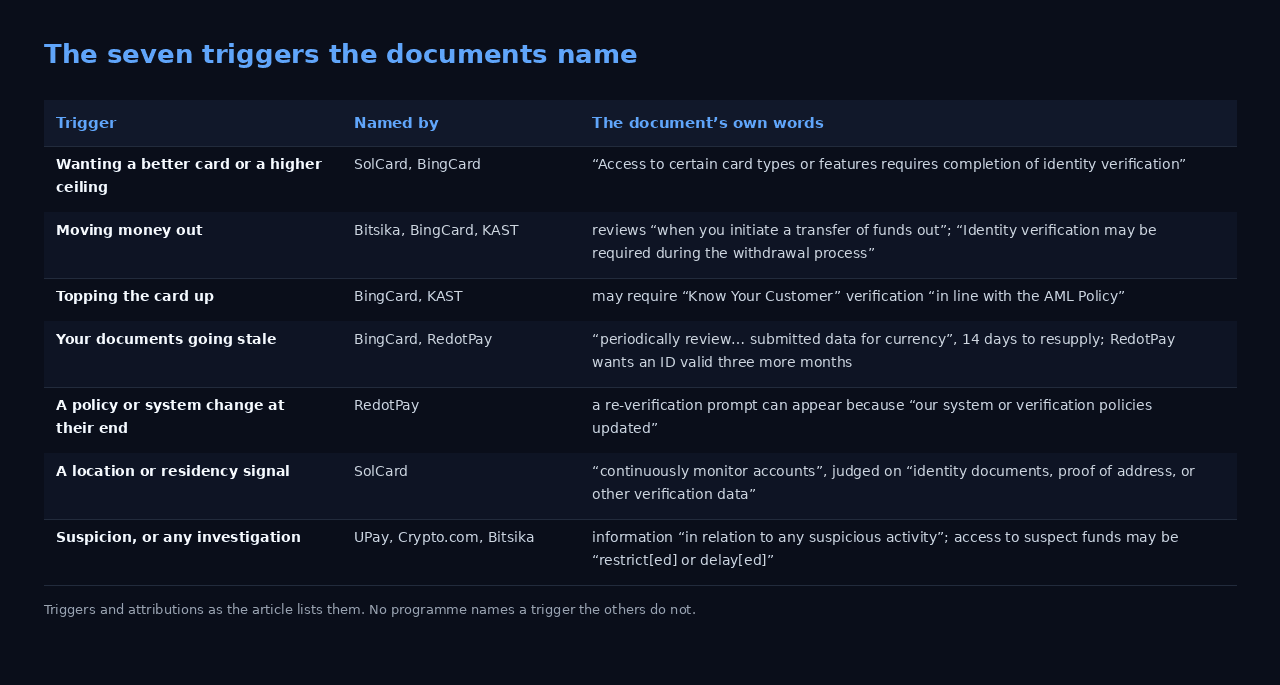
Nobody enumerates these, so people assume the request is random. It is not. Across the ten documents, the same seven events recur, and five of them are things you do rather than things that happen to you.
| Trigger | Named by | The document's own words |
|---|---|---|
| Wanting a better card or a higher ceiling | SolCard, BingCard | “Access to certain card types or features requires completion of identity verification” |
| Moving money out | Bitsika, BingCard, KAST | reviews “when you initiate a transfer of funds out”; “Identity verification may be required during the withdrawal process” |
| Topping the card up | BingCard, KAST | may require “Know Your Customer” verification “in line with the AML Policy”; top-ups refused where checks are “not satisfactorily completed” |
| Your documents going stale | BingCard, RedotPay | “periodically review… submitted data for currency”, 14 days to resupply; RedotPay wants an ID valid three more months |
| A policy or system change at their end | RedotPay | a re-verification prompt can appear because “our system or verification policies updated” |
| A location or residency signal | SolCard | “continuously monitor accounts”, judged on “identity documents, proof of address, or other verification data” |
| Suspicion, or any investigation | UPay, Crypto.com, Bitsika | information “in relation to any suspicious activity”; access to suspect funds may be “restrict[ed] or delay[ed]” |
Read that as a schedule rather than a risk register. The two moments most likely to produce a request are a withdrawal and a top-up — the two moments when you have the most money in play.
The exit is gated by the same check
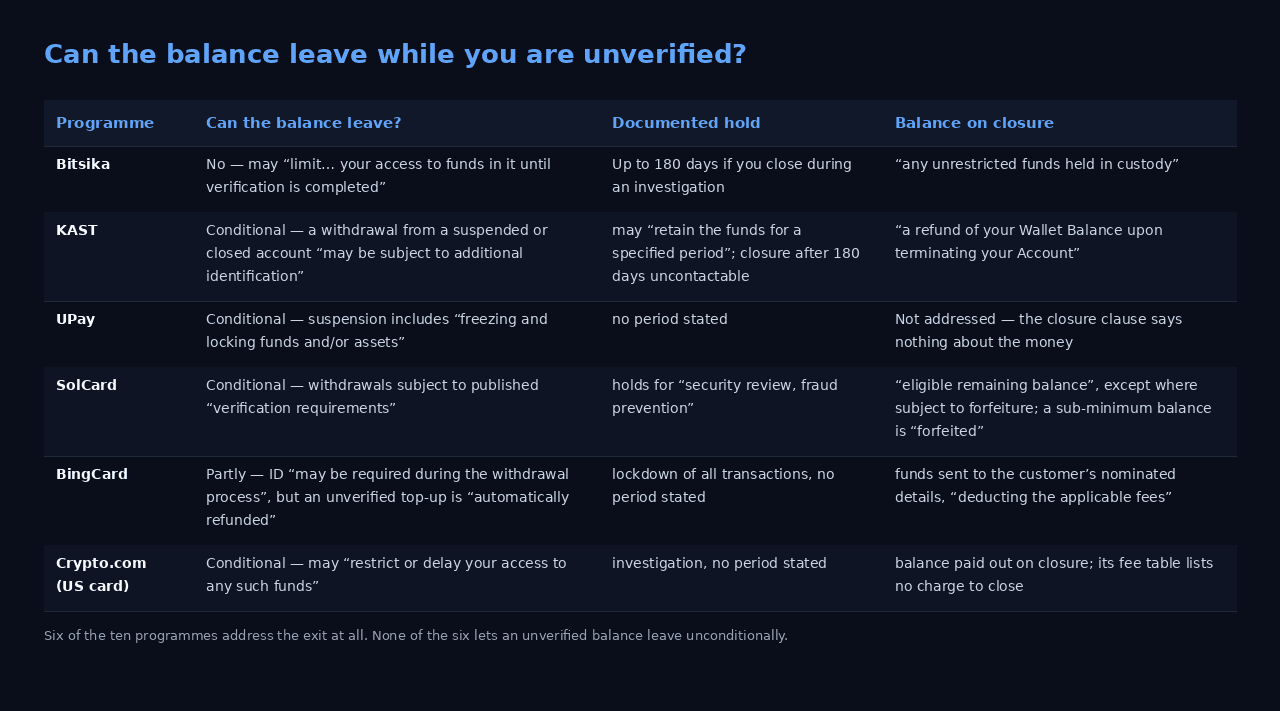
Every competing page frames the downside as losing the card. The documents frame it as losing access to the balance, and they are specific about it. This is the table to check before deciding how much to keep on a card.
| Programme | Can the balance leave while you are unverified? | Documented hold | Balance on closure |
|---|---|---|---|
| Bitsika | No — may “limit… your access to funds in it until verification is completed” | Up to 180 days if you close during an investigation | “any unrestricted funds held in custody” |
| KAST | Conditional — a withdrawal from a suspended or closed account “may be subject to additional identification” | may “retain the funds for a specified period”; closure after 180 days uncontactable | “a refund of your Wallet Balance upon terminating your Account” |
| UPay | Conditional — suspension includes “freezing and locking funds and/or assets” | no period stated | Not addressed — the closure clause says nothing about the money |
| SolCard | Conditional — withdrawals subject to published “verification requirements” | holds for “security review, fraud prevention” | “eligible remaining balance”, except where subject to forfeiture; a sub-minimum balance is “forfeited” |
| BingCard | Partly — ID “may be required during the withdrawal process”, but an unverified top-up is “automatically refunded” | lockdown of all transactions, no period stated | funds sent to the customer's nominated details, “deducting the applicable fees” |
| Crypto.com (US card) | Conditional — may “restrict or delay your access to any such funds” | investigation, no period stated | balance paid out on closure; its fee table lists no charge to close |
Three things stand out. BingCard's automatic refund of an unverified top-up is the kindest clause in the set: money that cannot be credited goes back rather than sitting in limbo. SolCard is the only programme whose terms use the word forfeit, and it uses it twice — for misrepresenting residency, “a material breach”, and for a balance under the app's refundable minimum. UPay's silence is the shape to fear: a clause that freezes funds, a clause that closes the account, and none that returns anything. If your card is already frozen, our frozen funds guide is the next thing to read.
A no-KYC tier is a deferred ID check, not an exemption
“Tiered KYC” is the industry's preferred phrase, and it is accurate as far as it goes. What nobody does is put numbers against it, which is a shame, because the numbers are published and they are the useful part.
SolCard's own comparison page, updated 23 November 2026, states that “Virtual cards up to $10,000/month do not require uploading an ID” while Platinum is listed as “Required (KYC + liveness)” with no monthly limit, and its footer adds that “Identity verification may be required for certain card tiers, features, or spending limits”. BingCard sells an Unverified Account with published limitations. At the other end, RedotPay — routinely listed as light-touch — says “Identity verification is mandatory for all RedotPay users” in a help page dated 26 July 2026, which should settle how it is described.
So a tier is a ceiling with a date on it, and the date is largely yours to set: you reach it when your spending grows, when you want the physical card, or when the programme re-prices its tiers. That is a fair trade chosen deliberately and a bad surprise if you believed the marketing. One live example, with its caveat: The Defiant reported in 2026 that some unverified SolCard users lost access to their virtual Visa cards. We could not read the article's body — it renders client-side and served us a loading placeholder — so we neither rely on it nor repeat its figures.
The documents that say nothing
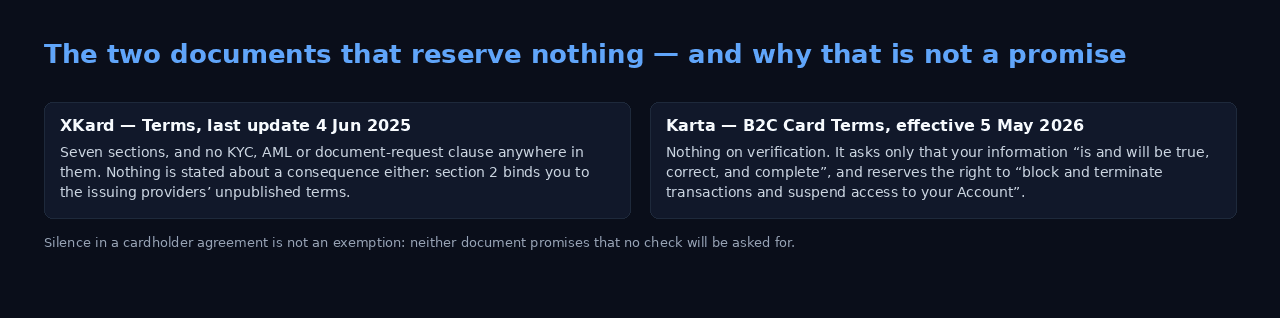
Two of the ten documents contain no verification clause whatsoever, and both are worth looking at closely, because silence reads like safety and is not.
XKard — the programme Kardd earns most from, which is why it belongs in this section — publishes terms last updated 4 June 2025 running to seven numbered sections. No KYC clause, no AML mention, no document request, and section 5 says “We do not collect or store personal data unless required by law or for transactional security”. That sentence is about XKard's own data handling, not a commitment that nobody will ask you for ID: section 2 requires you to comply with the issuing providers' terms, which are not published anywhere we could find. Karta's B2C card terms, effective 5 May 2026, are similar — no due diligence clause, an undertaking that your information “is and will be true, correct, and complete”, a right to “block and terminate transactions”, and Karta Finance Inc. named as the contracting party while “The issuer for this card program is Third National”.
That is the pattern: a short, friendly front-end agreement that defers the hard clauses to a bank agreement you never see. A thin terms page is therefore a weaker signal than a long one with an explicit clause — a programme that writes “we may request additional documents” has at least told you the truth about itself.
What being unverified costs you besides access
There is a quieter second bill. Three protections you might assume you have are conditional on verification, and the conditions are in writing.
Dispute rights. Under 12 CFR 1005.18(e)(3), a US prepaid issuer need not apply Regulation E's liability limits and error-resolution rules to an account it has not verified — the detail we costed in crypto card chargebacks. The commentary adds the bit that bites: verification is not complete while requested documents are outstanding, and an institution “may not delay completing its consumer identification and verification process” because you have asserted an error. Your dispute does not pause the ID request; the ID request pauses your dispute.
An exit route in law. The US prepaid rule says nothing about returning a balance when verification cannot be completed. The UK rules do, at regulation 31(2) — but only where a UK-regulated firm is in the chain.
None of which argues for abandoning no-KYC cards. It argues for treating an unverified balance as a float rather than a store. The regulatory floor underneath all of it moves again in July 2027, which we cover in crypto card KYC rules.
What to do before you load, and when the request lands
- Find the verification clause before you fund the card. Search the terms for “verification”, “due diligence” and “from time to time”. Thirty seconds tells you which of the ten patterns above you are signing.
- Search the same document for the exit. The question is not whether they can close you — they all can — but whether any clause says how the balance comes back. UPay has none; KAST and BingCard do.
- Treat the published tier ceiling as your own limit, and keep the balance at spending size. Every freeze clause here applies to whatever sits on the card: a float you would not mind losing access to for 180 days is the right size.
- Have the documents ready even if you never intend to send them: an in-date ID with three months to run, a matching address document, a source-of-funds trail. Refusing is a choice; being unable to comply is not.
- Read what is actually being asked. A login re-verification, a tier upgrade and a source-of-funds enquiry are three events with three different answers. RedotPay's re-verification wants ID photos and a spoken video selfie — a silent video is rejected and the clock keeps running.
- If you will not verify, withdraw first and in one go. Do it before the deadline in the notice, not after: once the account is restricted, the withdrawal itself becomes the thing that needs verification.
And if a programme drops its no-KYC tier entirely rather than asking you individually, the warning signs are in our piece on crypto card shutdowns.
Final take
The honest answer to “will this card ask me for ID later?” is that eight of the ten documents we read reserve the right, the other two publish nothing that would stop them, and two more programmes publish nothing readable at all. That is what a card running on someone else's licence looks like from the inside. The commentary gets the direction right and the consequence wrong: the thing to plan for is not losing a card, which is replaceable, but a balance sitting behind a verification step you had decided not to take.
So choose on the clause rather than the claim. A programme that writes down what it may ask for, when, and how your money gets out has told you more than one whose terms are four paragraphs of goodwill — and on that test the intimidating documents are the reassuring ones. Read the clause before you load the card, not after the message arrives.
Compare what each card has actually written down
Kardd reads every programme's own documents — KYC level, custody, funding model, fees and the clauses behind them — so you can see which cards publish a verification policy and which leave it to an issuer you will never meet.
Kardd may earn a commission on sign-ups, including XKard, whose terms are quoted critically above. No commission changes a comparison score. Affiliate disclosure.
Sources
Every document below was read on 28 November 2026; each carries its own date where it states one. KAST Platform Terms (7 July 2026) — “requested continually”, the Custodian Wallet freeze, withdrawals subject to further identification, the 180-day closure. UPay Terms of Use (15 September 2026) — documents “from time to time”, source of wealth, “(f) for any other reasons”, freezing and locking funds. BingCard Terms of Service (19 April 2023) — the Unverified Account, the periodic review and its 14-day window, lockdown without notification, the automatic refund of an unverified top-up. Bleap Cardholder Terms (EEA) (28 June 2026) — “KYC and any ongoing checks”, and Unlimit EU Ltd as the Cyprus-licensed issuer. Bitsika Terms & Conditions (undated) — reviews on a transfer out, access limited until verification completes, the 180-day hold.
RedotPay, KYC at a glance (26 July 2026) and how to resubmit login verification documents (23 October 2026). SolCard Terms (27 September 2026) — tier KYC, continuous monitoring, termination without notice, both forfeiture clauses; tier figures from SolCard's comparison page (updated 23 November 2026). Crypto.com US cardholder agreement (1 September 2026, issued by Community Federal Savings Bank) — the photo-ID request, cancellation for inaccurate information, and FDIC cover conditional on verification. XKard terms and conditions (4 June 2025) — seven sections, no verification clause. Karta B2C Card Terms (5 May 2026) — no due diligence clause, Third National named as issuer.
Rules: regulation 28 of the Money Laundering Regulations 2017 (current to 26 November 2026) for ongoing monitoring at paragraph (11); regulation 31 for the duty to cease and terminate, and the repayment carve-out at 31(2); 12 CFR 1005.18 and its commentary (CFPB) for paragraph (e)(3) and comments 18(e)-4 to 18(e)-6.
Not obtainable, and not guessed: goblincard.com serves a 1.8 KB client-rendered shell and returned HTTP 404 at eleven candidate legal paths; Laso Finance's user agreement renders no text without a browser; the issuer-level agreements behind XKard and Karta are unpublished. How a support team behaves in practice is not verifiable from documents, and we have not claimed it either way.
Related Articles
- Crypto Card KYC Rules 2026: What Changes in July 2027
- Crypto Card Issuers 2026: Who Actually Issues Your Card
- Crypto Card Frozen? What to Do When Your Card Locks Your Funds
- Crypto Card Shutdowns 2026: The Clauses That End a Card
- Best No-KYC Crypto Cards in 2026: The Independent Comparison
- Are No-KYC Crypto Cards Safe? The Honest Answer
Frequently Asked Questions
Can a no-KYC crypto card ask for ID later?
Yes, and most have written the right down in advance. Eight of the ten documents we read reserve a request after onboarding: KAST's says information “might be requested continually”, UPay's ends its triggers with “(f) for any other reasons”. The two that reserve nothing say nothing about verification at all, so not one of the ten rules it out.
Why does a crypto card ask for ID after signup rather than at signup?
Because the duty is continuous. Regulation 28(11) of the UK's Money Laundering Regulations 2017 requires “ongoing monitoring of a business relationship”, including keeping due diligence documents “up-to-date”. It sits with the licensed issuer behind the card and reaches you through the brand's terms. A programme that collected nothing deferred the moment; it did not remove it.
What happens if I refuse to verify my crypto card account?
Restriction, then closure. KAST warns of “restricted access… or termination” and a freeze on “part or all assets”; UPay may “suspend or close” the account, “freezing and locking funds”; Crypto.com says “we may cancel your Card”. Where a UK-regulated firm is in the chain, regulation 31 requires termination.
Can I get my balance out of an unverified crypto card account?
Often not without verifying. Bitsika may limit access “until verification is completed” and hold funds “up to 180 days” during an investigation; BingCard requires ID “during the withdrawal process”. Skipping the check at the entrance does not skip it at the exit.
Does a no-KYC tier mean the card will never ask for ID?
No — a tier is a published ceiling. SolCard allows virtual cards “up to $10,000/month” with no ID and marks Platinum “Required (KYC + liveness)”; RedotPay says verification is “mandatory for all”. The tier tells you when the request arrives, not whether.
Can a card ask an already verified account to verify again?
Yes. RedotPay publishes a procedure for when “we've asked you to resubmit your login verification documents”, requiring “both ID photos and a new video selfie” read aloud. BingCard reserves a periodic review with 14 days to resupply, then may revoke your verified status.
Which crypto cards publish no verification clause at all?
XKard's seven-section terms (4 June 2025) and Karta's B2C card terms (5 May 2026) contain none, and both defer to unpublished issuer agreements. Goblin Card publishes no reachable cardholder document — eleven paths returned 404 — and Laso Finance's renders no text without a browser. Silence is not a promise.