Crypto Card Top-Up Not Credited 2026: Only 1 of 6 Helps
- One of six card programmes publishes a recovery route. RedotPay gives a timetable — 7 to 15 business days — and a price. Tria, SolCard, Karta Personal and Crypto.com publish no wrong-network process at all.
- Recovery is priced, and the floor can exceed the mistake. RedotPay charges $10 flat on deposits of $10–$100, 10% to $5,000, then $500. Kraken's hardest category is a flat $500.
- The refund may not come back to you. RedotPay needs a refund address “on the same network as the incorrect deposit”; KuCoin refunds only to the original sending address — the exchange's, if you withdrew from one.
- Nobody publishes a durable network list. RedotPay points at “the Deposit page in your app”; SolCard says use the dashboard “rather than a figure you saw elsewhere”. There is no citable list.
- A network that worked can stop working. The Bitrefill Card dropped USDT on every network on 17 March 2025 and “will not be able to recover the payments”.
On this page
- What “not credited” actually means: five reasons, one of them expensive
- Three ways a card takes crypto, and only one carries the risk
- A crypto card top-up not credited: who publishes a policy, who says nothing
- What recovery costs when it is offered
- The refund address is the trap nobody warns you about
- Two providers kill recovery for the same reason
- The right network can become the wrong one
- Below the minimum is a different problem with a better answer
- What to do, in order, in the first hour
- Final take
- Sources
- Related articles
- FAQ
You sent USDT to your card's deposit address and the balance never moved. Every page ranking for this question answers it for a wallet or an exchange, where you either hold the keys or can withdraw again — and a card is neither. So on 26 November 2026 we read what the card programmes themselves publish. A crypto card top-up not credited has exactly five documented causes, and the gap between them is money: one needs a paid recovery request that may fail, one is fixed by sending a second deposit, and one needs nothing but patience.
Of the six card programmes whose own deposit documentation we could read, one publishes a recovery route with a timetable and a price. One publishes a flat refusal. The other four say nothing about the most expensive mistake their product allows.
What “not credited” actually means: five reasons, one of them expensive
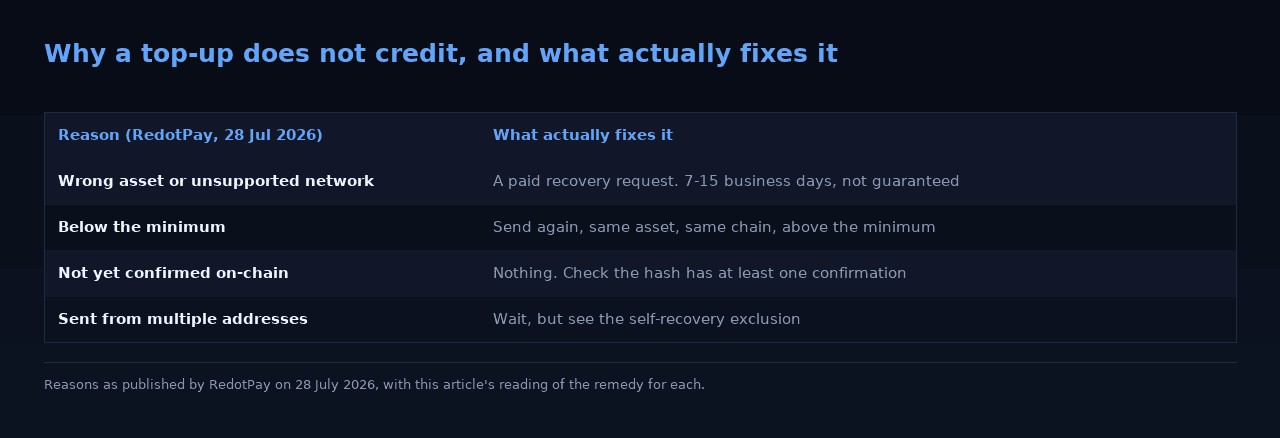
RedotPay is the only card programme in our set that enumerates the causes, in an article dated 28 July 2026. Read it as a checklist: four of its five reasons are not a lost-funds event at all, and treating them as one is how people pay a recovery fee they never needed.
| Reason (RedotPay, 28 Jul 2026) | What it says | What actually fixes it |
|---|---|---|
| Wrong asset or unsupported network | “your deposit will not credit automatically” | A paid recovery request. 7–15 business days, not guaranteed |
| Below the minimum | “Deposits below the minimum amount can't be credited” | Send again, same asset, same chain, above the minimum — they are combined |
| Not yet confirmed on-chain | “Network congestion can delay confirmations” | Nothing. Check the hash has at least one confirmation |
| Sent from multiple addresses | “can take about 3–5 days to process” | Wait — but see the self-recovery exclusion below |
| Security hold | “linked to a restricted or high-risk source” | Contact support for verification |
Only the first row is the catastrophe people fear, and what separates it from the second is a single screen in your wallet. Note too that the minimum is measured after costs: the deposit “needs to meet the minimum amount after network fees to be credited”, so a send that clears the floor before fees can land under it. That is a quieter cousin of the charge we costed in crypto card top-up fees — except that one is disclosed.
Three ways a card takes crypto, and only one carries the risk
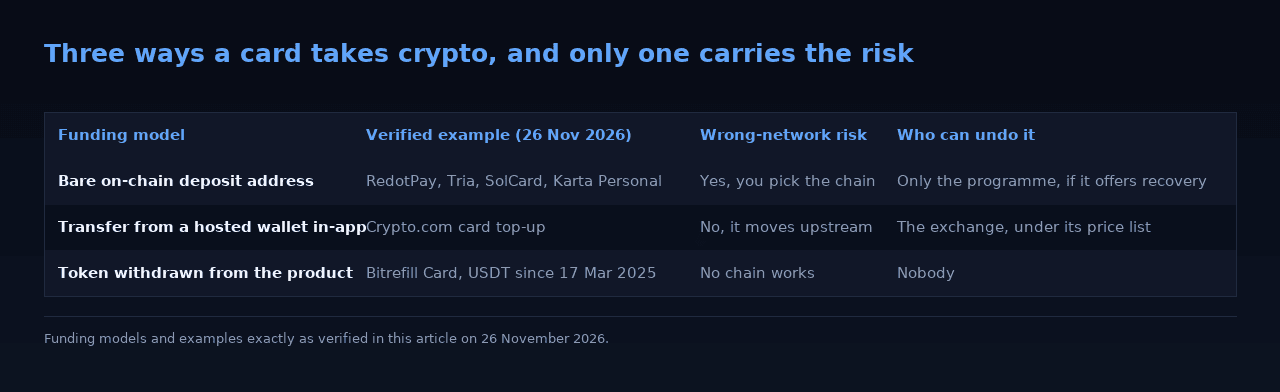
Before hunting for a recovery policy, work out which kind of card you hold: two of the three funding models cannot produce a wrong-network loss at the card step at all. Every competing page omits this distinction, and it decides whether anyone can help you.
| Funding model | Verified example (26 Nov 2026) | Wrong-network risk at the card step | Who can undo a mistake |
|---|---|---|---|
| Bare on-chain deposit address, each coin locked to named chains | RedotPay, Tria, SolCard, Karta Personal | Yes — you pick the chain, in your own wallet | Only the programme, and only if it offers recovery |
| Transfer from a hosted wallet inside the same app | Crypto.com card top-up, from Cronos or Cronos zkEVM | No — it moves upstream to the exchange deposit | The exchange, under its own published price list |
| The token has been withdrawn from the product entirely | Bitrefill Card, USDT since 17 March 2025 | No chain works — nothing can be credited | Nobody: “will not be able to recover” |
The middle row is the one that misleads people. A Crypto.com card is topped up from a wallet already inside the app — its own guide, dated 18 June 2026, covers only “the Cronos or Cronos zkEVM Chain” and accepts “USDC, ETH, and any token that can be swapped to USDC or ETH”, converting the rest automatically. There is no raw address to misroute to. The risk did not vanish, though: it sits one step earlier, when you funded the exchange account — which is good news, because exchanges publish prices for this and cards mostly do not.
A caveat we will not dress up: on a self-custodial card a wrong-chain send should in principle be recoverable by you, because the funds land in your own address on another chain. We could not reach COCA's deposit documentation to verify that, so we are not claiming it. Custody models are set out per programme in our guide to who actually issues these cards.
A crypto card top-up not credited: who publishes a policy, who says nothing
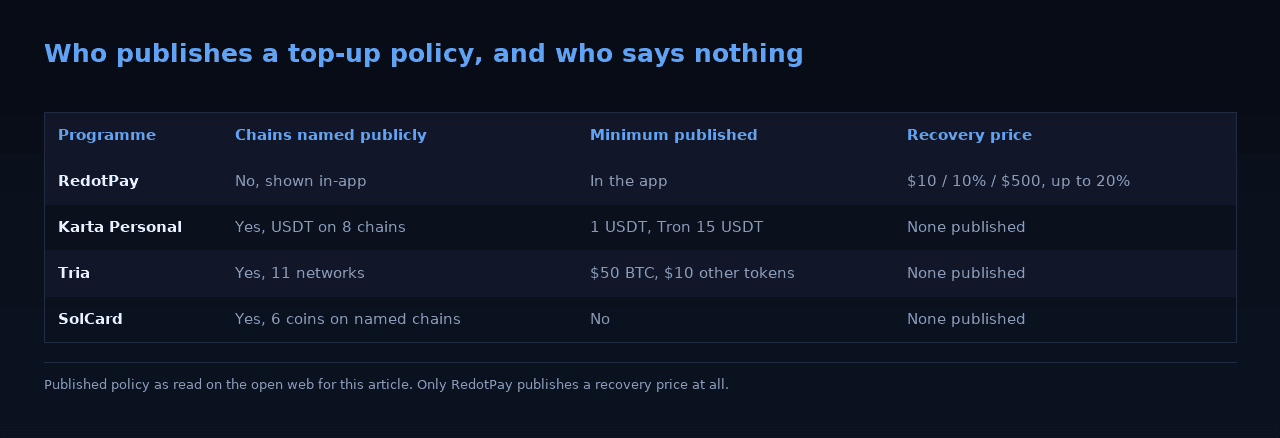
We read six card programmes' deposit documentation and recorded four things: whether the accepted chains appear anywhere on the public web, whether a minimum is published, whether a wrong-network outcome is addressed, and whether a recovery price exists.
| Programme | Chains named on the public web | Minimum published | Wrong-network outcome stated | Recovery price |
|---|---|---|---|---|
| RedotPay | No — “shown on the Deposit page in your app” | In the app; must clear it after network fees | Yes, a full article | $10 / 10% / $500, up to 20% |
| Karta Personal | Yes — USDT on 8 chains | 1 USDT, except Tron 15 USDT | Partly — “we'll assist you in resolving the issue” | None published |
| Tria | Yes — 11 networks; Avalanche excluded | $50 BTC, $10 other tokens | No | None published |
| SolCard | Yes — 6 coins, each on named chains | No — “differ from coin to coin and can change” | Six words: “The deposit may not arrive.” | None published |
| Crypto.com (card top-up) | Yes — Cronos and Cronos zkEVM only | 5 USDC / 0.0013 ETH | No | Not applicable — no raw address |
| Bitrefill Card | USDT withdrawn on all networks | Not applicable | Yes — “No deposits made with USDT will be accepted” | Explicitly none |
The pattern across the six is sharper than the rows. Four name their chains on the public web and none of those four prices a mistake. The one programme that does price a mistake is also the one that will not publish its chain list, pointing you at a screen instead. You can have a citable list or a priced remedy; so far, not both.
A seventh nearly made the table. Offramp's help centre carried an article on recovering incorrect top-ups, with a $30 fee and a card accepting only USDC on Polygon. Every URL in it now returns HTTP 404, confirmed directly. We have not counted it, and the disappearance is its own lesson in how durable these policies are.
What recovery costs when it is offered
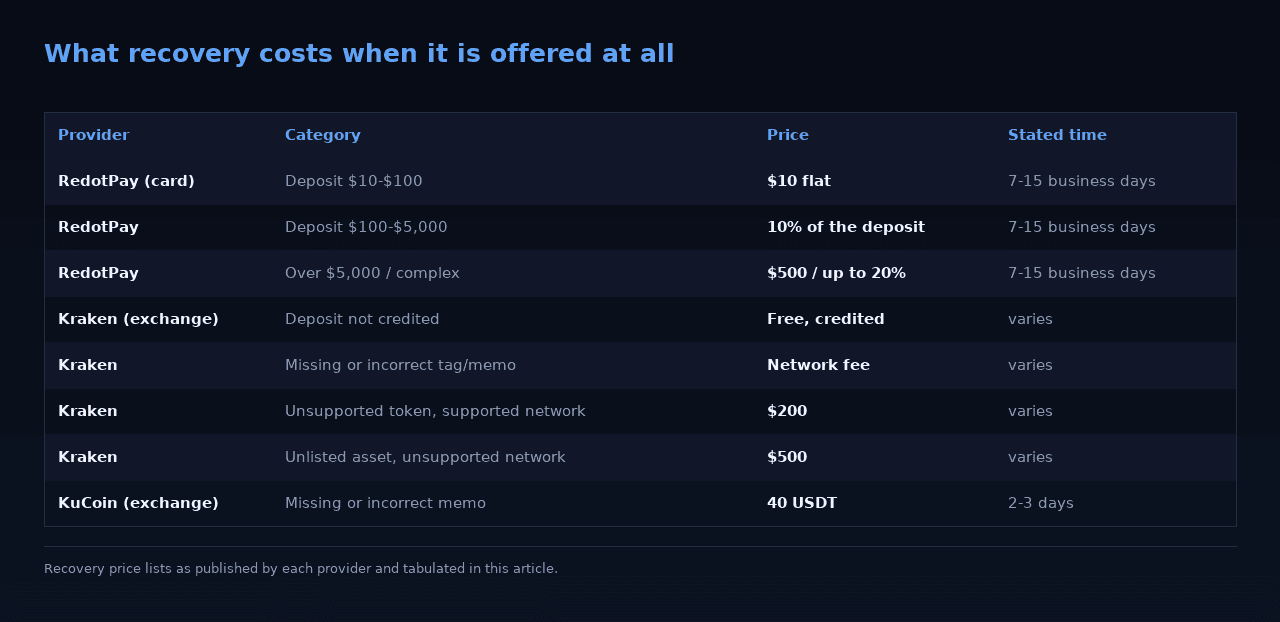
Four published price lists exist across the cards and the exchanges that feed them, built on two incompatible principles — and which one you face decides whether recovery is worth attempting at all.
| Provider | Category | Price | Stated time |
|---|---|---|---|
| RedotPay (card) | Deposit $10–$100 | $10 flat | 7–15 business days |
| RedotPay | Deposit $100–$5,000 | 10% of the deposit | 7–15 business days |
| RedotPay | Over $5,000 / “complex cases” | $500 / up to 20% | 7–15 business days |
| Kraken (exchange) | Deposit not credited | Free, credited | “varies” |
| Kraken | Missing or incorrect tag/memo | Network fee | “varies” |
| Kraken | Unsupported token, supported network | $200 | “varies” |
| Kraken | Unlisted asset, unsupported network | $500 | “varies” |
| KuCoin (exchange) | Missing or incorrect memo | 40 USDT | 2–3 days; refund in 5 |
| KuCoin | Unlisted, outdated or delisted token | 80 USDT | 2–3 days |
| CoinJar (exchange) | Recovery service | ~$100, mainly on success | Not stated |
RedotPay prices by how much you sent; Kraken and KuCoin by how hard the job is. The consequence is a dead zone at each end. RedotPay's $10 floor means recovering a $12 mistake costs $10, or 83% of it, and recovering exactly $10 costs the whole deposit. Kraken's flat $500 for the hardest category makes anything under $500 uneconomic to recover even though the service exists.
One row in Kraken's list has no equivalent on any card: a deposit that is simply uncredited costs nothing and is credited rather than refunded. That is the correct treatment, and it sets a benchmark. Every provider here also hedges — KuCoin states its table “does not represent a promise from KuCoin to recover your funds under any circumstances”, and RedotPay takes the handling fee before submission. You pay to join a queue, not to get your money back.
The refund address is the trap nobody warns you about
Assume you pay the fee and the recovery works. Where does the money go? Not necessarily to you: both providers with detailed rules constrain the destination in a way that quietly excludes the commonest case.
RedotPay: “The refund address must be on the same network as the incorrect deposit.” So you need a wallet you control on the chain you did not mean to use.
KuCoin: refunds go only to the original sending address, that address must be able to receive the returned asset, and the deposit must have come from a single sending address.
Now picture how most people fund a card: they withdraw from an exchange straight to the card's deposit address. Under KuCoin's rule the “original sending address” is then the exchange's hot wallet — not yours, not something you can prove control of, and an arbitrary inbound refund to it may never reach your account. The readers best protected by these rules are those who sent from their own self-custodied wallet, who are the least likely to need a card's help in the first place.
RedotPay's version stings differently. If you sent on a chain the card does not accept, you must now produce a receiving address on that chain — which may mean installing a wallet you have never used before the recovery can complete. Sort that out before you pay, not after.
Two providers kill recovery for the same reason
Here is a mechanic we did not expect to find twice: a deposit assembled from more than one sending address breaks recovery, and the two providers that mention it disagree only on severity.
- RedotPay treats it as a delay: “Deposits coming from more than one address can take about 3–5 days to process.”
- KuCoin treats it as fatal: “If your deposit involves multiple 'From' addresses on the blockchain, it cannot be recovered through self-recovery.”
This matters because you may not know you did it. A Bitcoin wallet spending several UTXOs, or an app sweeping balances from more than one account to cover a single send, produces exactly that shape on-chain without telling you. The transaction looks normal in your app and disqualifying on the explorer.
KuCoin's exclusion list rules out more than most people would guess: deposits to a non-KuCoin or incorrect address, tokens whose deposits are “temporarily closed for maintenance”, networks absent from the deposit dropdown, and transactions showing “Unconfirmed” or “Failed”. Self-recovery covers a narrow middle band of mistakes, not the category.
The right network can become the wrong one
Every warning on this subject assumes the error is yours. It need not be. A card programme can withdraw a token or chain it previously accepted, and your saved deposit address then quietly stops working.
The Bitrefill Card is the documented case. Its help page states that the card “no longer supports deposits of USDT on any network”, that this “went into effect on 17 March 2025 due to European regulations our partners need to comply with”, and that “no deposits made with USDT will be accepted”. On recovery it is unambiguous: Bitrefill “will not be able to recover the payments”. USDT remains a payment option for everything else on the site, so the token did not leave the business — only the card. Anyone who had topped that card up for a year and kept the address had a working habit turn into an unrecoverable loss on a date they had no reason to know. The regulatory backdrop to such changes in Europe is covered in our guide to MiCA and crypto cards.
This is why the absent chain lists matter more than they first appear. RedotPay says the accepted chains are “shown on the Deposit page in your app” and reserves the right to “update supported currencies, networks, and minimum deposit amounts from time to time”. SolCard says go by the dashboard “rather than a figure you saw elsewhere”. Both are being honest, and the honest version means there is no stable, citable list to check a send against — including the one in this article. That also makes chain support worth checking per card rather than per stablecoin; we set out the differences in USDT vs USDC on a debit card.
Below the minimum is a different problem with a better answer
Of the five failure modes, one has a genuinely cheap fix, and it is the one people panic about unnecessarily. RedotPay's rule: a below-minimum deposit is recovered by making another deposit of the same asset on the same network that does meet the minimum, after which both are combined and credited. No fee, no ticket, no queue — you top up again, correctly.
The minimums are small but unevenly placed, and the asymmetry is what to watch. Karta Personal takes 1 USDT on seven of its eight chains and 15 USDT on Tron — fifteen times the floor on the chain most people reach for precisely because its fees are lowest. Tria asks $50 for Bitcoin against $10 for everything else. SolCard publishes no figure at all.
What to do, in order, in the first hour
- Find the transaction on a block explorer for the chain you actually used — not the one you meant to use. If it reads “Unconfirmed” or “Failed”, there is nothing to recover yet and nothing to pay for.
- Check it has at least one confirmation. Congestion alone explains a large share of missing top-ups: Karta Personal puts normal crediting at 1 to 10 minutes and “in rare cases” up to an hour, Tria at near-instant but 2 to 4 hours when busy.
- Open your app's deposit screen and compare asset, chain and minimum as it reads today. If all three match and those windows have passed, this is a support question, not a recovery case.
- Check whether the send came from one address or several. If several, say so in your first message; it changes the timetable and, on some providers, your eligibility.
- If the chain or asset was wrong, open a recovery request immediately with the hash, network, asset, amount, deposit address and a screenshot of the withdrawal. Delay is the one variable wholly within your control.
- Before paying any fee, establish where a refund would land and whether you hold an address there. Weigh the fee against the amount: under RedotPay's floor, a small mistake is not worth recovering.
- Treat an unsolicited offer of help as a scam. The results for this query are seeded with “recovery experts” charging upfront. Your provider's own help centre, reached from inside the app, is the only route worth using.
One thing to know in advance: an AML or sanctions review is a separate track from a misroute, with its own timetable and no fee schedule. We cover those holds in crypto card frozen funds.
Final take
The common advice — double-check the network, because a wrong-chain send means lost funds and no card will help — is half right, and the wrong half is the expensive one. Recovery routes do exist: one of our six card programmes publishes one with a timetable, and the exchanges funding most of these cards publish detailed price lists. The finding is not that help is unavailable but that it is priced, discretionary, slow, and constrained in ways that exclude the most ordinary way of making the mistake.
So the defensive move is not a bookmark of supported chains, because no programme publishes one it will stand behind. Treat the deposit screen as the only authority at the moment of sending, make the first send to any new card small and comfortably above the minimum, and prefer a funding model that cannot produce the error at all — on that test a hosted-wallet top-up beats a bare address, whatever their other merits.
Check how a card takes your money before you send any
Kardd reads what every programme publishes — funding model, accepted assets, custody, KYC level, fees and the clauses behind them — so you can tell a bare deposit address from a hosted-wallet transfer before you load the first $100.
Kardd may earn a commission on sign-ups, including XKard. We earn nothing from any card or exchange named here. Affiliate disclosure.
Sources
All pages read on 26 November 2026; each provider's own date is given where it states one. RedotPay, wrong crypto or wrong network (28 July 2026) — the 7–15 business day window, the “not guaranteed” wording, the tiered fees and the same-network refund condition. RedotPay, deposit not arrived (28 July 2026) — the five reasons and the multiple-address delay. RedotPay, supported currencies and minimums (21 July 2026) — the in-app Deposit page as authority, the after-network-fees minimum and the top-up-again remedy. Kraken, crypto assets deposit recovery (21 September 2026) — the five-row fee table and the non-guarantee. KuCoin, self-recovery (7 August 2026) — the 40 and 80 USDT fees, the five-business-day refund, the single-sending-address rule and the exclusion list.
Card programmes: Tria Card top-up guide — eleven networks, the Avalanche exclusion, $50 / $10 minimums. SolCard, native coin deposits (27 September 2026) — the per-chain coin rule, the dashboard-minimum instruction and “The deposit may not arrive.” Karta Personal, topping up with crypto (14 January 2026) — eight USDT chains, 1 USDT against 15 USDT on Tron, and the crediting window. Crypto.com, Cronos card top-up (18 June 2026) — the Cronos scope and the 5 USDC / 0.0013 ETH figures. Bitrefill, USDT no longer supported — effective 17 March 2025. CoinJar on wrong-network sends (9 February 2026) — the ~$100 fee, and the best page currently ranking for the general question.
Not obtainable, and not guessed: xkard.com redirects to a client-rendered lander returning no readable text without a browser, so XKard's deposit terms are unread. COCA's own deposit page was unreachable, so its single-address cross-chain deposits are treated as unverified. KAST returned no published wrong-network policy. Offramp's help centre returns HTTP 404 at every URL we tried. How a support team behaves in practice is not verifiable from documents, and we have not claimed it either way.
Related Articles
- Crypto Card Top-Up Fees 2026: The Cost to Load $100
- Crypto Card Spending Limits 2026: The Real Numbers
- Tria Card Review 2026: Self-Custodial Visa, Up to 6% Cashback
- SolCard Review 2026: The No-KYC Solana Crypto Card
- Best No-KYC Crypto Cards in 2026: The Independent Comparison
- Crypto.com Debit Card Review 2026: Fees, Limits and Alternatives
Frequently Asked Questions
Why is my crypto card top-up not credited?
RedotPay is the one card programme that enumerates the causes, and it lists five: the wrong asset or an unsupported network, a deposit below the minimum, a transaction not yet confirmed, a send from more than one address, and a security hold on a “restricted or high-risk source”. Only the first needs a paid recovery request; the second is fixed by topping up again.
Can a crypto card recover funds sent on the wrong network?
Sometimes, and only one of the six programmes we read publishes a route. RedotPay says recovery “when possible, typically takes 7–15 business days” and “is not guaranteed, and handling fees apply”. The Bitrefill Card says the opposite outright: it “will not be able to recover the payments”. Tria, SolCard, Karta Personal and Crypto.com's card top-up page publish no process at all.
How much does it cost to recover a wrong-network deposit?
RedotPay charges $10 flat on deposits of $10–$100, 10% from $100–$5,000, $500 above that, and “up to 20%” on complex cases. Kraken charges $200 for an unsupported token on a supported network and $500 for an unlisted asset on an unsupported one, but nothing when a deposit is merely uncredited. KuCoin charges 40 USDT for a missing memo and 80 USDT for an unlisted or delisted token.
Where does a recovered deposit get sent back to?
Not necessarily to you. RedotPay requires the refund address to be “on the same network as the incorrect deposit”, so you need a wallet on the chain you did not mean to use. KuCoin refunds only to the original sending address — which, if you withdrew from an exchange, is the exchange's hot wallet rather than anything you control.
Does sending from two addresses at once affect a deposit?
Yes, and two providers say so independently. RedotPay treats it as a delay of “about 3–5 days”. KuCoin treats it as disqualifying: a deposit involving multiple “From” addresses “cannot be recovered through self-recovery”. A wallet spending several UTXOs produces that shape without telling you, so check the explorer.
Can a network that used to work stop working?
Yes. The Bitrefill Card “no longer supports deposits of USDT on any network”, effective 17 March 2025, which Bitrefill attributes to “European regulations our partners need to comply with”. A saved address that worked before that date accepts nothing after it, and Bitrefill “will not be able to recover the payments”.
What should I do first if a card top-up has not arrived?
Find the transaction on a block explorer for the chain you actually used and check it has at least one confirmation; unconfirmed or failed means there is nothing to recover yet. Then compare the asset, chain and minimum against your app's deposit screen as it reads today. If they match, it is a timing question; if not, open a recovery request immediately.