Solana is fast, cheap, and the backbone of a growing ecosystem. But spending SOL in the real world still requires converting to fiat — and most crypto cards either don’t support Solana or demand full identity verification.
Here are the no-KYC crypto cards that actually let you spend SOL (and Solana-based tokens) at any merchant.
Which No-KYC Cards Support Solana?
Only a handful of no-KYC cards accept Solana-native assets:
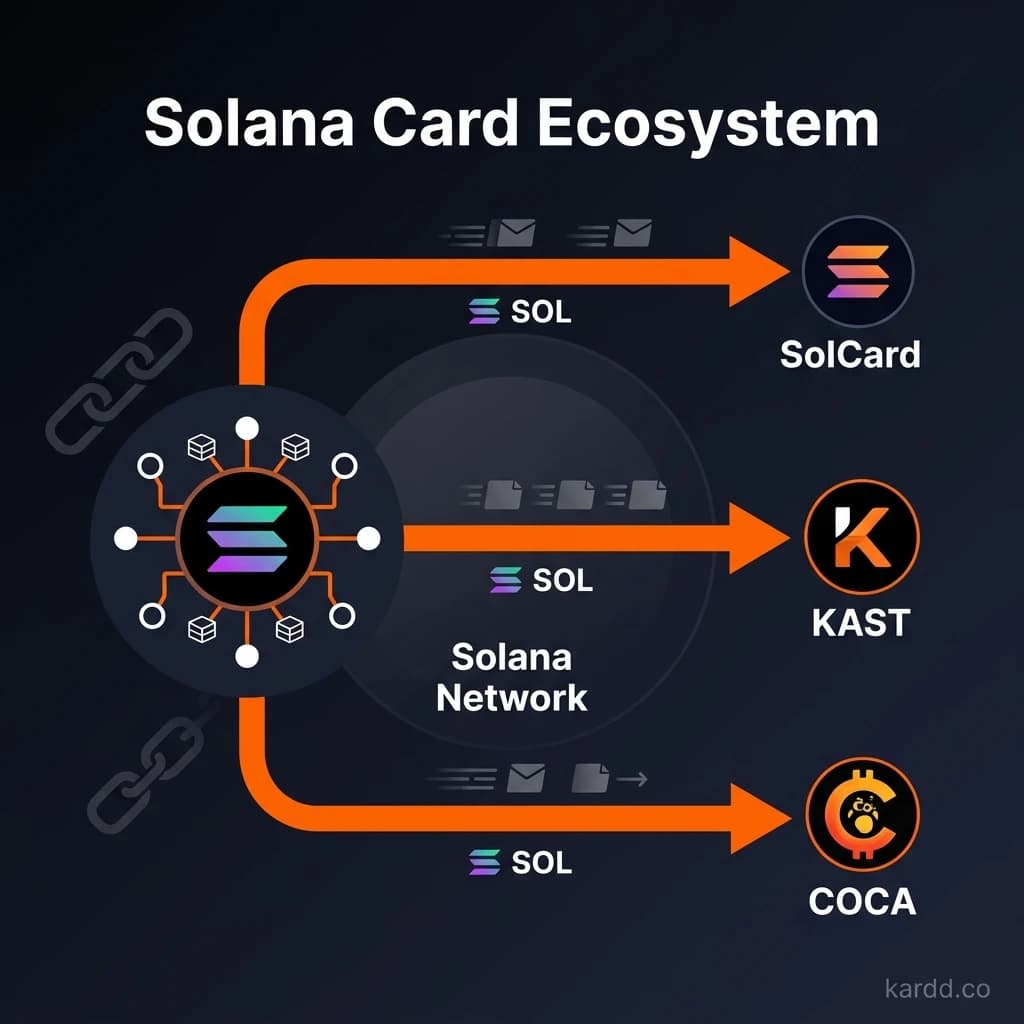
| Card | SOL Support | SPL Tokens | KYC Level | Fee | Limit | Mobile Pay |
|---|---|---|---|---|---|---|
| SolCard | Direct SOL | USDT, USDC on Solana | Zero KYC | 5% | $5,000/mo | Apple + Google Pay |
| KAST | USDT/USDC (multi-chain incl. Solana) | Yes | Minimal | 2% | $3,000/mo | Apple Pay |
| COCA Card | Via Solana network | Multi-chain SPL | Minimal | 2.5% | $3,000/mo | Apple Pay |
Most no-KYC cards don’t support Solana natively. Cards like XKard, BingCard, and Goblin Card accept USDT — but on TRON or BNB Chain, not Solana. If you hold SOL or SPL tokens and don’t want to bridge, SolCard is the primary option.
Best Solana Card: SolCard Deep Dive
SolCard is purpose-built for the Solana ecosystem:
What you get
- Load SOL, USDT (SPL), or USDC (SPL) directly — no bridging required
- Solana network speeds (~1 second confirmation)
- Zero KYC — email only
- Apple Pay + Google Pay support
- Virtual card (no physical option)
- $5,000/month limit
The cost
- 5% top-up fee (the highest among no-KYC cards)
- ~0.5% exchange rate spread
- Effective rate: ~5.5% per transaction
Who it’s for: SOL holders who want the simplest path from wallet to spending. No bridges, no swaps, no chain-hopping. Load SOL, spend dollars.
Who should look elsewhere: Users who prioritize low fees over convenience. If you’re willing to swap SOL to USDT on a DEX, you can use XKard at 2.3-4.5% (lower than SolCard’s 5%).
Alternative: XKard with USDT Bridge
If SolCard’s 5% fee is too steep, here’s the workaround:
- Swap SOL → USDT on a Solana DEX (Jupiter, Raydium) — ~0.3% slippage
- Bridge USDT from Solana to TRON — via Allbridge or Portal (~$1-2 fee)
- Load USDT (TRC-20) onto XKard — 2.3-4.5% fee
Total cost: ~3-5% (depending on XKard tier). Comparable to SolCard but gives you Apple Pay, Google Pay, AND up to $100K limits. The trade-off is an extra 5-10 minutes of setup per load.
For a full comparison of all 11 cards, see our main comparison guide.
How to Load SOL onto a No-KYC Card
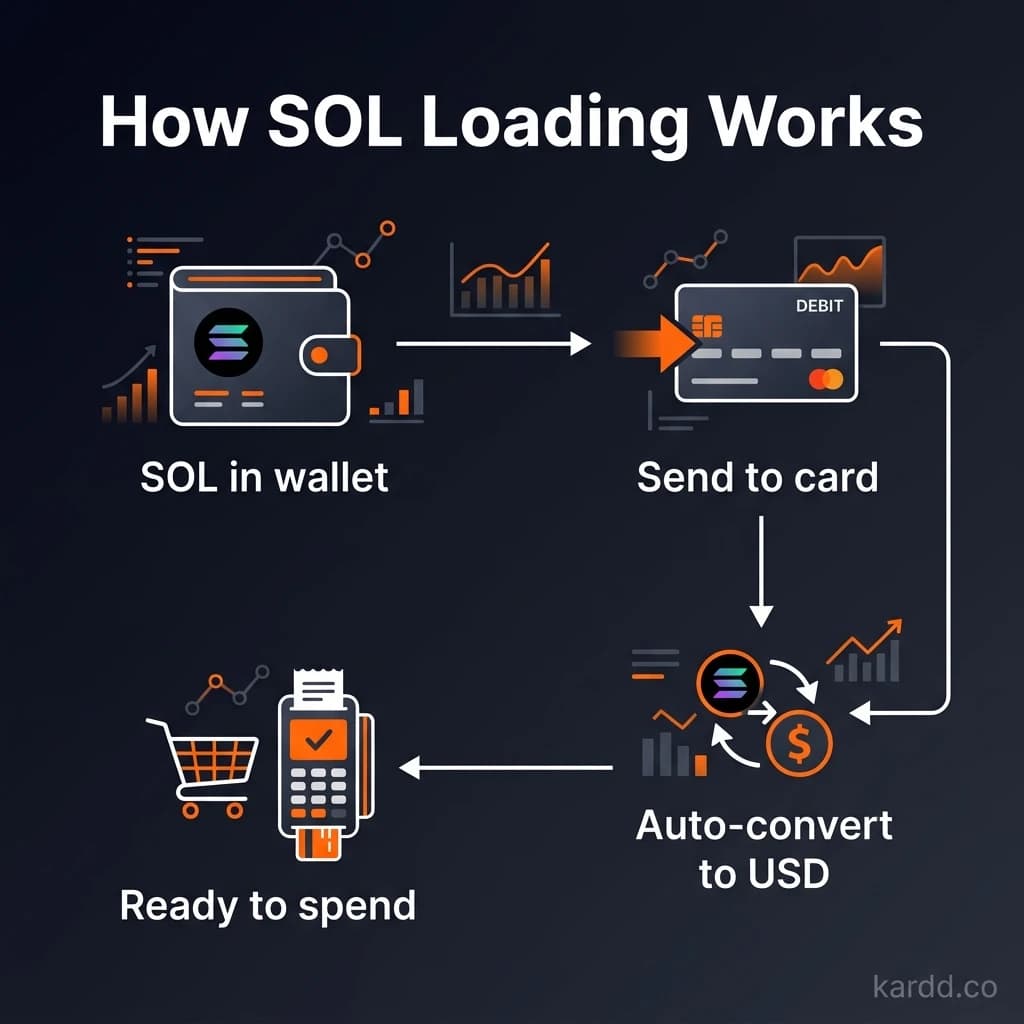
On SolCard (direct SOL)
- Log into SolCard dashboard
- Click “Top Up”
- Select SOL (or USDT/USDC on Solana)
- Copy the Solana deposit address
- Send SOL from Phantom, Solflare, or any Solana wallet
- Balance arrives in ~1 second after confirmation
- Ready to spend
On KAST or COCA (USDT via Solana)
- Swap SOL → USDT on Jupiter or Raydium
- Log into card dashboard
- Select USDT deposit, choose Solana network
- Send USDT (SPL) to the provided address
- Balance arrives in seconds
SOL vs USDT: Which Should You Load?
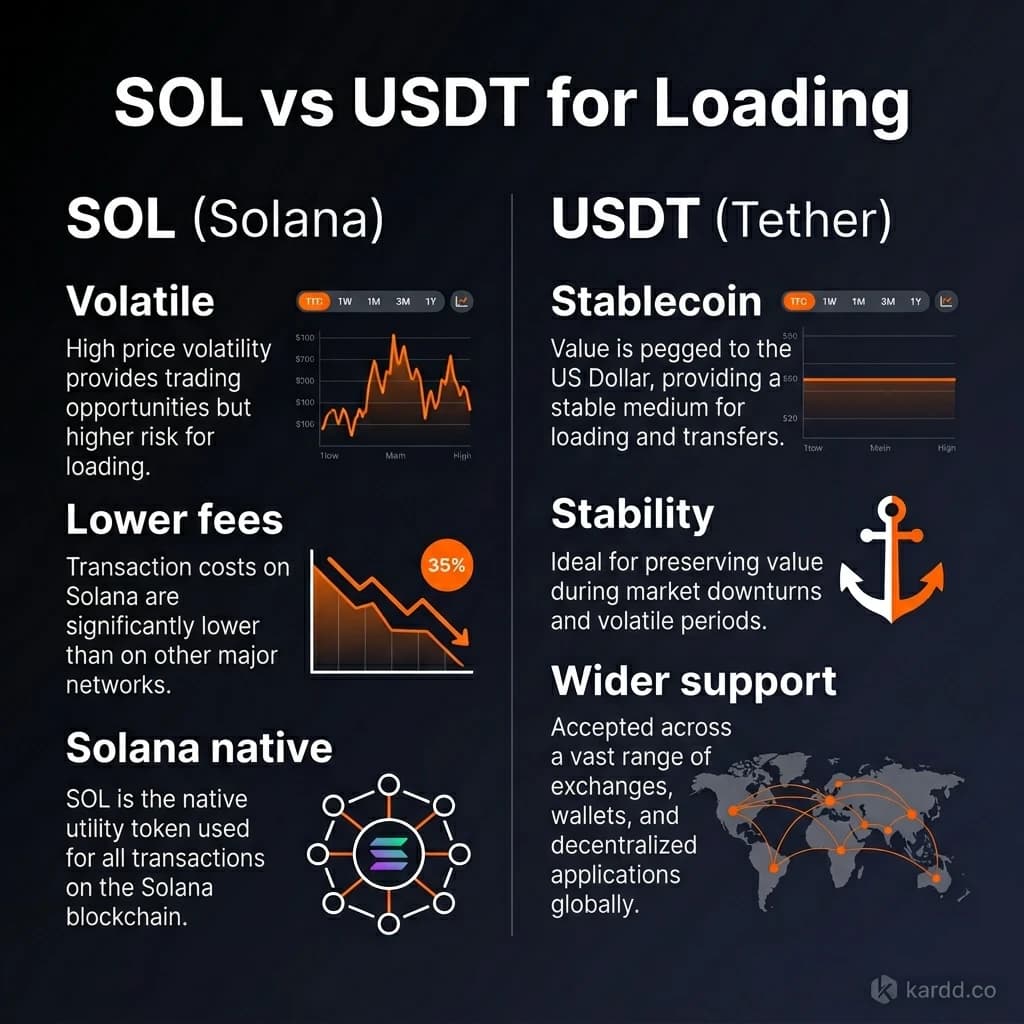
| Factor | Load SOL | Load USDT |
|---|---|---|
| Price volatility | SOL fluctuates — card balance may differ from load amount | Stablecoin — $1 = $1 |
| Conversion rate | Provider converts SOL→USD at their rate (potential spread) | Minimal spread (USDT ≈ USD) |
| Best for | SOL holders who don’t want to swap | Users who want predictable fiat value |
| Risk | SOL drops 10% between load and spend = 10% loss | Negligible — stablecoin pegged to USD |
Recommendation: Unless you specifically want SOL exposure up to the moment of spending, swap to USDT or USDC first. Stablecoins eliminate volatility risk and typically get tighter exchange rate spreads on card loads.
FAQ
Can I spend SOL directly at merchants?
Not directly. The card converts SOL to USD (or your local fiat) at the point of loading. When you tap your card at a store, it’s a regular Visa/Mastercard fiat transaction. The merchant never sees crypto.
Why is SolCard’s fee 5% when other cards charge 1-2%?
SolCard is the only zero-KYC card with native SOL support, Apple Pay, and Google Pay. The fee reflects the convenience premium of spending SOL without any bridging, swapping, or chain-hopping.
Is SolCard safe to use?
SolCard is tracked on Kardd.co with weekly status updates. Like all no-KYC cards, there are inherent risks. See our safety guide for mitigation strategies.
Conclusion
Solana users have limited but functional no-KYC options. SolCard is the simplest (5% fee, direct SOL loading), while XKard via a USDT bridge offers better rates and limits for users willing to do an extra swap.
This guide covers how to load and spend SOL. For the ranked comparison of every card that accepts Solana deposits, see the best Solana crypto cards.
Compare Solana-compatible cards
See which cards support SOL, SPL tokens, and Solana network deposits.
Compare on Kardd.coCards Mentioned in This Guide
Last verified: March 18, 2026. Card details, fees, and KYC requirements may change without notice. Always verify current terms directly with the card issuer before loading funds. Kardd.co is an independent comparison site — we are not affiliated with any card issuer except through publicly available affiliate programs. Full affiliate disclosure