Crypto Card Statements 2026: No KYC, No Paper Trail

- In the UK and EEA a statement is an entitlement, not a feature. Regulation 53(1) of the Payment Services Regulations 2017 requires it “on paper or on another durable medium at least once per month free of charge”.
- Two US prepaid agreements carry a clause headed “Periodic Statements Alternative”. Crypto.com's US Prepaid Visa and BitPay's Prepaid Mastercard both substitute a phone balance, a 12-month online history and a 24-month written history on request — a right neither app surfaces.
- Skip verification and both regimes take the statement away. 12 CFR 1005.18(c)(2) drops the written-history duty for an unverified prepaid account; UK regulation 42(2)(b)(iii) reduces it, where an instrument “is used anonymously”, to letting you “verify the amount of funds stored”.
- Crypto.com has no statement, only a CSV that expires. Its help page says the download “is only available for 30 days starting from the date of export”, and the history keeps 30 reports.
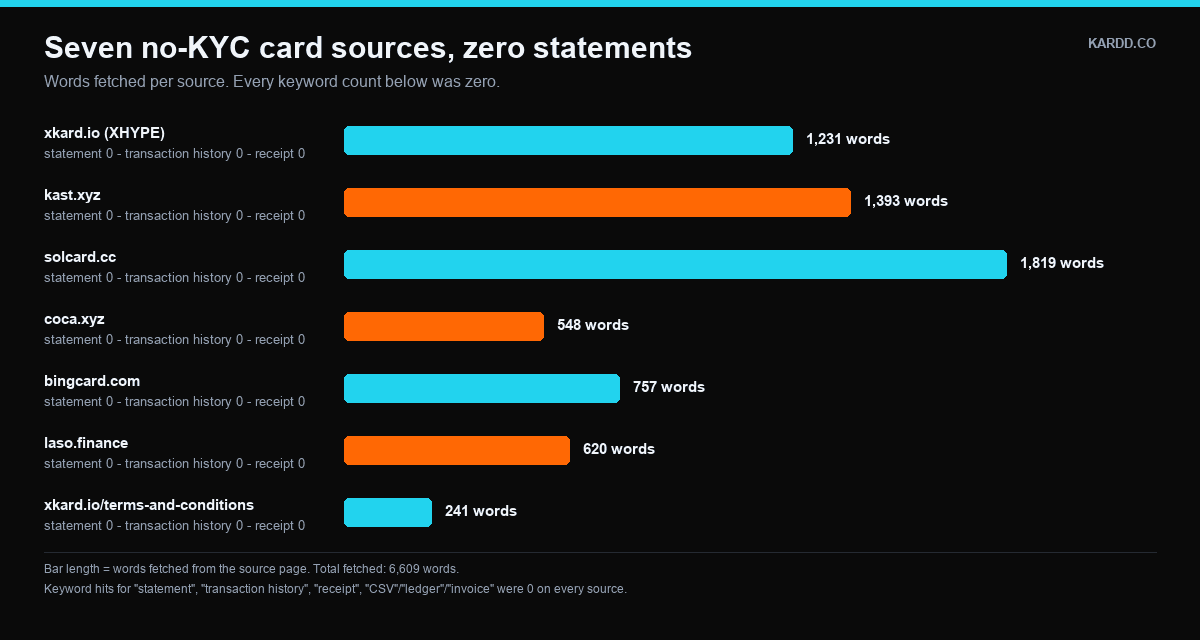
- Of seven no-KYC sources fetched live, “statement” appears zero times. So do “transaction history”, “receipt”, “CSV”, “ledger” and “invoice”.
On this page
- What a crypto card statement must contain, by law
- The clause that replaces your statement
- The carve-out for people who did not verify
- What the programmes actually hand you
- The 30-day expiry nobody mentions
- The no-KYC record: seven sources, no statements
- What to do if your card gives you nothing
- Final take
- Sources
- Related articles
- FAQ
Someone asks you to prove what you spent — an accountant, a landlord, a visa caseworker, a tax authority — and you go looking for a crypto card statement. On most of these cards what you find is a scrolling list inside an app. The stakes are not abstract: one programme below keeps a generated export for exactly 30 days, and two agreements grant a 24-month written history that neither app mentions. So we spent 20 November 2026 reading the documents instead of the marketing — four cardholder agreements totalling about 47,000 words of extracted text, the UK and US rules behind them, seven programmes' own statement pages, and the live record of seven no-KYC sources.
Three words get used as though they meant the same thing, and the question turns on keeping them apart. A statement is a periodic document the issuer produces and stands behind. A history is a list you can look at. An export is a file you generate yourself. Only the first is what anyone asking for proof means, and it is the one most crypto cards do not produce. The pattern underneath is uncomfortable: the further a card sits from identity verification, the weaker your claim to a paper trail — and that is written into the regulations on both sides of the Atlantic, not into product design.
What a crypto card statement must contain, by law
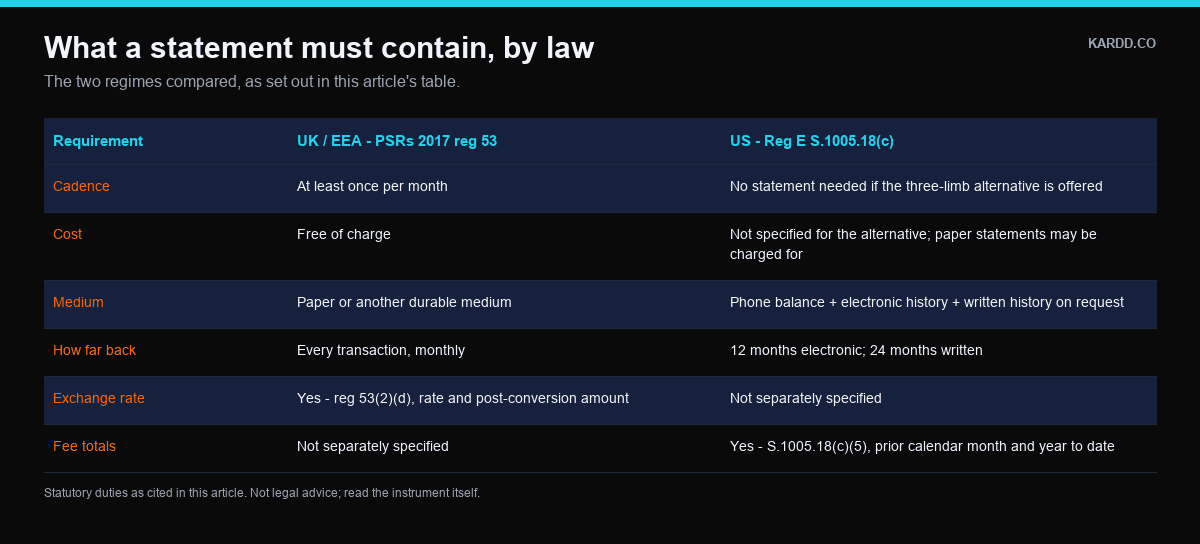
Start with the floor, because almost nothing written about this topic mentions that there is one. In the UK, regulation 53(1) of the Payment Services Regulations 2017 is unambiguous: the payer's payment service provider under a framework contract “must provide to the payer the information specified in paragraph (2) in respect of each payment transaction on paper or on another durable medium at least once per month free of charge”. That is the rule that implemented PSD2 Article 57 into UK law, and the EEA equivalent still applies across the single market.
Three phrases do the work. At least once per month sets a cadence. Free of charge removes the fee. On paper or on another durable medium is the one the industry quietly ignores: a list that lives only inside an app, and changes when the app changes, is not obviously durable. Regulation 53(3) makes the intent explicit, describing an agreed manner “which enables the payer to store and reproduce the information unchanged”.
The United States takes a different route to a lower place. Regulation E requires periodic statements generally at 12 CFR § 1005.9(b), but for prepaid accounts § 1005.18(c) offers a documented way out. Both regimes agree on the content: an itemised record, with charges and exchange rates broken out rather than buried in a net figure.
| Requirement | UK / EEA — PSRs 2017 reg 53 | US — Reg E § 1005.18(c) |
|---|---|---|
| Cadence | At least once per month | No statement needed if the three-limb alternative is offered |
| Cost | Free of charge | Not specified for the alternative; paper statements may be charged for |
| Medium | Paper or another durable medium | Phone balance + electronic history + written history on request |
| How far back | Every transaction, monthly | 12 months electronic; 24 months written |
| Transaction reference | Yes — reg 53(2)(a), with payee information where appropriate | Yes — the § 1005.9(b) items, per § 1005.18(c)(3) |
| Charges itemised | Yes — reg 53(2)(c), with a breakdown | Yes — § 1005.18(c)(4), all fees, however charged |
| Exchange rate shown | Yes — reg 53(2)(d), rate and post-conversion amount | Not separately specified |
| Fee totals | Not separately specified | Yes — § 1005.18(c)(5), prior calendar month and year to date |
| Value date | Yes — reg 53(2)(e), debit value date | Via the § 1005.9(b) items |
One row rewards a second look. The year-to-date fee total at § 1005.18(c)(5) has to appear “on any history of account transactions provided or made available” — not just on statements. If your card is a US prepaid programme and its export does not total your fees for the year, that is a gap worth asking about.
The clause that replaces your statement
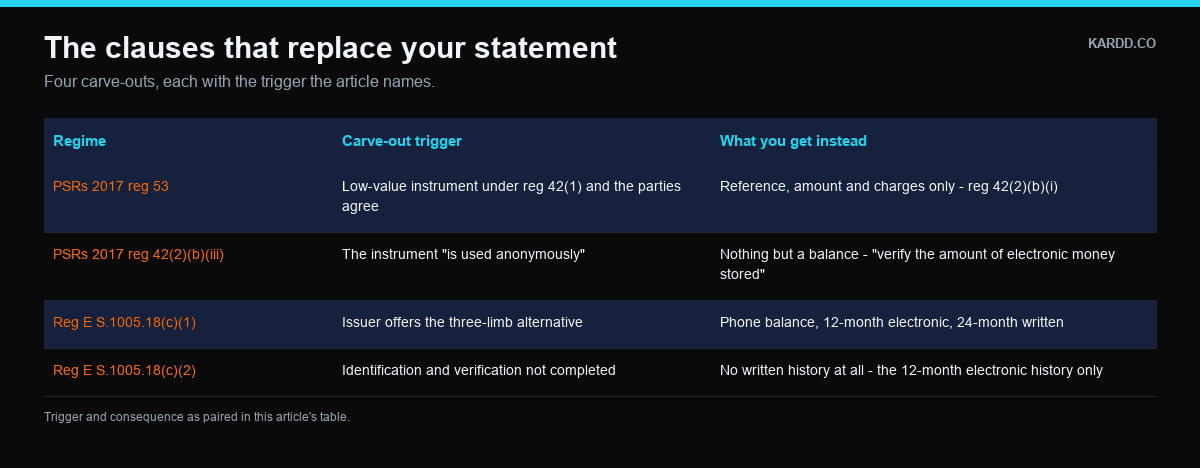
Here is the part we could not find written about anywhere. Two of the four agreements we read carry a clause whose heading says exactly what it does, and the heading is identical in both: “Obtaining Balance and Transaction Information for Your Card; Periodic Statements Alternative”. It is clause 21 in the Crypto.com US Prepaid Visa agreement and clause 21 in the BitPay Prepaid Mastercard agreement, and the drafting barely differs.
Both open by handing the job back to you — “You should keep track of the amount of funds available in your Card Account” — then set out the three limbs Regulation E accepts in place of a statement. You get your balance by telephone. A 12-month history sits online at the self-service website on the back of the card. And then the sentence nobody is told about:
That is a free, written, 24-month record of your card transactions, available on an oral or written request, because § 1005.18(c)(1)(iii) requires it of any issuer using the alternative. If you hold a US prepaid crypto card and need a document rather than a screenshot, quote that clause.
Its companion is pure risk transfer. Clause 20 in both agreements is headed “Receipts”: “You agree to retain your receipts to verify your transactions.” Crypto.com adds that transaction information “will be available via the Crypto.com App”. The paper trail is contractually your job, and the app is a convenience rather than a commitment.
Two contrasts from the same stack. The Exodus Card rest-of-world terms contain “statement” exactly once, in the clause on the accuracy of your sign-up information — no statement clause at all. The Coinbase One Card, being a credit card, goes the other way: “Statement” is a defined term meaning “the regular periodic billing statement we send to you”, with a Closing Date each Billing Cycle. It also carries a line no prepaid programme here does — “Paper Statement Fee. The fee for each paper statement is $5. Electronic statements are always available at no cost” — which in the UK would run straight into regulation 53's “free of charge”.
The carve-out for people who did not verify
Now the finding that reframes everything above. Both regimes carry an exception, and both are aimed at the same person: the cardholder who was never identified.
In the United States it is § 1005.18(c)(2), headed “Periodic statement alternative for unverified prepaid accounts”. For prepaid accounts that are not payroll or government benefit accounts, a financial institution “is not required to provide a written history of the consumer's account transactions” under (c)(1)(iii) “for any prepaid account for which the financial institution has not completed its consumer identification and verification process”. The 24-month written history — the one good thing in clause 21 — is conditional on having been verified.
In the UK it is regulation 42, which disapplies parts of the rulebook for low-value payment instruments: those usable only for transactions of €30 or less (€60 within the UK), with a spending limit of €150 (€300 within the UK), or which “store funds that do not exceed 500 euros at any time”. Where it applies, regulation 42(2)(b) lets the parties agree that regulation 53 does not apply, substituting a reference, the amount and any charges. Then comes limb (iii), the case that matters here — “where the payment instrument is used anonymously”, the provider must simply “enable the payer to verify the amount of funds stored”.
| Regime | Default duty | Carve-out trigger | What you get instead |
|---|---|---|---|
| UK / EEA PSRs 2017 reg 53 | Itemised information monthly, free, on a durable medium | Low-value instrument under reg 42(1) and the parties agree | Reference, amount and charges only — reg 42(2)(b)(i) |
| UK / EEA PSRs 2017 reg 42(2)(b)(iii) | As above | The instrument “is used anonymously” | Nothing but a balance — “verify the amount of funds stored” |
| US Reg E § 1005.18(c)(1) | Periodic statements under § 1005.9(b) | Issuer offers the three-limb alternative | Phone balance, 12-month electronic, 24-month written |
| US Reg E § 1005.18(c)(2) | As above | Identification and verification not completed | No written history at all — the 12-month electronic view only |
Two regulators, two legal traditions, one conclusion: the itemised, durable, provable record is a thing verified cardholders get. That is a real cost of a no-KYC card, and it belongs beside the dispute rights you give up. It is the cost nobody prices in, because it only bills you the day somebody asks for proof.
What the programmes actually hand you
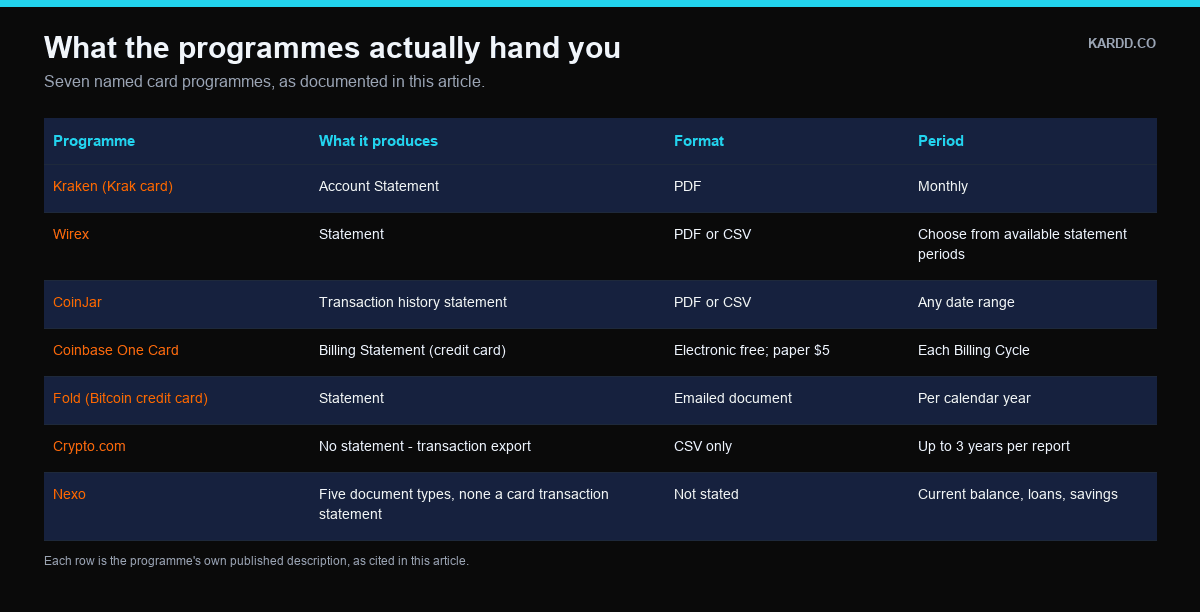
The law sets a floor and the agreements set a minimum. What you get is a product decision, and the spread across seven programmes is wider than the marketing suggests. We walked each one's own published instructions on 20 November 2026.
| Programme | What it produces | Format | Period | Delivery |
|---|---|---|---|---|
| Kraken (Krak card) | Account Statement | Monthly | In app under Reporting; email when each is ready | |
| Wirex | Statement | PDF or CSV | Choose from available statement periods | Generated then downloaded |
| CoinJar | Transaction history statement | PDF or CSV | Any date range | Emailed to the registered address |
| Coinbase One Card | Billing Statement (credit card) | Electronic free; paper $5 | Each Billing Cycle | Sent or made available per the agreement |
| Fold (Bitcoin credit card) | Statement | Emailed document | Per calendar year | Email only — no in-app download |
| Crypto.com | No statement — transaction export | CSV only | Up to 3 years per report | In-app download, expires after 30 days |
| Nexo | Five document types, none a card transaction statement | Not stated | Current balance, loans, savings | My profile → Documents |
Kraken is the only programme here that behaves the way the UK rulebook describes without being asked: a monthly document, on a durable medium, pushed to you. Wirex and CoinJar produce a real statement but make you ask. Fold has statements, but a yearly one by email is an awkward artefact if what you needed was last month.
The Nexo row is worth dwelling on. Its tax-reporting page lists what you can generate — account confirmation, card confirmation, current account balance, loan statement, savings statement — and a card transaction statement is not among them. “Card confirmation” is viewing “the latest details of your Nexo Card”, which is metadata, not spending. For a card marketed partly on its tax tooling, that is a conspicuous absence.
The 30-day expiry nobody mentions
Crypto.com's export deserves its own section, because it contains the single most consequential sentence we found and nothing in the SERP mentions it. Its help page — dated 20 July 2026 — walks you through Card, then More, then Settings, then Export Transaction History, selecting the Crypto.com Card and a date range, then Export to CSV. Each report can cover up to three years. And then:
That matters for a record you expect to keep. The file is not a document the issuer holds for you; it is a job output with a lifespan. Generate your 2026 CSV in January, leave the link in the app, and by February there is nothing behind it. Generate 31 reports and the first drops off — and there is no PDF statement to fall back on.
A fair product decision and a bad records strategy, and the fix is one habit: export monthly and move the file off the phone the same day. The same logic applies to anything you need for a crypto card tax position, where the window you care about is years long and the export's is a month.
The no-KYC record: seven sources, no statements
This site exists for cards that do not ask who you are, so what those programmes publish about records is the question that matters most. We fetched six live no-KYC card sites plus XKard's terms page on 20 November 2026 — every one returned HTTP 200 and served real body text, not a JavaScript shell — and searched each for six words.
| Source fetched | Words | “statement” | “transaction history” | “receipt” | “CSV” / “ledger” / “invoice” |
|---|---|---|---|---|---|
| xkard.io (XHYPE) | 1,231 | 0 | 0 | 0 | 0 |
| xkard.io/terms-and-conditions | 241 | 0 | 0 | 0 | 0 |
| kast.xyz | 1,393 | 0 | 0 | 0 | 0 |
| solcard.cc | 1,819 | 0 | 0 | 0 | 0 |
| coca.xyz | 548 | 0 | 0 | 0 | 0 |
| bingcard.com | 757 | 0 | 0 | 0 | 0 |
| laso.finance | 620 | 0 | 0 | 0 | 0 |
| Total | 6,609 | 0 | 0 | 0 | 0 |
Zero, across 6,609 words of published copy from seven sources. The only near-miss is XKard, whose two matches for “export” both describe exporting your private key to MetaMask or Trust Wallet — self-custody language, not record-keeping. Bitsika appeared in our earlier card sets and is excluded here rather than scored: its site now sells mobile-game top-ups.
Be careful what this proves. A homepage, an FAQ and a terms page are not an app, and several of these programmes may well show a transaction list once you are inside. The count establishes something narrower and still useful: not one makes a published promise about statements, in a market where Kraken and Wirex both document theirs in detail. Set that beside regulation 42(2)(b)(iii) and § 1005.18(c)(2) and the silence looks less like an oversight than like the legal position. If records matter, ask before you load — and see what these programmes keep about you, which has a surprisingly different answer.
What to do if your card gives you nothing
Most of the fix is habit rather than paperwork. In rough order of leverage:
- Ask for the 24-month written history, in writing. On a US prepaid programme, quote clause 21 and § 1005.18(c)(1)(iii). It is a right, not a favour. Expect a refusal if you were never verified — § 1005.18(c)(2) — but ask, because many programmes do verify even when onboarding felt light.
- Export monthly, not annually, and store the file yourself. This single habit defeats both the 30-day download window and the 30-report history cap, and it gives you the per-month granularity that a yearly statement cannot.
- Keep the receipts the agreement tells you to keep. Clause 20 in both prepaid agreements is explicit that retaining receipts is your job. On a card with no statement, a merchant receipt plus a dated export is the strongest pair you can assemble.
- Record the crypto side at the same time. A card statement shows a fiat amount; a disposal needs the acquisition cost too, and no card document carries it. Kraken notes that some jurisdictions require records kept five to seven years or longer.
- If you need provable records, choose for them up front. A programme that publishes a monthly PDF has told you something one that publishes nothing has not. That is a comparison criterion, like a fee.
And if the request is from a landlord or a visa caseworker rather than an accountant, be realistic: a CSV you generated yourself carries far less weight than an issuer-produced PDF with a period on it. That is the practical argument for keeping a verified card alongside a no-KYC one.
Final take
The honest summary is that “crypto card statement” describes three different things and the industry is happy for you not to notice. The UK rulebook says a statement is monthly, free and durable. The US rulebook lets a prepaid issuer swap it for a phone line, a 12-month screen and a document you have to request. The apps range from Kraken emailing a PDF every month to Crypto.com handing you a CSV that stops working in 30 days. At the no-KYC end, where this site lives, nobody publishes a promise at all — which, given that both regulators release providers from the duty when the holder is anonymous or unverified, is the most consistent finding in the set. Anonymity has a price list, and one line reads: your records are your own problem.
Compare what each card actually documents
Kardd reads what every programme publishes — issuer, KYC level, fees, limits and the clauses behind them — so you can tell a card that writes its rules down from one that writes a landing page.
Kardd may earn a commission on sign-ups, including XKard, whose published pages say nothing about statements in either direction. Affiliate disclosure.
Sources
All read on 20 November 2026. The Payment Services Regulations 2017, Part 6 — regulation 53 (information for the payer on individual payment transactions), regulation 42 (low-value payment instruments, including the anonymity limb at (2)(b)(iii)) and regulation 55. 12 CFR § 1005.18 on the eCFR — (c)(1) the periodic statement alternative, (c)(2) the unverified-account exception, (c)(3) content via § 1005.9(b), (c)(4) fees and (c)(5) summary fee totals. Crypto.com US Prepaid Visa cardholder agreement (clauses 20 and 21; about 13,800 words of extracted text) and the BitPay Prepaid Mastercard cardholder agreement (the same clauses, about 10,000 words). Exodus Card rest-of-world terms (one occurrence of “statement”, in the sign-up clause). Coinbase One Card cardholder agreement (the “Statement” and “Billing Cycle” definitions and the $5 Paper Statement Fee).
Programme procedures, from each provider's own help pages: Kraken on Krak card management (monthly PDF Account Statements under Reporting, with an email when each is ready); Wirex on generating a statement (statement periods, PDF or CSV); Crypto.com on exporting transaction history (CSV only, up to three years per report, last 30 reports, 30-day download window; page dated 20 July 2026); CoinJar on transaction history statements (PDF or CSV by date range, emailed); Fold on downloading a card statement (per year, by email; page dated 23 September 2026); and Nexo on tax reporting and account statements (the five document types under My profile → Documents).
Counted rather than guessed. The no-KYC figures are our own fetches on 20 November 2026, HTML stripped to body text and searched case-insensitively: xkard.io, xkard.io/terms-and-conditions, kast.xyz, solcard.cc, coca.xyz, bingcard.com and laso.finance all returned 200 with real rendered copy. bitsika.com returned 200 but now serves a mobile-game top-up site and was excluded rather than scored. Word counts are of extracted text.
Related Articles
- Crypto Card Taxes 2026: What a Swipe Actually Triggers
- Crypto Card Data Retention 2026
- Crypto Card Credit Checks 2026: Who Pulls, Who Reports
- Crypto Card Chargebacks 2026: What You Can Actually Dispute
- Crypto Card KYC Rules 2026
- Crypto Card Closure Fees 2026
Frequently Asked Questions
How do I get a crypto card statement?
It depends on the programme. Kraken's Krak card produces a monthly PDF under profile → Reporting → Account Statements and emails you when each is ready. Wirex generates a PDF or CSV from a Statement menu on each account. Crypto.com produces no statement at all, only a CSV export. Look for a Statements or Reporting section first.
Is a crypto card issuer legally required to send me a statement?
In the UK and EEA, yes by default. Regulation 53(1) of the Payment Services Regulations 2017 requires the payer's provider to supply the regulation 53(2) information for each transaction “on paper or on another durable medium at least once per month free of charge”. In the United States it is softer: § 1005.18(c)(1) lets a prepaid issuer skip statements if it offers a telephone balance, a 12-month electronic history and a 24-month written history on request.
What is a “Periodic Statements Alternative” clause?
It is the clause a US prepaid programme uses instead of sending statements, and two agreements we read carry that exact heading at clause 21 — the Crypto.com US Prepaid Visa and the BitPay Prepaid Mastercard. Each gives a phone balance, a 12-month online history, and “the right to obtain a 24-month written history of account transactions”. Neither app mentions that right.
Do no-KYC crypto cards give you statements?
Nothing they publish says so. Across seven no-KYC sources fetched on 20 November 2026 — 6,609 words of body text — “statement”, “transaction history”, “receipt”, “CSV”, “ledger” and “invoice” appear zero times between them. A homepage is not an app, so this is absence of evidence, but no programme in the set makes a published promise.
Does skipping KYC cost you the right to a statement?
In both regimes, yes. § 1005.18(c)(2) says an institution need not provide the 24-month written history “for any prepaid account for which the financial institution has not completed its consumer identification and verification process”. UK regulation 42(2)(b)(iii) reduces the duty, where an instrument “is used anonymously”, to enabling you to “verify the amount of funds stored”.
Can I use a crypto card statement for my taxes?
You can, but it is half the record. Spending crypto is usually a disposal, so you need the acquisition cost as well as the spend, and a card document shows only the fiat side. Kraken's card guidance notes that some jurisdictions require records kept for five to seven years or longer.
Why did my crypto card transaction export stop working?
Because some exports are generated files with an expiry, not permanent documents. Crypto.com's help page says the Export History shows the last 30 generated reports and that “the download is only available for 30 days starting from the date of export”. Download it to your own storage the day it is ready.