Bitget Wallet Card Review 2026: Non-Custodial Crypto Visa, $600/mo 0% Fees
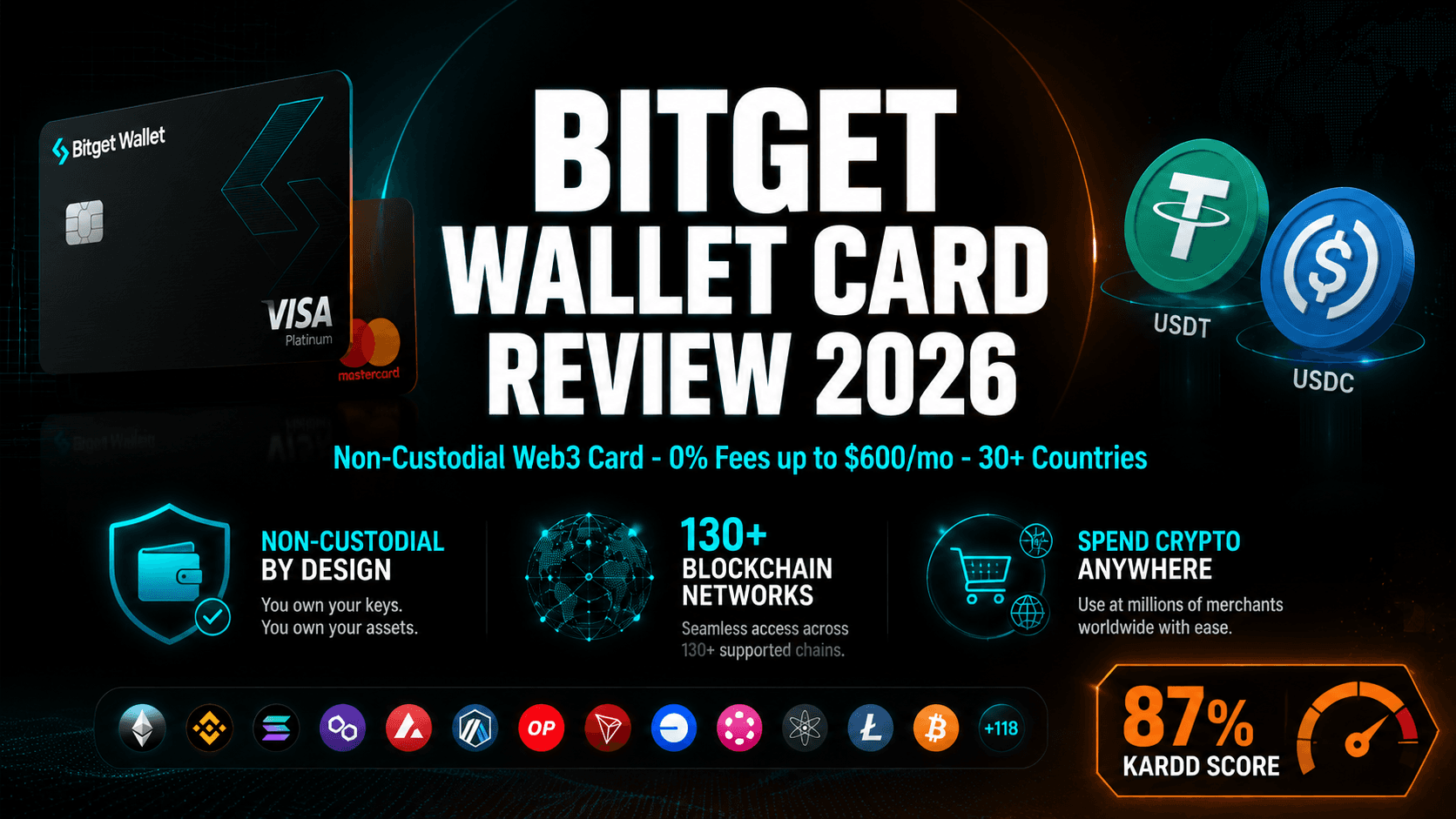
Our verdict: The Bitget Wallet Card is a non-custodial Visa/Mastercard issued through the Bitget Wallet app (80M+ users globally, 130+ chain support). The killer feature: a monthly $600 zero-fee quota that fully refunds all FX, top-up, and conversion fees on spending within that cap. Above the quota, fees stay competitive at 0.9-1.7%. Apple Pay, Google Pay, WeChat Pay, Alipay all supported. The constraint: not available in the US or Canada. For Web3-native users in Europe, LATAM, or APAC who want self-custody plus real spending utility, this is one of the strongest cards available.
The Bitget Wallet Card is one of the few non-custodial crypto cards built on a real multi-chain wallet rather than a custodial exchange. Bitget Wallet itself supports 130+ blockchains and has 80M+ users worldwide. The card layer on top accepts USDT/USDC top-ups, settles via Visa or Mastercard (depending on your region), and offers a monthly $600 zero-fee quota that refunds every fee class on spending within the cap.
We tested how the 0-fee quota actually plays out, mapped Bitget against MetaMask Card and COCA Card for Web3 spenders, and dug into the region-specific differences (the APAC variant is a Visa, the LATAM/EU variant is a Mastercard, with different activation costs and limits). Here is the breakdown.
What is the Bitget Wallet Card?
The Bitget Wallet Card is a crypto debit card issued through the Bitget Wallet app (note: distinct from Bitget Exchange — these are two separate products under the same parent brand). The wallet is self-custodial — you control your keys via seed phrase. The card runs on top of it: you top up via on-chain transfer from your wallet, the funds settle into a card balance, and you spend that balance at any merchant accepting Visa or Mastercard.
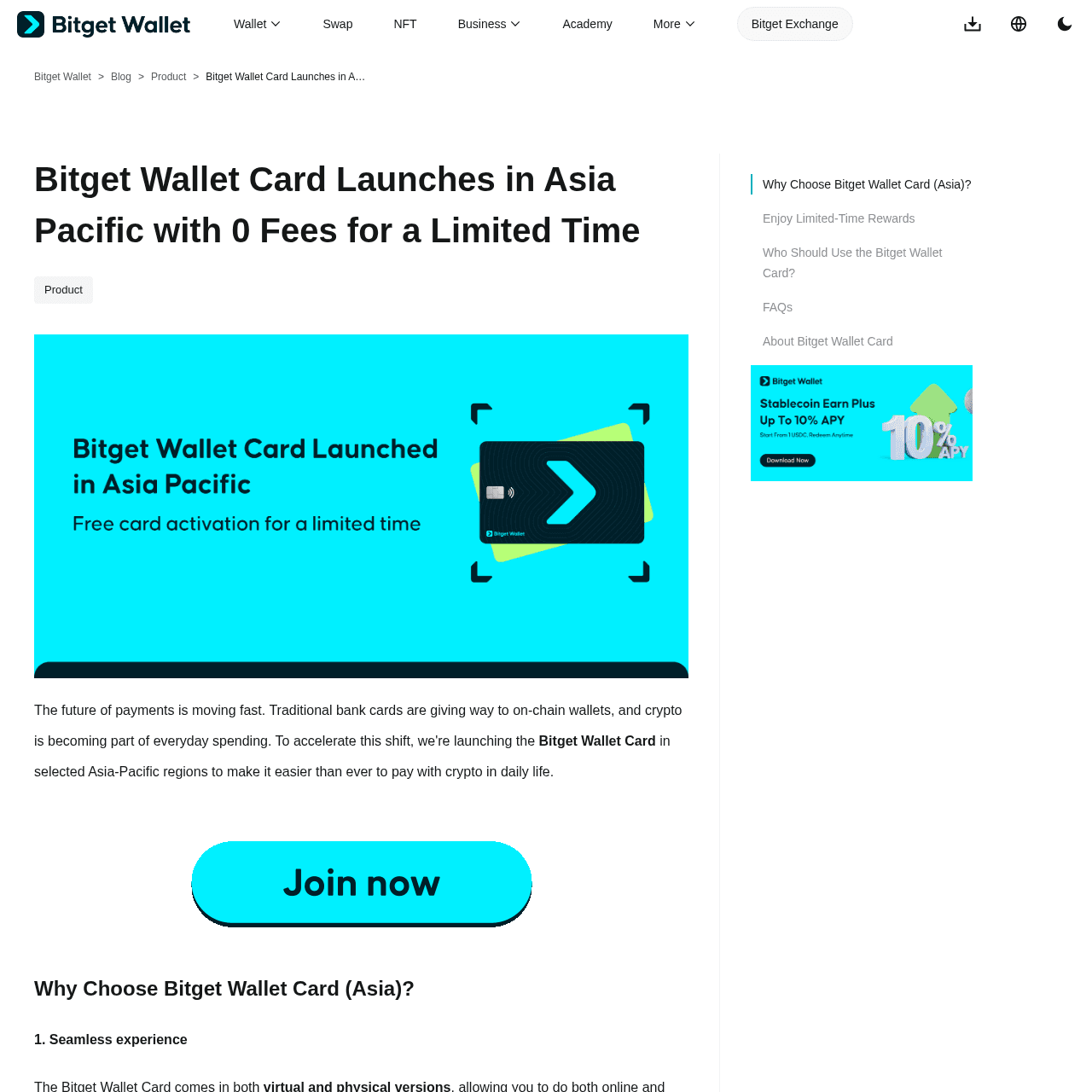
The card is issued by region-specific partners: Visa in APAC (launched October 2025), Mastercard in LATAM (launched 2025 in partnership with Mastercard across 11 LATAM countries), and Mastercard in Europe. Each region has slightly different fee structures and activation costs, but the underlying mechanics are the same: top up with USDT or USDC, get a virtual card, add to your phone wallet, spend.
Key Features
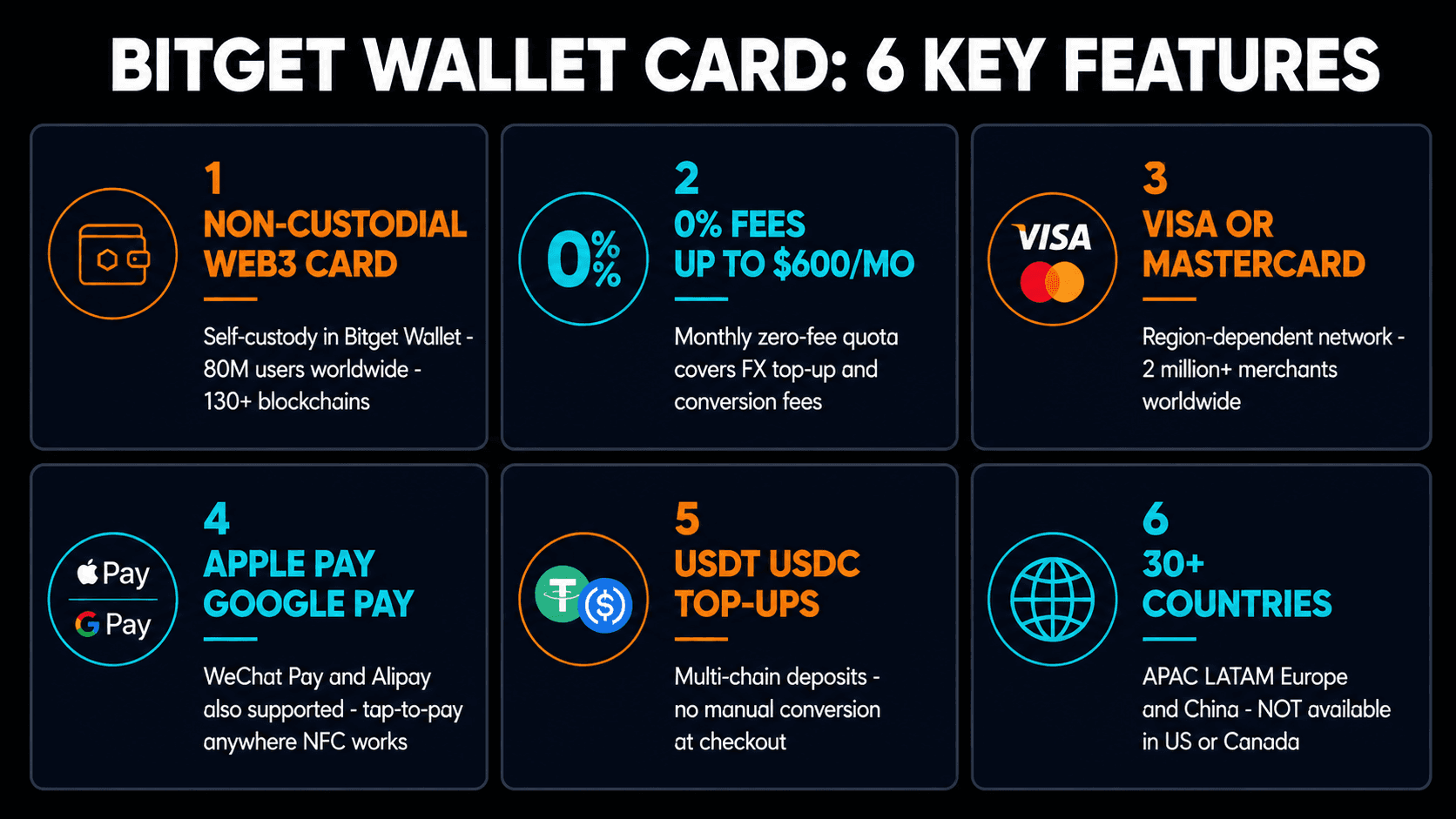
- Non-custodial Web3 wallet. Bitget Wallet itself is fully self-custodial — you hold the keys via seed phrase. The card layer is one of the only non-custodial cards offering this level of multi-chain depth (130+ blockchains, 80M+ users).
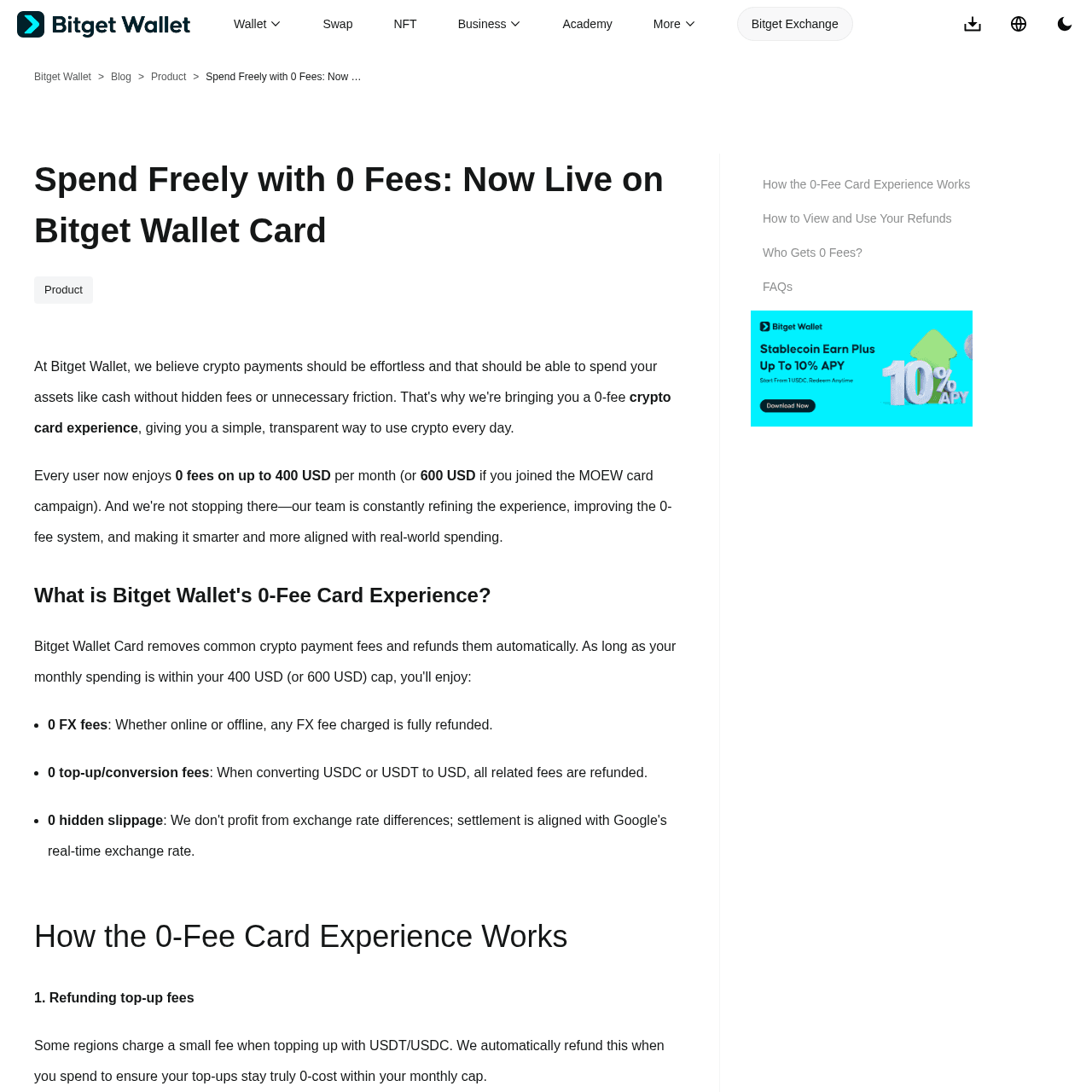
- $600 monthly zero-fee quota. All card spending within $600/month is fully fee-refunded — including FX fees, top-up fees, and conversion fees. Settlement closely tracks Google's real-time FX rate, no hidden markups.
- Visa or Mastercard. Network depends on region: Visa in APAC, Mastercard in LATAM and Europe. Accepted at 2M+ merchants worldwide.
- Apple Pay, Google Pay, WeChat Pay, Alipay. Add the virtual card to any major mobile wallet for instant tap-to-pay. No physical card needed for most everyday use.
- Multi-chain top-ups. Deposit USDT or USDC across multiple supported networks. No manual conversion at checkout — the card auto-settles at point of sale.
- Wide regional coverage. 30+ countries across APAC, LATAM, Europe (EEA + UK), and China.
- High spend limits. $12,000/day, $150,000/year for most users. Higher than most no-KYC alternatives.
- Recoverable card account. Even if you lose your wallet seed phrase, you can still keep spending with the card (but you lose deposit/withdraw ability). Important nuance for self-custody users.
Fees & Pricing
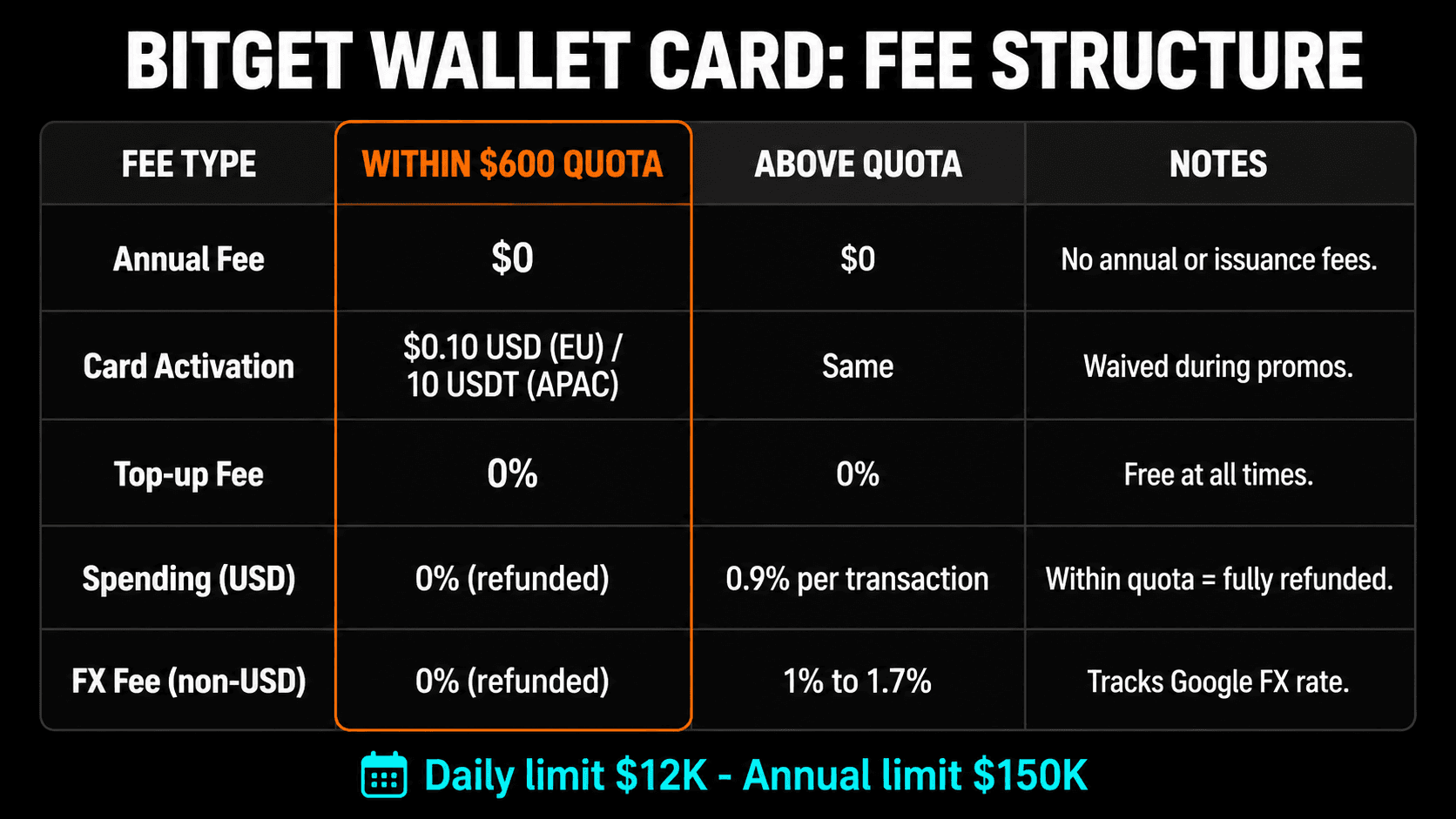
| Fee | Within $600 Quota | Above Quota |
|---|---|---|
| Annual fee | $0 | $0 |
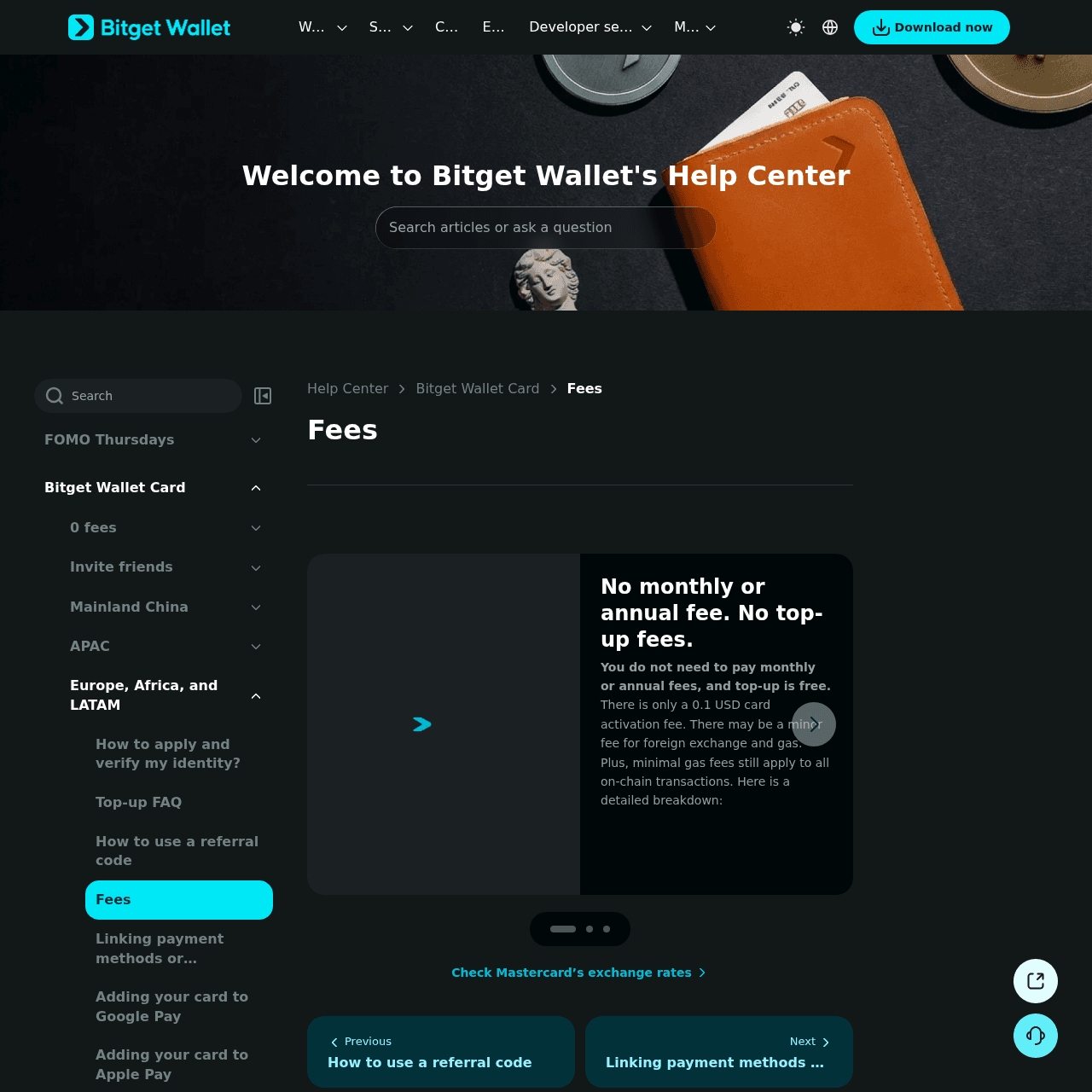
| Card activation | $0.10 (EU/LATAM) / 10 USDT (APAC) | Same (one-time) |
| Top-up | 0% | 0% |
| Card spend (USD) | 0% (refunded) | 0.9% |
| FX (non-USD) | 0% (refunded) | 1% to 1.7% |
| Cancellation | $0 | $0 |
How the $600 zero-fee quota works: For each calendar month, the first $600 of card spend has every fee refunded back to your account. If you spend $400 in your local currency (EUR/GBP/SGD), the FX fee that would normally apply gets credited back. If you exceed $600 in a month, additional spending is charged the standard fees for your region. This effectively makes Bitget Wallet Card the lowest-cost option in the market for moderate spenders.
Real-World Earnings & Promotions
Bitget Wallet runs aggressive promotions to drive card adoption:
- 20% welcome cashback for new users in APAC (capped, time-limited).
- 8% ride-hailing cashback in LATAM (Uber, DiDi, inDrive) on a rolling promotion.
- Ongoing cashback in BGB token based on card tier (similar to Crypto.com's CRO model but smaller in scale).
- 2% cashback on crypto purchases for the first 1,000 new users via card / Apple Pay / Google Pay.
Reality check: The headline promotional rates are not the long-term cashback you should rely on. They're marketing pushes that rotate. The persistent value is the $600/month zero-fee quota plus the modest BGB ongoing cashback. For users planning to spend more than $600/month consistently, treat the promotions as a bonus, not a feature.
Where the Card Works (Countries)
- Europe: EEA + UK (Mastercard)
- Latin America: Argentina, Brazil, Chile, Colombia, Ecuador, El Salvador, Guatemala, Mexico, Panama, Peru (Mastercard)
- APAC: Singapore, South Korea, Japan, Vietnam, Malaysia, Taiwan, Australia, Thailand, Philippines (Visa)
- China: Available (separate launch)
- NOT available: United States, Canada
For US/Canada users, see Gemini Credit Card or Crypto.com Visa.
How to Get Started
- Download Bitget Wallet — iOS App Store or Google Play. Available in 30+ countries (not US).
- Create or import wallet — non-custodial setup with seed phrase. You hold the keys.
- Complete KYC — light identity verification required for card activation (despite the wallet being non-custodial). Takes ~1 minute if your info is clean.
- Apply for card — navigate to Wallet > Bank Card in the app. Activation costs $0.10 (EU/LATAM) or 10 USDT (APAC), often waived during promos.
- Top up — deposit USDT or USDC from your wallet via Card Top-Up. Multi-chain networks supported.
- Add to Apple/Google Pay — instant virtual card available after activation. Add to your phone wallet for tap-to-pay.
- Spend — use online, in-store, or via mobile wallet at 2M+ Visa/Mastercard merchants worldwide.
Pros & Cons
Pros
- Non-custodial — you hold the keys
- $600/month zero-fee quota (fees fully refunded)
- $0 annual fee, $0 issuance fee
- 0% top-up fee always
- Visa or Mastercard network (region-dependent)
- Apple Pay, Google Pay, WeChat Pay, Alipay support
- 130+ blockchains supported in the wallet
- $12K/day, $150K/year spend limits (high)
- 30+ countries (APAC + LATAM + EU + UK + China)
- Aggressive promotions (20% welcome cashback, 8% ride-hailing)
Cons
- Not available in US or Canada
- Above $600/mo quota: 0.9-1.7% per transaction
- Physical card still in development (virtual-only currently)
- Card activation requires KYC despite non-custodial wallet
- BGB cashback exposes you to small-cap token risk
- Region-dependent network (Visa or Mastercard, not both)
- Settlement rate "closely follows" Google FX — minor spread possible
- If you lose your wallet seed, you can't deposit/withdraw (spending still works)
- Promotional rates rotate — not a permanent reward structure
- Stablecoin-only spending (USDT/USDC) — no direct BTC/ETH spending
Bitget Wallet Card vs Competitors
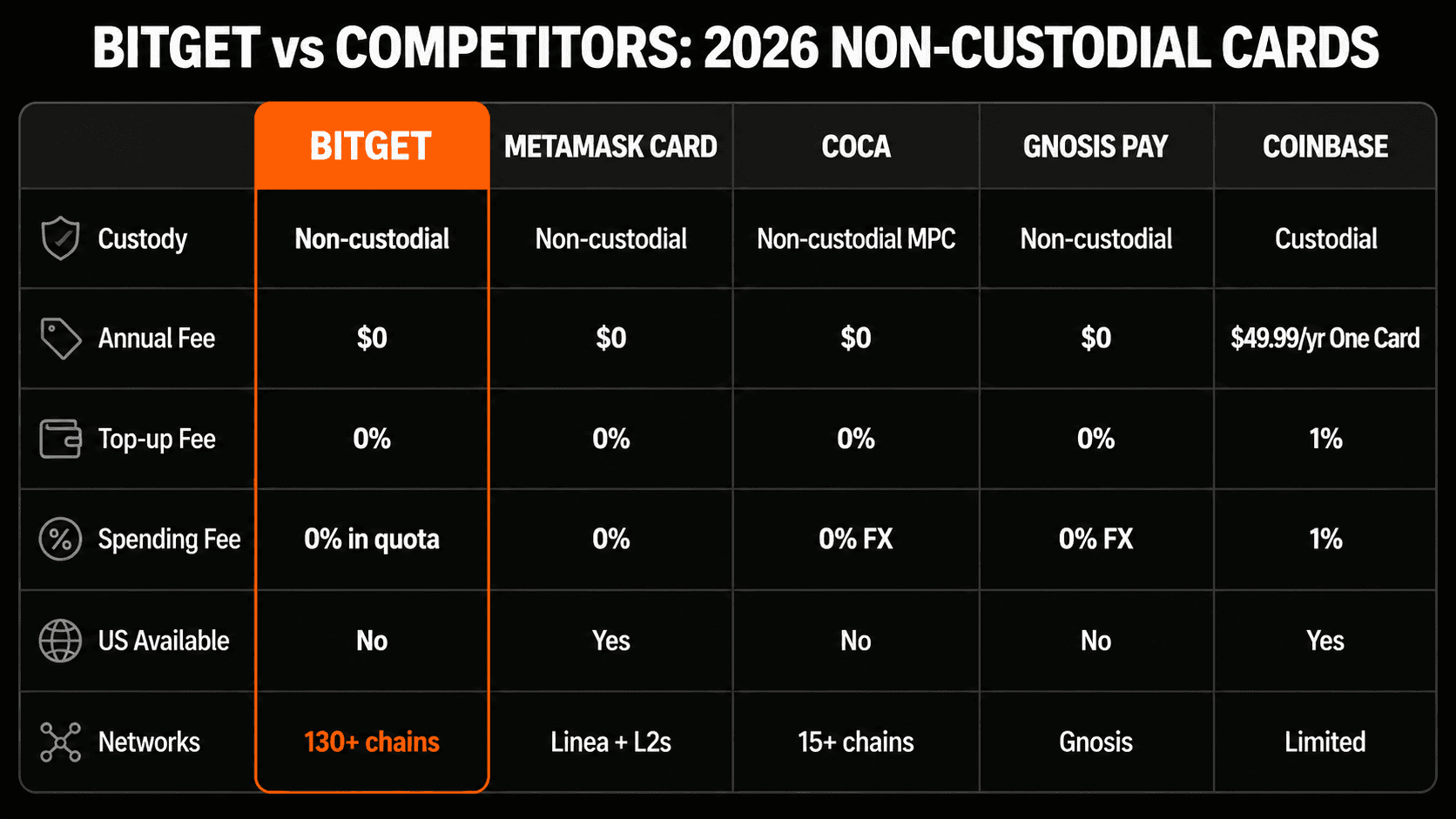
| Feature | Bitget Wallet | MetaMask Card | COCA Card | Gnosis Pay |
|---|---|---|---|---|
| Custody | Non-custodial | Non-custodial | Non-custodial MPC | Non-custodial |
| Annual Fee | $0 | $0 | $0 | $0 |
| Fee Structure | 0% up to $600/mo, then 0.9-1.7% | ~1% FX | 0% FX (tier-based) | 0% FX |
| Cashback | BGB token tiers + promos | 3% USDC | Up to 8% USDT | Up to 4% GNO |
| Networks | 130+ chains in wallet | Linea + L2s | 15+ chains | Gnosis only |
| Apple Pay | Yes | Yes | Yes | No |
| US Available | No | Yes | No | No |
Bottom line: Bitget Wallet Card wins on the $600 zero-fee quota and the deepest multi-chain wallet support. COCA Card wins on max cashback (up to 8% with staking). MetaMask Card wins for US-availability and DeFi-native users. Gnosis Pay wins for pure non-custodial purity (no KYC mid-flow).
Who Should Use Bitget Wallet Card?
- Web3-native spenders in supported regions. If you live in Europe, LATAM, APAC, or China and want self-custody plus real spending utility, this is one of the strongest cards.
- Moderate monthly spenders ($300-$600 range). The zero-fee quota covers your usage entirely — you spend at retail rates with zero fees of any kind.
- Multi-chain stablecoin holders. If your USDC is scattered across Polygon, BNB Chain, Arbitrum, Base, and other L2s, Bitget Wallet handles all of it natively.
- International travelers within supported regions. Apple Pay + 2M+ merchants + region-specific Visa/Mastercard = useful card abroad.
- Promo hunters. The aggressive welcome cashback (20% APAC) and rotating campaigns (8% ride-hailing LATAM) can pay off if you time your spending.
Who Should NOT Use It
- US or Canada residents. Not available. Use Gemini Card or Crypto.com instead.
- Heavy spenders ($2,000+/month). The $600 zero-fee quota covers only a portion; above quota fees of 0.9-1.7% eat into your spending. Consider COCA Card for unlimited 0% FX with staking tiers, or XKard Whale for higher annual caps.
- Users who want a physical card immediately. Physical cards still in development as of May 2026. Virtual-only currently.
- Privacy maximalists. KYC required for card despite wallet being non-custodial. Look at Laso Finance for truly zero-KYC.
- BTC/ETH direct spenders. Card accepts only USDT/USDC top-ups. Convert your BTC/ETH first in the wallet.
Final Verdict
The Bitget Wallet Card is the strongest non-custodial debit card available outside the US in 2026. The combination of self-custody on 130+ chains, a $600 monthly zero-fee quota, low above-quota fees, and full Apple Pay/Google Pay support makes it a no-brainer for Web3-native users in Europe, LATAM, or APAC who want a real spending tool without giving up custody of their funds. The only meaningful constraints are geographic (not available in US/Canada) and structural (above-quota fees apply, physical card still pending).
For everyone else — US users, very heavy spenders, US-card-history-focused applicants — this isn't your card. Check our best crypto cards 2026 guide or the Web3 cards comparison for alternatives.
FAQ
Is the Bitget Wallet Card non-custodial?
Yes. The Bitget Wallet Card is issued by the Bitget Wallet app, which is a non-custodial self-custody wallet. You hold your own keys via seed phrase. Card funds are topped up from your wallet via on-chain transfers. The wallet has 80M+ users globally and supports 130+ blockchains. Even if you lose your seed phrase, you can still spend with the card — you just lose deposit/withdraw ability.
Is the Bitget Wallet Card available in the US or Canada?
No. Available in Europe (EEA + UK), Latin America (Argentina, Brazil, Chile, Colombia, Ecuador, El Salvador, Guatemala, Mexico, Panama, Peru), APAC (Singapore, South Korea, Japan, Vietnam, Malaysia, Taiwan, Australia, Thailand, Philippines), and China. Not available in the US or Canada.
What are the Bitget Wallet Card fees?
Within the monthly $600 zero-fee quota: 0% on everything (FX, top-up, conversion all refunded). Above the quota: 0.9% to 1.7% per transaction depending on region. No annual fee, no issuance fee. Activation is $0.10 (EU/LATAM) or 10 USDT (APAC), often waived during promos.
Does the Bitget Wallet Card support Apple Pay?
Yes. The card integrates with Apple Pay, Google Pay, WeChat Pay, and Alipay. Add it to your phone wallet immediately after activation and tap-to-pay anywhere NFC contactless is accepted.
What is the daily spending limit?
Daily spending limit is $12,000 for most users. Annual limit is $150,000. Exact limits may vary by region's card issuing partner. View your specific limits in the Bitget Wallet app after card activation.
Is Bitget Wallet the same as Bitget Exchange?
No. They're two separate products under the Bitget brand. Bitget Wallet is a non-custodial self-custody wallet app (your keys, your crypto). Bitget Exchange is a centralized crypto exchange (custodial). The Bitget Wallet Card is issued by the wallet, not the exchange. You don't need a Bitget Exchange account to use the card.
What stablecoins and chains are supported for top-ups?
USDT and USDC are the primary supported stablecoins. Top-up networks vary by region's card issuing partner, but the wallet itself supports 130+ blockchains for receiving deposits. Common supported top-up networks include Ethereum, BNB Chain, Polygon, Solana, Arbitrum, Base, and Tron.
Can I get a physical Bitget Wallet Card?
Physical cards are currently under development as of May 2026. Virtual card holders will be the first to become eligible to apply for a physical card once available. For now, you can use the virtual card via Apple Pay, Google Pay, WeChat Pay, or Alipay for contactless spending anywhere those wallets are accepted.