How to Buy Bitcoin with a Credit Card 2026: Complete Guide (Cash Advance Warning)
The honest truth: Buying Bitcoin with a credit card is convenient but expensive. Most banks classify crypto purchases as cash advances, which means you pay (a) 3-5% platform fee + (b) 3-5% cash advance fee from your bank + (c) immediate interest at 17.99-29.99% APR with no grace period + (d) a 1-4% spread baked into the rate. Total cost on a $100 buy can hit $110-120 before interest accrues. If you have time, use ACH bank transfer (0-1.5% total). If you must use plastic, use a debit card (avoids the cash advance trap).
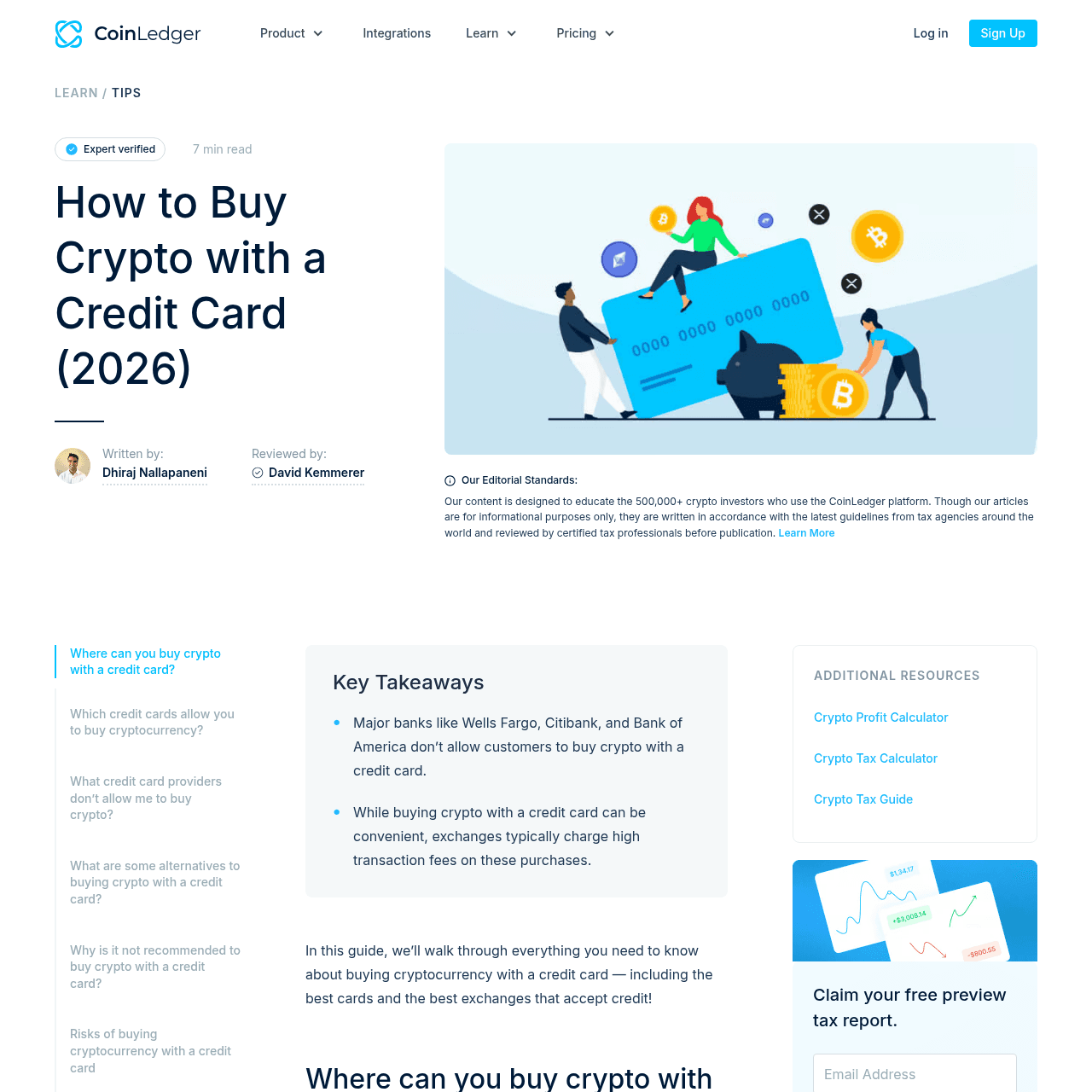
You can buy Bitcoin with a credit card on every major exchange — Coinbase, Binance, Kraken, Crypto.com, MoonPay, ChangeHero, Guardarian, and dozens of others. The transaction takes minutes, the Bitcoin lands in your wallet immediately, and the user experience is simple. But the cost is brutal: most credit card crypto purchases are flagged by your bank as cash advances — triggering the highest-fee, fastest-interest, no-grace-period treatment your card offers. Combined with the platform's own 3-5% card fee, you can easily pay 8-12% total just to acquire Bitcoin, before any interest accrues.
This guide explains exactly what the costs are, which platforms are cheapest, the no-KYC options for small amounts, and how to avoid the cash advance trap entirely. After you buy, we'll also show you how to spend that Bitcoin via a crypto card without giving up custody.
The Cash Advance Problem
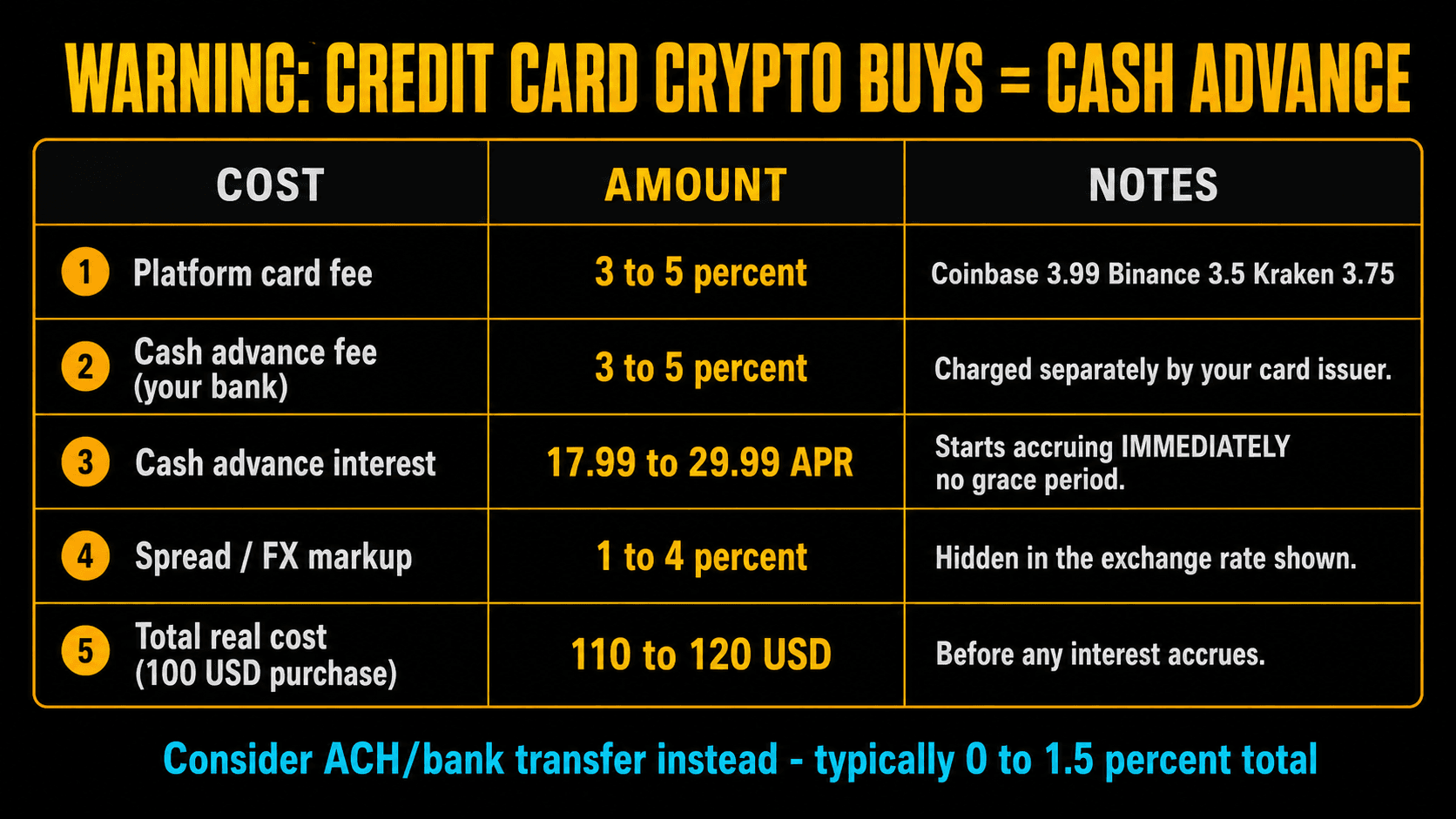
Most US, UK, EU, and Canadian banks classify cryptocurrency purchases — even via legitimate exchanges like Coinbase — as cash advances rather than regular purchases. The reason: crypto is treated like cash withdrawal in regulatory categorization (MCC code 6051 or similar). The financial consequences are significant:
| Cost Layer | Amount | Notes |
|---|---|---|
| Platform card fee | 3-5% | Coinbase 3.99%, Binance 3.5%, Kraken 3.75% + €0.25 |
| Cash advance fee (bank) | 3-5% | Charged separately by your card issuer |
| Cash advance APR | 17.99-29.99% | Accrues immediately, no grace period |
| Exchange spread (FX markup) | 1-4% | Hidden in the BTC price shown to you |
| Total real cost ($100 purchase) | $108-120 | Before any interest accrues |
Worst case scenario: You buy $1,000 of Bitcoin on Coinbase with a credit card. Platform fee: $39.90. Your bank classifies it as a cash advance: $30 fee. Spread baked in: $20 (2%). Total upfront cost: $89.90. Then 24.99% APR starts accruing immediately. If you pay the full balance 30 days later, you owe roughly another $20 in interest. Net cost: $110 to acquire $1,000 of Bitcoin — 11% effective fee.
Should You Use a Credit Card at All?
Honestly? Rarely. Here's a simple decision flowchart:
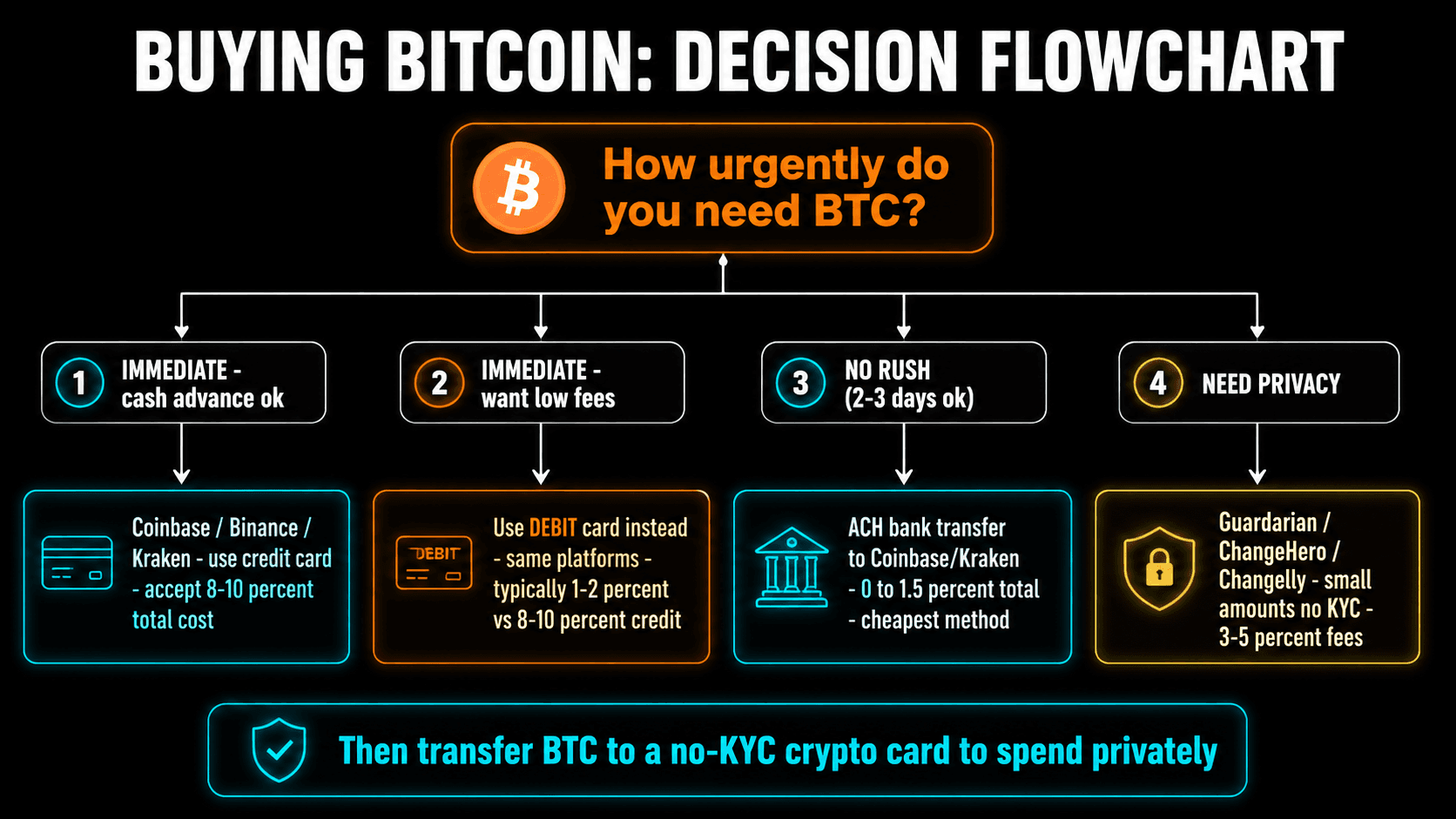
- If you have 2-3 days: Use ACH bank transfer to Coinbase, Kraken, or Gemini. Cost: 0-1.5% total. This is the cheapest method by a wide margin.
- If you need it now and have a debit card: Use the debit card instead of credit. Same platform fees (~3-4%), no cash advance penalty. Total cost: ~3-5%.
- If you need it now and only have a credit card: Check with your bank first — some explicitly do NOT treat crypto as cash advance (rare but worth checking). If they do, you'll pay 8-12% total.
- If you need privacy on a small amount: Use Guardarian, ChangeHero, or Changelly. KYC waived under ~$700/day. Fees 3-5%.
- If you specifically want to earn crypto rewards on spending: Use a crypto rewards card like Gemini Credit Card (US) or COCA Card (EU/APAC) instead. You earn crypto on every purchase rather than buying it directly.
Best Platforms to Buy Bitcoin with a Credit Card
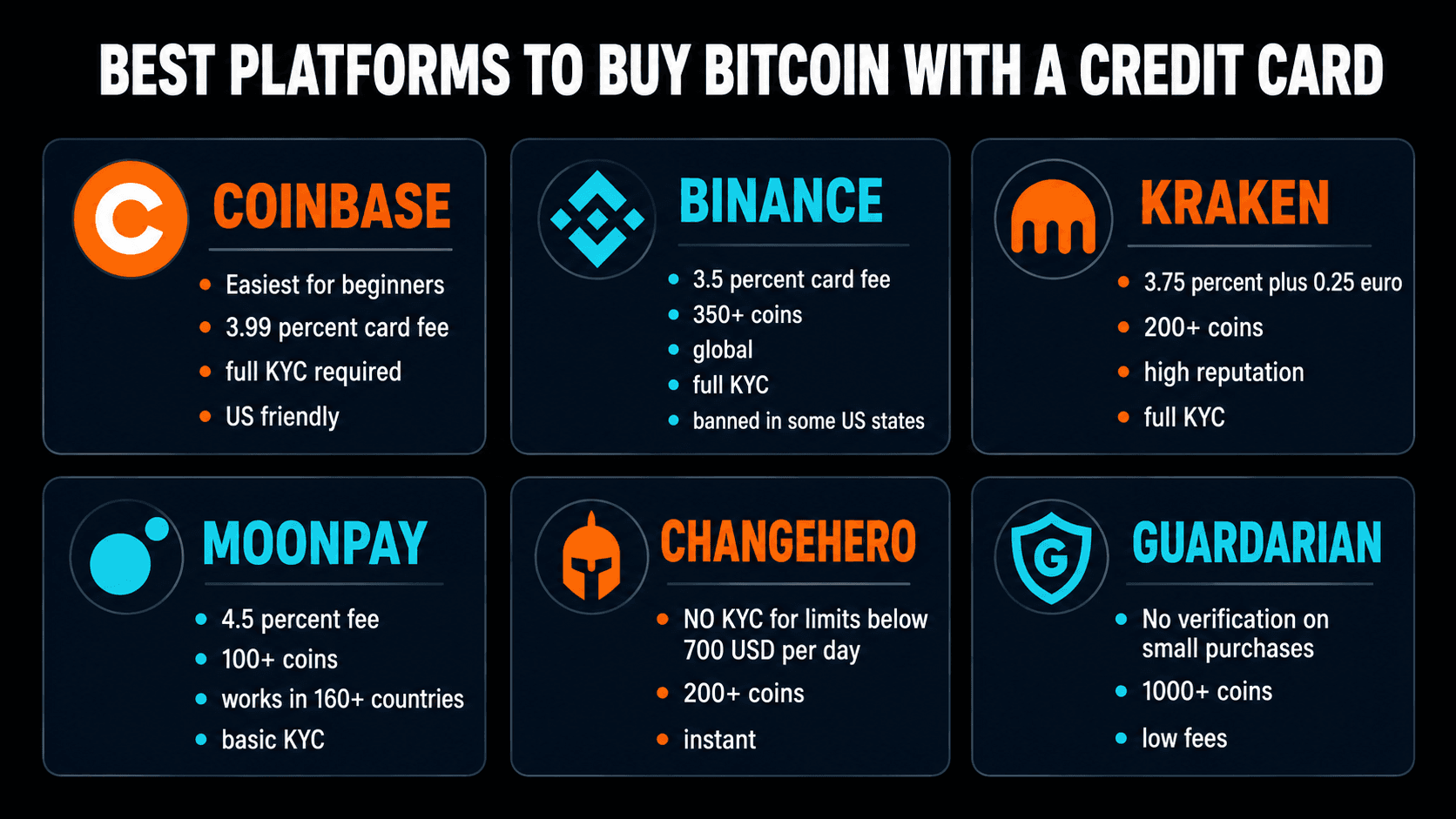
Coinbase — best for beginners (US)
Credit card fee: 3.99%. KYC: Full (passport/driver's license + selfie). Available: 100+ countries. Coins: 200+. Reputation: Highest mainstream trust. Most-likely-to-be-treated-as-cash-advance by US banks. Beginners-friendly interface. iOS/Android apps. Fast on-ramp from credit card to BTC.
Binance — lowest fees globally
Credit card fee: 3.5%. KYC: Full. Available: 150+ countries (banned in several US states — use Binance.US in those). Coins: 350+. Liquidity: Highest globally. Aggressive promotions for new users. Multiple sub-platforms (Binance, Binance.US, Binance Pay).
Kraken — high reputation, transparent fees
Credit card fee: 3.75% + €0.25. KYC: Full. Available: US (all states) + 190+ countries. Coins: 200+. Strong reputation for security and transparency. Pro Trader interface with much lower fees if you use ACH/bank transfer instead. Good US choice as a Binance.US alternative.
Crypto.com — flexible payment options
Credit card fee: 2.99-3.5%. KYC: Full. Available: 90+ countries. Coins: 350+. Mobile-first experience. Often runs promos waiving fees for first purchase. Also offers their own crypto debit card (see our Crypto.com review).
MoonPay — on-ramp aggregator
Credit card fee: 4.5%. KYC: Basic (limited verification for smaller amounts). Available: 160+ countries. Coins: 100+. MoonPay is integrated into many wallet apps (MetaMask, Trust Wallet, Uniswap) as the on-ramp provider, so you may be using MoonPay even when it looks like the wallet directly. Higher fees than the major exchanges but excellent UX.
No-KYC Options for Small Purchases
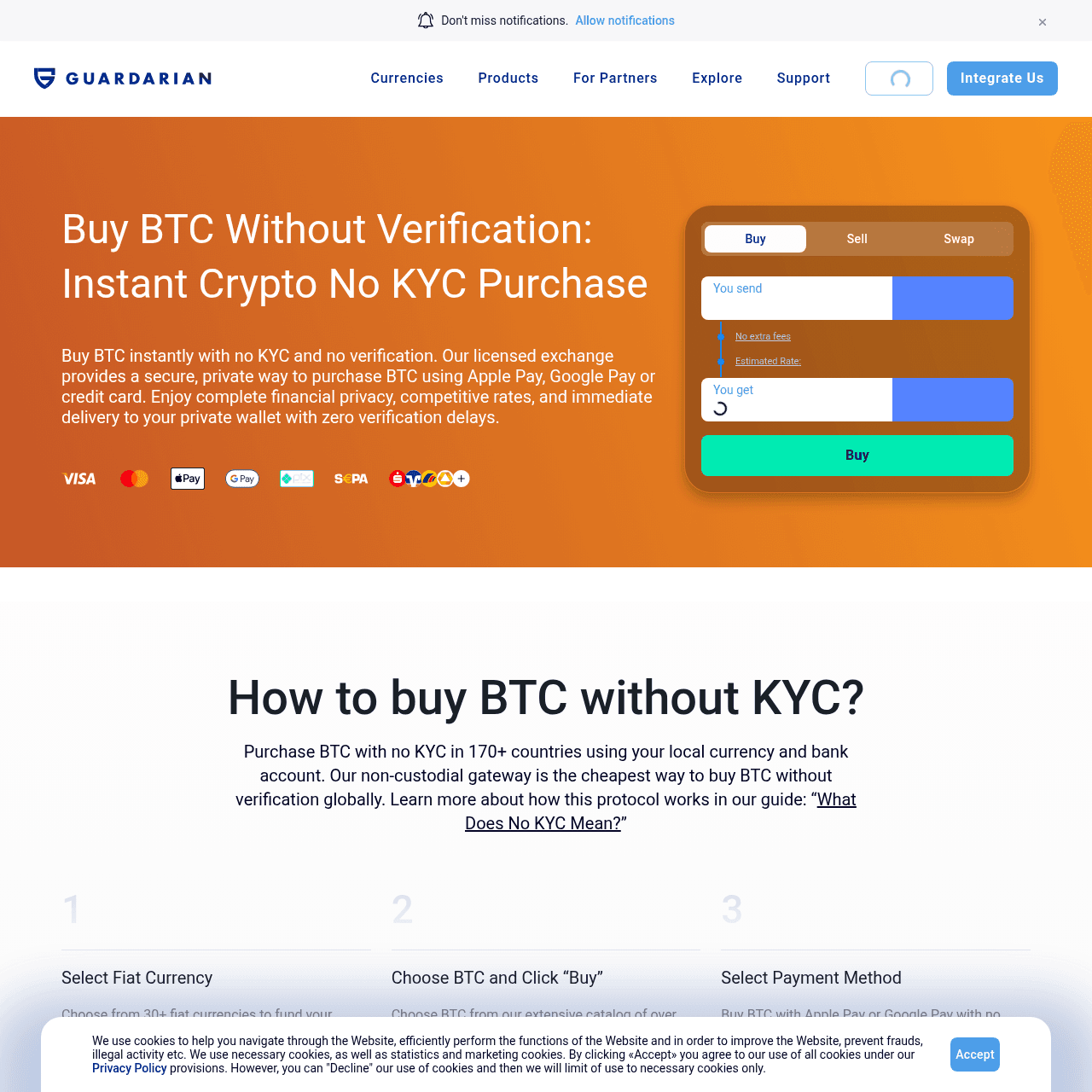
Guardarian — no verification on small purchases
Card fee: ~4%. KYC: None on small purchases (varies by amount and region). Available: Most countries. Coins: 1,000+. Designed specifically for privacy-conscious users who want crypto without an exchange account.
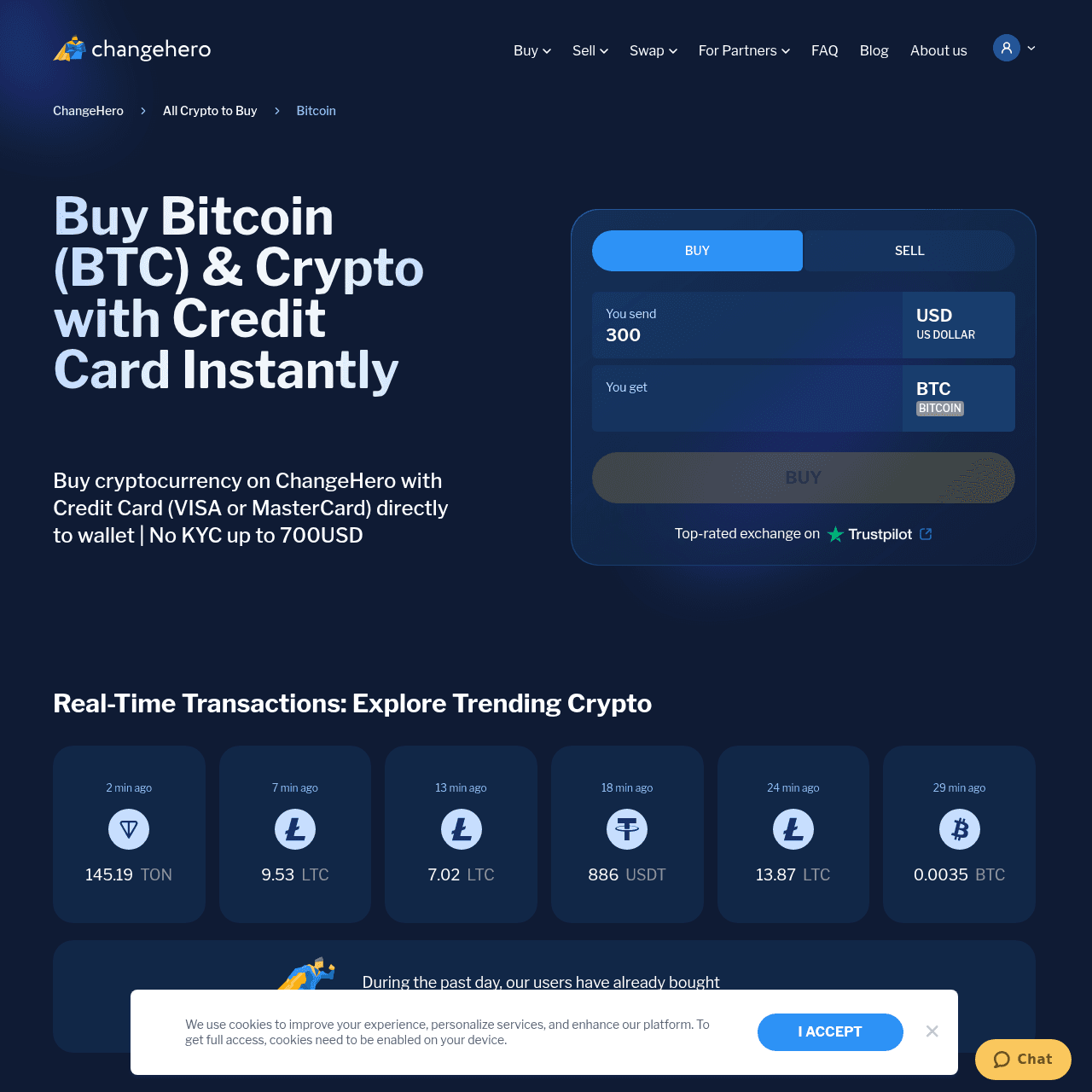
ChangeHero — no-KYC up to ~$700/day
Card fee: ~4%. KYC: None below ~$700/day; KYC kicks in for larger amounts. Available: 180+ countries. Coins: 200+. Apple Pay + Google Pay + credit/debit. Fast UX for one-off purchases.
Changelly — under $150 no-KYC
Card fee: ~3.5-5%. KYC: None below $150 per purchase; standard KYC above. Available: Most countries. Coins: 500+. Good for small recurring purchases without identity exposure.
MoonPay
Card fee: 4.5%. KYC: Basic ID for some purchases, sometimes waived for small amounts in certain regions. Tier-based verification.
Important caveat: "No KYC" on credit card crypto purchases is increasingly rare. Most platforms that advertise no-KYC ramps will still ask for your card details, name, and email — which is a form of identity collection even if no government ID is uploaded. True anonymity requires cash, P2P, or carefully-funded no-KYC wallets — not credit card purchases.
Step-by-Step: Buy Bitcoin with a Credit Card
- Pick your platform. Coinbase for beginners; Kraken for US after Coinbase; Binance for global users; Guardarian/ChangeHero for small no-KYC amounts.
- Verify your bank's policy first. Call or chat with your card issuer and ask: "Do you classify crypto purchases as cash advances?" If yes, factor in the extra 3-5% + APR. If no, you save 30-50% of total cost.
- Create an account on the platform. Email + password. Coinbase, Binance, Kraken will require KYC before you can buy. Guardarian/ChangeHero may allow small purchases without uploading ID.
- Complete KYC if required. Government ID (passport/driver's license/national ID) + live selfie. Approval usually 5-60 minutes.
- Add your credit card. Most platforms accept Visa, Mastercard, and some accept Amex/Discover.
- Buy Bitcoin. Enter the dollar amount, review the fees + total cost, confirm. The BTC lands in your platform account immediately.
- Withdraw to your own wallet. Critical step. Don't leave BTC on the exchange. Send to a self-custody wallet (Bitcoin Core, Electrum, Ledger, Trezor) or to a crypto debit card for spending.
After You Buy: How to Spend Your Bitcoin
Buying is half the journey. The other half is what you do next. Three options:
- Hold long-term. Move BTC to a hardware wallet (Ledger, Trezor) or a non-custodial software wallet. Treat as an investment.
- Spend via a crypto debit card. Load a card with USDT/USDC (after converting BTC) or directly with BTC (limited cards support this). See our recommendations:
- Laso Finance — truly no-KYC virtual Visa (US-friendly)
- XKard — zero KYC, physical + virtual card
- Goblin Card — physical no-KYC card accepting BTC
- KAST — stablecoin Visa with SOL staking
- COCA Card — non-custodial card with 6% APY
- Spend via Lightning Network. If you want native BTC payments without conversion, use a Lightning wallet (Phoenix, Wallet of Satoshi, Strike) and find merchants that accept Lightning directly.
Risks You Need to Understand
1. Credit card debt at crypto-card APRs
If you finance a Bitcoin purchase on a credit card and don't pay it off immediately, you're carrying debt at 17.99-29.99% APR. Bitcoin needs to appreciate by that rate just for you to break even on the financing cost. Don't buy crypto with credit you can't repay in full at the next statement.
2. Bank account closures
Some US, UK, and EU banks (Chase, Capital One, Lloyds, Barclays, and others have done this) have closed accounts of customers with regular crypto purchases. Even though it's legal, your bank can decide not to participate. Use a card you'd be ok losing access to in the worst case.
3. Chargebacks won't work
Once Bitcoin is in your wallet, the transaction is irreversible on-chain. If you have buyer's remorse or get scammed, you cannot reverse a chargeback through your credit card the way you would for a physical product. Crypto buys are final.
4. Tax implications
In the US, buying Bitcoin is not a taxable event (it's acquisition). But selling, swapping, or spending the BTC later creates a capital gain/loss. The IRS now requires 1099-DA reporting for sales/trades starting with 2025 activity. Keep records of every purchase: date, USD value, fees paid.
5. Exchange risk
Don't leave BTC on the exchange after purchase. Move it to your own wallet. Exchanges can be hacked (Mt. Gox, FTX) or freeze withdrawals during volatility. Your BTC is only your BTC when you control the keys.
Frequently Asked Questions
Can I buy Bitcoin with a credit card?
Yes, most major crypto exchanges (Coinbase, Binance, Kraken, Crypto.com) and on-ramp services (MoonPay, ChangeHero, Guardarian) accept credit cards. However, your bank may treat the purchase as a cash advance — triggering a 3-5% fee on top of the platform's 3-5% card fee, plus immediate interest accrual at 17.99-29.99% APR with no grace period. Total cost can reach 8-12% before interest.
Why is buying Bitcoin with a credit card so expensive?
Three reasons. First, the crypto platform charges 3-5% as their card processing fee. Second, your bank typically classifies the purchase as a cash advance — adding another 3-5% fee and immediate interest accrual at credit card APRs (17.99-29.99%) with no grace period. Third, the exchange spread (1-4%) is baked into the price you see. ACH bank transfers cost 0-1.5% total by comparison.
Can I buy Bitcoin with a credit card without KYC?
Rarely. Credit card transactions almost always require identity verification due to chargeback risk. A few services allow small no-KYC purchases (ChangeHero up to ~$700/day, Guardarian small amounts, Changelly under $150) but limits are restrictive. For larger amounts, KYC is unavoidable on credit card rails.
What's the best platform to buy Bitcoin with a credit card?
For ease + safety: Coinbase (3.99% fee, US-friendly). For lowest fees: Kraken (3.75% + €0.25) or Binance (3.5%, banned in some US states). For no-KYC small purchases: Guardarian or ChangeHero. Always check whether your bank will treat the purchase as a cash advance before proceeding.
Is it better to use a debit card instead?
Yes, usually. Debit card crypto purchases are not classified as cash advances — you avoid the additional bank fee + immediate interest. Platform fees are similar (3-4% range). Net effect: debit card crypto buy costs ~3-5% total, vs credit card costs ~8-12% total. Unless you specifically need credit, use a debit card.
Can I earn credit card rewards on Bitcoin purchases?
Usually no. When a purchase is classified as a cash advance, you typically don't earn rewards points or cashback. Some general-purpose cards do treat crypto as a regular purchase (rare); call your issuer to confirm. If you want crypto rewards specifically, use a dedicated crypto rewards card like Gemini Credit Card (up to 4% in crypto) or COCA Card (up to 8%).
What's the minimum I can buy?
Most platforms: $10-$25 minimum. Coinbase requires $1.99 minimum. Binance requires $15 equivalent. ChangeHero and Guardarian let you buy from $20. Smaller purchases have proportionally higher percentage fees due to fixed-cost components.
What if my bank declines the purchase?
Common reasons: your card issuer blocks crypto purchases entirely (Chase, Bank of America, Capital One, and Citi all have done this at various times), the merchant code is flagged, or you exceeded your cash advance limit. Solutions: try a different card, try ACH bank transfer (lower fees anyway), or use a P2P service like LocalBitcoins or Bisq.
Want to skip the credit card markup?
Compare 30+ crypto debit cards on Kardd — many accept BTC directly or convert at 0% FX. Some are no-KYC.
Compare All Crypto Cards →