Crypto.com Debit Card Review 2026: Fees, Limits, and No-KYC Alternatives
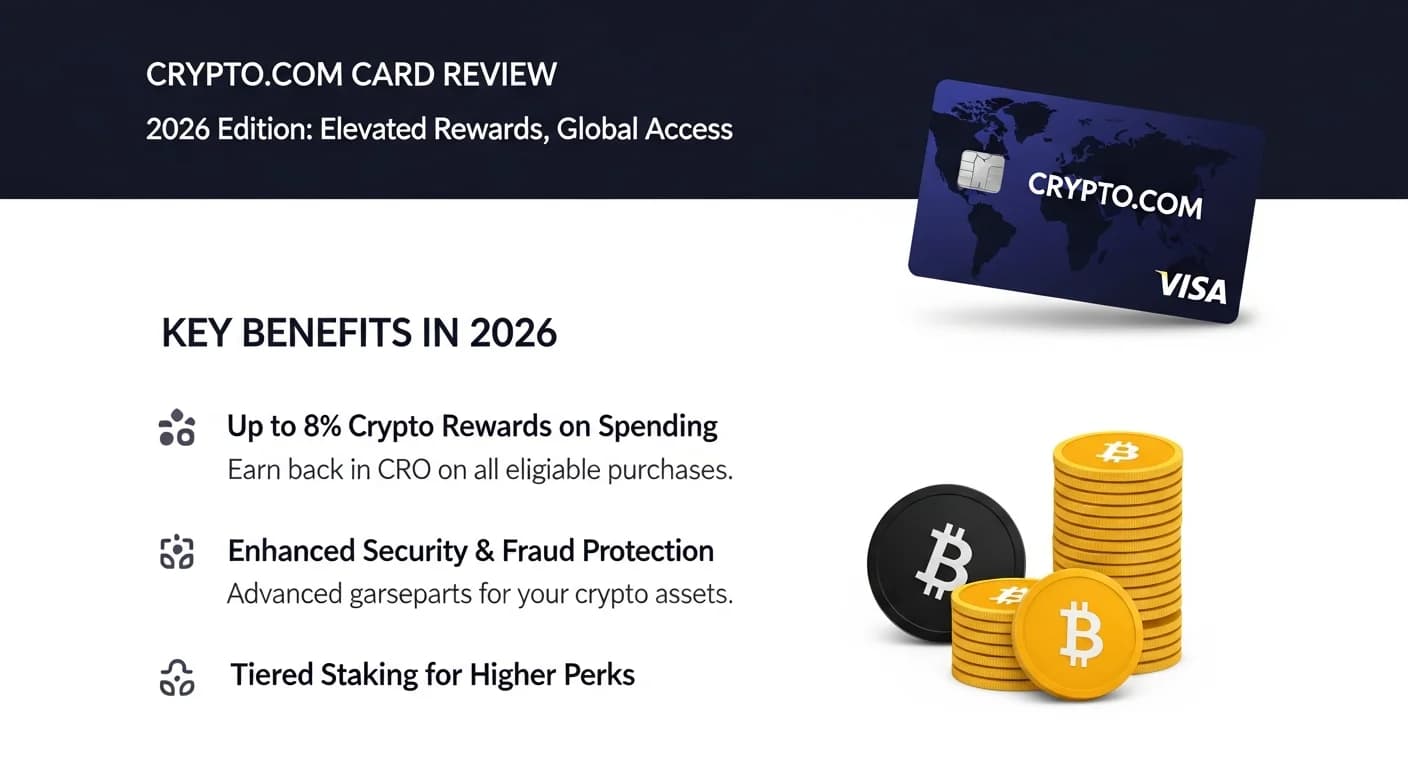
Crypto.com’s Visa card is one of the most recognized crypto cards on the market. Sleek metal designs, up to 6% cashback, Netflix and Spotify rebates — on paper, it’s hard to beat. But the fine print tells a different story.
Heavy CRO staking requirements, mandatory KYC, and a tier system that locks the best perks behind five- and six-figure commitments make the Crypto.com card less accessible than the marketing suggests. This review breaks down the real costs, the actual limits, and whether privacy-focused alternatives might be a better fit.
What Is the Crypto.com Card?
The Crypto.com Visa card is a rewards credit/debit card issued by Crypto.com, one of the largest cryptocurrency exchanges. It works like any traditional Visa card — swipe, tap, or use online at any Visa-accepting merchant worldwide.
What makes it different is the rewards structure. Instead of earning airline miles or hotel points, you earn cashback in CRO (Crypto.com’s native token). Higher-tier cards also offer perks like 100% rebates on Netflix, Spotify, and Amazon Prime subscriptions.
The catch? To unlock meaningful rewards, you need to stake (lock up) significant amounts of CRO tokens for 12 months. The free tier offers just 1.5% back. Getting to 5% or 6% requires staking $50,000 or $500,000 in CRO — and that CRO is locked for a full year, exposed to whatever price swings the token experiences.
Crypto.com Card Tiers and Fees
Crypto.com offers five card tiers ranging from a free entry-level card to a premium Obsidian tier requiring half a million dollars in CRO staking. Here’s the full breakdown:
| Card Tier | CRO Stake / Fee | Cashback | Welcome Bonus | Key Perks |
|---|---|---|---|---|
| Midnight | Free — no stake | 1.5% | $100 (spend $1,500 in 90 days) | Basic Level Up access |
| Ruby | $500 stake or $4.99/mo | 3.5% | $200 (spend $2,000 in 90 days) | Level Up Plus membership |
| Indigo / Jade | $5,000 stake or $29.99/mo | 4.5% | $300 (spend $5,000 in 90 days) | Netflix, Spotify rebates |
| Rose / Icy | $50,000 stake (12 months) | 5% | $300 | Full streaming rebates, airport lounge |
| Obsidian | $500,000 stake (12 months) | 6% | $300 | All perks, concierge, private benefits |
A few things stand out. The free Midnight tier is genuinely free with no staking, but 1.5% cashback is below what many traditional credit cards offer. The Ruby tier at $4.99/month (or $500 CRO stake) bumps you to 3.5% — competitive, but that $500 in CRO is locked for a year and subject to price volatility.
The mid-tier Indigo/Jade at $5,000 or $29.99/month is where the streaming perks kick in. But $360/year in subscription fees (or $5K locked in a volatile token) is a significant commitment for Netflix and Spotify rebates.
The top tiers — Rose/Icy and Obsidian — are designed for high-net-worth users willing to lock $50K–$500K in CRO. The rewards are generous, but the risk of CRO price decline during the 12-month lockup is real. CRO has lost over 80% of its value from its all-time high, and stakers during that period watched their locked capital evaporate.
Crypto.com Card Limits
Crypto.com doesn’t publicly list granular spending limits for every tier, but here’s what we know from user reports and their support documentation:
- ATM withdrawals: Vary by tier. Higher tiers get increased monthly ATM limits. The Midnight tier has basic ATM access, while Obsidian cardholders get significantly higher withdrawal allowances.
- Daily spending: Standard Visa limits apply. Most users report being able to make purchases up to several thousand dollars per transaction without issue.
- Monthly top-up limits: Tied to your card tier and verification status. Higher CRO stakes unlock higher top-up ceilings.
- Cross-border fees: No foreign transaction fees on most tiers — a genuine advantage over many traditional cards.
The important thing to note: all of these limits require full identity verification. You cannot access any tier or any limit without completing Crypto.com’s KYC process first.
The KYC Problem: What Crypto.com Requires
This is where the Crypto.com card becomes a dealbreaker for privacy-conscious users. Crypto.com requires comprehensive identity verification before you can order any card tier — including the free one. Here’s what they ask for:
- Government-issued photo ID — passport, driver’s license, or national ID card
- Selfie verification — real-time photo to match against your ID
- Proof of address — utility bill, bank statement, or government letter dated within 3 months
- Social Security number (US users) or equivalent tax ID
- Source of funds — for higher tiers, Crypto.com may ask you to explain where your crypto came from
This is full-spectrum identity verification. Your name, face, address, government identifiers, and financial history are all collected, stored, and subject to Crypto.com’s data security practices and any future regulatory requests.
For users who got into crypto specifically for financial privacy or self-sovereignty, this defeats the purpose. You’re handing over more personal data than a traditional bank requires for a basic checking account.
No-KYC Alternatives to the Crypto.com Card
If you want to spend crypto without handing over your identity, several cards now offer competitive features with zero or minimal verification. Here are the three strongest alternatives:
XKard — Best Overall No-KYC Card
- KYC: Zero — email only
- Cashback: None (trade-off for privacy)
- Top-up fee: 2.3–4.5%
- Monthly limit: Up to $100,000 (Whale tier)
- Mobile pay: Apple Pay + Google Pay
- Card type: Virtual + Physical (Visa & Mastercard)
XKard is the closest thing to a full-featured crypto card without identity verification. Zero KYC, both mobile wallets, and limits that scale up to $100K/month make it the go-to for users who want Crypto.com-level functionality without the surveillance. Read our full XKard review.
SolCard — Best for Solana Users
- KYC: Zero
- Top-up fee: 5%
- Monthly limit: $5,000
- Mobile pay: Apple Pay + Google Pay
- Card type: Virtual
If you hold SOL, USDT, or USDC on Solana, SolCard is purpose-built for you. No KYC, fast on-chain funding, and full mobile wallet support. The 5% top-up fee is higher than XKard, but the native Solana integration is seamless. Read our full SolCard review.
KAST — Lowest Fees with Minimal KYC
- KYC: Minimal (email + phone)
- Top-up fee: 2%
- Monthly limit: $3,000
- Mobile pay: Apple Pay
- Card type: Virtual + Physical
KAST offers the lowest top-up fees in the no-KYC space at just 2%. You’ll need to provide an email and phone number (minimal KYC), but no government ID. For users who want to minimize costs and don’t mind light verification, KAST is hard to beat.
Crypto.com vs No-KYC Cards: Side-by-Side
Here’s how the Crypto.com card stacks up against the top no-KYC alternatives across the metrics that matter:
| Feature | Crypto.com (Indigo) | XKard | SolCard | KAST |
|---|---|---|---|---|
| KYC Required | Full (ID, selfie, address, SSN) | None | None | Minimal (email + phone) |
| Setup Time | Days to weeks | Minutes | Minutes | Minutes |
| Staking / Lockup | $5,000 CRO for 12 months | None | None | None |
| Monthly Fee | $29.99/mo (or stake) | None | None | None |
| Cashback | 4.5% | None | None | None |
| Top-Up Fee | None (fiat loading) | 2.3–4.5% | 5% | 2% |
| Apple Pay | Yes | Yes | Yes | Yes |
| Google Pay | Yes | Yes | Yes | No |
| Physical Card | Yes (metal) | Yes | No | Yes |
| Streaming Rebates | Netflix, Spotify (100%) | No | No | No |
| Data Collected | Everything | Email only | Email only | Email + phone |
The trade-off is clear. Crypto.com wins on rewards — if you’re willing to stake thousands in CRO and hand over your full identity. No-KYC cards win on speed, privacy, and accessibility — you can be spending crypto in minutes rather than waiting days for verification approval.
For most privacy-conscious users, the 2–5% top-up fee on no-KYC cards is worth paying to avoid the identity exposure. See all 11 no-KYC cards compared.
Frequently Asked Questions
Is the Crypto.com card free?
Only the Midnight tier is free with no staking requirement. All other tiers require either a monthly subscription ($4.99-$29.99/month) or a CRO staking lockup ranging from $500 to $500,000 for 12 months.
What are the spending limits on the Crypto.com card?
Crypto.com card limits vary by tier. The free Midnight tier has basic limits, while higher tiers like Obsidian ($500K CRO stake) unlock premium limits. All tiers require full KYC verification before any spending is allowed.
Can I use the Crypto.com card without KYC?
No. Crypto.com requires full identity verification including government-issued photo ID, selfie verification, proof of address, and Social Security number (for US users). There is no way to use their card without completing KYC. For no-KYC alternatives, cards like XKard and SolCard allow spending with zero verification.
What are the best alternatives to the Crypto.com card without KYC?
The top no-KYC alternatives are XKard (zero KYC, Apple Pay + Google Pay, up to $100K/month), SolCard (zero KYC, native Solana support, $5K/month), and KAST (minimal KYC, 2% top-up fee, physical + virtual cards). All three are available through Kardd.co.
The Bottom Line
The Crypto.com card is a strong product for users who are comfortable with full identity verification and willing to lock up CRO tokens. The cashback rates are competitive, the metal cards look great, and the streaming rebates add genuine value at higher tiers.
But if privacy matters to you — or if you don’t want to stake thousands of dollars in a volatile token to unlock decent rewards — the no-KYC alternatives have caught up in functionality. Cards like XKard, SolCard, and KAST now offer Apple Pay, Google Pay, virtual and physical options, and limits up to $100K/month — all without handing over your passport.
The question isn’t whether the Crypto.com card is good. It is. The question is whether the rewards are worth the privacy cost. For a growing number of crypto users in 2026, the answer is no.