Tokyniq Review 2026: Is Tokyniq Legit? Card or Directory?
Crypto directories are everywhere in 2026. Type “best crypto tools” into any search engine and you will find dozens of sites listing exchanges, wallets, cards, and DeFi platforms. Tokyniq is one of them — a crypto tools directory that aims to be a one-stop shop for discovering and comparing crypto services.
But does a generalist directory actually help when you need something specific? We spent time with Tokyniq to find out what it does well, where it falls short, and how it compares to a specialist approach like Kardd.
What Is Tokyniq?
Tokyniq is a crypto tools directory and comparison website. It is not a card provider, not an exchange, and not a wallet. Think of it as a curated catalog of crypto services — you browse categories, filter by your needs, and get pointed toward tools that match.
The site is free to use. No account required, no KYC on the directory itself. You land on the page, pick a category, and start browsing. Tokyniq earns revenue through affiliate commissions when users click through to listed services and sign up.
This is a perfectly legitimate model — it is the same one Kardd uses for card comparisons. The question is not whether the model works, but whether the execution delivers real value.
What Tokyniq Covers
Tokyniq organizes crypto tools into several broad categories:
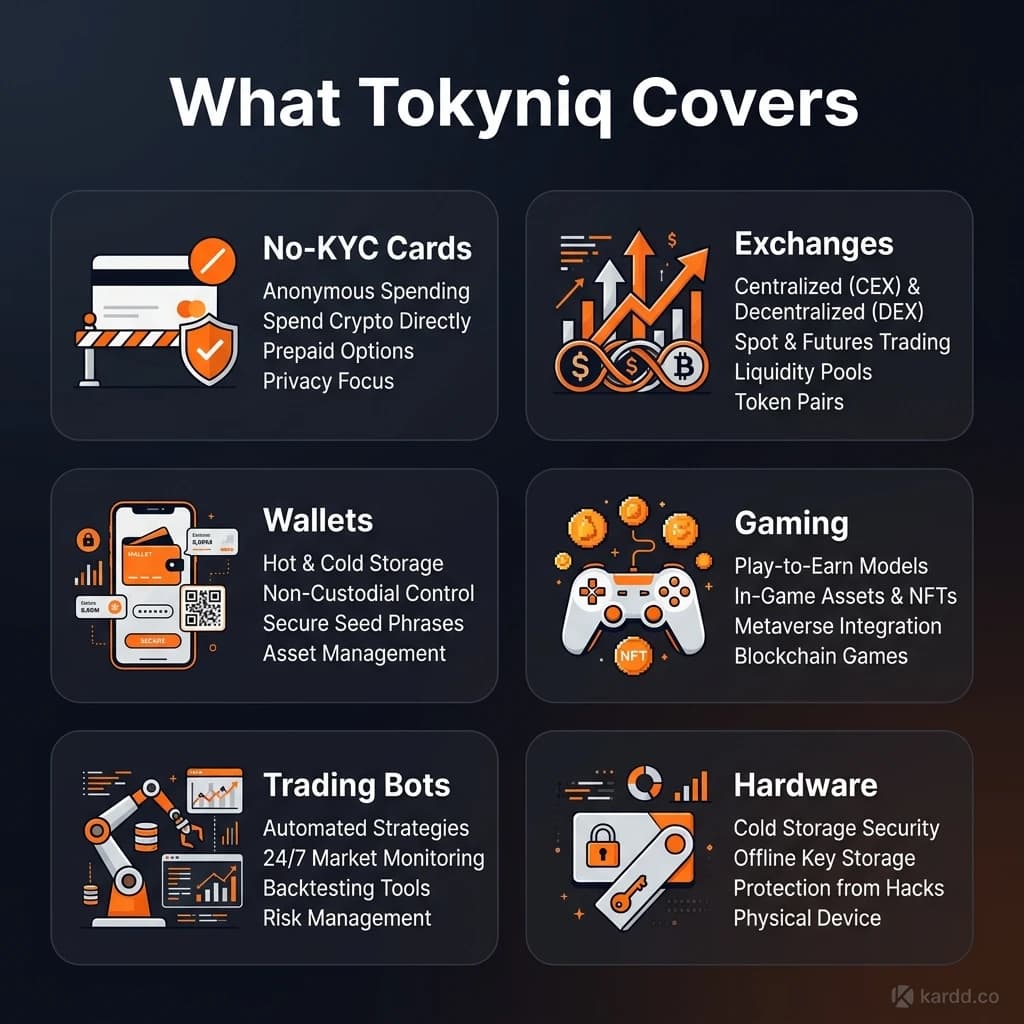
No-KYC Virtual Cards
Prepaid crypto cards that do not require identity verification
Exchanges
Centralized and decentralized crypto exchanges
Wallets
Hot wallets, cold storage, and multi-chain wallets
Gaming
Crypto gaming platforms and play-to-earn tools
Trading Bots
Automated trading solutions and copy-trading platforms
Hardware
Physical devices for crypto storage and security
The breadth is impressive on paper. Tokyniq also includes a comparison tool where you select your needs — what crypto you hold, what you want to do with it, whether KYC matters — and it recommends matching tools.
For someone new to crypto who wants a high-level overview of what is available, this is genuinely useful. You can quickly scan the landscape and understand what categories of tools exist.
Tokyniq vs Kardd: Different Approaches to Crypto Discovery
This is not an apples-to-apples comparison. Tokyniq and Kardd serve different purposes, and understanding the difference matters.
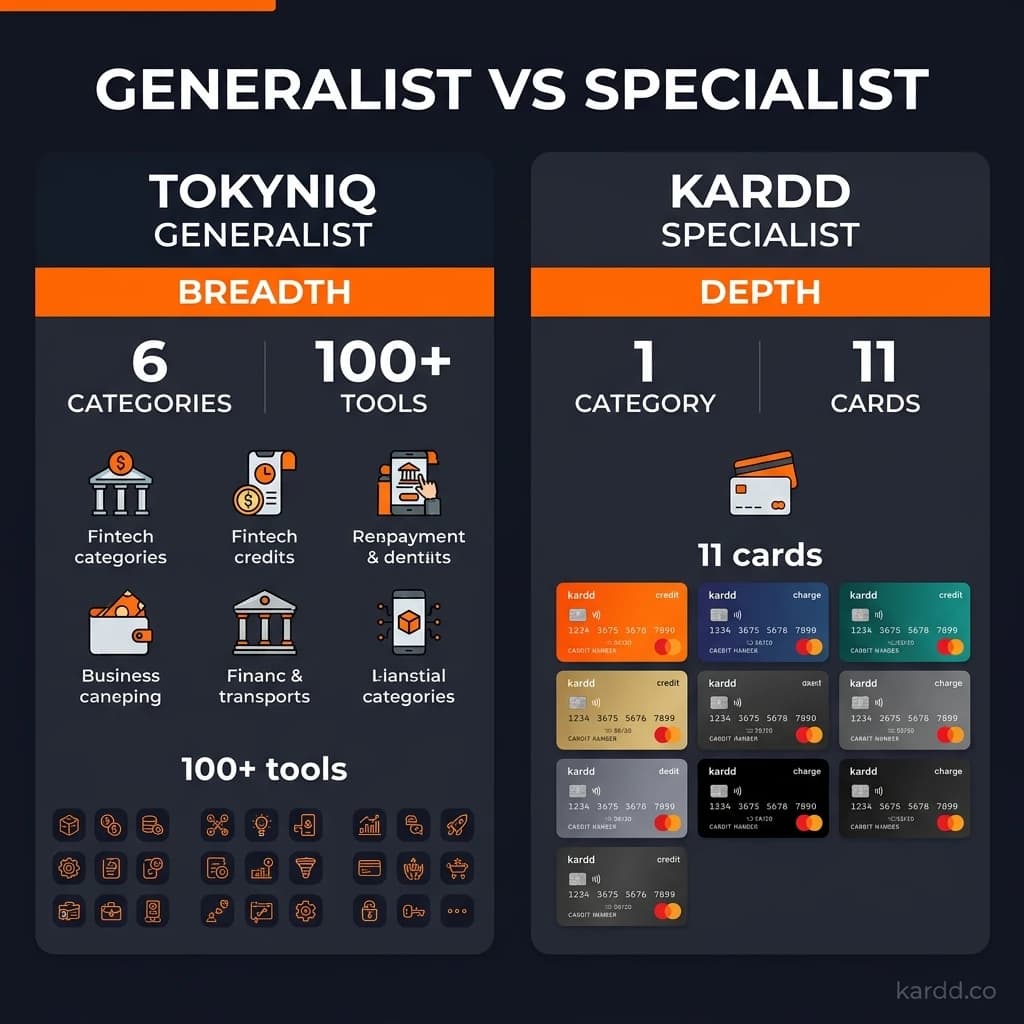
| Feature | Tokyniq | Kardd |
|---|---|---|
| Focus | All crypto tools (cards, exchanges, wallets, gaming, bots, hardware) | No-KYC crypto cards only |
| Depth | Overview-level listings per category | Deep fee breakdowns, weekly verification, tier comparisons |
| Comparison Tool | Needs-based recommendation quiz | Side-by-side card comparison with live data |
| KYC Info | Listed as a tag/filter | Detailed KYC tier breakdown (none, minimal, light, full) |
| Fee Detail | Basic or not listed | Full breakdown: top-up, FX, annual, ATM, hidden spreads |
| Verification | Not specified | Cards tested and verified weekly |
| Revenue Model | Affiliate commissions | Affiliate commissions |
| Price | Free | Free |
The analogy works like this: Tokyniq is a department store. Kardd is a specialty shop. If you want to browse across crypto categories and get a sense of the market, Tokyniq gives you that. If you specifically need a no-KYC crypto card and want to know exactly what you will pay, which ones actually work right now, and which ones might disappear next month — that is what Kardd was built for.
Where Tokyniq Falls Short
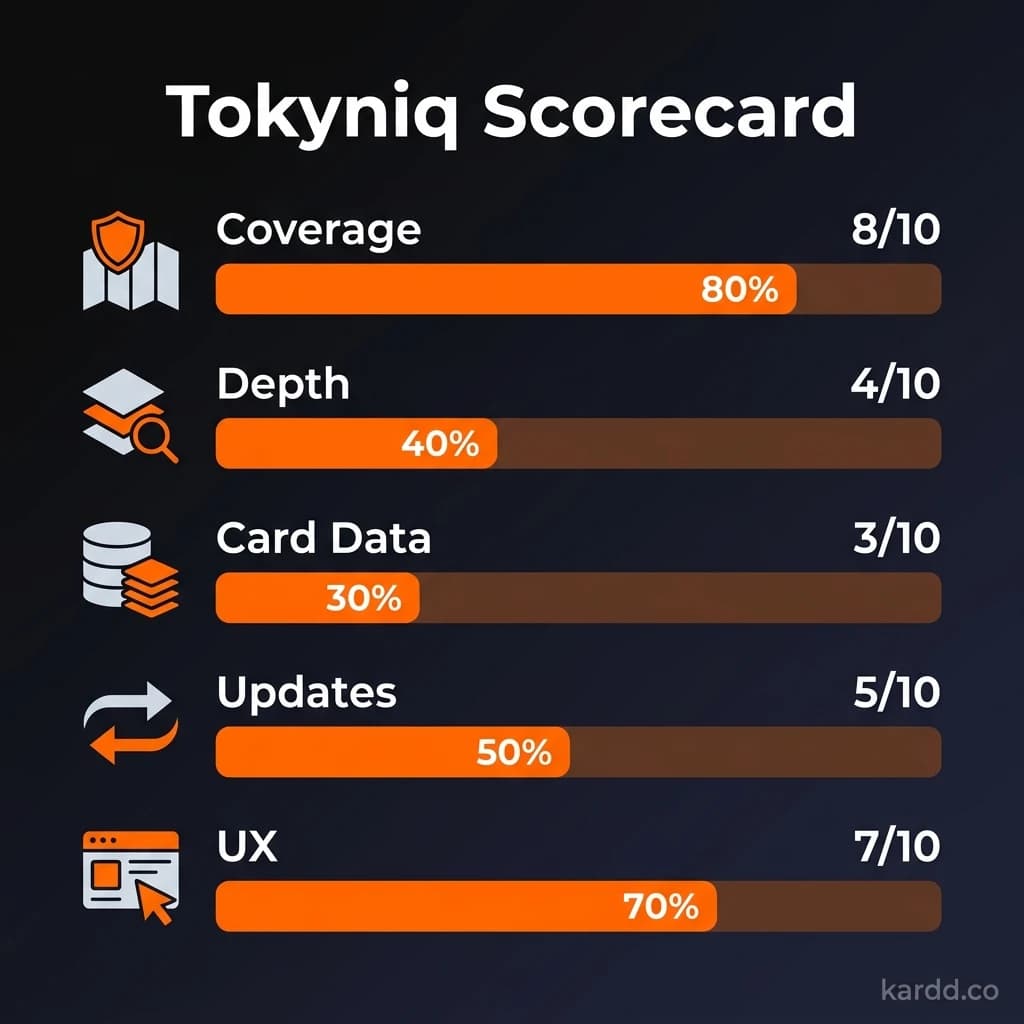
Tokyniq's biggest strength is also its biggest weakness: breadth over depth.
1. Surface-Level Card Information
When you are comparing no-KYC crypto cards, the details matter enormously. A 1% difference in top-up fees translates to hundreds of dollars per year. Tokyniq lists cards, but it does not break down fee structures the way a dedicated comparison needs to. You will not find true cost analysis at different spending volumes, hidden spread warnings, or weekly status checks on whether a card is still operational.
2. No Verification of Listings
The no-KYC card space is volatile. Cards launch, get shut down, add KYC, change fees, or freeze funds with zero notice. A directory that lists cards without actively verifying their current status can send users toward dead or compromised products. Kardd tests every listed card weekly and flags status changes in real time.
3. Recommendation Accuracy
A generalist recommendation tool has to balance recommendations across many categories. When it comes to no-KYC cards specifically, the nuances — which networks are supported, whether Apple Pay works, what the real FX spread is — require specialist knowledge that a broad quiz cannot capture.
4. Limited Risk Context
No-KYC crypto cards carry real risks: fund freezes, provider shutdowns, hidden fees. An honest directory needs to surface those risks clearly. Generalist directories tend to present tools as equivalent options without highlighting the risk differences between them.
None of this means Tokyniq is bad. It means it is optimized for a different use case — broad discovery rather than deep evaluation.
Who Should Use Tokyniq?
Tokyniq makes sense for specific use cases:
Use Tokyniq When...
- You are new to crypto and want to explore what tools exist
- You need tools across multiple categories (not just cards)
- You want a quick overview before diving deeper elsewhere
- You are researching the crypto ecosystem broadly
Use Kardd When...
- You specifically need a no-KYC crypto card
- You want detailed fee breakdowns and true cost analysis
- You need to know which cards are actually working right now
- You want side-by-side comparisons with real data
- Risk awareness and provider reliability matter to you
The honest answer: most people will benefit from using both. Start with Tokyniq if you are exploring the crypto landscape. Switch to Kardd when you are ready to make a decision about a specific no-KYC card.
Frequently Asked Questions
Is Tokyniq free to use?
Yes. Tokyniq is a free crypto tools directory. You can browse categories, use the comparison tool, and get recommendations without paying anything or creating an account.
Does Tokyniq require KYC?
Tokyniq itself does not require KYC — it is a directory, not a financial service. However, the tools and services listed on Tokyniq may have their own KYC requirements depending on the provider.
What is the difference between Tokyniq and Kardd?
Tokyniq is a broad crypto tools directory covering exchanges, wallets, cards, gaming, and more. Kardd focuses exclusively on no-KYC crypto cards with deep comparisons, fee breakdowns, and weekly verification of card providers.
How does Tokyniq make money?
Tokyniq uses an affiliate revenue model. When users click through to a listed tool and sign up, Tokyniq earns a referral commission from the provider. This is a standard model in the comparison space — Kardd uses the same approach.
The Bottom Line
Tokyniq is a solid general-purpose crypto tools directory. It does a good job of organizing the crypto landscape into browsable categories, and its recommendation tool is a reasonable starting point for newcomers. If you want a broad overview of what is available across exchanges, wallets, cards, gaming, and trading tools, Tokyniq delivers that.
Where it falls short is depth. When the stakes are real — when you are loading actual money onto a no-KYC card and need to know the true fees, current operational status, and risk profile — a generalist directory is not enough. You need a specialist.
That is the gap Kardd fills. We do one thing: no-KYC crypto card comparisons. Every card is tested weekly. Every fee is broken down to the actual cost at your spending volume. Every risk is disclosed. No filler, no fluff, no categories we do not deeply understand.
Use Tokyniq to explore. Use Kardd to decide.
Ready to find your no-KYC card?
Compare every no-KYC crypto card side-by-side with real fee breakdowns, risk ratings, and weekly verification.
Last verified: March 22, 2026. This review reflects our honest assessment based on publicly available information. Tokyniq is a third-party directory — we are not affiliated with them. Kardd.co is an independent comparison site. Full affiliate disclosure